Research
Protein Folding with Neural Ordinary Differential Equations
Protein Folding with Neural Ordinary Differential Equations Overview Research area: Machine learning for structural biology — specifically, protein structure prediction using continuous-depth neural n
- arXiv
- 2510.16253
- Published
- 2025-10-17
- Authors
- Arielle Sanford, Shuo Sun, Christian B. Mendl
AI summary
Protein Folding with Neural Ordinary Differential EquationsOverview
Research area: Machine learning for structural biology — specifically, protein structure prediction using continuous-depth neural networks as a replacement for AlphaFold 2's Evoformer trunk.
Technical level: Advanced. The paper assumes familiarity with Transformer attention, AlphaFold's Evoformer internals (MSA and pair representations), and numerical ODE solvers.
Scope: The paper replaces the 48 discrete Evoformer blocks of AlphaFold 2 (via the open-source OpenFold implementation) with a single Neural Ordinary Differential Equation module and benchmarks the resulting model on runtime and qualitative structural plausibility.
What This Paper Is About
AlphaFold 2's Evoformer is a stack of 48 separate, non-weight-sharing blocks, which makes it expensive to train and run. The authors ask whether that entire stack can be collapsed into a single shared vector field that is integrated over a continuous "depth" variable, as in Neural ODEs. The goal is not to beat AlphaFold's accuracy but to test whether a continuous-depth reformulation can produce biologically plausible protein structures at a fraction of the compute.
Key Contributions
-
A continuous-depth Evoformer. The paper formulates an ODE whose vector field performs one pass of Evoformer-style operations — MSA row-wise attention with pair bias, MSA column-wise attention, an MSA transition, an outer product mean, a triangle multiplication update, and a pair transition — and integrates the result over a continuous depth variable t ∈ [0, 1].
-
Time-dependent gating of the update. Rather than using the raw difference between updated and original states, the vector field scales those differences by mixing coefficients σ_m(t) and σ_z(t), produced by a shallow MLP over the scalar depth variable t and squashed through a sigmoid, producing a smooth evolution of the representations.
-
A deliberately lightweight implementation. The authors omit both of AlphaFold's triangle attention modules (incoming and outgoing), remove chunked softmax and fused kernels from MSA attention, replace AlphaFold's full outer product with a reduced-rank elementwise interaction (rank 32), substitute a symmetric approximation for the split incoming/outgoing triangle multiplication branches, and use a basic two-layer MLP with ReLU and normalization for the pair transition.
-
A resource-matched proof of concept. The best-performing model was trained for 17.5 hours on a single GPU, and the paper reports both a runtime benchmark against OpenFold's standard Evoformer stack and visual comparisons of predicted structures.
Main Findings
-
Runtime scales linearly rather than quadratically. On 50 test proteins with sequences ranging from 21 to 852 residues, the Neural ODE Evoformer averaged 4.85 seconds per protein (about 0.0300 seconds per residue), while OpenFold's Evoformer averaged 65.06 seconds per protein (about 0.2230 seconds per residue) — over 7 times slower per residue on average. The fitted runtime for the Neural ODE model was time = 0.004625 × residues + 3.64, versus a quadratic fit of time = 0.000641 × residues² − 0.0497 × residues + 15.83 for OpenFold.
-
Helices are captured, fine details are not. In visualizations of three proteins (1fv5, 4epq, 1ujs), α-helices were generally identified and positioned correctly, and the overall global fold often reflected the major structure. Deviations from the OpenFold ground truth were clear in fine-grained details, especially loop regions and global packing, and were more pronounced for large or complex folds such as 4epq.
-
It beats a truncated Evoformer. Compared with an OpenFold model using only 24 Evoformer blocks, the ODE-based model produced substantially more organized structures with higher-confidence predictions, according to the per-residue confidence (pLDDT) coloring in the figures.
-
The model does not match the original architecture. The paper states plainly that the Neural ODE-based Evoformer does not fully replicate the accuracy of the original architecture.
-
Extreme training efficiency relative to AlphaFold. The reported 17.5 hours on a single GPU contrasts with AlphaFold's original training of over 11 days using hundreds of TPU v3 cores, a compute cluster size equivalent to 512 GPUs, and vast curated datasets. Training hardware here was an NVIDIA Quadro P4000 GPU (8 GB memory), Intel Core i7-7700 CPU at 3.60 GHz (4 cores, 8 hardware threads), and 32 GiB DDR4 main memory.
-
No numerical structure accuracy metrics are reported. The paper does not report TM-score, GDT, RMSD, or numerical pLDDT values; structural quality is assessed only through rendered visual comparisons.
Methodology in Plain English
The idea starts from a standard observation: a residual network layer computes state + f(state), which looks exactly like one Euler step of an ODE. Shrink the steps infinitely and you get a differential equation instead of a stack of layers. Neural ODEs exploit this, and they carry two practical benefits — backpropagation via the adjoint sensitivity method keeps memory constant with respect to depth, and the solver's step size can adapt to the difficulty of the input.
The authors' bet is that AlphaFold's 48 Evoformer blocks each make only a small incremental adjustment to the MSA and pair representations, so the whole stack can be viewed as one smooth transformation. They build a vector field that does one pass of simplified Evoformer-style updates, subtracts the inputs to get a "delta," and scales that delta by learned time-dependent gates. An ODE solver then integrates this field from t = 0 to t = 1.
For supervision, they ran OpenFold inference on protein monomers and saved the MSA and pair representations at the entry and exit of the 48-block Evoformer, treating those as ground-truth endpoints; for some proteins they also saved intermediate per-block representations. Data came from the OpenProteinSet, with structural templates from PDB70 supplied to OpenFold as coarse structural priors. The dataset comprised 500 training proteins (reduced to 370 after a 350-residue length filter), 50 validation proteins, and 50 test proteins.
Training had two phases. A preliminary phase on 80 proteins used intermediate representations sampled at blocks 0, 8, 16, 24, 32, 40 and 48 (stride 4 in practice, capped at 20 epochs) to teach the model incremental refinement. The main phase used endpoints only, training the model to predict block 48's output from block 0's input, bounded by a validation-loss tolerance. To save compute, hidden dimensionality was set to 64 uniformly across both streams — versus AlphaFold's 384 for the MSA (c_m) and 128 for the pair (c_z) — and the MSA was reduced to at most 64 clustered sequences, taken off the top half of OpenFold's 128 clustered sequences. The solver was classical fourth-order Runge-Kutta (RK4) rather than the more accurate but costlier Dormand-Prince (DOPRI5), and sequence length was capped at 350 residues. Recycling steps were omitted entirely to isolate the effect of the continuous-depth reformulation.
Why This Matters
Impact on research. The paper is a proof of concept that continuous-depth modeling can approximate a very deep, purpose-built biological architecture at a small fraction of the cost. If the approach scales with more capacity, it offers a route to protein structure prediction that is cheaper, more memory-efficient, and potentially more interpretable — solver tolerances give a tunable knob between speed and numerical precision that fixed-depth stacks simply do not have.
Real-world applications:
- Structure prediction on modest hardware. The reported training ran on a single workstation-grade GPU, suggesting the approach could be accessible to labs without large compute clusters.
- High-throughput screening. The linear runtime scaling with sequence length makes long proteins proportionally less punishing, which matters for scanning large protein families or designed variants.
- Secondary-structure-level annotation. Since α-helices were reliably captured, the model could serve as a fast first-pass tool for identifying secondary structure elements.
- Interpretable dynamics. Because the model is a single vector field integrated over depth, it may be easier to probe what the representation is doing at any intermediate "depth" than to attribute behavior to one of 48 separate blocks.
Industry relevance. The cost profile is directly relevant to pharmaceutical and biotech workflows where structure prediction is a routine, high-volume step. A model that runs over 7 times faster per residue on average, and that scales linearly rather than quadratically, changes the economics of large-scale batch prediction — even before accuracy is fully closed. The paper's framing is explicitly a lightweight alternative rather than a replacement, which is the honest position for a system trained in 17.5 hours on one GPU.
Future Directions
-
Scale up the inputs. Increase the clustered MSA sequences per input from 64 to 128 or more to match AlphaFold's diversity-preserving input, and restore distinct, larger hidden dimensions (c_m = 384, c_z = 128).
-
Better numerics. Replace the fixed-step RK4 solver with an adaptive solver such as Dormand-Prince for improved numerical stability and precision — the adaptive-tolerance trade-off is one of the main theoretical draws of the Neural ODE formulation and is not yet exercised here.
-
Remove the length cap. Drop the 350-residue sequence cap to enable full-length protein modeling. Notably, the runtime benchmark already included sequences up to 852 residues, even though training was capped at 350.
-
Denser and more varied supervision. Replace stride-4 block sampling with full per-block supervision in the preliminary phase, remove the fixed 20-epoch preliminary limit in favor of validation-loss dynamics, and train on a larger, more diverse protein set to improve generalization.
-
An open question the paper leaves implicit: whether the accuracy gap to the full Evoformer is a fundamental limitation of the continuous-depth formulation or simply a consequence of the reduced hidden size, reduced MSA depth, and simplified modules used to fit the experiment onto one GPU.
Target Audience
Researchers and graduate students in machine learning and computational structural biology who are interested in continuous-depth models, Neural ODEs, or efficient approximations of large biological architectures. It is also relevant to practitioners who need protein structure prediction at scale on limited hardware, and to anyone studying parameter-sharing and depth-reduction strategies in Transformer-based models. Readers unfamiliar with AlphaFold's Evoformer or with ODE solvers will find the paper dense; the appendix, which gives full tensor shapes and pseudocode for every submodule, is the most accessible entry point for implementation-minded readers.
Authors’ abstract
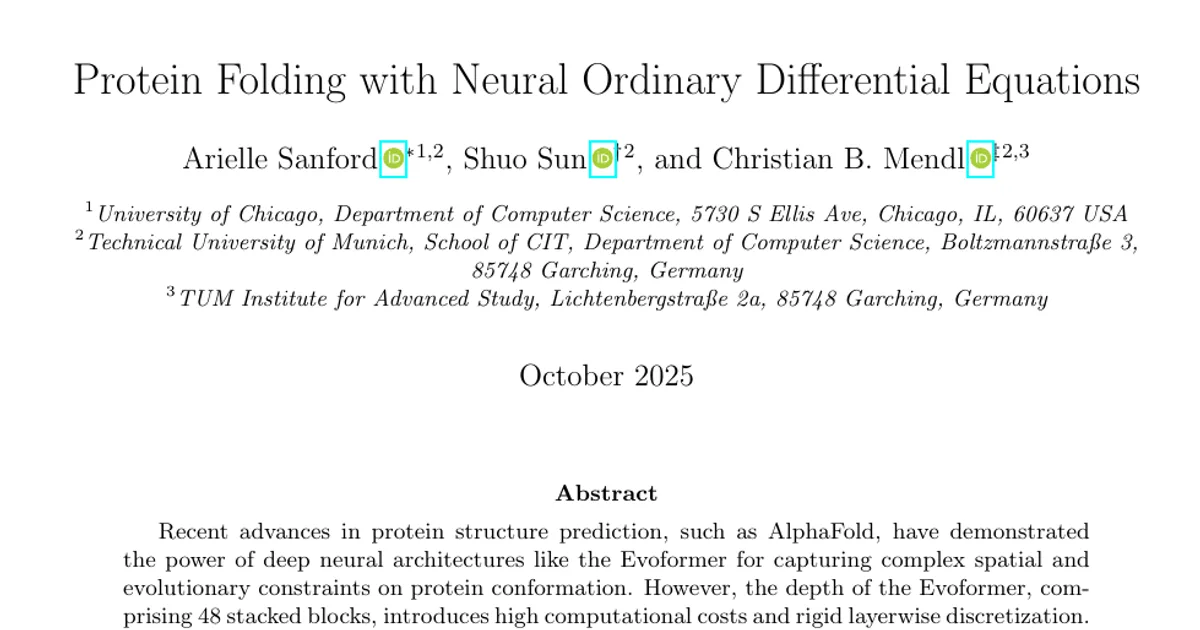
Recent advances in protein structure prediction, such as AlphaFold, have demonstrated the power of deep neural architectures like the Evoformer for capturing complex spatial and evolutionary constraints on protein conformation. However, the depth of the Evoformer, comprising 48 stacked blocks, introduces high computational costs and rigid layerwise discretization. Inspired by Neural Ordinary Differential Equations (Neural ODEs), we propose a continuous-depth formulation of the Evoformer, replacing its 48 discrete blocks with a Neural ODE parameterization that preserves its core attention-based operations. This continuous-time Evoformer achieves constant memory cost (in depth) via the adjoint method, while allowing a principled trade-off between runtime and accuracy through adaptive ODE solvers. Benchmarking on protein structure prediction tasks, we find that the Neural ODE-based Evoformer produces structurally plausible predictions and reliably captures certain secondary structure elements, such as alpha-helices, though it does not fully replicate the accuracy of the original architecture. However, our model achieves this performance using dramatically fewer resources, just 17.5 hours of training on a single GPU, highlighting the promise of continuous-depth models as a lightweight and interpretable alternative for biomolecular modeling. This work opens new directions for efficient and adaptive protein structure prediction frameworks.