Research
Product distribution learning with imperfect advice
Overview Research area: Theoretical machine learning — specifically distribution learning (property testing/estimation) within the "algorithms with predictions" framework. Technical level: Advanced. T
- arXiv
- 2511.10366
- Published
- 2025-11-13
- Authors
- Arnab Bhattacharyya, Davin Choo, Philips George John, Themis Gouleakis
AI summary
Overview
Research area: Theoretical machine learning — specifically distribution learning (property testing/estimation) within the "algorithms with predictions" framework.
Technical level: Advanced. The paper is a theory contribution organized around sample-complexity upper and lower bounds, though the core ideas can be described in plain terms.
Scope: One sentence — the paper asks how much the classical sample complexity of learning a product distribution over the Boolean hypercube can be reduced when the learner is handed an advice distribution that may be close to, or far from, the truth.
What This Paper Is About
Learning a product distribution on the Boolean hypercube {0,1}^d normally requires Θ(d/ε²) samples. The authors ask whether this can be improved if the learner is additionally given an advice mean vector q, with no guarantee that q is anywhere near the true mean p. The goal is an algorithm that performs better than the classical baseline when the advice is accurate, while remaining no worse than the baseline when the advice is bad — and that never needs to know the advice quality in advance.
Key Contributions
-
A "test-then-optimize" algorithm (TestAndOptimizeMean) that draws
Õ(d^{1-η}/ε²)samples when||p − q||_1 < ε d^{0.5 − Ω(η)}, succeeding with probability at least 1 − δ and running in polynomial time, despite no a priori bound on||p − q||_1being known to the algorithm. -
A refined sample-complexity trade-off — under a τ-balancedness condition, the algorithm's sample complexity is
Õ((d/ε²)(d^{−η} + min(1, f(p,q,d,η,ε)))), wheref = ||p − q||_1² / (d^{1−4η} τ⁶ ε²); this becomes sublinear indexactly when the advice is accurate. -
A new tolerant ℓ₂ mean tester for product distributions that uses
O((√d/ε²) log(1/δ))samples to distinguish||p − q||_2 ≤ εfrom||p − q||_2 ≥ 2ε, plus the ApproxL1 procedure that turns this into a certified estimate of||p − q||_1using block partitioning of coordinates. -
Two impossibility results: (a) the balancedness assumption is necessary — without it, sublinear sample complexity is impossible even when
||q − p||_1 = O(1); and (b) when||q − p||_1 ≫ ε√d, no algorithm with sublinear sample complexity exists.
Main Findings
-
Classical baseline: For product distributions on
{0,1}^d,Θ(d/ε²)samples are both necessary and sufficient to learn the distribution within total variation distance ε with probability at least 2/3, achieved by the empirical mean. -
Advice helps, but only up to a threshold: Sublinear-in-
dsample complexity is achievable when||p − q||_1 < ε d^{0.5 − Ω(η)}; the abstract states the resulting complexity asÕ(d^{1−η}/ε²). -
Exact advice recovers identity testing: With
q = p, the problem reduces to identity testing, which for product distributions requiresΘ(√d/ε²)samples (Daskalakis and Pan; Canonne, Diakonikolas, Kane and Stewart). This is the fundamental floor even with perfect advice. -
Balancedness is essential (a surprising result): The algorithm relies on the assumption that no coordinate marginal of
Pis too close to 0 or 1 (τ-balanced:τ ≤ P_i(1) ≤ 1 − τ), which links TV distance to the ℓ₂ error of the mean vector. The authors prove this is unavoidable: if coordinates can be arbitrarily close to 0 or 1, sublinear sample complexity is impossible even with||q − p||_1 = O(1). They note this contrasts with identity testing, whereO(√d/ε²)samples suffice without any balancedness assumption. -
Far advice is hopeless: When
||q − p||_1 ≫ ε√d, the paper shows no sublinear-sample algorithm exists. -
Divergence from the Gaussian case: The closest prior work (Bhattacharyya et al., 2025) studied learning Gaussians with imperfect advice and did not need a balancedness-type assumption; the ℓ₂-approximation subroutine here for product distributions is new.
Methodology in Plain English
The algorithm follows a "measure first, then optimize" pattern:
-
Test the advice. A tolerant tester (using
O(√d/ε² · log(1/δ))samples) checks whether||p − q||_2is at most ε (accept) or at least 2ε (reject). Internally it samples each coordinate via a Poissonization trick, forms the statisticZ = Σ_i [(X_i − m q_i)² − X_i]whereX_i ~ Poi(m p_i), and showsE[Z] = m² ||p − q||_2². Chebyshev's inequality separates the two cases. -
Localize the disagreement. Because ℓ₂ distance can overstate ℓ₁ distance by a factor of
√d, the authors partition thedcoordinates intod/kblocks of sizek. Within each block, the ℓ₁/ℓ₂ ratio improves from√dto√k. Running the tolerant tester per block against a geometric ladder of thresholdsℓ_i = 2^{i−1} αyields ApproxL1, which either certifies that||p − q||_2 > ζ/2, or returnsλwith||p − q||_1 ≤ λ ≤ 2√k (⌈d/k⌉ α + 2||p − q||_1). -
Constrain and solve. If
λis small (specificallyλ < ε√d), the algorithm drawsÕ(λ²/ε⁴)samples and solves a constrained least-squares problem — the empirical mean projected onto the ℓ₁ ball of radiusλaround q — which achieves ℓ₂ error ε inpoly(n,d)time. This mirrors the sample complexity of the (computationally inefficient) Scheffé tournament but is efficient. If the advice is rejected as too far, the algorithm falls back to the plain empirical mean withÕ(d/ε²)samples.
The choice of block size k, the ladder base α, and the rejection threshold ζ are tuned in terms of ε, d, τ, and η so that the sample count lands on the stated bound.
Why This Matters
Impact on research: The paper extends the algorithms-with-predictions framework into distribution learning, where most prior work had focused on online algorithms, scheduling, indexing, matching, and TSP. It also isolates a genuine gap between product distributions and Gaussians — balancedness is mandatory here but not in the Gaussian analogue — which raises a structural question about when ℓ₂ control over parameters translates into TV control over distributions. The new tolerant ℓ₂ tester for product distributions is stated to be new to the authors' knowledge.
Real-world applications (the paper motivates these settings rather than enumerating specific products):
- Reusing a previously trained model from a related dataset as a starting point for estimation on new unlabeled data.
- Tracking an evolving data-generating process, where past inference guides current inference.
- Acting on expert-supplied or third-party parameter estimates for high-dimensional binary data, without trusting them outright.
- Any high-dimensional binary estimation pipeline where a cheap, perhaps stale, prior exists and samples are expensive to acquire.
Industry relevance: The general pattern of "detect whether the prior is usable, then decide how much data to collect" is directly applicable to systems that want to ship a cheap fallback fallback behavior when a stored model or configuration drifts, rather than assuming predictions are always good. The paper's guarantee that the algorithm's performance never degrades below the advice-free baseline — without knowing the advice's quality — is the crux of its practical appeal.
Future Directions
- Weakening or removing balancedness. The authors show balancedness cannot simply be dropped for product distributions; an open question is whether a weaker, checkable condition on the target distribution permits sublinear sample complexity.
- Tightening the ℓ₁ threshold. The current guarantee requires
||p − q||_1 < ε d^{0.5 − Ω(η)}, and the impossibility result kicks in at≫ ε√d. Whether the true threshold lies strictly between these bounds is unresolved here. - Extending beyond product distributions. The paper compares its setting to Gaussian learning with imperfect advice; natural next steps are other structured classes (e.g., other graphical-model families) where similar "test cheaply, then constrain the search space" decompositions might apply.
- Tuning the block structure. The coordinate-partition parameter
ktrades off ℓ₁/ℓ₂ slack against the number of blocks tested; whether a more adaptive partition (beyond uniform blocks) yields sharper bounds is not settled here.
Target Audience
Theoretical computer scientists and machine learning theorists working on distribution learning, property testing, statistical estimation, or the algorithms-with-predictions framework. Graduate students and researchers who want a rigorous treatment of how imperfect side information affects sample complexity will find the paper most useful; practitioners can read the introduction and the plain-language overview of TestAndOptimizeMean without needing to follow the Chebyshev and Cauchy–Schwarz arguments in the proofs.
Authors’ abstract
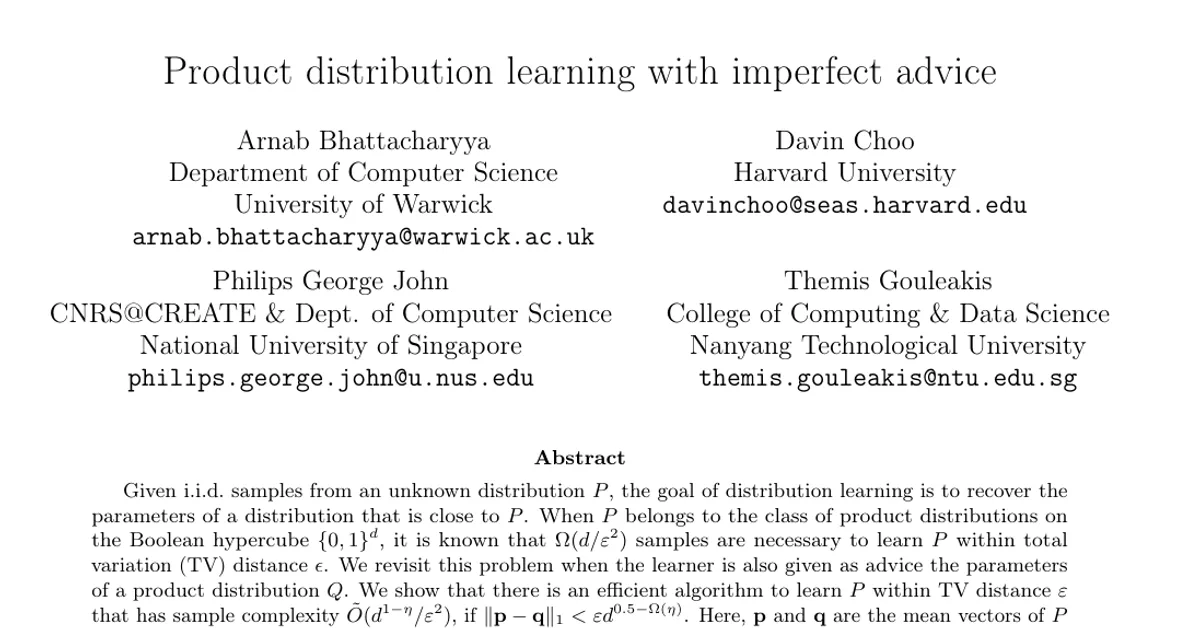
Given i.i.d.~samples from an unknown distribution $P$, the goal of distribution learning is to recover the parameters of a distribution that is close to $P$. When $P$ belongs to the class of product distributions on the Boolean hypercube $\{0,1\}^d$, it is known that $Ω(d/\varepsilon^2)$ samples are necessary to learn $P$ within total variation (TV) distance $\varepsilon$. We revisit this problem when the learner is also given as advice the parameters of a product distribution $Q$. We show that there is an efficient algorithm to learn $P$ within TV distance $\varepsilon$ that has sample complexity $\tilde{O}(d^{1-η}/\varepsilon^2)$, if $\|\mathbf{p} - \mathbf{q}\|_1 < \varepsilon d^{0.5 - Ω(η)}$. Here, $\mathbf{p}$ and $\mathbf{q}$ are the mean vectors of $P$ and $Q$ respectively, and no bound on $\|\mathbf{p} - \mathbf{q}\|_1$ is known to the algorithm a priori.