Research
ProAR: Learning Prospective Reasoning with Autoregressive Video Models
Overview Research area: Computer vision, specifically autoregressive video generation and "video-native reasoning" — models that reason about a task by generating how the visual world evolves. Technic
- arXiv
- 2610.03664
- Published
- 2026-10-02
- Authors
- Linghui Shen, Tinghui Zhu, Sheng Zhang, Muhao Chen
AI summary
Overview
Research area: Computer vision, specifically autoregressive video generation and "video-native reasoning" — models that reason about a task by generating how the visual world evolves.
Technical level: Advanced. The paper assumes familiarity with diffusion/flow-matching objectives, causal attention in transformers, autoregressive rollouts, and representation alignment methods.
Scope (one sentence): The paper introduces ProAR, a training framework that gives autoregressive video models two forms of foresight — an evolving prediction of the final goal frame and a representation-level anticipation of the next temporal state — and evaluates it on 13 visual reasoning tasks plus an embodied manipulation benchmark.
What This Paper Is About
Autoregressive (AR) video models generate video chunk by chunk, but they are trained only to predict the next locally plausible chunk, not to reach a task outcome. This short-sightedness means small local errors compound during rollout and can steer generation away from the goal entirely. ProAR's goal is to convert autoregressive video generation into a goal-directed reasoning process by equipping the model with long-range outcome awareness and short-range transition awareness.
Key Contributions
-
Reframing the problem. The authors revisit autoregressive video generation from a reasoning perspective, identifying the absence of prospective guidance — the ability to anticipate future outcomes and state transitions from observed history — as the key limitation of next-chunk prediction.
-
ProAR framework. They propose ProAR, which combines a goal belief (an evolving prediction of the final frame, injected via an asymmetric attention mask) with future representation self-alignment (a teacher-student mechanism that aligns noisy current hidden states with clean next-chunk hidden states), providing outcome and transition guidance at minimal overhead.
-
Empirical validation across reasoning domains. Experiments across perceptual, spatial, abstract, and embodied reasoning benchmarks show complementary benefits from the two components, consistent gains, and improved training efficiency, with generalization to embodied reasoning on WorldArena.
Main Findings
-
VBVR (10 perceptual/spatial tasks): ProAR raises the mean score from 0.663 (Standard AR, a Wan2.2-TI2V-5B backbone adapted to causal attention with teacher forcing) to 0.801, a 20.8% relative improvement. It exceeds closed-source Seedance 2.0 and bidirectional Wan2.2 5B SFT by 0.174 and 0.065 respectively. ProAR beats Standard AR on 8 of the 10 tasks, with the largest absolute gains on Slide Puzzle (+0.543), Stable Sort (+0.330), and Pipe Puzzle (+0.122).
-
VideoRLVR (3 abstract reasoning games): Standard AR already outperforms both bidirectional Wan2.2 SFT and its reinforcement-learning variant. ProAR improves the average success rate from 50.97 to 52.97 and average precision from 61.56 to 67.17. Precision rises on all three games, including Sokoban from 40.18 to 47.62. Success rates reach 82.70 on Maze, 30.20 on FlowFree, and 46.00 on Sokoban.
-
Training efficiency: On the 10-task VBVR subset, ProAR reaches a mean score of 0.708 after only 2,500 steps, already exceeding the 0.663 that Standard AR reaches after 10,000 steps. After Transition guidance activates at step 7,500, the score rises from 0.7666 to 0.8010 by step 10,000 — with no additional optimization steps.
-
Components are complementary: On VBVR, Outcome alone yields 0.786 and Transition alone yields 0.683 versus 0.663 for Standard AR, while the combination reaches 0.801. On VideoRLVR, Outcome and Transition individually raise average precision from 61.56 to 64.82 and 63.50, while full ProAR reaches 67.17. ProAR leads among AR variants on 7 of 10 VBVR tasks and 8 of 12 VideoRLVR metrics.
-
When to activate Transition alignment: Starting alignment from scratch (Step 0) gives mean 0.799, starting at step 5,000 gives 0.782, and the default late start at step 7,500 gives 0.801. The authors hypothesize that early in training the backbone lacks stable, task-relevant representations, making its internal teacher targets less informative, so a fine-tuning warm-up helps.
-
Asymmetric attention mask: Removing the mask yields a mean of 0.799 versus 0.801 with it. The difference is small, but the asymmetric pattern is sparser and thus more computationally efficient, and it protects the goal belief from the uncertain current chunk.
-
Embodied reasoning (WorldArena): ProAR achieves an EWMScore of 60.95 — the second-highest among the methods reported, behind FlowWAM's 63.71 — and improves 8 of the 9 component metrics relative to Standard AR, raising EWMScore from 60.43 to 60.95. Gains include Depth Accuracy (88.42 to 91.11), Instruction Following (80.88 to 81.96), Interaction Quality (73.12 to 73.86), and Trajectory Accuracy (41.74 to 42.34).
-
Computational cost: Training overhead is only 12%–14% total. Outcome guidance appends one goal frame per chunk, increasing token count by 8%–11% for 3–8 chunk videos. The Transition predictor has 236M parameters (4.7% of the 5B backbone) and adds 2%–3% to training compute. At inference the predictor is discarded entirely; measured on an NVIDIA B200, overall inference time increases by roughly 12% at chunk size 4 and roughly 8% at chunk size 8.
-
Layer and alignment details: Representations are extracted from backbone block 15 of a 30-block DiT; layers 10, 15, and 20 all outperform Standard AR (0.663) and Outcome-only (0.786). The predictor is a lightweight 3-block DiT.
Methodology in Plain English
The researchers start from a standard autoregressive video diffusion setup: video is split into latent chunks, each chunk is generated conditioned on the clean chunks before it using flow matching, and training uses teacher forcing so all target chunks are denoised in parallel under a causal attention mask. They then add two training-time mechanisms.
For outcome guidance, at every autoregressive step the model simultaneously denoises the current chunk and a noisy version of the final ground-truth frame (the goal). Both streams share one backbone and one forward pass. An asymmetric attention mask lets goal tokens see only the clean history and themselves — never the noisy current chunk — while current tokens can additionally attend to the goal tokens. This means the uncertain present cannot corrupt the goal belief, but the goal belief can steer the present. During inference, only the generated current chunk is appended to history, and the goal belief is re-estimated at every step from the growing history, so it refines itself as the video unfolds.
For transition guidance, they exploit a side effect of teacher forcing: within a single forward pass, the clean next chunk is already encoded in the history stream while the noisy current chunk is processed in the current stream. The hidden state of the clean next chunk (teacher, with stop-gradient) is therefore available for free. A small training-only predictor (3 transformer blocks) maps the noisy current chunk's hidden states (student) toward that teacher target using a token-wise cosine distance loss. This nudges current representations to anticipate what comes next. The predictor is removed at inference, so it costs nothing at test time.
The full objective is the current-chunk loss plus a weighted goal loss (λ_goal = 0.25) plus a weighted alignment loss (λ_align = 0.01, or 0.05 on WorldArena). Because the raw cosine loss is much larger than the generation losses, the weighted alignment term contributes roughly 3%–10% of the total loss. Models are optimized with AdamW at learning rate 5×10⁻⁶ and global batch size 16, trained on 2–4 NVIDIA B200 GPUs.
Why This Matters
The paper targets a mismatch that matters for any system where a generated video is the reasoning process: next-chunk prediction optimizes local plausibility, not task success, and autoregressive rollouts cannot revise past mistakes. ProAR shows that lightweight, training-only foresight mechanisms can close much of that gap without changing the chunk-wise generation process or adding meaningful inference burden.
Real-world applications:
-
Robotic manipulation and embodied control: The WorldArena results on RoboTwin 2.0 bimanual tasks suggest AR video models can serve as embodied simulators that produce physically coherent, task-directed manipulation trajectories rather than drifting toward failed grasps.
-
Interactive world models and games: AR models support long-horizon, low-latency streaming, so goal-aware AR generation could improve maze navigation, puzzle solving, and other game-like tasks where the generated video is the solution path.
-
Real-time simulation and planning: Because the transition predictor adds zero inference cost and the goal frame adds only one auxiliary frame per chunk, the approach is compatible with low-latency interactive settings.
-
Physical-process simulation: The paper cites simulation of physical processes as a use case, where valid intermediate states matter more than pixel-level plausibility.
Industry relevance: The framework is built on an open-source Wan2.2-TI2V-5B backbone and adds only 12%–14% training overhead, making it attractive to teams that already train or fine-tune video models and want better task-directed behavior without swapping architectures or paying substantially more at inference.
Future Directions
-
What happens with longer horizons and larger chunk sizes: The paper notes that the relative inference overhead of the outcome module shrinks with larger chunks, but does not report how far goal-belief refinement remains reliable over long rollouts.
-
Alternative goal targets and multiple goals: The current design uses the final ground-truth frame as the sole goal target at every step; whether richer or hierarchical goal representations would help is not addressed.
-
Richer self-supervision targets: The transition module aligns against the immediate next clean chunk from a shared middle layer (block 15); the paper leaves open whether multi-step future representations or different layer selections could provide stronger guidance.
-
Beyond the reported benchmarks: The authors position prospective modeling as a direction for physical and embodied intelligence, but the evaluation is limited to the selected VBVR tasks, three VideoRLVR games, and WorldArena manipulation, so generalization to other reasoning domains remains an open question. The paper's own limitations discussion (Appendix A.6) is not included in the available text.
Target Audience
Researchers and engineers working on video generation, world models, and embodied AI who are already comfortable with diffusion/flow-matching training and autoregressive architectures. It is also relevant to practitioners who want to improve task-directed behavior in existing AR video models with modest training overhead, and to readers interested in how reasoning capabilities can be induced in generative video models without replacing the chunk-wise generation paradigm.
Authors’ abstract
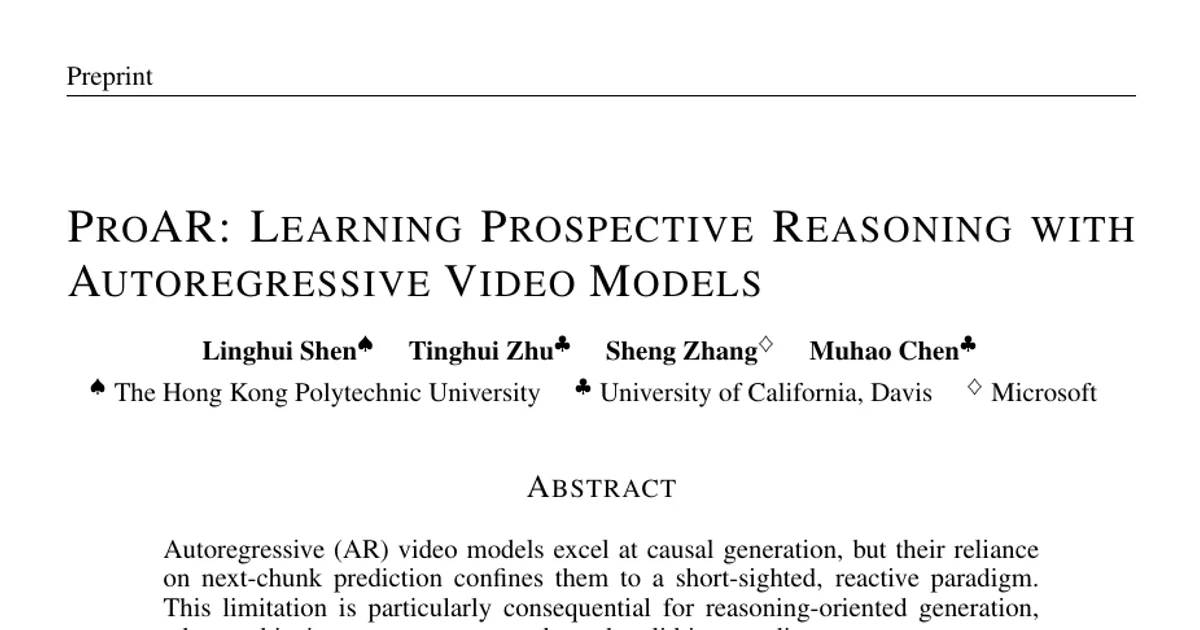
Autoregressive (AR) video models excel at causal generation, but their reliance on next-chunk prediction confines them to a short-sighted, reactive paradigm. This limitation is particularly consequential for reasoning-oriented generation, where achieving a target outcome through valid intermediate states matters more than local visual plausibility. To address this challenge, we propose Learning Prospective Reasoning with Autoregressive Video Models (ProAR), a novel framework that transforms autoregressive video generation into a goal-oriented reasoning process. ProAR introduces two key components: (1) To anchor generation to the long-range outcome, we integrate goal-frame prediction into the autoregressive loop via an asymmetric attention mask, enabling the predicted goal frame to guide the generation of intermediate states without being disrupted by them. (2) To guide short-range transitions, we introduce future representation self-alignment to encourage current hidden states to anticipate upcoming temporal dynamics. By leveraging teacher-forcing in AR training, we extract clean future representations in a single forward pass and align current representations with them using a lightweight, training-only predictor. Together, these two mechanisms seamlessly combine explicit, sparse target supervision with implicit, dense step-wise guidance, promoting coherent, goal-directed reasoning progress with modest computational cost. Experiments show that ProAR's complementary components consistently improve performance across diverse visual reasoning benchmarks. The framework proves highly training-efficient, surpassing fully trained standard AR baselines using only 25% of the training steps. This paradigm also demonstrates promising applicability to embodied reasoning tasks.