Research
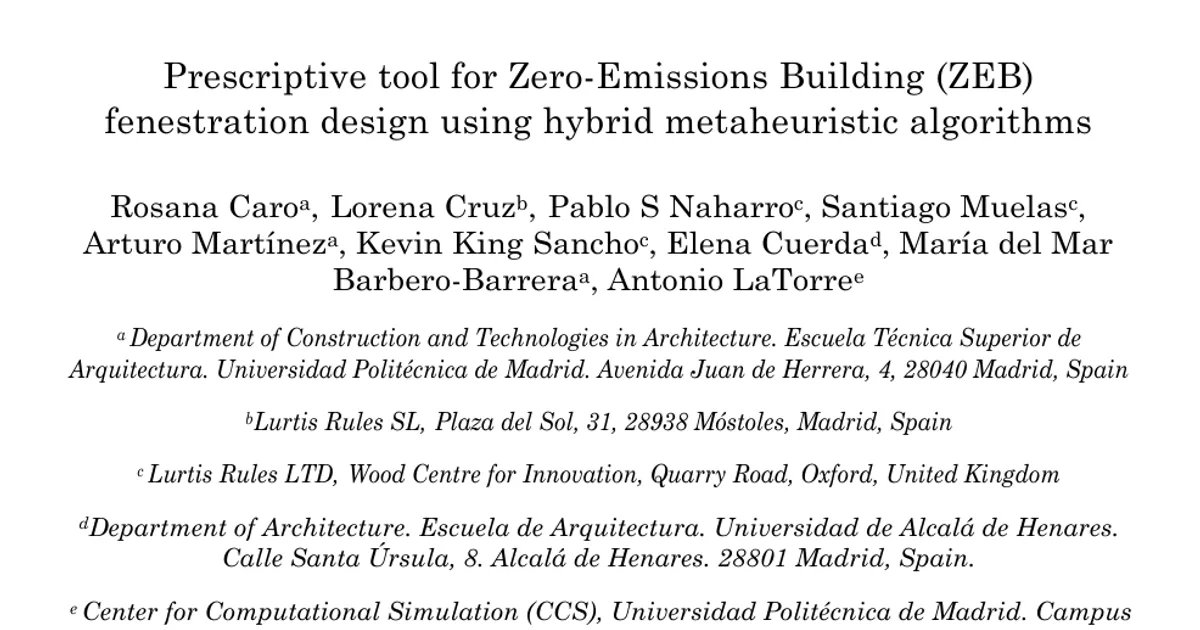
Prescriptive tool for zero-emissions building fenestration design using hybrid metaheuristic algorithms
Overview Research area: Computational intelligence — specifically hybrid metaheuristic optimization — applied to building performance simulation and architectural design, with a focus on Zero-Emission
- arXiv
- 2512.04102
- Published
- 2025-11-26
- Authors
- Rosana Caro, Lorena Cruz, Arturo Martinez, Pablo S. Naharro, Santiago Muelas, Kevin King Sancho, Elena Cuerda, Maria del Mar Barbero-Barrera, Antonio LaTorre
AI summary
Overview
Research area: Computational intelligence — specifically hybrid metaheuristic optimization — applied to building performance simulation and architectural design, with a focus on Zero-Emissions Buildings (ZEBs).
Technical level: Advanced. The work sits at the intersection of evolutionary computation, building physics simulation, and architectural practice, and assumes familiarity with optimization algorithms and building energy concepts.
Scope (one sentence): The paper proposes and tests a simulation-based, hybrid metaheuristic method that automatically optimizes nineteen architecturally controllable fenestration variables across three Spanish climate zones to reduce heating demand, cooling demand, and thermal discomfort in residential buildings.
What This Paper Is About
Designing Zero-Emissions Buildings means satisfying many competing performance goals at once, and conventional design methods struggle with that complexity. Fenestration — façade openings and their shading systems — is especially consequential because it both loses heat through high thermal transmittance and admits solar radiation, so it strongly shapes energy demand and occupant comfort. The paper's goal is a practical, automated design tool that searches this fenestration design space and produces detailed outputs that architects can actually prescribe, rather than abstract optimized parameters.
Key Contributions
- A novel simulation-based optimization method for fenestration design built for practical application, not just academic demonstration — it is framed as a prescriptive tool for ZEB design.
- A hybrid metaheuristic algorithm combined with a rule-based, updatable catalog that fully automates the design process, creates a highly diverse search space, minimizes designer bias, and yields detailed, prescription-ready solutions.
- A nineteen-variable optimization formulation covering fenestration parameters over which architects have genuine design flexibility, targeting three objectives simultaneously: heating demand, cooling demand, and thermal discomfort.
- A cross-climate evaluation of the method in three Spanish climate zones, including a statistical comparison against a baseline Genetic Algorithm.
Main Findings
- The proposed algorithm outperforms the baseline Genetic Algorithm: the abstract reports a significant advantage in both solution quality and robustness, and states these differences were proven statistically significant. The abstract does not report effect sizes, objective values, or run counts.
- Warm climates are the hard case: the results highlight specific challenges in reducing cooling demand in warm climate zones, suggesting that fenestration-based passive strategies alone face limits there.
- Automated movable shading beats fixed shading: the study reports superior efficiency for automated movable shading systems compared to fixed solutions, indicating that dynamic shading control is a more effective lever than static design choices.
- The optimization produces prescribed design detail: the method is reported to generate solutions detailed enough to be used directly for architectural prescription, which is what distinguishes it from optimization studies that only output variable vectors. The abstract does not specify the form of these outputs.
Methodology in Plain English
The researchers framed fenestration design as a search problem rather than a manual design exercise. Design options are encoded as nineteen variables that architects can realistically control. A rule system plus a catalog of options — which can be updated — defines and expands the space of valid designs, so the search is not limited to a narrow set of conventional configurations and is less dependent on the starting assumptions of whoever set up the model.
Onto this they applied a hybrid metaheuristic: a search algorithm that combines more than one optimization strategy, paired with building performance simulation to evaluate how each candidate design performs on heating demand, cooling demand, and thermal discomfort. The simulation acts as the judge of each candidate. To check whether the hybrid approach is actually better and not just lucky, they benchmarked it against a standard Genetic Algorithm and applied statistical tests to the comparison. They ran this whole procedure for three different Spanish climate zones, since the trade-offs between heating and cooling differ by climate.
A key point is the word "prescriptive": the pipeline is designed to end in concrete, detailed design specifications rather than only a performance score.
Why This Matters
Research impact. The paper contributes to the literature on simulation-based optimization for building design in two ways: it presents a hybrid metaheuristic (rather than a standard GA) with a rigorous statistical comparison against the baseline, and it attacks the "last mile" problem — most optimization studies end at optimal parameters, whereas this one aims at prescription-ready outputs. The updatable catalog and rule-based search-space definition also offer a template for making optimization studies less biased by hand-picked design options. The abstract does not report how these contributions transfer to other building types or climates outside the tested zones.
Real-world applications:
- Early-stage façade design for residential ZEB projects, where architects could use the tool to generate and compare fenestration and shading schemes against energy and comfort targets.
- Shading system specification, using the reported advantage of automated movable shading to justify motorized/dynamic shading over fixed overhangs or louvers in the relevant climates.
- Warm-climate retrofit and new-build planning, where the identified difficulty of cutting cooling demand can inform where passive fenestration measures suffice and where additional strategies are needed.
- Climate-zone-specific design guidance, since the method was exercised across three distinct Spanish climate zones and produces zone-relevant solutions.
Industry relevance. The tool targets a practical bottleneck: architects and façade engineers need design decisions that are both energy-defensible and buildable. A workflow that automates search, reduces bias, and outputs prescriptive detail fits naturally into performance-driven design processes and regulatory contexts where heating, cooling, and comfort must be documented.
Future Directions
- Addressing cooling demand in warm climates, which the paper itself flags as a challenge — whether through broader design variables, additional shading or control strategies, or coupling fenestration optimization with other building systems.
- Extending beyond the three Spanish climate zones tested, to determine whether the hybrid algorithm's quality and robustness advantages hold in colder, hotter, or more humid contexts.
- Clarifying and validating the prescription-ready outputs — how detailed solutions are represented, and how usable they are in actual architectural practice and modeling tools.
- Testing the updatable catalog and rule mechanism as an evolving resource, since its maintainability is central to the claim of minimizing bias and expanding the search space.
Target Audience
Researchers in evolutionary and hybrid metaheuristic optimization who work on real-world constrained design problems; building performance simulation and building energy researchers studying ZEB design; architects and façade engineers interested in performance-driven design workflows; and practitioners or policymakers looking for climate-zone-specific evidence on fenestration and shading strategies, especially regarding movable versus fixed shading and the difficulty of reducing cooling loads.
Authors’ abstract
Designing Zero-Emissions Buildings (ZEBs) involves balancing numerous complex objectives that traditional methods struggle to address. Fenestration, encompassing façade openings and shading systems, plays a critical role in ZEB performance due to its high thermal transmittance and solar radiation admission. This paper presents a novel simulation-based optimization method for fenestration designed for practical application. It uses a hybrid metaheuristic algorithm and relies on rules and an updatable catalog, to fully automate the design process, create a highly diverse search space, minimize biases, and generate detailed solutions ready for architectural prescription. Nineteen fenestration variables, over which architects have design flexibility, were optimized to reduce heating, cooling demand, and thermal discomfort in residential buildings. The method was tested across three Spanish climate zones. Results demonstrate that the considered optimization algorithm significantly outperforms the baseline Genetic Algorithm in both quality and robustness, with these differences proven to be statistically significant. Furthermore, the findings offer valuable insights for ZEB design, highlighting challenges in reducing cooling demand in warm climates, and showcasing the superior efficiency of automated movable shading systems compared to fixed solutions.