Research
PremiseCheck: Efficient Fact-Checking of Human and AI Peer Reviews
Overview Research area: Natural Language Processing — automated fact-checking of peer-review comments against the papers they discuss. Technical level: Intermediate. The paper is readable without deep
- arXiv
- 2610.21046
- Published
- 2026-10-15
- Authors
- Dingjie Song, Zhiling Yan, Ziqian Zhang, Yuxuan Zhang, Lichao Sun
AI summary
Overview
Research area: Natural Language Processing — automated fact-checking of peer-review comments against the papers they discuss.
Technical level: Intermediate. The paper is readable without deep technical background, but it assumes familiarity with AUROC, LLM prompting, and the notion of "decision models" (models that return a probability that a statement holds for a text).
Scope: The paper introduces ReviewFact, a benchmark of review-comment factual errors across three fields, and PremiseCheck, a two-model pipeline that checks each comment by splitting it into explicit premises with an LLM and verifying each premise with a cheap decision model.
What This Paper Is About
Peer review is under strain from growing submission volume, and review comments — whether written by humans or by AI — sometimes misstate what the paper actually says. The authors turn this into a standalone task: given a paper and one review comment, score how likely the comment contains a factual error about that paper. Their goal is a checker that is as accurate as a frontier LLM but much cheaper and faster, because such a system would run on every comment of every review.
Key Contributions
- The ReviewFact benchmark. A benchmark that labels factual errors in human-written and AI-written review comments under one definition across NLP, machine learning, and the natural sciences, and that measures cost and latency alongside accuracy. It holds 9,267 comments on 217 papers, built from the expert annotations of ReviewCritique (NLP), ReviewScore (machine learning), and Phys. Rev. B (natural sciences).
- The PremiseCheck framework. A pipeline in which an LLM rewrites each comment as explicit premises without reading the paper, and a decision model (Jev) routes each premise and verifies it against the paper or against general knowledge. A comment receives the score of its weakest premise.
- Cost–accuracy evidence across all three fields. PremiseCheck checks each comment on its own at accuracy comparable to holistic GPT-5.5 at roughly half the cost, and on NLP reviews at a quarter of the cost with a no-reasoning decomposer.
- Ablations on what drives the result. The gains come from decomposition rather than from one specific model: four decision models from different providers, including the open-weight Kev-27B, come within one point of holistic GPT-5.5 as verifiers. A cascade baseline costs more than PremiseCheck yet is less accurate on every part.
Main Findings
- Accuracy parity at about half the cost. With a medium-reasoning decomposer (GPT-5.5) and Jev as verifier, PremiseCheck scores 63.0 AUROC on NLP (−0.3 versus the 63.2 reference), 68.7 on machine learning (+1.8 versus 66.9), and 67.5 on natural science (−0.3 versus 67.8), at 51.2%, 46.6%, and 47.4% of the reference cost respectively.
- Cheaper again without reasoning. With a no-reasoning decomposer, cost falls to 24.6% on NLP, 19.5% on machine learning, and 22.3% on natural science, with AUROC of 63.1, 63.7, and 66.0; time falls to 45.0%, 37.5%, and 21.9% of the reference.
- Cheap baselines fall short. Holistic Jev scores 49.9, 61.2, and 58.7 AUROC; GPT-5.4-mini scores 53.7, 58.7, and 61.4; holistic GPT-5.5 without reasoning falls to 49.3 on NLP at twice PremiseCheck's cost. The cascade (Jev, with the 70% most suspicious comments sent to GPT-5.5) reaches 59.1, 65.7, and 66.7.
- Decision models are only weak as holistic judges. Jev, Kev-27B, Microsoft Decision-1, and Perplexity Decider score 50 to 57 as holistic judges but come within one point of holistic GPT-5.5 as verifiers inside PremiseCheck. On single premises written out by human annotators, Jev is as accurate as GPT-5.5.
- Expensive verifiers add nothing. GPT-5.5 as verifier is no more accurate than Jev but makes the pipeline cost 3.1 times as much as holistic judgment; a GPT-5.4-mini verifier costs 1.4 times as much as with Jev.
- Cheap decomposers suffice. With Kev-27B as verifier, GPT-5.6 Sol, GPT-5.6 Luna, and Nemotron Super 3 as decomposers are non-inferior to holistic GPT-5.5 at 6% to 17% of the cost of their holistic judgment; weaker decomposers lose 2 to 6 points. With Jev as verifier and a no-reasoning decomposer, Kev-27B is non-inferior at 17.8% of the reference API cost, not counting GPU time.
- Longer papers yield larger savings. Relative cost falls from 53% for the shortest third of papers to 49% for the longest third, since only the decision model reads the paper.
- Question phrasing matters. Asking 16 phrasings of the verification question in one call (eight supporting, eight contradicting) raises AUROC from 63.1 to 65.7, a significant gain attributable to the contradiction questions.
- Routing is needed but the route is not. Kev-27B agrees with Jev on only 65% of routes yet gives the same AUROC; skipping routing lowers AUROC from 61.8 to 58.8 on a common set of machine-learning premises.
- Minimum beats mean. Aggregating premises by mean instead of minimum lowers AUROC to 59.4.
- Batching and fusion. Batched holistic GPT-5.5 without reasoning reaches 67.8 at 7.7% of reference cost; batched PremiseCheck reaches 69.0 at 20%; fusing the two by percentile ranks reaches 71.5 at 28%, significantly above batched holistic GPT-5.5. The two scores have a rank correlation of only 0.56.
- Flagging works. Among the 5% most suspicious comments, flags from PremiseCheck hit errors two to three times as often as random, while holistic GPT-5.5 does little better than random; reading the three most suspicious comments per paper finds an error for 40% of papers containing one with batched PremiseCheck, versus 29% with batched holistic GPT-5.5.
- Scope limits. PremiseCheck targets facts, not judgment: on labels that also count unimportant concerns or unreasonable requests, it falls behind holistic GPT-5.5, significantly on Phys. Rev. B, but the gap disappears on factual errors alone. On Misunderstanding and Neglect — almost all NLP errors — it scores above holistic GPT-5.5, though not significantly.
- Failure analysis. Three annotators assign 164 sampled failures to stages. On NLP, false alarms come mostly from decomposition (58%); on natural-science reviews, mostly from verification (45%). Holistic GPT-5.5 fails on only 13% and 15% of the machine-learning and natural-science false alarms.
Methodology in Plain English
The authors first define the task precisely: a system takes a paper and one comment from a review of it, and returns a score where low means the comment probably contains a factual error. The error taxonomy is borrowed from ReviewCritique — Misunderstanding, Neglect, Unstated statement, and Inaccurate summary. Errors of judgment (e.g., whether a concern is important) are explicitly out of scope.
The benchmark reuses existing expert annotations rather than collecting new ones. Because the source datasets were built for broader purposes, the authors map their annotations onto the new label and filter out comments outside the task. For the physics reviews, where experts often flagged comments as wrong for reasons of judgment rather than fact, GPT-5.5 decides from the expert's written rationale whether the error is factual; two of the authors independently repeat this decision on the 178 comments that have a rationale and agree with GPT-5.5 at Cohen's κ of 0.76 and 0.77 (and with each other at 0.70). Swapping in the human labels changes the PremiseCheck-versus-GPT-5.5 difference only within −3.7 to +2.7, never significantly.
PremiseCheck itself runs in four steps. A decomposer LLM sees only the comment — never the paper — and rewrites it as an argument with a conclusion and between one and six self-contained declarative premises, including implicit ones such as what a question presupposes. A decision model then reads only each premise to route it as paper-grounded or knowledge-based, and finally reads the paper together with the premise to answer the matching question ("The proposition is true according to the paper" or "The proposition is true"). The comment score is the minimum of its premise scores. Cost stays low because the LLM call excludes the paper and because the decision model generates no text — asking several phrasings of the same question about the same input adds almost no cost. On NLP reviews, all decision-model calls together cost $0.0015 per comment.
Evaluation uses AUROC with factual errors as the class to detect, plus mean cost in dollars and latency in seconds, both reported relative to holistic GPT-5.5 at medium reasoning. A system is called non-inferior when the lower bound of a 95% bootstrap interval (2,000 resamples over papers) for the paired AUROC difference exceeds −3, a margin fixed before the experiments; repeated paper input for the baseline is billed at the cached price, which favors the baseline.
Why This Matters
Impact on research. Factual errors in review comments mislead authors and distort editorial decisions, and at current submission volumes they cannot be caught by hand — an area chair cannot reread every paper, and authors can correct an error only in the rebuttal. PremiseCheck makes comment-level fact-checking cheap enough to run on every comment, and it returns the specific premise the paper appears to refute, so a human checks one claim instead of rereading the paper. ReviewFact also gives future checkers a benchmark that scores accuracy, cost, and latency together rather than accuracy alone.
Real-world applications:
- Reviewer support: checking each comment as soon as it is written, before the rest of the review exists.
- Area-chair triage: flagging the few most suspicious comments per paper for human attention.
- Author rebuttals: identifying which specific claim in a review the paper actually contradicts.
- AI-assisted reviewing systems: screening machine-generated review comments before they reach authors.
Industry relevance. The result is directly about inference economics: a frontier LLM is used only where its flexibility is needed (rewriting a short comment), while the expensive paper-reading step is pushed to a decision model billed at $0.042 per million input tokens. The finding that four decision models from different providers, including the open-weight Kev-27B, all work as verifiers means the approach is not tied to one vendor, and the finding that decomposers much cheaper than GPT-5.5 suffice lowers the barrier further.
Future Directions
- Better decomposition. Most false alarms on the NLP reviews come from the decomposition stage, where a premise adds to, redirects, or blurs what the reviewer said; a decomposer that stays closer to the reviewer's wording is the natural next step.
- Detecting errors of judgment. Unimportant concerns and unreasonable requests lie outside PremiseCheck and are stated to require different methods.
- More open-weight decision models. Only Kev-27B is tested as an open decision model; the authors leave further open models to future work, noting that Jev is served through an API.
- Continued benchmarking. ReviewFact is offered as a way to measure future checkers on accuracy, cost, and latency together, and the batched/fused setting (best result: 71.5 AUROC at 28% of reference cost) suggests headroom for combining approaches.
Target Audience
Researchers in NLP and computational peer review, builders of fact-checking and claim-verification systems, and anyone working on cost-aware LLM system design. It is also useful for area chairs, editors, and conference organizers considering deployment of automated review-comment screening, and for readers interested in how far cheap decision models can replace frontier LLMs once a task is decomposed properly.
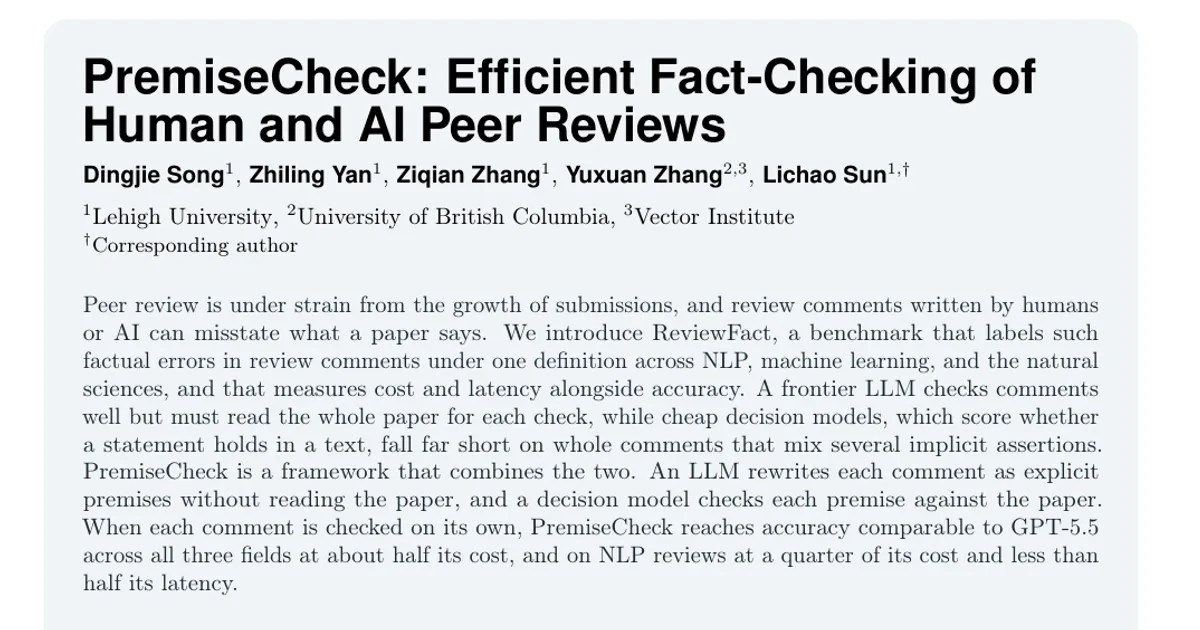
Authors’ abstract
Peer review is under strain from the growth of submissions, and review comments written by humans or AI can misstate what a paper says. We introduce ReviewFact, a benchmark that labels such factual errors in review comments under one definition across NLP, machine learning, and the natural sciences, and that measures cost and latency alongside accuracy. A frontier LLM checks comments well but must read the whole paper for each check, while cheap decision models, which score whether a statement holds in a text, fall far short on whole comments that mix several implicit assertions. PremiseCheck is a framework that combines the two. An LLM rewrites each comment as explicit premises without reading the paper, and a decision model checks each premise against the paper. When each comment is checked on its own, PremiseCheck reaches accuracy comparable to GPT-5.5 across all three fields at about half its cost, and on NLP reviews at a quarter of its cost and less than half its latency.