Research
Predicting Steering Vectors and Adapter Weights for Few-Shot Author-Style Transfer
Overview Research area: Natural language processing, specifically author-level style transfer and personalization of large language models, applied to scientific abstract generation. Technical level:
- arXiv
- 2610.03163
- Published
- 2026-10-02
- Authors
- Leonard Popp, Danni Liu, Supriti Sinhamahapatra, Jan Niehues
AI summary
Overview
Research area: Natural language processing, specifically author-level style transfer and personalization of large language models, applied to scientific abstract generation.
Technical level: Intermediate. The paper assumes familiarity with activation steering, LoRA adapters, and hypernetworks, but each method is explained well enough for a reader with general machine-learning background.
Scope: A comparative study of six methods (three baselines, three proposed) for generating a scientific abstract in a specific author's style, given only three example abstracts and a structured outline of the new paper.
What This Paper Is About
The paper tackles a "cold-start" personalization problem: given three abstracts written by a particular author, can a model write a new abstract for an unseen paper in that author's style? Scientific writing makes this hard because formal conventions leave little surface variation, and since authors write their own topics, a model trying to extract style easily copies content instead. The authors propose and compare three new methods against three standard baselines, measuring both how well the output imitates the author and how good the text actually is.
Key Contributions
-
A documented style-quality trade-off. Across all six methods, on both seen and unseen authors, the authors find a consistent trade-off between imitating style and producing fluent text, with the hypernetwork occupying what they call the most efficient position on the trade-off.
-
Near-orthogonal steering vectors that perform equally well. Manually computed and network-predicted steering vectors have average cosine similarity near zero at every layer examined (−0.03, −0.05, −0.04 at layers 18, 19, 20) yet achieve comparable style accuracy, suggesting at least two unrelated directions support style conditioning and no single axis is required.
-
Author-level contrastive steering. Instead of contrasting an author against an inventory of other styles, the authors contrast an author's real abstracts against the model's own style-neutral generations for the same content. This holds topic fixed, removes the need for a predefined style inventory, and outperforms the inventory-based method of Konen et al. (2024) at both layer scopes tested (34.0% vs 31.0% at layers 20–22, and 36.0% region results at 18–20).
-
Prediction instead of per-author artifacts. A network predicts steering vectors in a single forward pass from three examples, and a hypernetwork predicts LoRA adapters directly, so no per-user vector or per-user training is needed at deployment.
Main Findings
-
Fine-tuning buys style but destroys quality. The LoRA baseline reaches the highest style accuracy on both test sets (49.8% on 203 seen authors, 37.5% on 328 unseen authors), but its preference rate against human-written abstracts collapses to 38.1% (seen) and 39.0% (unseen), far below the zero-shot baseline's 97.9% and 97.4%. Manual inspection found frequent repetitions.
-
The hypernetwork gives the best balance. It reaches 36.5% style accuracy at a 91.3% preference rate on seen authors, and 31.4% at 95.5% on unseen authors. On the unseen set this is an 8.5-point style improvement over zero-shot while giving up only 1.9 points of preference rate.
-
Few-shot in-context learning fails at this task. The few-shot baseline scores below zero-shot on both style metrics (28.1% vs 31.0% on seen authors; 18.3% vs 22.9% on unseen authors), despite receiving the same examples the LoRA baseline is trained with. The authors suggest instruction-following pulls output toward a generic instructed register.
-
Manual steering collapses at full depth. Applied to layers 18–20, manual steering achieves 36.0% style accuracy on validation. Applied to all 36 layers it falls to 2.5%, which the authors attribute to displacement accumulating along the residual stream.
-
Learned steering behaves differently across depth. Its style accuracy is essentially flat between a narrow band and full depth (34.0% at layers 18–20 vs 35.0% at all 36), while narrowing instead improves the preference rate (97.5% vs 89.6%).
-
Vector density differs sharply. Predicted steering vectors have an L1/L2 ratio of 39.5 to 40.1, matching the expected value for a dense Gaussian vector in 2,560 dimensions (40.4), whereas manual vectors sit at 17.3 to 19.4, indicating sparser structure. Both methods perturb hidden activations by a comparable magnitude, between 18% and 36% of the hidden activation norm.
-
Style metrics are entangled with content. The k-NN author classifier reaches 53.2% on held-out ground-truth abstracts; removing style at fixed content drops it to 31.0%, so 22.2 points of that score come from style-like signal and the remaining 31.0% is attainable from content alone.
-
The judges were validated. The GPT-OSS-20B topic preservation judge reaches 99.3% accuracy on 2,464 abstract-introduction pairs, misclassifying 18 (16 false negatives, 2 false positives).
Methodology in Plain English
The authors built a dataset from an arXiv snapshot, restricted to the cs.AI and cs.LG categories with permissive licenses and a publication year capped at 2022, guaranteeing the ground-truth abstracts were human-written. Papers with parsable LaTeX source and an introduction were kept, and identical author names were treated as one person. This yielded 1,232 papers from 203 authors averaging 6.07 papers each (range 5–14); one paper per author became validation, one became test, and 826 formed the training set. A separate unseen-author test set has 1,312 papers from 328 authors with exactly four papers each. For each paper, Qwen3-4B-Instruct-2507 converts the cleaned LaTeX into bullet-point outlines under four headings: Context, Methodology, Results, and Conclusion. No model ever sees the original abstract as input.
Three methods are compared against three baselines. Manual contrastive steering computes a vector by subtracting the model's own style-neutral generation activations for the same content from the author's real abstract activations, then averages over the three references and adds the result to the residual stream at a chosen intensity λ and layer set. Learned steering trains a network that embeds the three reference abstracts with a frozen STAR encoder, averages them into a 128-dimensional author representation, concatenates a learned layer embedding, and passes this through a four-block MLP to output a vector per layer; the head is zero-initialized so training starts as a no-op. The hypernetwork predicts LoRA adapters (rank 8, for query and value projections) instead, adding a module embedding to the input and using four linear heads to emit the adapter matrices, with initialization mirroring standard LoRA.
All methods use Qwen3-4B-Instruct-2507 as a frozen base model (36 layers, hidden dimension 2,560), decode with temperature 0.7, repetition penalty 1.05, top-p 0.8, top-k 20, and at most 1,024 tokens. Both learned networks are trained end-to-end against the author's ground-truth abstract while the base model and encoder stay frozen, and crucially the base model receives only the zero-shot prompt, so style must be carried entirely by the predicted parameters.
Evaluation uses three measures. Style is measured by authorship attribution with k-NN retrieval (k=3, cosine distance) in a fine-tuned distilbert-base-uncased embedding space, which admits new authors without retraining. Topic preservation is a binary judgment by GPT-OSS-20B comparing a generated abstract with the paper's introduction. Text quality is a pairwise preference rate, where GPT-OSS-20B compares each generated abstract against the real one, with each pair judged twice in swapped order to cancel position bias.
Why This Matters
Impact on research. The finding that two near-orthogonal steering directions achieve comparable style accuracy challenges the common assumption that style extraction is a search for one correct direction, and implies that vector similarity is not a valid way to validate a steering method. The paper also documents a genuine measurable trade-off between style imitation and fluency that recurs across methods and across seen and unseen authors, which is a useful framing for anyone building personalization systems.
Real-world applications:
- Personalized scientific writing assistance, where a tool drafts an abstract matching an individual researcher's established voice while describing new work.
- Cold-start content personalization, where a system adapts to a new user from a handful of samples without any history or retrieval infrastructure.
- Author-consistent document generation in publishing workflows, such as producing summaries or cover material in a specific writer's register.
- Style-preserving rewriting tools that must change tone without sacrificing the readability that aggressive fine-tuning destroys.
Industry relevance. The hypernetwork approach removes the need to train or store anything per user at deployment: one forward pass over three examples produces the adaptation. For platforms serving many users, this amortizes cost across the user base instead of scaling with it, which is the central practical advantage over per-user fine-tuning.
Future Directions
-
An author-specific control experiment. The paper reports the absence of a control distinguishing author-specific adaptation from a generic shift toward human-written abstracts, and leaves the within- versus between-author similarity of predicted vectors and of the effective LoRA update unmeasured.
-
A content-invariant style metric. Because the current classifier draws on content, the authors call for a classifier trained to be content-invariant plus a probe that isolates the generator from the metric, so style numbers can be read absolutely rather than only as rankings.
-
A full layer-scope sweep. The learned methods were evaluated at only two scopes, so the paper establishes only that a narrow band beats full depth, not that layers 18–20 are optimal. The authors note the gap between methods may narrow once each gets its own best scope.
-
Replication beyond one configuration. Results come from one base model (Qwen3-4B-Instruct), one broad domain (pre-2022 cs.AI/cs.LG arXiv abstracts), and English only, so whether the trade-off structure is a property of style conditioning in general remains open.
Target Audience
This paper is most useful to NLP researchers working on text style transfer, personalization, or parameter-efficient adaptation, and to practitioners building systems that must adapt a language model to individual users from very little data. It will also interest researchers studying activation steering and interpretability, since the near-orthogonality result speaks directly to how style is represented in model activations. Readers without background in LoRA or activation steering will need to consult the cited prior work first.
Authors’ abstract
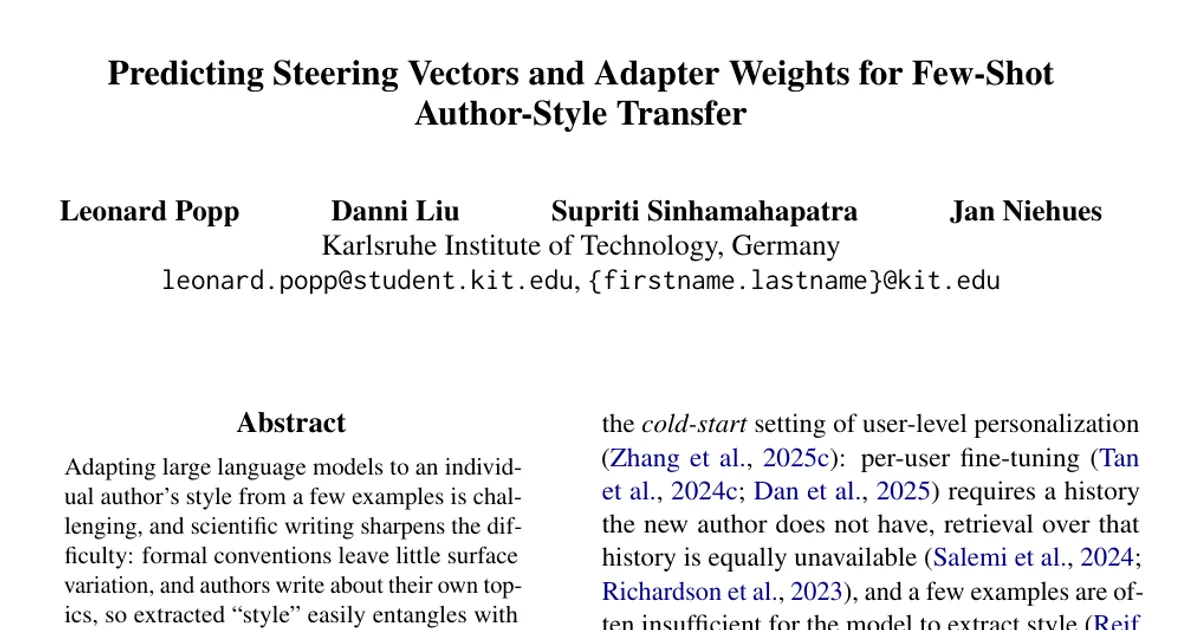
Adapting large language models to an individual author's style from a few examples is challenging, and scientific writing sharpens the difficulty: formal conventions leave little surface variation, and authors write about their own topics, so extracted ``style'' easily entangles with content. We study style-conditioned abstract generation from a few example abstracts per author and propose three methods: (1) contrastive activation steering, (2) a network that predicts steering vectors, and (3) a hypernetwork that predicts LoRA adapters. We find a consistent trade-off between style imitation and output quality: fine-tuning buys most of the available style signal but forfeits fluency, while the hypernetwork achieves the best trade-off on both seen and unseen authors. Our steering operates at author level, contrasting an author's abstracts against style-neutral generations for the same content. This holds topic fixed, removes the need for a predefined style inventory, and outperforms inventory-based steering. % [EDIT 1a] softened "no single optimal axis" claim Moreover, our analyses demonstrate that manually extracted and predicted steering vectors are near-orthogonal yet score comparably, indicating that style conditioning here can admit at least two unrelated directions rather than requiring one particular axis.