Research
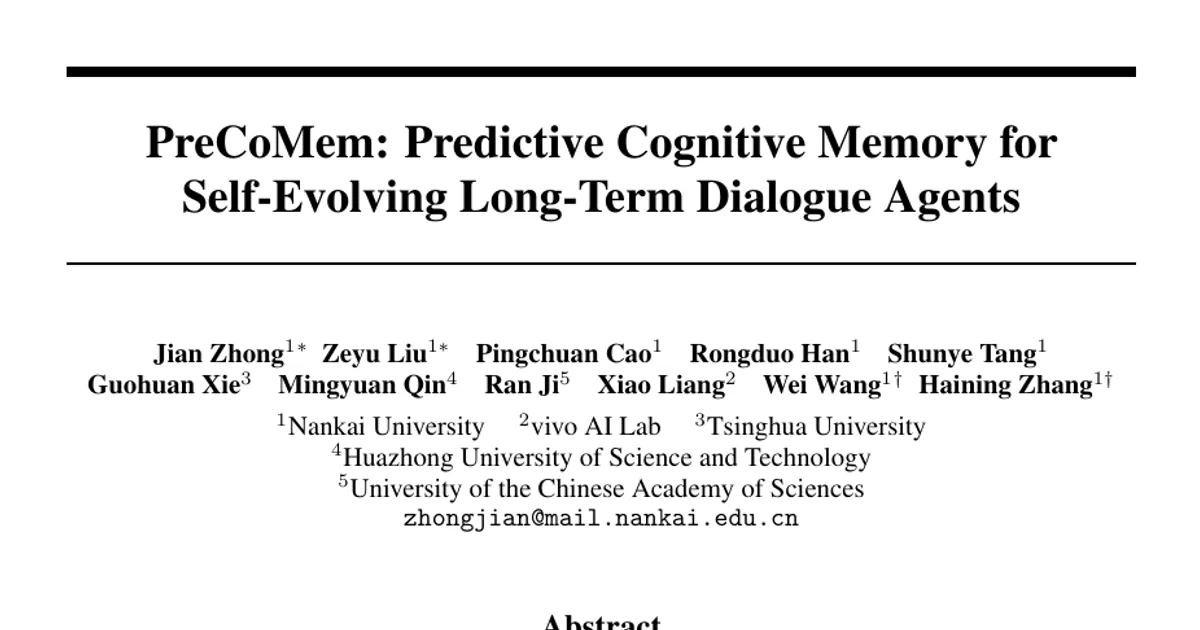
PreCoMem: Predictive Cognitive Memory for Self-Evolving Long-Term Dialogue Agents
Overview Research area: Long-term memory for LLM-based conversational agents (dialogue personalization, memory consolidation, continual adaptation). Technical level: Advanced — the paper leans on a fo
- arXiv
- 2610.29467
- Published
- 2026-10-21
- Authors
- Jian Zhong, Zeyu Liu, Pingchuan Cao, Rongduo Han, Shunye Tang, Guohuan Xie, Mingyuan Qin, Ran Ji, Xiao Liang, Wei Wang, Haining Zhang
AI summary
Overview
Research area: Long-term memory for LLM-based conversational agents (dialogue personalization, memory consolidation, continual adaptation).
Technical level: Advanced — the paper leans on a formal notation (belief stores, entropy-based reliability, closed-form confidence updates) and assumes familiarity with retrieval-augmented LLM agents. The core intuition, however, is explainable in plain terms.
Scope (one sentence): The paper proposes PreCoMem, a memory framework that decides when to reinforce, buffer, or correct a stored belief about a user, using a reliability-weighted "surprisal" signal rather than append-or-overwrite heuristics, and evaluates it on LoCoMo, LongMemEval-S, PersonaMem-v2, and a new drift benchmark called DiMoBench.
What This Paper Is About
Long-horizon dialogue agents must keep a stable model of the user (preferences, goals, life context) while still adapting when the user genuinely changes. Existing memory systems mostly append every observation or overwrite old entries with fixed heuristics, which makes it hard to tell transient noise apart from real belief drift — leading either to premature correction or to stubborn reliance on outdated memories (the authors call this "old-memory pull"). The goal is a consolidation mechanism that separates these cases without supervision, so the agent stays consistent under noise but does not freeze when the user actually changes.
Key Contributions
-
PreCoMem, a memory-consolidation framework that treats long-term memory as a dynamic, confidence-weighted prediction of the user's state rather than a transcript or a key-value store. Memory is split into an editable Belief Store of FACT/HYPOTHESIS nodes with continuous weights in [0,1], an immutable Episodic Cache for provenance, and an optional topic table used only as a retrieval prior.
-
A reliability-weighted surprisal signal ("Effective Surprisal") that gates every update. It combines semantic deviation and verifier-based contradiction evidence, then multiplies by a retrieval-reliability coefficient ρ derived from the entropy of Top-K retrieval scores, so the system becomes conservative when recall is diffuse.
-
A three-way two-threshold gate (MAINTAIN / PROFILE / CORRECT) with deterministic closed-form confidence updates. PROFILE acts as an explicit "waiting room" that stores ambiguous cues as low-confidence hypotheses (initial weight bands of [0.60, 0.70] for explicit events and [0.50, 0.59] for latent inferences) that must accumulate support to reach the promotion threshold τ_promote = 0.80.
-
DiMoBench and DiMoBench-XL, a controlled benchmark suite for implicit belief drift: five independent 350-turn dialogues with 200 QA pairs each (1,000 total), and an extended version with 1,050 turns, three sequential drifts, and 420 QA pairs each (2,100 total), with decoy retrieval and entity confounders.
Main Findings
-
Best overall accuracy on both main tabulated benchmarks. On LoCoMo, PreCoMem reaches 73.57 overall with gpt-4o-mini (+1.69 over the strongest baseline, TiMem at 71.88) and 85.06 with gpt-4.1 (+1.02 over TiMem at 84.04); both gaps exceed the reported cross-seed standard deviations. On LongMemEval-S with gpt-4.1 it reaches 89.39 (+3.23 over EverMemOS at 86.16), and 84.28 with gpt-4o-mini (+1.96, reported in the appendix).
-
Gains concentrate where memory must be updated or aggregated. On LongMemEval-S the largest improvements are SSP single-session preference (+9.24 over O-Mem), KU knowledge update (+4.75 over O-Mem; every KU question carries an old value superseded by a newer one), SSA (+3.96), and MS multi-session aggregation (+3.55). On LoCoMo the gain concentrates on Open-Domain (48.23 under gpt-4.1, +1.30 over MemOS), while baselines retain narrow leads on Single-Hop, Multi-Hop, and Temporal under gpt-4.1.
-
PersonaMem-v2 results. Under gpt-4.1, PreCoMem reaches 72.31 Open-Ended at 32k and 67.84 at 128k, which is +3.37 and +2.89 over EverMemOS. The lead is largest on anti-stereotypical, dynamic, and ownership-disambiguation categories, and shrinks to under two points on stereotypical or static cues.
-
Memory construction can be delegated to a smaller backbone. Across all twelve comparisons in Figure 3(a)–(d), keeping the answer model fixed but building memory with PreCoMem on a one-tier-smaller backbone still beats the larger backbone's native O-Mem memory.
-
Results hold on two benchmarks the authors did not design. On AMemGym, 0.458 Overall / 0.329 normalized Memory versus 0.430 / 0.296 for the strongest system reported there; on LoCoMo-Plus, 22.4 versus 21.05 for full-context GPT-4o.
-
Ablations show all three components matter. On LoCoMo, zeroing the surprisal gate collapses accuracy from 73.57 to 31.46 (every turn routed to MAINTAIN), removing confidence weighting drops it to 43.42, and removing the reliability adjustment drops it to 56.81. Letting an LLM emit the whole write decision end-to-end instead of bounded scalars costs 2.75 / 3.15 points on LoCoMo / LongMemEval-S and raises cross-seed standard deviation 20× on LoCoMo.
-
Fast recovery from drift on DiMoBench. After the change point, PreCoMem drops transiently but recovers fastest and stabilizes at 84%, while EverMemOS, TiMem, and O-Mem plateau at 78–80% and Mem0 fails to recover (54%).
-
The three operators play distinct roles (operator ablation). Removing PROFILE caps the asymptote at 72% (vs. 84%); removing CORRECT delays recovery (turn 320 vs. 250) and lowers the plateau to 77%; removing MAINTAIN fails to stabilize (54% at the end).
-
Storage grows linearly but "effective" memory stays flat. Raw item count rises roughly linearly, while the confidence-weighted total N_eff saturates by turn 200 at 25.8–28.5 on the representative persona (other personas within ±1.4), and deprecated facts occupy only 1.0% of Top-10 slots even after 1,050 turns and three drifts. On LoCoMo's ten dialogues (mean 588 turns), the default configuration ends with 287 raw items / 95.7 effective vs. 232 for O-Mem and 264 for EverMemOS, while the optional w < 0.05 pruning variant stores 168 items and still leads by +2.6 and +3.4 overall points.
-
Retrieval budget peaks at k = 10. Accuracy rises sharply through k ≈ 6, peaks at k = 10 (85.06% on LoCoMo with gpt-4.1), then drops mildly; larger k flattens the Top-k score distribution, lowering ρ and dampening effective surprisal.
Methodology in Plain English
The design starts from predictive coding: learning is driven by the mismatch between what you expect and what you observe, a quantity information theory calls surprisal. PreCoMem applies that idea to a user model made of small, actionable claims ("beliefs") such as preferences, goals, and life facts, each carrying a confidence value between 0 and 1.
Each turn runs a read–write loop. On the read side, the agent retrieves the top-K beliefs using a score that multiplies three retrieval signals (semantic similarity, BM25 lexical overlap, and topic relevance, weighted 0.4/0.4/0.2) by the belief's own confidence — so tentative hypotheses naturally rank below committed facts and act as an implicit reranker. On the write side, it computes how much the new user utterance deviates from recalled evidence (a blend of semantic deviation and a contradiction score from a verifier), then multiplies that by a reliability coefficient derived from how concentrated the retrieval scores are. If retrieval is spread across many near-equal candidates, the signal is down-weighted, because a mismatch against uncertain evidence is not trustworthy.
That final number is compared against two fixed thresholds (0.2 and 0.6). Below the low threshold, the turn is treated as consistent: MAINTAIN reinforces the supported beliefs, nudging their confidence upward proportionally to a strength score. Between the thresholds, the turn is ambiguous: PROFILE does not overwrite anything but writes a new low-confidence hypothesis, with an initial confidence inside a class-specific band capped well below the promotion threshold, and a slow decay applied to hypotheses that stop receiving support. Above the high threshold, the turn is reliably contradictory: CORRECT records the new observation as a fresh fact (initial weight 0.85) and softly decays only the beliefs the correct-agent flags as contradicted, rather than deleting them. Contradicted facts are therefore not demoted or erased; they sink in confidence and fall out of the top-K ranking on their own, while remaining available as provenance.
A deliberate division of labor keeps the system reproducible: a fixed-prompt LLM sub-agent only identifies relevant items and emits one bounded scalar (evidence strength, contradiction severity, or initial confidence), while a deterministic layer plugs those scalars into the closed-form update equations. The LLM proposes magnitudes; the gate and the confidence arithmetic control when and how much memory changes.
Evaluation uses an LLM-as-a-judge protocol from MemOS: a primary gpt-4.1-mini judge plus two gemini-2.5-flash judges with distinct prompts, blinded, with accuracy averaged over the three binary judgments. All methods share the backbone (gpt-4.1 or gpt-4o-mini) and the Qwen3-Embedding-0.6B embedding model, and baselines are run in their officially recommended configurations.
Why This Matters
Impact on research. The paper reframes long-term memory as a control problem over belief state rather than a storage-and-retrieval problem, and gives the write path a principled, entropy-adjusted signal. It also names and operationalizes a failure mode — old-memory pull — that is analogous to loss of plasticity in continual learning, and contributes a diagnostic benchmark (DiMoBench) specifically for non-stationary belief drift rather than static recall. The finding that a stronger memory mechanism on a smaller backbone can beat a larger backbone's native memory is directly relevant to how the field allocates model capacity.
Real-world applications (as suggested by the problem setting):
- Personalized assistants and companions that interact over hundreds or thousands of turns and must track shifting user preferences without flip-flopping on noisy remarks.
- Customer-support and account-management agents that must honor the most recent value a user stated (the knowledge-update setting) while remaining consistent about unchanged details.
- Health, coaching, or lifestyle agents where habits change gradually and single off-hand comments should not rewrite the user profile.
- Enterprise assistants with per-user profiles where storage must stay bounded as interaction history grows, and where auditability (provenance back to raw dialogue) matters.
Industry relevance. The system is implemented entirely on commodity components (gpt-4.1 / gpt-4o-mini plus a 0.6B embedding model) and keeps bounded token usage (3.1k–3.8k average response-model input tokens per query on the main table, comparable to baselines). The demonstration that effective memory plateaus while raw storage grows linearly addresses a direct operational cost concern for deployed long-lived agents; the paper does not report absolute latency in the main text, pointing instead to an appendix retrieval-latency profile.
Future Directions
-
Combining the write path with stronger read-path designs. Under gpt-4.1 on LoCoMo, EverMemOS, O-Mem, and TiMem still hold narrow leads on Single-Hop, Multi-Hop, and Temporal, which the authors attribute to their dedicated read-path designs. A natural next step is to pair PreCoMem's consolidation with those retrieval mechanisms rather than treating them as competing approaches.
-
Replacing fixed thresholds with learned or adaptive ones. The main experiments fix (θ_low, θ_high) = (0.2, 0.6) for reproducibility and reference an adaptive dynamic-threshold variant and cost-sensitive break-even derivation in the appendix; whether thresholds can be learned per user or per domain remains open.
-
Robustness beyond the tested horizons and domains. DiMoBench-XL covers 1,050 turns and three drifts; extending to much longer horizons, many more drift events, and multi-user or group conversations is untested in the reported results.
-
Pruning and provenance policy. The default keeps deprecated facts as provenance hooks while an optional w < 0.05 pruning variant matches it within seed variance; when to permanently forget versus retain deprecated evidence — and how forgetting interacts with traits that later resurface — is left as a design trade-off rather than a settled answer.
Target Audience
Researchers and engineers working on LLM agents with persistent memory, personalization, and continual adaptation will get the most from this paper, particularly those building retrieval-and-write pipelines who need a principled alternative to append-or-overwrite heuristics. It is also useful for evaluation-focused readers, since the DiMoBench construction (gradual drift, keyword-matched chatter, entity confounders) is a reusable template for stress-testing memory systems. Readers without a background in retrieval-augmented agents or probabilistic notation should expect a steep climb through Sections 2.3–2.4, though the three-operator intuition (reinforce / wait / correct) is accessible on its own.
Authors’ abstract
Long-horizon dialogue agents need to keep user memories stable enough for personalization while adapting when the user genuinely changes. Existing memory systems often append every observation or overwrite old entries by heuristic rules, which makes transient noise hard to distinguish from real belief drift. We introduce PreCoMem, a memory consolidation framework inspired by predictive coding that represents memory as confidence-weighted beliefs about the user's state. Its core signal, Effective Surprisal, combines semantic deviation and contradiction evidence, then downweights this signal when retrieval is diffuse and unreliable. According to effective surprisal, a two-threshold gate maps each turn to one of three deterministic updates: MAINTAIN reinforces supported beliefs, PROFILE stores ambiguous cues as low-confidence hypotheses, and CORRECT softly decays reliably contradicted facts. The PROFILE stage acts as an explicit waiting room, preventing premature commitment to noisy evidence. Experiments on LoCoMo, LongMemEval-S, and PersonaMem-v2 show consistent state-of-the-art accuracy; our new DiMoBench confirms that PreCoMem adapts to non-stationary belief drift without over-reacting to noise. The code is available at https://github.com/ZhongWishing/PreCoMem.