Research
PonderPounce: A Pretrained MLLM as an Episode Context Engine for Robot Control
Overview Research area: Robotics — memory-dependent robot manipulation, vision-language-action (VLA) models, and multimodal large language models (MLLMs) used as episode memory. Technical level: Advan
- arXiv
- 2608.24115
- Published
- 2026-08-25
- Authors
- Suhwan Choi, Jaeyoon Jung, Sungkyung Kim, Yunsung Lee, Youngjae Yu
AI summary
Overview
Research area: Robotics — memory-dependent robot manipulation, vision-language-action (VLA) models, and multimodal large language models (MLLMs) used as episode memory.
Technical level: Advanced. The paper assumes familiarity with VLA policy training, transformer KV caching, flow-matching action heads, and asynchronous dual-system control.
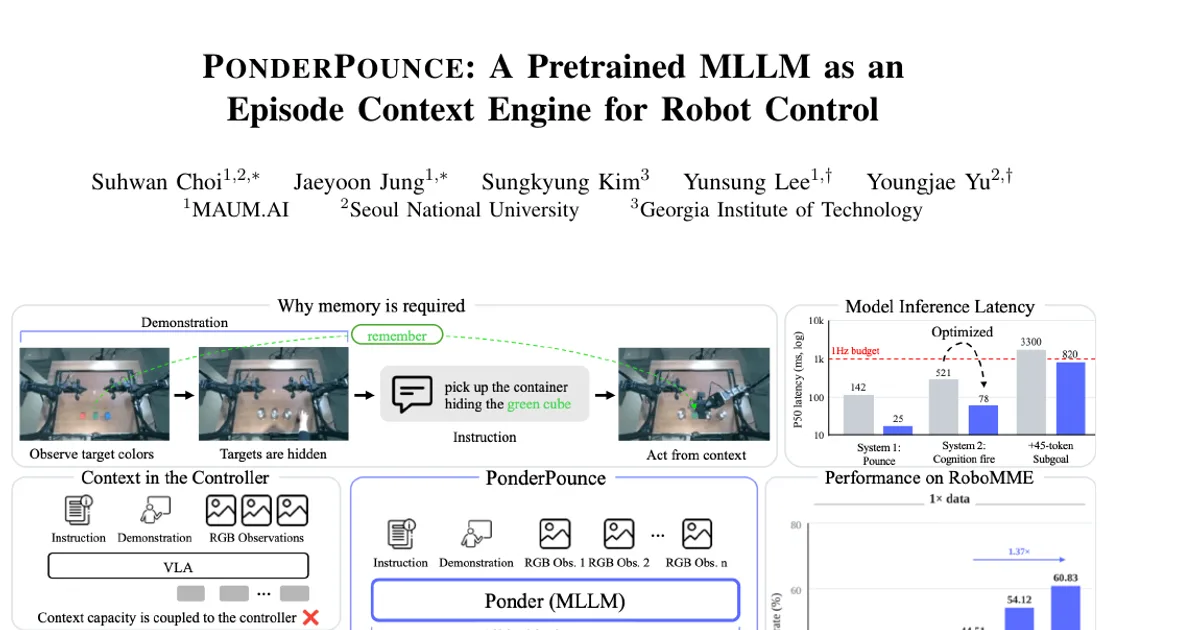
Scope: The paper proposes PonderPounce, a two-model system in which a pretrained MLLM ("Ponder", System 2) holds episode history and demonstrations in its native causal context and emits continuous "cognition" vectors to an action model ("Pounce", System 1) on an independent clock, and it evaluates this design on RoboMME, RoboCasa-DC, and four real-robot tasks.
What This Paper Is About
Robot manipulation often needs evidence that is not in the current camera frame: an object that became occluded, an earlier event, a referent, or a demonstrated procedure. Vision-language-action models typically carry over pretrained representations but do not use an MLLM's long causal context as episode memory; existing work instead builds purpose-made memory buffers, retrieval modules, or planning mechanisms. The paper asks whether a pretrained MLLM's own causal context can serve as the episode context engine while a separate action model handles control, and it answers this with a jointly trained, asynchronous dual-system architecture.
Key Contributions
-
A pretrained MLLM as an episode context engine. Ponder reuses native causal context to retain execution history and demonstrations, without a purpose-built memory module.
-
A scalable asynchronous context-to-control interface. Ponder sends continuous cognition and its age to Pounce on independent clocks. The two systems are jointly trained end to end without separate bridge pretraining, and their fixed interface allows Ponder to scale without changing the Pounce architecture.
-
An investigation of context use in robot control. Controlled experiments and ablations on RoboMME examine how execution history, transmitted cognition, model scale, and supervision affect control, while cognition-refresh interventions assess dependence on timely cognition.
-
Cross-embodiment and real-robot evaluation. RoboCasa-DC and four real-robot tasks assess applicability across action-model backbones and beyond simulation.
Main Findings
-
RoboMME base and 9× data: PonderPounce reaches 60.83% average success at the base data scale and 75.54% with 9× data, versus 44.51% and 57.88% for FrameSamp+Modul. That is a 16.32 pp margin at base scale and 17.66 pp with matched data. With 9× data, success rises by 14.71 pp over the base run.
-
Baselines without learned episode memory: π0.5 reaches 17.93% without history and 19.73% with past actions, versus 90.50% for humans. Other reported baselines include SAM2Act+ (21.37%), SimpleSG+QwenVL (29.00%), GroundSG+QwenVL (32.70%), and MemER (42.38%).
-
Execution history matters under matched supervision: A separately trained current-observation-only control with the same 9B Ponder, π0.5 Pounce, 1× dataset, and transition/subgoal/demo-reasoning supervision scores 26.21%, versus 60.83% with full history. The paper states this comparison does not isolate the individual contributions of past images, generated text, and cognition.
-
Supervision ablation: Removing demonstration-reasoning targets while keeping transition and subgoal supervision reduces success from 60.83% to 48.21%, still above MemER (42.38%) and FrameSamp+Modul (44.51%). Removing all LM-head grounding reduces success to 27.96%, below all four baselines.
-
Scale of the context engine: Scaling Ponder from 0.8B to 9B adds 6.71 pp (54.12% to 60.83%) while the Pounce architecture and interface are unchanged. A randomly initialized 9B Ponder scores 0.00% with the same recipe.
-
Family-level pattern: PonderPounce leads on Permanence and Reference at both scales, exceeding FrameSamp+Modul by 55.67 and 34.67 pp respectively at 9× scale. FrameSamp+Modul remains stronger on Imitation and 9× Counting. In PatternLock, the authors observed path deviations when subgoal updates lagged under 1 Hz inference.
-
Continuous cognition versus subgoal text: A separately trained Ponder passing generated subgoal text to a subgoal-conditioned π0.5 reaches 59.96%, versus 60.83% for continuous cognition. The continuous interface propagates action-loss gradients into Ponder and makes updated context available after every Ponder query, including within a subgoal.
-
Cognition refresh: With transition-only delivery (Ponder still runs every query), success falls from 60.83% to 1.83% when age is fixed at 300 ms, and recovers to 22.42% with true age. The authors interpret this as Pounce treating outdated execution context as current when held cognition is presented as fresh.
-
Offline staleness: On 757 held-out ticks from 80 task-balanced RoboMME episodes, normalized loss for the 1 s-refresh checkpoint rises from 1.00× at 0.3 s to 7.11× at 2.3 s and 9.22× at 4.3 s. Training with 2 s and 4 s refresh intervals lowers the 4.3 s ratios to 3.19× and 1.14×, but raises fresh-cognition (0.3 s) absolute loss from 0.117 to 0.213 and 0.232. The paper states these offline losses do not directly predict closed-loop success.
-
RoboCasa-DC: PonderPounce reaches 12.5% ± 0.9, versus 11.6% for SeeTraceAct, 11.2% for UniSkill, 8.8% for Vid2Robot, and 8.0% for ViVLA. Replacing cognition with the learned null state at inference lowers success to 8.6% ± 0.4 for the same checkpoint.
-
Real robot: Across four tasks under wall-clock asynchronous execution, PonderPounce achieves 60.98% mean success versus 40.67% for FrameSamp+Modul and 23.99% for π0.5. Per-task: PutFruits 11/14 (79%), TrackCube 10/16 (63%), RepickBlock 6/14 (43%), DrawPattern 9/15 (60%). It ties FrameSamp+Modul on DrawPattern (9/15) and shows its largest gain on TrackCube (from 5/16 to 10/16).
-
Inference latency: On a single H100 (bf16, batch 1), optimized per-call p50 is 78 ms for cognition-only refresh and 25 ms for action-model invocation. Across context lengths from 0.8K to 14K tokens, p95 is 93.7 ms for cognition-only refreshes and 871.1 ms for forced 45-token subgoal decodes. Fused Triton kernels reduce Pounce p50 from 142 ms to 25 ms (5.7×). Unoptimized rates of 7.1 Hz and 1.9 Hz become 40 Hz and 12.8 Hz; the 45-token subgoal case goes from 3.3 s (0.31 Hz, marked below target) to 0.82 s (1.2 Hz).
Methodology in Plain English
The system splits the job in two. Ponder is a pretrained MLLM (Qwen3.5-9B) that keeps an append-only record of the instruction, any demonstrations, its own generated subgoal text and demonstration reasoning, and earlier cognition carriers. At each query it appends the newest observation and K carrier tokens; the final hidden states of those carriers become the continuous "cognition" vector, with no decoding or pooling. Optional LM-head grounding lets it predict yes/no transition tokens and generate subgoal text, and for demonstration episodes with reasoning annotations it emits a demonstration-reasoning token once at the first execution transition.
Pounce is an action model (π0.5 3.6B on RoboMME, GR00T N1.5 3B on RoboCasa-DC). It receives the instruction, current observation, and optionally proprioception, plus a projected prefix containing the newest ready cognition and its age. If nothing is ready, it uses a learned null cognition with age zero. Only cognition and age cross the default interface. The action head predicts an h-step action chunk.
The two run on independent clocks. Pounce keeps predicting while Ponder processes new observations, and a latest-ready rule selects the most recent cognition whose computation has finished, with age measured from the source observation.
Training initializes both systems from pretrained checkpoints and jointly optimizes all trainable parts end to end, with no separate bridge pretraining. The loss combines action flow-matching MSE with token cross-entropy for grounding targets. Flow-matching gradients reach Ponder only through cognition, and those action gradients are multiplied by 0.5 into Ponder to limit co-training shortcuts; LM-head gradients are unchanged. When no grounding annotations exist, that loss weight is set to zero.
For inference, append-only StaticCache sessions keep a preallocated transformer KV cache so each call encodes only newly appended tokens, with Ponder's context limit set to 16K tokens. Ponder uses no torch.compile in the real-robot setting and Pounce runs eagerly without fused kernels there.
Evaluation uses RoboMME (16 tasks across Counting, Permanence, Reference, Imitation; 1,587 base training episodes and 14,400 fresh oracle episodes at 9× scale; three evaluations of 50 episodes per task; 1,300-step cap) and RoboCasa-DC in its Category-Balanced / Cross-Embodiment Demonstration setting (19 training and five held-out tasks; roughly 100 demonstration–execution pairs per task giving 1,900 training and 500 held-out pairs; five evaluations of 50 episodes per held-out task; 1,000-step cap). The real-robot study uses a Trossen ALOHA Stationary AI Kit with only the right arm, 710 teleoperated episodes, 59 held-out scenes, 30-step action chunks, and a 2-minute trial limit with human judging.
Why This Matters
Impact on research. The paper offers a different answer to the memory problem in robot learning: rather than building a memory module, reuse the causal context that a pretrained MLLM already has, and keep that context off the fast action path. The matched-history control (60.83% versus 26.21%) and the scale result (6.71 pp from 0.8B to 9B with the controller fixed) give evidence that accumulated context and context-engine scale contribute beyond supervision alone. The finding that a randomly initialized 9B Ponder scores 0.00% argues the recipe depends on pretraining.
Real-world applications.
- Tasks where a cue disappears before it must be acted on, such as pressing a button that briefly highlights target objects and then picking those objects.
- Tasks requiring an earlier observation to resolve the current referent, such as choosing the cup that hid a particular colored cube in an earlier video.
- Tasks that follow a demonstrated order or path, such as picking blocks in the order shown or reproducing a drawn pattern.
- Counting and sequencing tasks where the instruction specifies a number of objects to transfer before a stop condition.
Industry relevance. The reported numbers give a concrete latency budget story: at p50, 78 ms for cognition-only refresh and 25 ms for action invocation meet the stated 1 Hz per-call targets on an H100. The real-robot deployment reports per-task client tick rates of 22.9–27.8 Hz and non-null cognition ages with a median of 1,803 ms and p95 of 2,006 ms, which is the kind of timing detail that matters when deciding whether a slow context model can sit beside a fast controller. The authors also note that the context engine adds training and inference costs and that closed-loop robustness to additional delays remains untested.
Future Directions
- Matched-comparison memory research. The paper calls for comparing memory architectures under matched backbones, supervision, and training budgets, using history-component ablations and counterfactual episodes to isolate what execution history contributes.
- Representation probes. Understanding what cognition actually encodes, and how Pounce uses it, is left open.
- Deployment robustness. Controlled latency and jitter experiments, beyond the measured conditions, are needed to characterize robustness.
- Cheaper context and better labels. Adaptive cognition delivery and smaller or distilled context models could reduce computation while preserving control, and vision-language-generated or propagated labels could reduce annotation cost subject to label-quality validation. The authors also suggest that scaling soft-token learning may require longer, temporally coherent vision–action data with memory- and long-horizon-dependent behavior, with desktop and game interaction as complementary settings.
Target Audience
Robotics and embodied-AI researchers working on VLA models, episode memory, and long-horizon manipulation; engineers building dual-system or asynchronous robot control stacks; and readers interested in reusing pretrained MLLM context as a control-side representation rather than as a planner or a retrieval module. Readers wanting a beginner-level treatment should look elsewhere — the paper assumes fluency with transformer KV caching, flow-matching action heads, and benchmark evaluation protocol.
Authors’ abstract
Multimodal large language models (MLLMs) can integrate long visual histories, reason under partial observability, and infer behavior from a few examples. Yet vision-language-action (VLA) models generally inherit pretrained representations without using this contextual capacity as episode memory. Memory-dependent policies address this gap through purpose-built history mechanisms. PonderPounce instead reuses an MLLM's native causal context as robot memory. Ponder, a System2 MLLM, accumulates episode observations, demonstrations, and prior cognition in its native causal context and can generate subgoal text and demonstration reasoning for internal use. Pounce, a System1 VLA, receives the current observation, instruction, and proprioception directly; through the Ponder--Pounce interface, it asynchronously receives only the newest continuous cognition token and its age. Both are jointly trained end to end without a purpose-built memory module or separate bridge pretraining. Optimized serving achieves p50 latencies of 78ms for cognition refresh and 25ms for action-model invocation, supporting 20Hz action playback. On RoboMME with base-scale training data, PonderPounce reaches 60.83% with 9B and 50.04% with 0.8B under the same Pounce architecture and interface, versus 44.51% for FrameSamp+Modul and 17.93% for the current-observation π_{0.5}. With 9x data, it reaches 75.54% versus 57.88% for FrameSamp+Modul. On RoboCasa-DC, the same interface learns from action supervision alone and reaches 12.5% versus 11.6% for the strongest published demonstration-conditioned baseline, falling to 8.6% when cognition is replaced by a learned null state.