Research
Perceive, Act and Correct: Confidence Is Not Enough for Hyperspectral Classification
Overview Research area: Computer vision for remote sensing — specifically semi-supervised hyperspectral image (HSI) classification, with a focus on uncertainty estimation from evidential deep learning
- arXiv
- 2511.10068
- Published
- 2025-11-13
- Authors
- Muzhou Yang, Wuzhou Quan, Mingqiang Wei
AI summary
Overview
Research area: Computer vision for remote sensing — specifically semi-supervised hyperspectral image (HSI) classification, with a focus on uncertainty estimation from evidential deep learning.
Technical level: Advanced. The paper builds on Dirichlet-based evidential deep learning, epistemic uncertainty estimation, semi-supervised pseudo-labeling, and CNN/Transformer HSI backbones.
Scope: The paper proposes CABIN, a model-agnostic semi-supervised framework that uses estimated epistemic uncertainty to drive sample selection and to triage pseudo-labels, and evaluates it on five hyperspectral benchmarks across four state-of-the-art backbones.
What This Paper Is About
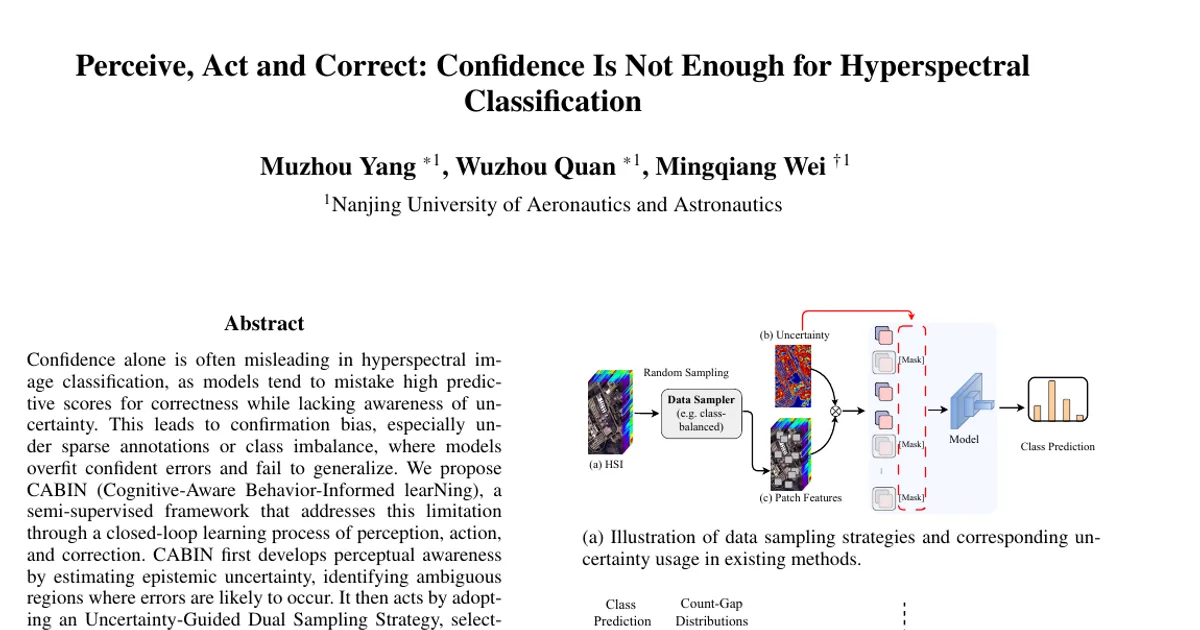
Hyperspectral classifiers tend to treat high confidence as proof of correctness, even when a pixel is a mixture of materials or sits on an ambiguous class boundary. This leads to confirmation bias: the model reinforces its own confident mistakes, especially under sparse annotations or class imbalance, and generalization suffers. The goal of this paper is to make uncertainty an active driver of learning behavior — deciding what to explore, what to trust, and what to discard — rather than a passive by-product of prediction.
Key Contributions
- CABIN framework. A semi-supervised, uncertainty-guided framework that forms a closed loop of perception (epistemic uncertainty estimation), action (sample selection), and correction (pseudo-label triage). It is presented as model-agnostic and plug-and-play.
- UGDSS (Uncertainty-Guided Dual Sampling Strategy). A dual-path sampling strategy that uses epistemic uncertainty to split candidates into a high-uncertainty subset for exploration and a low-uncertainty subset for stable pseudo-labeling. It includes an adaptive histogram-based threshold, Diverse-Representative Query Selection (DRQS) via K-means++ over feature embeddings, and Uncertainty-Guided Gaussian Feature Perturbation (GFP).
- FDAS (Fine-Grained Dynamic Assignment Strategy). A pseudo-label triage mechanism built on a new Uncertainty-Gap metric (UG_alpha), defined as the gap between the largest and second-largest exponentially moving-averaged evidence values. It partitions pseudo-labeled data into reliable, ambiguous, and noisy subsets and applies EDL loss, Generalized Cross Entropy (GCE) loss, or discards them, respectively.
- Empirical validation. CABIN is integrated into four state-of-the-art classifiers (CNN-based ReS² and CLOLN; Transformer-based SSFTT and GSC-ViT) across five datasets, with reported gains while using fewer labeled samples.
Main Findings
- Indian Pines gains with fewer labels. Under the SSFTT baseline, CABIN raises Overall Accuracy (OA) from 87.35% to 90.08% and Kappa (×100) from 85.48 to 88.66. For ReS², OA improves by +7.69 points (79.70 to 87.39); for CLOLN by +0.92 (83.77 to 84.69); for GSC-ViT by +2.76 (84.64 to 87.40). These results are achieved with 240 samples rather than the 320 (20 per class) used by the other methods.
- Consistent gains across datasets and backbones. Salinas OA: ReS² +1.06, CLOLN +1.92, SSFTT +1.51, GSC-ViT +1.47. PaviaU OA: +2.43, +1.16, +1.87, +1.92 respectively. LongKou OA: +0.74, +1.02, +1.09, +0.55. HongHu OA: +0.5, +2.44, +1.07, +0.49, with the largest single improvement being CLOLN's +2.44% OA on HongHu.
- Reported trade-offs. SSFTT's Average Accuracy on Pavia University drops by 0.92 points, and GSC-ViT's AA on HongHu drops by 0.82 points. GSC-ViT's AA on LongKou drops 1.05 points.
- Both modules contribute, and they are complementary. On Indian Pines under SSFTT, UGDSS alone raises OA from 87.35% to 89.80% and FDAS alone to 88.87%; using both reaches 90.08% OA and Kappa 88.66. On Salinas, using both raises OA from 96.00% to 97.51% and Kappa from 95.55 to 97.23.
- Peak performance at 50% of the annotations. In the annotation-ratio study (Indian Pines and Salinas), performance peaks at a 50% ratio (90.08% OA on Indian Pines, 97.51% on Salinas). At 75% and 100%, performance is slightly lower (89.01% and 89.15% on Indian Pines), which the authors attribute to redundant or noisy supervision. Note that the paper's introduction also states results "using only half of the original training labels" and "25% fewer labeled samples," while the contribution list phrases this as "as little as 75% of the original annotations."
- Perturbation count matters and is dataset-dependent. For the number of augmented samples, OA and Kappa on Indian Pines are best at 5, but the authors report the overall balance is better at 6; on Salinas, performance peaks at 4.
- UG_alpha separates sample difficulty where confidence does not. During training, softmax confidence saturates near 1.0, while UG_alpha progressively separates easy from ambiguous/noisy samples: by Epoch 50 easy samples begin to emerge, and by Epoch 99 a clear boundary forms between high-UG (reliable) and low-UG (ambiguous/noisy) instances.
- DRQS reduces spatial redundancy. Visualizations show purely uncertainty-based sampling forms dense, redundant clusters in locally correlated regions, whereas DRQS-selected samples are more spatially dispersed while still covering key uncertainty regions.
- GFP keeps augmented features within class boundaries. t-SNE visualizations indicate augmented features do not cross category boundaries, which the authors link to improved feature consistency and intra-class compactness.
- Runtime reported. Training times increase with CABIN. For SSFTT, Indian Pines goes from 17.49 s to 24.21 s; HongHu from 22.66 s to 36.69 s. For GSC-ViT, LongKou goes from 16.24 s to 20.15 s and HongHu from 44.13 s to 56.52 s. The introduction describes "virtually no additional computational costs," while the appendix reports these higher wall-clock times.
Methodology in Plain English
The method treats a classifier as something that should know what it does not know. Using evidential deep learning, the model outputs a non-negative evidence vector per sample; adding one gives Dirichlet parameters, class probabilities are the mean of that Dirichlet, and epistemic uncertainty is computed as the number of classes divided by the total evidence. To reduce the sensitivity of this estimate, each input is passed through several spectral-spatial random transforms and the uncertainty outputs are averaged.
That uncertainty then drives two behaviors. First, an adaptive threshold derived from the first local minimum of a histogram of uncertainty values splits unlabeled candidates into a high-uncertainty group and a low-uncertainty group. The high-uncertainty group is refined by clustering its feature embeddings with K-means++ and picking the sample nearest each cluster centroid, which avoids redundant picks; those samples are then augmented by injecting Gaussian noise whose strength scales with their uncertainty, with values clamped to their original dynamic range. The low-uncertainty group is treated as candidate pseudo-labels.
Second, pseudo-labels are triaged. For each one, the method computes behavioral confidence (maximum predicted probability) and the Uncertainty-Gap, a smoothed measure of how far the top evidence value is above the second. Samples that are confident and well separated in evidence get the standard evidential loss; samples that are confident but evidence-ambiguous get the noise-robust Generalized Cross Entropy loss (with q set to 0.7); samples low on both are discarded. Both thresholds are updated by exponential moving average, so the criteria track the model's evolving state. The total objective combines the evidential loss on labeled and augmented data with weighted terms for the reliable and ambiguous subsets, where both balancing weights are set to 0.3.
The overall pipeline has three stages: pretrain on a small labeled subset, use UGDSS to select informative unlabeled samples for annotation, then retrain with the labeled set plus pseudo-labeled data under FDAS.
Why This Matters
Research impact. The paper challenges a widely used proxy in semi-supervised learning: static confidence thresholds (as in FixMatch) and historical consistency (as in CGMatch). It argues these are slow to adapt to a model's current cognitive state, and demonstrates that an evidential uncertainty gap can substitute for them as a selection and triage criterion. It also shows that this idea can be bolted onto existing supervised HSI classifiers rather than replacing them.
Real-world applications.
- Precision agriculture: crop-type mapping from UAV hyperspectral imagery, where the WHU-Hi-HongHu dataset covers 22 crop classes with high intra-class variability, and LongKou covers 9 land-cover classes.
- Urban planning and land-cover inventory, using datasets such as Pavia University with 9 major semantic classes.
- Military reconnaissance and surveillance, cited by the authors as a primary application domain for fine-grained material and land-cover analysis.
- Environmental and resource monitoring, where hundreds of contiguous spectral bands are used to identify material composition at pixel level.
Industry relevance. Labeling hyperspectral pixels is expensive and requires expert annotation. A framework that reaches peak accuracy with half the annotations, and that supports progressive annotation workflows (pretrain, then selectively label only the most informative samples), has direct cost implications for remote-sensing service providers. The model-agnostic design means it can be applied on top of existing deployed backbones, though the appendix reports that training times do increase.
Benchmarks used. Indian Pines (145×145 pixels, 224 bands, 24 water absorption bands removed leaving 200 usable bands, 16 classes), Salinas (512×217 pixels, 3.7 m resolution, 224 bands, 20 bands removed leaving 204, 16 classes, 54,129 labeled pixels), Pavia University (103 bands, 610×340 pixels, 9 classes), WHU-Hi-LongKou (550×400 pixels, 270 bands spanning 400–1000 nm, roughly 0.463 m resolution, 9 classes, 204,542 labeled pixels), and WHU-Hi-HongHu (940×475 pixels, 270 bands, roughly 0.04 m resolution, 22 crop classes). Evaluation uses Overall Accuracy, Average Accuracy, and Cohen's Kappa. Preprocessing includes PCA retaining the top 30 principal components, and the standard protocol uses 20 samples per class for training, 20 for validation, and the remainder for testing.
Future Directions
- Adaptive control of perturbation strength. The augmentation count that works best varies by dataset (5 and 6 on Indian Pines, 4 on Salinas), and the authors note too much perturbation introduces noise. Automatically tuning this per dataset or per class remains open.
- Extending beyond HSI. Because CABIN is presented as model-agnostic and plug-and-play, testing it on other dense-prediction domains with ambiguous boundaries — medical imaging, segmentation of mixed-material scenes — is a natural next step.
- Closing the accuracy-versus-cost gap. The introduction claims virtually no additional computational cost, while the appendix reports longer training times. Reconciling this, for example by reducing the multi-transform uncertainty averaging or the K-means++ clustering overhead, is an unresolved engineering question.
- Revisiting the annotation-ratio result. Performance peaking at 50% of annotations and declining at 75% and 100% suggests the selection pool and the noise-handling thresholds interact in ways not yet fully characterized; the paper does not report a theoretical account of why extra labels hurt.
Target Audience
Researchers and graduate students working on hyperspectral remote sensing, semi-supervised learning, or uncertainty-aware deep learning will benefit most, along with practitioners who need to reduce annotation cost for spectral image classification. Readers should be comfortable with Dirichlet distributions, evidential deep learning, pseudo-labeling, and standard HSI benchmark protocols. Beginners can follow the high-level motivation — confidence is not correctness — but the method sections require intermediate-to-advanced background.
Note on provenance: the paper text identifies affiliation as Nanjing University of Aeronautics and Astronautics and lists code at https://github.com/Muzhou-Yang/CABIN. The supplementary material is marked "AAAI 2026 Supplementary Material Camera Ready." Mingqiang Wei is listed as corresponding author. Acknowledgement is given to the National Natural Science Foundation of China (No. T2322012, No. 62572240). Experiments are reported on a workstation with a single AMD EPYC 7K62 CPU and an NVIDIA A100 GPU, Ubuntu 24.04, CUDA 12.6, and PyTorch 2.7.1, using the AdamW optimizer, batch size 48, and 100 training epochs.
Authors’ abstract
Confidence alone is often misleading in hyperspectral image classification, as models tend to mistake high predictive scores for correctness while lacking awareness of uncertainty. This leads to confirmation bias, especially under sparse annotations or class imbalance, where models overfit confident errors and fail to generalize. We propose CABIN (Cognitive-Aware Behavior-Informed learNing), a semi-supervised framework that addresses this limitation through a closed-loop learning process of perception, action, and correction. CABIN first develops perceptual awareness by estimating epistemic uncertainty, identifying ambiguous regions where errors are likely to occur. It then acts by adopting an Uncertainty-Guided Dual Sampling Strategy, selecting uncertain samples for exploration while anchoring confident ones as stable pseudo-labels to reduce bias. To correct noisy supervision, CABIN introduces a Fine-Grained Dynamic Assignment Strategy that categorizes pseudo-labeled data into reliable, ambiguous, and noisy subsets, applying tailored losses to enhance generalization. Experimental results show that a wide range of state-of-the-art methods benefit from the integration of CABIN, with improved labeling efficiency and performance.