Research
ParalESN: Enabling parallel information processing in Reservoir Computing
Overview Research area: Reservoir Computing and sequence modeling — specifically efficient, parallelizable recurrent architectures that bridge classical Echo State Networks and modern State Space Mode
- arXiv
- 2601.22296
- Published
- 2026-01-29
- Authors
- Matteo Pinna, Giacomo Lagomarsini, Andrea Ceni, Claudio Gallicchio
AI summary
Overview
Research area: Reservoir Computing and sequence modeling — specifically efficient, parallelizable recurrent architectures that bridge classical Echo State Networks and modern State Space Models.
Technical level: Intermediate to Advanced. The paper assumes familiarity with reservoir computing, echo state property, state space models, and linear algebra (diagonalization, complex eigenvalues).
Scope: The paper introduces ParalESN, a class of untrained recurrent networks built on diagonal linear recurrence in the complex domain, and analyzes its theory, efficiency, and empirical performance against traditional reservoir computing and fully trainable sequence models.
What This Paper Is About
Reservoir Computing (RC) is efficient to train because only a linear readout is learned, but it inherits two hard limits from ordinary recurrent networks: input sequences must be processed one time step at a time, and making reservoirs high-dimensional requires dense matrices with prohibitive memory cost. The authors ask whether reservoir dynamics can be restructured so the recurrence itself is parallelizable, while preserving the theoretical guarantees (the Echo State Property and universality) that make Echo State Networks reliable.
Key Contributions
-
ParalESN architecture. A class of untrained RNNs whose reservoir uses a diagonal, complex-valued transition matrix, letting the recurrence be parallelized via associative scan. A shallow variant (ParalESN) and a deep variant (ParalESN (deep)) are both studied, with only the readout trained.
-
Memory-efficient parameterizations. The transition matrix is diagonal, the input weight matrix in layers after the first uses a fixed ring topology that only requires storing an N_h-dimensional vector of scaling coefficients, and the non-linear mixing layer uses a 1-D convolution kernel requiring only k + 1 parameters regardless of sequence length or hidden size.
-
Theoretical guarantees. A sufficient and necessary condition for the Echo State Property in diagonal linear reservoirs, a proof that arbitrary linear reservoirs admit an equivalent representation in complex diagonal form, and a universality result for the resulting model class in the family of fading memory filters.
-
Efficiency and accuracy evidence. Empirical results across memory, forecasting, time series classification, and pixel-level classification benchmarks, including comparisons not only with ESNs but with LSTM, Transformer, S4, LRU, and Mamba.
Main Findings
-
ESP condition is exact. A ParalESN has the Echo State Property if and only if every diagonal element λ_i of the effective transition matrix satisfies |λ_i| < 1, where the modulus is the complex modulus. Because the transition matrix is diagonal, the spectral radius can be controlled directly through the largest diagonal element in absolute value.
-
Equivalent expressivity to linear reservoirs. Proposition 4.2 states that with probability 1, for a linear-recurrence ESN with a 1-layer MLP readout and i.i.d. transition entries, there exists a ParalESN with MLP readout producing the same output for any given input. Theorem 4.3 concludes that the class of ParalESN models with the ESP and MLP readout is universal in the family of fading memory filters.
-
Logarithmic versus linear scaling. Figure 2 reports that ParalESN's recurrence time scales logarithmically with sequence length while traditional ESNs scale linearly. On sMNIST, traditional ESNs run out of memory at approximately 100K reservoir neurons, while ParalESN fits into memory.
-
Training speed. Across the regression benchmarks, ParalESN trains an entire order of magnitude faster than traditional ESNs, except on Lorenz25 and Lorenz50, where the relatively small sequence length reduces the benefit of parallelizing the recurrence. Even ParalESN (deep) trains faster than a single-layer traditional ESN.
-
Memory-based tasks (128 recurrent neurons). On MemCap (higher is better), ESN scores 50.6 ± 1.6 and ParalESN (deep) scores 125.0 ± 0.2. On ctXOR10 (lower is better), ESN (deep) scores 5.2 ± 1.0 (best) and ParalESN (deep) scores 5.6 ± 0.4. On SinMem10, ParalESN (deep) scores 1.0 ± 0.2 (best).
-
Forecasting tasks (128 recurrent neurons). ParalESN (deep) achieves the best result on Lz50 (29.4 ± 0.3), ETTh1 (8.8 ± 0.1), ETTm1 (6.5 ± 0.0, tied with ParalESN at 6.5 ± 0.1), and ETTm2 (5.0 ± 0.0), while ESN (deep) is best on Lz25 (9.7 ± 0.2), MG (2.0 ± 0.0), MG84 (4.2 ± 0.2), and N30 (10.1 ± 0.1).
-
Time series classification (1024 recurrent neurons). ParalESN improves over shallow ESN by +27.9% on Blink, +3.7% on FaultDetectionA, +7.6% on FordA, +5.7% on FordB, and +3.3% on StarLightCurves. ParalESN (deep) improves over ESN (deep) by +10.0% on Blink, +8.8% on FaultDetectionA, +2.7% on FordA, +0.7% on FordB, and +2.3% on StarLightCurves.
-
sMNIST and psMNIST. ParalESN achieves higher test accuracy than traditional ESN by +13.4% on sMNIST and +17.1% on psMNIST; ParalESN (deep) gains +7.7% and +13.1% over ESN (deep). Absolute accuracies at roughly 160K parameters: S4 99.2 ± 0.0 (best on sMNIST), LRU 98.5 ± 0.2, Transformer 98.4 ± 0.1, Mamba 98.4 ± 0.1, LSTM 97.5 ± 1.4, ParalESN (deep) 97.2 ± 0.2, ParalESN 96.2 ± 1.3, ESN (deep) 91.4 ± 1.1, ESN 82.5 ± 7. On psMNIST: S4 97.9 ± 0.0 (best), LRU 97.8 ± 0.1, Transformer 97.4 ± 0.2, ParalESN 96.9 ± 0.1, ParalESN (deep) 95.2 ± 0.1, LSTM 92.8 ± 0.5, Mamba 92.6 ± 0.1, ESN (deep) 82.1 ± 3.7, ESN 78.2 ± 1.6.
-
Cost metrics. On sMNIST, ParalESN trains in 2.7 ± 0.7 minutes with 0.01 ± 0.00 kg emissions and 0.04 ± 0.10 kWh energy, versus Transformer at 141.0 ± 14.1 minutes, 0.60 ± 0.28 kg, and 1.81 ± 0.86 kWh, and ESN at 4.3 ± 0.1 minutes. On psMNIST, ParalESN trains in 2.8 ± 0.3 minutes with 0.01 ± 0.00 kg emissions and 0.04 ± 0.00 kWh energy.
-
Aggregate ranking. The critical difference diagram computed via a Wilcoxon test shows ParalESN (deep) as the top-performing model on average, with no statistically significant difference in performance between ParalESN (deep) and ESN (deep), though the former is considerably more efficient. ParalESN (deep) outperforms its shallow counterpart by a statistically significant margin.
-
Reported caveats. The authors note that complex-valued arithmetic in PyTorch is generally not as optimized as real-valued arithmetic, so the efficiency advantage is measured under conservative conditions. They also flag that the computational efficiency metrics reported for S4 are likely underestimates because a different and more powerful GPU was used for that model due to hardware availability constraints.
Methodology in Plain English
The authors keep the reservoir computing recipe of fixing a recurrent system randomly and training only the output layer, but they change the recurrent system itself. Instead of a dense real-valued transition matrix, they use a diagonal matrix with complex-valued entries, so each hidden unit's state evolves independently. This makes the recurrence a linear operation that can be computed for all time steps at once using associative scan, rather than stepping through the sequence.
Two design choices recover the expressivity lost by making the matrix diagonal. First, a mixing layer applies a 1-D convolution (followed by a tanh non-linearity on the real part) across the hidden dimension, letting components interact. Second, the deep variant stacks blocks and connects them with a ring-topology input matrix that essentially shifts and rescales the previous block's output, using only one scaling coefficient per hidden unit. Eigenvalues are initialized with magnitudes drawn uniformly from a range and phases drawn uniformly from another range, giving direct control over stability and memory. Bias and input weights are sampled from uniform distributions and rescaled relative to the eigenvalue magnitude.
The theory side proceeds by writing the model as a linear recurrence with a non-linear output function, then showing that the standard spectral-radius condition is both necessary and sufficient in the diagonal case, and by diagonalizing an arbitrary linear reservoir to show ParalESN can reproduce it. Experiments compare against traditional shallow and deep ESNs on memory tasks, forecasting tasks, UEA & UCR classification tasks, sMNIST and psMNIST, plus fully trainable baselines (LSTM, Transformer, S4, LRU, Mamba), with training time, CO2 emissions, and energy tracked.
Why This Matters
Research impact. The work connects classical reservoir computing theory to the state space model literature. It shows that the parallel-scan linear recurrence used in modern sequence models can be adopted inside a reservoir without losing the Echo State Property or universality in fading memory filters, and it shows the untrained paradigm can remain competitive with fully trained alternatives at a small fraction of the cost.
Real-world applications (derived from the task families evaluated; the paper does not itself enumerate application domains):
- Time series forecasting on electricity transformer temperature data, through the ETTh1, ETTh2, ETTm1, and ETTm2 benchmarks.
- Chaotic signal prediction, through the Lorenz96 and Mackey-Glass tasks and the ctXOR and SinMem memory tasks.
- Long-sequence classification from the UEA & UCR repository, such as Blink, FaultDetectionA, FordA, FordB, and StarLightCurves.
- Pixel-level sequential classification, through sMNIST and psMNIST.
Industry relevance. The reported results target a practical bottleneck: training cost, memory footprint, and energy use. ParalESN and ParalESN (deep) are reported to require half or less of the training time, CO2 emissions, and energy of traditional RC, and to avoid the out-of-memory wall that traditional ESNs hit at roughly 100K reservoir neurons. The introduction also notes the active area of hardware implementations of RC, which is relevant where reservoir layers are realized in physical substrates.
Future Directions
-
Exploiting faster complex arithmetic. The authors observe that the efficiency gap is measured under conservative conditions because PyTorch complex arithmetic is less optimized than real arithmetic; a dedicated or better-optimized complex implementation would likely widen the advantage further.
-
Fairer efficiency comparisons. The S4 cost figures come from a more powerful GPU, which the authors flag as likely underestimates; standardizing hardware for all baselines would clarify the true efficiency ordering.
-
Deeper theoretical questions. The diagonalization argument covers arbitrary linear reservoirs with i.i.d. entries under an ESP-satisfying configuration; extending the analysis to other reservoir structures and to the multi-layer case is left implicit.
-
The Lorenz25 and Lorenz50 exception. Parallelization yields no order-of-magnitude gain on these two tasks because of their short sequence lengths, suggesting the crossover point at which the parallel approach stops paying off deserves further characterization.
-
Additional analyses. Appendix G is described as containing hyperparameter sensitivity analyses, ablations, and Long Range Arena benchmarks, indicating open questions around long-range temporal modeling and robustness to hyperparameter choice.
Target Audience
This paper is most useful to researchers and practitioners working on efficient sequence models: reservoir computing and Echo State Network specialists, state space model and long-sequence modeling researchers, and engineers who care about training cost, memory footprint, and energy consumption in time series forecasting and classification. Readers with a background in recurrent networks and linear algebra will extract the most value; newcomers can follow the empirical sections but the theoretical analysis assumes comfort with diagonalization, complex eigenvalues, and fading memory filter definitions.
Authors’ abstract
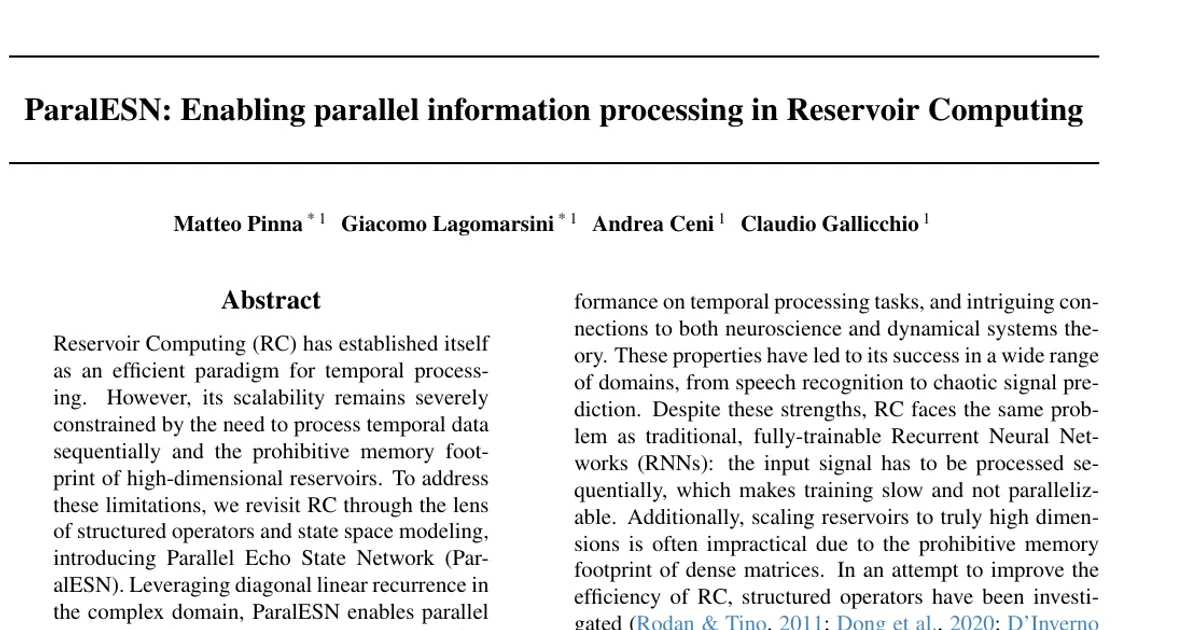
Reservoir Computing (RC) has established itself as an efficient paradigm for temporal processing. However, its scalability remains severely constrained by the need to process temporal data sequentially and the prohibitive memory footprint of high-dimensional reservoirs. To address these limitations, we revisit RC through the lens of structured operators and state space modeling, introducing Parallel Echo State Network (ParalESN). Leveraging diagonal linear recurrence in the complex domain, ParalESN enables parallel processing of temporal data and the construction of efficient, high-dimensional reservoirs. A thorough theoretical analysis demonstrates that the Echo State Property and the universality guarantees of traditional Echo State Networks are preserved, while also admitting an equivalent representation of arbitrary linear reservoirs in the complex diagonal form. Empirically, ParalESN achieves competitive predictive accuracy with traditional RC and with fully trainable sequence models, while delivering computational savings by orders of magnitude. Overall, ParalESN offers a scalable and principled pathway for integrating RC within the deep learning landscape.