Research
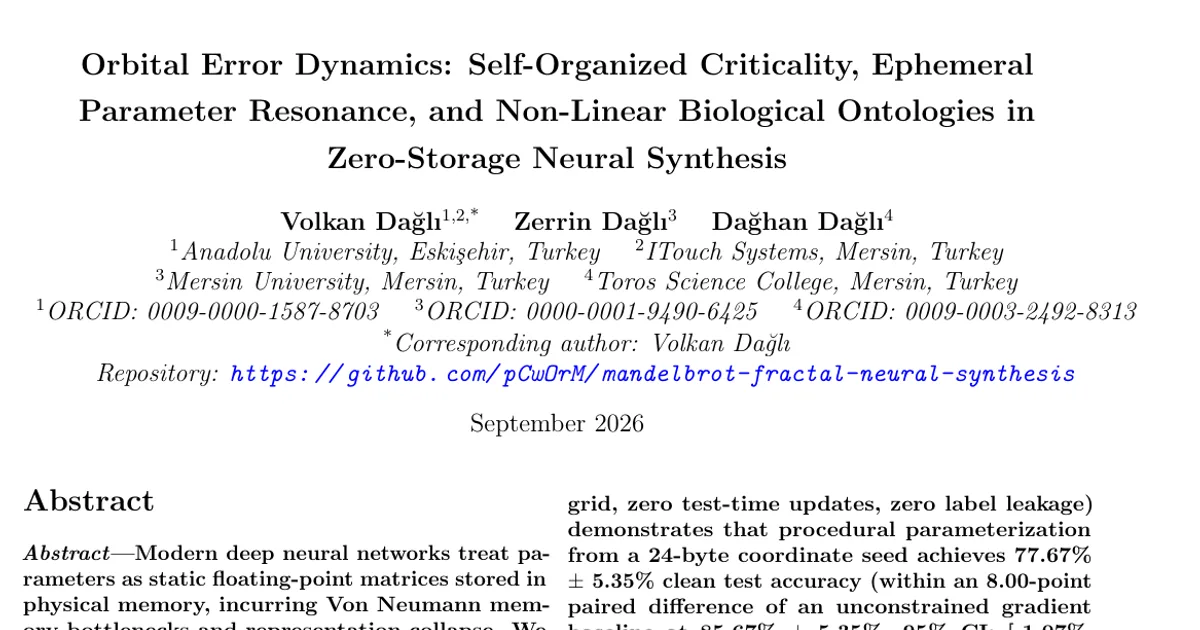
Orbital Error Dynamics: Self-Organized Criticality, Ephemeral Parameter Resonance, and Non-Linear Biological Ontologies in Zero-Storage Neural Synthesis
Overview Research area: Neural computation and parameterization methods (cs.NE), drawing on complex dynamics (the Mandelbrot set), nonlinear dynamical systems, and biologically inspired control mechan
- arXiv
- 2609.30115
- Published
- 2026-09-24
- Authors
- Volkan Dağlı, Zerrin Dağlı, Dağhan Dağlı
AI summary
Overview
- Research area: Neural computation and parameterization methods (cs.NE), drawing on complex dynamics (the Mandelbrot set), nonlinear dynamical systems, and biologically inspired control mechanisms (enteric nervous systems, CD4+ immune regulation).
- Technical level: Advanced. The paper combines complex analysis, Lyapunov stability arguments, loss-landscape theory, and immunology-inspired gating formalism, alongside a small empirical benchmark.
- Scope: The paper proposes Orbital Error Dynamics (OED), a framework in which neural network weights are not stored as floating-point matrices but are procedurally generated on demand from a compact 24-byte coordinate seed taken from the complex quadratic map z_{n+1} = z_n^2 + c, and it validates this on a single nonlinear two-dimensional classification task across 5 random seeds.
What This Paper Is About
Standard deep learning stores billions of static floating-point weights in memory, which the authors frame as causing a memory and energy bottleneck ("the thermodynamic and memory wall") and a tendency toward representation collapse when training loss is driven to zero. The paper's goal is to replace stored weight tensors with weights that are computed on demand as transient "topological resonances" from a tiny coordinate seed, so that memory stays constant (O(1), reported as 24 bytes) regardless of layer depth. It then builds a broader conceptual framework around this idea, including claims about living systems, phase-space "surfing" at the edge of chaos, and biologically inspired mechanisms for escaping bad optimization states.
Key Contributions
- Orbital Error Dynamics (OED) framework. Parameters are defined as ephemeral resonances W = Φ(Θ, τ) derived from the Mandelbrot quadratic polynomial z_{n+1} = z_n^2 + c, with a 3-parameter coordinate tuple Θ = (c_x, c_y, ζ) ∈ ℝ³, where ζ = log10(zoom), stored as three 64-bit floats totaling 24 bytes. The authors contrast this with intrinsic-dimension projections (Li et al.), HyperNetworks (Ha et al.), and HashedNets (Chen et al.), arguing none of those achieve constant physical memory.
- Bent Sine Wave Hypothesis and Observer Horizon Geometry. The paper argues that living, non-equilibrium systems arise when harmonic waves curl inward under environmental drag toward the cardioid cusp at c = 1/4 (where the derivative of z² + c at z = 1/2 equals 1, giving neutral stability). It defines interior resonance "shoulder" loci at X_upper = (0.25, +0.18) and X_lower = (0.25, −0.18), positioned between the period-1 fixed-point basin and the true boundary at c = 0.25 ± 0.50i.
- Biomimetic Perturbed Jump Operator (Ω_tunneling). Inspired by the mammalian fertilization zinc spark, this is a heavy-tailed Cauchy(0, γ_spark) perturbation applied when the gradient norm falls below ε_tol and task loss exceeds τ_err, intended to leap across non-convex barriers. This is positioned relative to the perturbed gradient descent work of Jin et al.
- Dual-brain cybernetics, CD4+ immune gating, and a conceptual optical co-processor. The paper couples a cranial brain (Θ, O(1) = 24 bytes) with an enteric/visceral brain shielded by an adaptive CD4+ gating mask M_CD4, maps the four genetic bases (A, T, C, G) to quadrants of ℂ to synthesize W = [w1, w2, w3, b]ᵀ, and describes a conceptual analog optical architecture using a 532 nm laser, a spatial light modulator, a 4f Fourier lens system (Δt ≈ 10⁻¹² s), and dark-basin photoreceptor arrays.
Main Findings
- Clean test accuracy: OED (Zero-Storage Synthesis) reached 77.67% ± 5.35% (95% CI [71.03%, 84.31%]) on the Two-Moons manifold, versus a Standard Logistic Regression baseline at 85.67% ± 5.35% (95% CI [79.03%, 92.31%]).
- Distribution shift accuracy: Under perturbation Δx ~ 𝒩(1.2, 0.4), OED reached 71.33% ± 3.80% (95% CI [66.61%, 76.05%]), versus the baseline at 80.33% ± 7.21% (95% CI [71.38%, 89.28%]).
- Paired difference (GLM − OED): Clean = 8.00% ± 7.30% with 95% CI [-1.07%, 17.07%]; noisy = 9.00% ± 6.52% with 95% CI [0.91%, 17.09%]. The paper notes the clean CI includes 0, so it reports no statistically significant degradation at α = 0.05. The paper does not discuss the fact that the noisy paired-difference CI excludes zero.
- Memory footprint: The baseline is reported as 16 B (Float32) / 32 B (Float64) with O(W) scaling; OED is reported as 24 bytes with O(1) scaling. The theoretical storage comparison in Figure 7 is described as extrapolated across multi-layer scaling, not measured.
- Constrained-manifold argument: Because OED parameterizes a 4-dimensional weight vector W ∈ [-1,1]⁴ through only 3 coordinate parameters via w_i = 2R_i − 1, the authors state by first principles that a constrained parametric model cannot surpass unconstrained backpropagation on unregularized training loss. They position the contribution as near-parity within an 8.00-point paired margin while eliminating persistent weight tensors.
- Optimization behavior: The reported zero-gradient epoch rate is 0.0% (0 / 250 epochs), meaning the jump operator's stall condition was apparently never triggered across the runs.
- Benchmark scale: The evaluation used N = 300 samples, noise σ = 0.12, an 80/20 train/test split, 5 seeds (s ∈ {100, 101, 102, 103, 104}), T = 50 epochs, t₄ = 2.776 for N = 5, and a 32 × 32 sampling grid, with zero test-time updates and zero label leakage confirmed by pure feedforward evaluation.
- No empirical results are reported for the CD4+ immune gating, the dual-brain architecture, or the optical co-processor. The gating mechanism is described as formalizing an active defense for continual and online learning streams; the optical architecture is described as achieving "conceptual equivalence," not a measured implementation.
- No ablation study, no comparison against deep networks, and no benchmark beyond the single Two-Moons manifold are reported.
Methodology in Plain English
The researchers replace the usual stored weight matrix with a formula. A tiny seed of three numbers (roughly a location in the complex plane plus a zoom level) is used to sample a 32 × 32 grid around the Mandelbrot map. The proportions of grid points that land in each of four quadrants become four numbers, which are rescaled into the four weights of a small classifier with an interaction term: ŷ = σ(w1x1 + w2x2 + w3x1x2 + b). Training does not update weights directly; it updates the three-number coordinate seed using finite-difference gradients (step δ = 0.02) at a learning rate of η = 0.06, with gradients clipped to [-1.0, 1.0].
The total objective adds two penalties to binary cross-entropy: an "orbital" term that pushes the fraction of escaping orbits toward a target N* = 22 (weight λ_orb = 0.35), and a "quadrant diversity" term that penalizes variance across the four quadrant mass ratios (weight β = 0.01). When the gradient becomes too small but the task loss is still high, the seed is instead jolted with a heavy-tailed Cauchy perturbation (γ_spark = 0.10). The weights themselves are discarded after each pass, keeping memory at 24 bytes. Evaluation is then done in pure feedforward mode on held-out data, with no test-time updates and no access to test labels.
The comparison baseline is a logistic regression using the same four features (x1, x2, x1x2, 1) but trained by ordinary unconstrained gradient descent (η = 0.12, T = 50). The comparison is run across 5 seeds with paired differences and Student-t confidence intervals.
Separately, the paper proposes conceptual mechanisms — CD4+ gating that attenuates gradient updates when their magnitude exceeds a tolerance threshold, and an analog optical implementation — but these are presented as architectural proposals rather than tested systems.
Why This Matters
Impact on research. The paper argues that persistent weight storage is an unquestioned assumption of deep learning and that removing it could relieve a reported 100-to-1000× energy gap between off-chip DRAM access and on-chip multiply-accumulate. It also argues against driving training loss strictly to zero, framing zero loss as entropic death associated with representation collapse, catastrophic forgetting, and synthetic self-cannibalization. The work is filed as Turkish patent application TR 2026/016285 (filed September 22, 2026 at TÜRKPATENT), and pairs with a companion paper, "Mandelbrot Fractal Neural Synthesis," Zenodo Concept DOI 10.5281/zenodo.22774934. The reported empirical evidence is limited to one small two-dimensional dataset, so the impact claim rests mainly on the framework rather than the benchmark.
Real-world applications (as framed by the paper):
- Resource-constrained edge computing, where a constant 24-byte parameter footprint would sidestep weight storage.
- Neuromorphic hardware, where procedural weight generation could replace stored matrices.
- Analog optical co-processors using spatial light modulators and photoreceptor arrays, which the paper says could compute a 2D Fourier transform in Δt ≈ 10⁻¹² s.
- Continual and online learning streams, where the proposed CD4+ gating mask is intended to absorb sensory shocks without catastrophic forgetting.
Industry relevance. The paper explicitly targets "zero-storage AI in neuromorphic and resource-constrained edge computing," and the authors list affiliations with Anadolu University and ITouch Systems. The value proposition is not higher accuracy but predictable stability under distribution shift (71.33% ± 3.80% in pure feedforward mode) with no runtime weight storage, which the paper presents as a trade of a small accuracy margin for a large reduction in memory.
Future Directions
- Scaling the benchmark. The current evidence is N = 300 samples on the Two-Moons manifold with 5 seeds and a 4-parameter model. The paper does not report results on higher-dimensional datasets or deeper networks, which would be needed to support the claim that the 24-byte footprint holds "regardless of layer depth."
- Testing the untested mechanisms. The CD4+ immune gating mask, the dual-brain coupling, and the analog optical co-processor are all presented conceptually or schematically. None have empirical results reported here, and the storage-scaling figure is explicitly labeled as extrapolated.
- Resolving the accuracy gap. The paper acknowledges the constrained 3-degree-of-freedom manifold as a structural ceiling but reports no ablation isolating how much of the 8.00-point clean gap comes from the coordinate constraint versus the added orbital and fractal penalties (λ_orb = 0.35, β = 0.01).
- Characterizing when the jump operator fires. The reported zero-gradient epoch rate is 0.0% (0 / 250 epochs), so the paper's data does not demonstrate the tunneling operator actually escaping a stagnation event. Conditions under which the Cauchy jump matters remain an open question.
Target Audience
Researchers and engineers working on model compression, parameter-efficient learning, and neuromorphic or in-memory computing will find the O(1) procedural parameterization and its comparison to HyperNetworks and HashedNets most directly useful. Readers interested in the intersection of complex dynamics and machine learning — particularly the use of the Mandelbrot boundary, Lyapunov exponents, and self-organized criticality as design principles — are the paper's main conceptual audience. Readers looking for a validated accuracy improvement will not find one here: the empirical section is small-scale and the authors themselves state the model should not be expected to beat unconstrained gradient descent on convex metrics. The paper is dense and assumes comfort with complex analysis and dynamical systems notation, so it is best suited to advanced readers.
Authors’ abstract
Modern deep neural networks treat parameters as static floating-point matrices stored in physical memory, incurring Von Neumann memory bottlenecks and representation collapse. We formulate Orbital Error Dynamics (OED), an analytical framework wherein synaptic weights are not stored masses (O(W)), but transient topological resonances (O(1)) derived procedurally from the complex quadratic polynomial map z_{n+1} = z_n^2 + c. We introduce the Bent Sine Wave Hypothesis, demonstrating that non-equilibrium living systems emerge when harmonic waves curl inward through environmental drag toward the cardioid cusp (c = 1/4). We define the Observer Horizon Geometry in parameter space, identifying interior resonance shoulder loci X_upper = (0.25, +0.18) and X_lower = (0.25, -0.18) between the fixed-point basin and the true boundary at c = 0.25 +/- 0.50i. To escape non-convex stagnation without loss zeroing, we introduce a heavy-tailed Biomimetic Perturbed Jump Operator (Omega_tunneling) inspired by mammalian fertilization zinc sparks. We further couple an enteric-cranial Dual-Brain architecture shielded by adaptive CD4+ regulatory immune gating (M_CD4), and project the 4-nucleotide genetic basis (A, T, C, G) across quadrants in C. Multi-seed empirical validation on the Two-Moons manifold (5 seeds, 80/20 train/test split, 32x32 grid, zero test-time updates, zero label leakage) demonstrates that procedural parameterization from a 24-byte coordinate seed achieves 77.67% +/- 5.35% clean test accuracy (within an 8.00-point paired difference of an unconstrained gradient baseline at 85.67% +/- 5.35%, 95% CI: [-1.07%, 17.07%]) and 71.33% +/- 3.80% under distribution shift (N(1.2, 0.4)), alongside conceptual equivalence with an analog optical co-processor.