Research
OracleZoom: On-Policy Self-Distillation Inspired Reference-Constrained Recursive Image Super Resolution
OracleZoom: On-Policy Self-Distillation Inspired Reference-Constrained Recursive Image Super Resolution Overview Research area: Computer vision — single-image super-resolution (SR), specifically recur
- arXiv
- 2609.06490
- Published
- 2026-09-06
- Authors
- Shubhashis Roy Dipta, Sourajit Saha, Shaswati Saha, Nobin Sarwar
AI summary
OracleZoom: On-Policy Self-Distillation Inspired Reference-Constrained Recursive Image Super ResolutionOverview
Research area: Computer vision — single-image super-resolution (SR), specifically recursive/extreme-magnification SR built on latent diffusion models.
Technical level: Advanced. The paper assumes familiarity with diffusion-based SR, LoRA adaptation, KL-regularized latent distributions, exponential moving average (EMA) teachers, and no-reference image quality assessment metrics.
Scope: The paper introduces Oracle Zoom, a training framework that keeps recursive super-resolution anchored to the last available ground-truth image after ground-truth supervision becomes computationally impossible, across recursion depths up to 256× on seven datasets.
What This Paper Is About
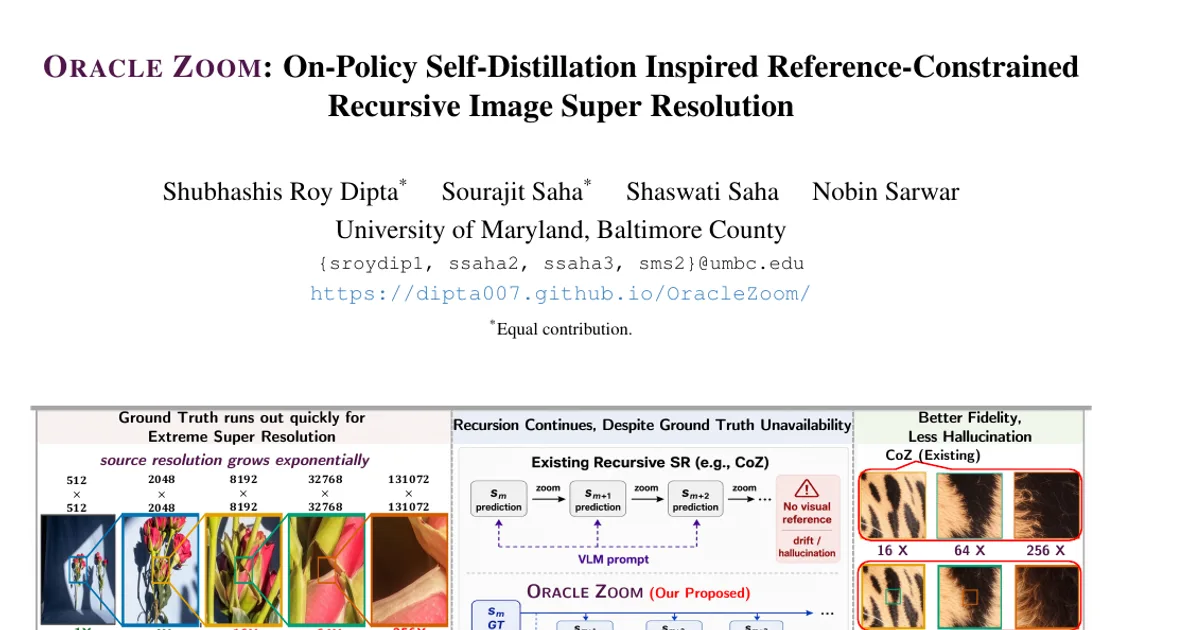
Recursive super-resolution reaches extreme magnification by feeding a model's own output back in as the next input, like repeated digital zoom. But ground truth for each deeper step grows geometrically: the paper states that for a 512×512 input and successive 4× magnifications, targets at 4×, 16×, 64×, and 256× require source regions of 2048², 8192², 32768², and 131072² pixels, and a single uncompressed 131072×131072 RGB image needs about 52 GB of storage. That makes deep-scale supervision impractical, so deeper predictions have no visual target to check them against. Oracle Zoom's goal is to keep those unsupervised deeper zooms anchored to the last ground-truth image that is still observable.
Key Contributions
-
Formulating the supervision gap in recursive SR. The paper identifies and formalizes the point at which ground truth becomes prohibitively expensive at deeper magnifications while the model increasingly relies on its own predictions, and ground-truth supervision ends (the paper trains to a boundary at 4×). Ground-truth targets are assumed available only up to step m; no target exists for steps beyond that.
-
Reference-constrained recursion beyond ground truth. Oracle Zoom is an on-policy self-distillation-inspired framework that carries the last ground-truth image past the supervision boundary without deeper annotations, by aligning the region being zoomed with each deeper prediction and projecting that prediction back to the resolution where ground truth is observable.
-
Separating verifiable content from unresolved detail. Cross-scale consistency preserves observable ground-truth evidence, a frozen no-reference quality model guides detail that projection cannot determine, a KL-constrained pretrained latent prior limits drift, and EMA consistency stabilizes learning at the supervision boundary. The paper also establishes a bound (Proposition 1) on quality-driven deviation under the KL constraint.
-
Reported SOTA quality and reduced hallucination. Across seven datasets, the paper reports 0.713 mean CLIPIQA, best aggregate 4× fidelity at 0.199 LPIPS and 0.160 DISTS, and 0.706 CLIPIQA at 256×. It also reports that an independent cross-family vision–language judge prefers Oracle Zoom in 68% and 78% of clear-preference comparisons at 64× and 256×, while Chain-of-Zoom hallucinates 2–5× more often.
Main Findings
-
Aggregate results over seven test sets. In Table 2, Oracle Zoom leads MUSIQ (57.80), MANIQA (0.598), CLIPIQA (0.713), LPIPS (0.199), and DISTS (0.160), and is second on NIQE (6.90, behind OSEDiff's 6.70). The comparison includes HiT-SR, MambaIR, SwinIR, SeeSR, OSEDiff, and CoZ.
-
Consistent CLIPIQA leadership across scales and datasets. Oracle Zoom achieves the highest CLIPIQA on 4KLSDB, DIV2K, and DIV8K at every reported recursion depth, and ranks first in CLIPIQA, MUSIQ, and MANIQA on all three datasets from 16× onward.
-
Gains are larger away from the training domain. At 4×, Oracle Zoom leads CoZ by 0.036 CLIPIQA on DIV2K and 0.040 on DIV8K, compared with 0.015 on the in-domain set.
-
Deep-scale quality. At 256×, Oracle Zoom obtains 0.706 CLIPIQA, versus 0.579 for CoZ, 0.532 for OSEDiff, and 0.463 for SwinIR. Figure 5(a) reports Oracle Zoom remaining above 0.70 CLIPIQA throughout the recursion.
-
Fidelity at the target-available scale is not sacrificed. At 4×, Oracle Zoom records the best LPIPS (0.199) and DISTS (0.160) in the aggregate table, so its perceptual-quality gain does not come at the expense of ground-truth agreement where a target exists.
-
Projected-reference fidelity at 16×. When no 16× target exists but the region remains observable in the 4× ground truth, Oracle Zoom achieves the lowest P-DISTS (0.215) and highest projected DINOv2 similarity (0.691), versus 0.239 and 0.633 for CoZ.
-
Hallucination divergence at deeper scales. At 4× and 16×, Oracle Zoom and CoZ have similar hallucination rates. At 64× and 256×, Oracle Zoom's rate decreases to 0.21 and 0.14, while CoZ rises to 0.55 and 0.70 (Figure 5(c), with 95% Wilson intervals). The paper notes that because ground truth is unavailable at these scales, the judge measures consistency with preceding zooms, not explicit recovery of unseen fine detail.
-
Ablation isolates each objective's role (Table 3). Removing supervision raises 4× LPIPS from 0.199 to 0.215; removing cross-scale consistency raises P-DISTS from 0.215 to 0.232; removing quality guidance drops CLIPIQA from 0.714 to 0.594; removing the latent prior raises CLIPIQA to 0.794 but degrades P-DISTS to 0.330 and raises hallucination from 0.303 to 0.907; removing EMA produces smaller changes (0.203 LPIPS, 0.216 P-DISTS, 0.702 CLIPIQA, 0.305 hallucination), consistent with a lightweight stabilizer.
-
Qualitative behavior. The paper reports that OSEDiff progressively removes local structure and CoZ develops repetitive textures as recursion deepens, while Oracle Zoom maintains the orientation and continuity of visible fur and skin patterns through 256×.
Methodology in Plain English
The framework starts from a fixed-scale SR model and applies it repeatedly, so the output at one step becomes the input to the next. A frozen multi-scale vision–language model generates caption-based prompts for each zoom step to guide the region being magnified.
The key move is what happens after ground truth runs out. Instead of leaving deeper predictions unconstrained, Oracle Zoom aligns the region being zoomed with the last available ground-truth image, projects each deeper prediction back to that resolution, and matches the two — so whatever is still observable keeps constraining what the model generates. Anything the projection cannot determine (the genuinely new fine detail) is guided by a frozen no-reference quality model. Because perceptual quality alone can reward sharp but unsupported patterns, a KL constraint keeps the adapted latent distribution close to the frozen pretrained SR model's; under shared isotropic covariance this reduces to a latent MSE term. An EMA copy of the adapter supplies a slowly varying consistency target at the supervision boundary.
Training runs on the model's own recursive predictions and backpropagates through the chain, so deeper-scale losses also update the earlier predictions that become their inputs, matching inference behavior. Only the adapter is trained — the SR backbone, VAE decoder, VLM prompter, quality model, and base model stay frozen, and all auxiliary branches are training-only. The implementation builds on CoZ's one-step OSEDiff with SD3-medium as the frozen backbone and a GRPO-tuned Qwen2.5-VL-3B-Instruct prompter, using rank-16 LoRA with 7.1M trainable parameters. The shared adapter is trained across the 4×→16× recursive chain. Loss weights are λ_xscale = 1.0, λ_qual = 0.4, λ_prior = 8.0, λ_ema = 0.1, with EMA decay 0.95, AdamW in fp32 at learning rate 5×10⁻⁵, weight decay 10⁻², 500-step warmup, effective batch size 4, and early stopping after roughly 9.3k steps.
Training data is a 1,000-image set sampled from 129,484 candidates in the 4KLSDB training split, filtered to keep images with a short side of at least 2048 pixels, discarding the lowest-quality decile, balancing caption-derived content groups, filtering with DFN5B/SigLIP2 agreement on photographic content, and removing near-duplicates from all evaluation sets. Evaluation uses the same CoZ recursion with matched inputs, zoom paths, crops, prompts, and metrics across every method, processing a 512×512 center crop through four 4× steps.
Why This Matters
Impact on research. The paper reframes extreme-magnification SR from an unconstrained synthesis problem into an optimization problem anchored to observable evidence and a pretrained prior, and provides a KL-based bound relating the quality objective to deviation from the base latent model. It also contributes an evaluation approach for regimes with no ground truth: projected-reference metrics at the last target-available resolution, plus an anchored pairwise VLM judge from a different model family than the prompter.
Real-world applications (as framed by the paper):
- Safety-critical imaging applications across domains, which the introduction cites as motivation for high-fidelity recursive SR.
- Extreme magnification of photographic content where capturing true high-resolution ground truth is infeasible.
- Reference-based restoration tasks where preserving observable structure matters more than inventing plausible texture, such as documentation of cable and panel boundaries illustrated in the qualitative comparisons.
- Scenarios requiring consistency checks against existing evidence rather than free-form generative enhancement.
Industry relevance. The method requires only a 7.1M-parameter LoRA on top of an existing frozen SR model and a 1,000-image training set, so it is an adaptation layer rather than a new model — relevant for teams already running diffusion SR pipelines. The reported reduction in hallucination at deep scales (0.14 versus 0.70 at 256×) speaks directly to trustworthiness concerns for generative magnification in production.
Future Directions
- Extending supervision to degradation models, adaptive zoom paths, and stronger reference-aware evaluation for deeper recursive magnification, as stated in the Limitations section.
- Measuring exact recovery at deeper scales, which the paper states is currently impossible because ground truth is unavailable; projected-reference metrics and the anchored VLM judge only assess consistency with observable evidence.
- Moving beyond synthetic center-crop recursion to establish performance for physical camera zoom or arbitrary user-selected regions.
- Addressing domain-specific degradations, where the paper reports smaller fidelity gains on DRealSR and RealSR.
- Reducing dependence on a fixed no-reference quality model and a pretrained SR prior, both of which can bias the type of detail encouraged at unsupported scales.
Target Audience
Researchers and practitioners working on diffusion-based super-resolution, extreme-magnification or recursive restoration pipelines, and generative models trained beyond available supervision. It is also relevant to engineers deploying image enhancement where hallucination risk and fidelity to observable evidence are decision criteria, and to readers interested in on-policy self-distillation and KL-constrained adaptation of frozen generative backbones. The paper assumes familiarity with SR benchmarks and no-reference quality metrics; readers without that background will find the metric tables dense. Note that the provided content is truncated partway through Appendix A.1, so the supplementary derivations, full proof of Proposition 1, and extended results referenced in the appendix are not available here. Training and inference wall-clock times, memory costs, and compute requirements are not reported in the available content.
Authors’ abstract
Recursive Super-Resolution (SR) extends fixed-scale SR to extreme magnification by repeatedly feeding predictions back into the same model, analogous to zooming an image repeatedly. However, ground truth availability at every scale, especially at depth, remains challenging as the required source resolution grows geometrically, leaving deeper predictions unsupervised. We present OracleZoom, an on-policy distillation-inspired, reference-constrained framework that trains on its trajectory while carrying the last ground-truth evidence beyond the supervision boundary. Direct and cross-scale supervision constrain verifiable content, while a no-reference quality objective guides unresolved fine-scale detail. A KL-constrained pretrained latent prior limits quality-driven drift, while EMA consistency stabilizes the supervision boundary. Across seven datasets, OracleZoom achieves the state-of-the-art SR quality across zooming scales, averaging 0.713 CLIPIQA, with larger gains on deeper scales, while significantly reducing hallucinations. Code, data, and models are available at https://dipta007.github.io/OracleZoom/ .