Research
Optimizing Classification of Infrequent Labels by Reducing Variability in Label Distribution
Overview Research area: Machine learning — specifically Extreme Classification (XC), the subfield concerned with assigning the correct labels to an input when the set of possible labels is extremely l
- arXiv
- 2511.07459
- Published
- 2025-11-07
- Authors
- Ashutosh Agarwal
AI summary
Overview
Research area: Machine learning — specifically Extreme Classification (XC), the subfield concerned with assigning the correct labels to an input when the set of possible labels is extremely large, with a focus on rare or infrequent categories.
Technical level: Advanced. The work assumes familiarity with multi-label classification, One-vs-All classifier design, Siamese-style neural architectures, and knowledge transfer techniques.
Scope: The paper introduces LEVER, a method for improving classification of sparse, infrequent labels in extreme classification by reducing inconsistency in how those labels are distributed, and it releases two new multi-intent datasets.
What This Paper Is About
In extreme classification, some categories appear far less often than others. These infrequent categories have very few training examples, and the abstract states that they also suffer from high label inconsistency — meaning the same kind of input is not consistently associated with the same label. That inconsistency drags down classification accuracy for exactly the labels that are already hardest to learn. The paper's goal is to make One-vs-All classifiers perform better on these rare categories by reducing that label inconsistency rather than by simply adding more data.
Key Contributions
- The LEVER method: A new approach designed specifically to address underperforming infrequent categories in Extreme Classification tasks.
- A Siamese-style architecture for label consistency: LEVER uses a robust Siamese-style architecture combined with knowledge transfer, aiming to reduce label inconsistency and thereby improve One-vs-All classifier performance.
- Broad empirical validation: The method was tested across multiple XC datasets, with the abstract reporting substantial improvements in the handling of infrequent categories and describing the result as setting a new benchmark for the field.
- Two new multi-intent datasets: The paper introduces two newly created datasets intended as resources for future XC research.
Main Findings
- Infrequent categories underperform due to label inconsistency: The abstract identifies high label inconsistency, alongside sparse samples, as a core reason rare categories are hard to classify correctly.
- Reducing inconsistency improves rare-label classification: LEVER's central claim is that addressing inconsistency — not just data sparsity — yields better performance for infrequent categories.
- Substantial gains reported across multiple XC datasets: The abstract states that testing across several XC datasets showed substantial improvements on infrequent categories. Specific datasets, metrics, effect sizes, and baseline comparisons are not given in the abstract.
- A new benchmark is claimed: The paper positions its results as setting a new benchmark for the field. The abstract provides no numerical evidence or comparative table to support this claim; the details are not in the abstract.
- New datasets contributed: Two multi-intent datasets were created and released to support future research. The abstract does not describe their size, domain, label space, or construction process.
Methodology in Plain English
The core idea is that rare labels are hard to learn not only because there are few examples of them, but because those examples are inconsistent — inputs that ought to share a label don't reliably behave that way in the learned representation. LEVER attacks that inconsistency directly.
It does so with a Siamese-style architecture: a network design that processes pairs of inputs through parallel, weight-sharing pathways and is typically trained to compare or align them. By pairing examples in this way, the model can be encouraged to produce consistent representations, transferring knowledge between related examples rather than treating each sparse example in isolation. That improved consistency is then fed into One-vs-All classifiers — the standard setup where a separate binary decision is learned for each label — to boost their accuracy on the infrequent categories they normally struggle with. The abstract does not describe the loss functions, pairing strategy, or training procedure in detail.
Why This Matters
Extreme classification underpins systems where the number of possible labels is enormous and the distribution is heavily skewed — a situation that is the norm in production, not the exception. Progress on rare labels therefore has consequences well beyond a benchmark score.
Impact on research: The paper reframes rare-label failure as partly a consistency problem rather than purely a data-scarcity problem, which suggests an alternative research direction to sampling and reweighting strategies. The release of two multi-intent datasets also gives the community new testbeds.
Real-world applications:
- Large-scale content tagging and recommendation: Assigning niche topical labels to items when popular categories dominate the training data.
- Search and query understanding: Mapping rare or long-tail user intents to the correct action or answer category.
- Support and intent routing: Directing user requests to the right destination when some intents occur far less often than common ones.
- E-commerce and catalogue classification: Correctly categorizing the long tail of rarely sold or rarely listed products.
Industry relevance: Long-tail label distributions are standard in deployed ML systems, and rare categories are often the most business-critical or the most costly to get wrong. Methods that improve rare-label accuracy without requiring large amounts of additional annotated data for each rare class are directly relevant to teams operating at scale.
Future Directions
- Understanding why consistency helps: Isolating whether gains come from the Siamese pairing, the knowledge transfer, or the interaction between them would clarify the mechanism.
- Extending beyond One-vs-All: The abstract frames the contribution in terms of One-vs-All classifiers; whether the approach transfers to other XC architectures is an open question.
- Characterizing the new datasets: The two multi-intent datasets invite follow-up work examining how methods behave on multi-intent inputs specifically, a setting the abstract flags but does not analyze.
- Robustness at extreme scale: Testing whether the consistency gains hold as label spaces grow and the rarest categories become rarer still.
Target Audience
Researchers and practitioners working on extreme classification, long-tail learning, and multi-label problems with skewed label distributions. It is also relevant to engineers building large-scale tagging, recommendation, or intent-classification systems who need better performance on rare categories, and to anyone looking for benchmark datasets for multi-intent classification. Readers should be comfortable with neural architecture design and multi-label classifier training, as the abstract presumes that background.
Authors’ abstract
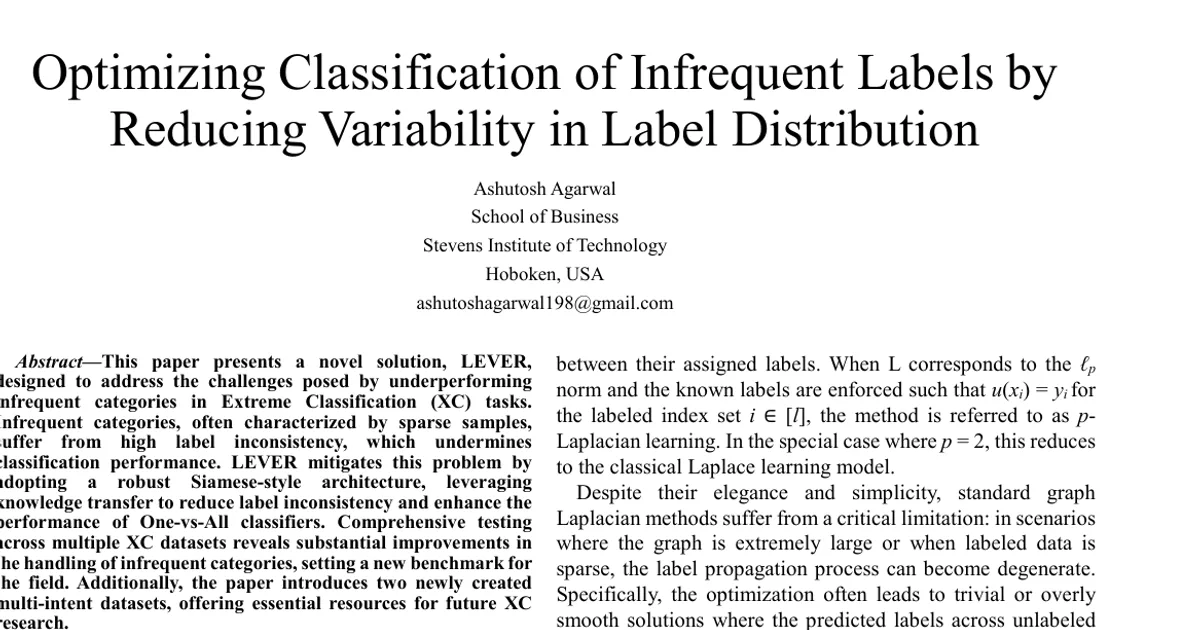
This paper presents a novel solution, LEVER, designed to address the challenges posed by underperforming infrequent categories in Extreme Classification (XC) tasks. Infrequent categories, often characterized by sparse samples, suffer from high label inconsistency, which undermines classification performance. LEVER mitigates this problem by adopting a robust Siamese-style architecture, leveraging knowledge transfer to reduce label inconsistency and enhance the performance of One-vs-All classifiers. Comprehensive testing across multiple XC datasets reveals substantial improvements in the handling of infrequent categories, setting a new benchmark for the field. Additionally, the paper introduces two newly created multi-intent datasets, offering essential resources for future XC research.