Research
OpenWAM: An Open, Modular Exploration Towards Systematic World-Action Model Pretraining
Overview Research area: Robotics — specifically World-Action Models (WAMs), which combine video-generative world knowledge with embodied control. The work sits at the intersection of robot learning, v
- arXiv
- 2609.07398
- Published
- 2026-09-07
- Authors
- Yuran Wang, Siqiao Huang, Mingleyang Li, Chenhao Zhang, Jiaqi Liang, Weiyang Jin, Yue Chen, Xuemin Chi, Donghao Zhou, Qize Yu, Yu-Kai Wang, Yuhan Rui, Shenzhe Yao, Zhen Yuan, Zhenhao Shen, Kefei Zhu, Zijie Zhu, Ning Gao, Xiaowei Chi, Guanqi He, Shanghang Zhang, Hao Dong, Lin Shao, Hang Zhao
AI summary
Overview
Research area: Robotics — specifically World-Action Models (WAMs), which combine video-generative world knowledge with embodied control. The work sits at the intersection of robot learning, video generation, and large-scale pretraining.
Technical level: Advanced. The paper assumes familiarity with generative video backbones, latent representations, denoising objectives, and robot policy learning; its main contribution is a research infrastructure and a set of design principles rather than an introductory tutorial.
Scope in one sentence: The paper introduces an open, modular stack for studying how World-Action Models should be built, uses it to run controlled experiments and extract three design principles, and composes those principles into a pretrained model evaluated across simulation and real robots.
What This Paper Is About
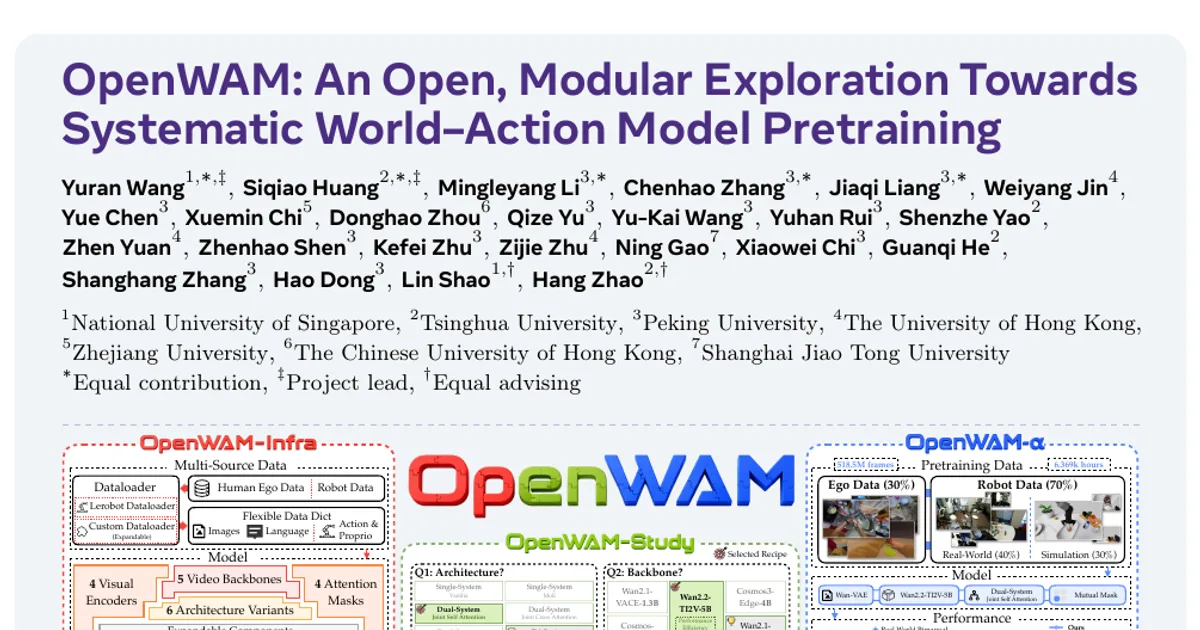
World-Action Models aim to take the world knowledge learned by video-generation models and convert it into control signals a robot can execute. The problem the authors identify is that existing systems are monolithic: the generative backbone, visual representation, architecture, information flow, inference procedure, and training data are entangled, so it is hard to tell which design decisions actually matter or why. The goal of OpenWAM is to separate those entangled pieces into composable modules so that world-action pretraining becomes a controlled experimental program rather than a single bundled recipe.
Key Contributions
-
OpenWAM-Infra — an infrastructure layer that factorizes the WAM design space into composable modules, with unified training, inference, deployment, and evaluation, so design choices can be varied and compared in a controlled way.
-
OpenWAM-Study — a set of controlled experiments organized around three questions: what should be inherited from upstream generative priors, how world learning and action learning interact, and how their synergy scales.
-
Three distilled design principles — (a) upstream knowledge transfers through a sufficiently capable generative backbone plus a compact, information-rich latent space; (b) world-action synergy requires dedicated action capacity, explicit world-to-action information flow, and synchronized joint denoising; (c) embodied pretraining mainly improves out-of-domain generalization, and one-stage co-training over egocentric and robot data combines world coverage with action grounding.
-
OpenWAM-α and a full open release — a WAM pretrained on roughly 6,400 hours of egocentric human and robot data and evaluated across eight simulation benchmarks and real-robot experiments, with the infrastructure, evaluation protocols, pretrained models, and data recipes released.
Main Findings
-
What to inherit matters, and how it is inherited matters more: the abstract claims upstream knowledge transfers when the generative backbone is sufficiently capable and when the latent space is compact but information-rich. The specific comparisons behind this claim are not given in the abstract.
-
Synergy is not automatic: world-action synergy is claimed to require three ingredients together — dedicated action capacity, explicit world-to-action information flow, and synchronized joint denoising. Which of these were ablated individually is not stated in the abstract.
-
Pretraining helps most out of domain: the authors report that embodied pretraining principally improves generalization beyond the training distribution, rather than only improving in-domain performance.
-
Co-training beats a single data source in principle: one-stage co-training over egocentric human data and robot data is claimed to integrate broad world coverage with action grounding, rather than treating them as separate stages.
-
OpenWAM-α performs consistently across embodiments: the abstract states that across eight simulation benchmarks and real-robot experiments spanning single-arm manipulation, bimanual manipulation, and dexterous hands, OpenWAM-α "delivers consistently excellent performance," maintaining its standing from simulation to the physical world. No numeric results, baselines, or margins appear in the abstract.
Methodology in Plain English
The authors treat World-Action Model design as an experiment rather than a single architecture. First, they build infrastructure that breaks the system into interchangeable parts — the generative backbone, the visual representation, the architecture, how information flows between world and action components, the inference procedure, and the training data — and give all of those parts one shared pipeline for training, inference, deployment, and evaluation. Second, on top of that substrate they run controlled studies: change one design choice at a time and observe the effect, organized around what to inherit from video priors, how world and action learning influence each other, and how the combination scales. Third, they convert the outcomes into three stated principles. Finally, they build a model that follows all three principles at once, pretrain it on a large mixed corpus of egocentric human video and robot data in a single co-training stage, and test it both in simulation and on physical robots across several robot form factors. The abstract does not describe the architecture in detail, the evaluation protocol specifics, or the experimental controls.
Why This Matters
Impact on research: The paper's core argument is methodological — that tightly coupled WAM systems hide which design choices are responsible for results. Providing a factorized, shared infrastructure with unified evaluation turns WAM development into something closer to a reproducible experimental science, and the release of models, protocols, and data recipes lowers the barrier for other groups to build on or contradict the stated principles.
Real-world applications:
- General-purpose robot manipulation policies that transfer from simulation to physical hardware without per-task retraining.
- Bimanual and dexterous-hand platforms, such as warehouse or assembly robots, where coordination between two arms or many fingers is required.
- Learning from large corpora of egocentric human video, allowing robot capability to benefit from human demonstrations that were never collected on a robot.
- Cross-embodiment deployment, where one pretrained model is adapted to single-arm, dual-arm, or dexterous hardware.
Industry relevance: Robotics companies face high costs for collecting robot data and frequent failure when policies trained in one setting are deployed in another. A pretrained, openly released world-action model with published data recipes and evaluation protocols offers a reusable starting point, and the emphasis on out-of-domain generalization speaks directly to the gap between lab benchmarks and real deployment.
Future Directions
- Scaling the study: the abstract asks how world-action synergy scales but does not report scaling behavior in detail; mapping performance as a function of backbone size, data volume, and action capacity is a natural continuation.
- Extending the module space: OpenWAM-Infra is presented as composable; additional backbones, representations, and inference procedures can be swapped in and tested under the same controlled protocol.
- Broadening embodiments and domains: current evaluation spans single-arm, bimanual, and dexterous hands; the same principles invite testing on mobile manipulation, locomotion, or other embodied settings.
- Testing the principles against alternatives: the three stated principles are distilled from the authors' own experiments, so independent replication and adversarial ablation using the released stack would establish how general they are.
- Data recipe refinement: since one-stage co-training over egocentric human and robot data is claimed to be beneficial, the mix, filtering, and grounding of those data sources remains an open design question.
Target Audience
Researchers and engineers working on robot learning, embodied AI, and video-generative models who want to build or evaluate world-action models rather than treat them as black boxes. It is also relevant to practitioners who need a pretrained manipulation model spanning multiple robot form factors, and to groups interested in reproducible infrastructure and benchmarking for embodied pretraining. Readers without background in generative modeling or robot policy learning will find the paper's technical content demanding, though the three stated principles are accessible at a high level.
Authors’ abstract
World-Action Models inherit world knowledge from video-generative priors, and channel it into executable control signals through embodied experience. Existing systems, however, are monolithic: the generative backbone, visual representation, architecture, information flow, inference procedure, and training data are tightly coupled, obscuring which design choices matter and why. We introduce OpenWAM, an open research stack that turns world-action pretraining into a controlled experimental program. OpenWAM-Infra factorizes the WAM design space into composable modules with unified training, inference, deployment, and evaluation. On this substrate, OpenWAM-Study examines three questions through controlled experiments: what to inherit, how world and action learning interact, and how their synergy scales; and distills three principles: upstream knowledge transfers through a sufficiently capable generative backbone and a compact, information-rich latent space; world-action synergy requires dedicated action capacity, explicit world-to-action information flow, and synchronized joint denoising; and embodied pretraining principally improves out-of-domain generalization, with one-stage co-training over egocentric and robot data integrating world coverage and action grounding. Composing these principles, we build OpenWAM-α, an open WAM pretrained on roughly 6,400 hours of egocentric human and robot data and evaluated across simulation and real-world benchmarks. Across the eight simulation benchmarks and the real-robot experiments, which together span embodiments from single-arm and bimanual manipulation to dexterous hands, OpenWAM-α delivers consistently excellent performance, sustaining its top-tier standing from simulation to the physical world. We release the full stack, including infrastructure, evaluation protocols, pretrained models, and data recipes, to facilitate future research.