Research
On the Probabilistic Learnability of Compact Neural Network Preimage Bounds
On the Probabilistic Learnability of Compact Neural Network Preimage Bounds Overview Research area: Neural network verification (specifically the AllDNN-Verification / preimage bound computation probl
- arXiv
- 2511.11656
- Published
- 2025-11-10
- Authors
- Luca Marzari, Manuele Bicego, Ferdinando Cicalese, Alessandro Farinelli
AI summary
On the Probabilistic Learnability of Compact Neural Network Preimage BoundsOverview
Research area: Neural network verification (specifically the AllDNN-Verification / preimage bound computation problem), with a probabilistic, random-forest-based approach grounded in statistical tolerance limits.
Technical level: Advanced. The paper assumes familiarity with formal verification concepts (unsatisfiable cores, preimage bounds, #P-hardness), statistical learning theory (bootstrap ensembles, tolerance intervals, Chernoff bounds), and reinforcement-learning verification benchmarks.
Scope (one sentence): The paper introduces RF-ProVe, a random forest-based probabilistic method that returns compact unions of axis-aligned boxes under-approximating a neural network's preimage, with formal high-confidence guarantees on both purity and coverage.
What This Paper Is About
Computing the exact preimage of a neural network — the full set of inputs that map to a desired output — is #P-hard, so exact solvers do not scale and existing provable approximations (e.g., PREMAP, ε-ProVe) trade off scalability and compactness. The authors instead target a probabilistic relaxation: return a compact set of axis-aligned hyperrectangles that, with high confidence, covers at least a target fraction of the true preimage while containing at most a bounded fraction of incorrect points. Their goal is to produce far fewer polytopes than existing methods while giving formal statistical guarantees rather than deterministic soundness.
Key Contributions
-
RF-ProVe: a random-forest-inspired method that combines passive learning (training an ensemble of randomized decision trees on labeled samples) with an active resampling strategy to extract and validate compact unions of axis-aligned boxes representing neural network preimages. Notably, the ensemble does not use the traditional majority-voting scheme of a standard random forest.
-
Formal probabilistic guarantees: derivations based on Wilks (1942) statistical tolerance limits that bound both the purity of each returned region (the fraction of its volume that is truly positive) and the global coverage of the returned set over the true preimage.
-
A principled hyperparameter rule: an explicit formula for the number of resampling points needed per candidate region, n = ln(δ)/ln(R), derived from the theoretical analysis rather than set heuristically.
-
An empirical demonstration on standard verification benchmarks (VCAS, Cartpole, Lunarlander, Dubinsrejoin) showing that RF-ProVe produces substantially more compact solutions than the SINGLE-tree probabilistic baseline ε-ProVe, and competitive or better coverage than PREMAP and ε-ProVe.
Main Findings
-
Formal coverage and error bounds (Theorem 4). Under the stated assumptions, the returned solution B^A satisfies ((k−2)/k)^N · Vol(B*) ≤ Vol(B^A ∩ B*), Vol(B^A ∩ B*) ≥ R · Vol(B^A), and the false-positive volume satisfies Vol(B^A \ B*) ≤ (1−R) · Vol(B^A). Higher R tightens both the purity guarantee and, indirectly through n, the sampling cost.
-
Purity guarantee per region (Corollary 2). If n i.i.d. samples drawn from a region all satisfy the property, then with probability at least 1−δ, at least a fraction R of the region's volume is truly positive. The result assumes no knowledge of the underlying probability distribution, so it applies to general DNNs.
-
Sampling complexity is tractable. With δ = 0.001 and R = 0.995, the total required resamples stay under 1.5M even at depth D = 11 with up to 1024 boxes. For a fixed extreme maximum of 32000 boxes, depths D ∈ [5, 7] permit forests of 500–2000 trees. The paper adopts D = 5 in all experiments.
-
Chosen training set size. The authors report empirically that m = 20000 uniformly sampled examples provides sufficiently dense coverage of the input space across various depths; larger m gives diminishing returns while increasing training cost.
-
Dubinsrejoin: largest compactness gain. RF-ProVe returned 136 polytopes with 90.08% coverage and 0.3% error in 66s, versus ε-ProVe's 4929 polytopes at 85.02% coverage and 0.3% error in 260.23s, and PREMAP's 1002 polytopes at 78.7% coverage (0% error) in 656.47s.
-
Cartpole and Lunarlander: fewer boxes, comparable coverage. On Cartpole, RF-ProVe produced 22 polytopes at 76.8% coverage (0.3% error, 4.5s) versus ε-ProVe's 72 polytopes at 76.47% (0.27% error, 2s) and PREMAP's 66 polytopes at 75.5% (0% error, 32.37s). On Lunarlander, RF-ProVe produced 42 polytopes at 75.63% coverage (0.3% error, 59s), versus ε-ProVe's 440 polytopes at 76.51% (0.5% error, 12.2s) and PREMAP's 97 polytopes at 75.1% (0% error, 85.42s).
-
VCAS: matches PREMAP's box count at a fraction of the cost. RF-ProVe achieved 15 polytopes at 90.5% coverage with 0.06% error in 0.3s, matching PREMAP's 15 polytopes at 90.8% coverage (0% error, 12.8s). The Exact method (Matoba and Fleuret 2020) reached 100% coverage with 0% error but required 131 polytopes and 6352.21s on average. ε-ProVe took 0.65s but returned 122 polytopes at 90.48% coverage with 0.02% error.
-
Exact methods hit a scalability wall. Even on the simpler VCAS instances, the exact approach took more than 6300 seconds on average, which the authors cite as evidence of the practical bottleneck caused by #P-hardness.
-
Ensembles outperform a single tree. Because RF-ProVe aggregates positive regions from all T trees, the total covered region can only grow relative to the single-tree case, and the paper reports it is often significantly larger in practice.
Methodology in Plain English
The starting point is a simple observation: if you sample labeled input points and grow a decision tree, each leaf corresponds to an axis-aligned box in input space, and a "pure positive" leaf is a box that appears to contain only inputs producing the desired output.
The authors build an ensemble of such trees (structurally like a random forest, but without majority voting because each leaf is used independently as a candidate region). They collect every pure positive leaf across all T trees, up to a fixed maximum depth D. Note the paper defines a precision parameter ξ = 2^(−D), so deeper trees mean finer boxes; if a region cannot be resolved to ξ-precision, it is excluded, which can only make the result a looser but still valid under-approximation.
The problem with naive leaf extraction is that a leaf can look pure simply because few training points landed in it. The second stage fixes this with an active resampling loop: for each candidate box, the method checks whether it already contains at least n = ln(δ)/ln(R) positive training samples. If not, it draws n fresh uniform samples inside that box, labels them with the network, and keeps the box only if all of them are positive. This is the step that converts a heuristic-looking procedure into one with a formal guarantee — if all n samples pass, then with confidence 1−δ at least a fraction R of the box's volume is genuinely positive.
Duplicate boxes are removed, and the current solution's coverage is estimated by Monte Carlo: a fresh test set of k samples is checked against the collected boxes. If the estimated coverage reaches the target c, the loop stops; otherwise it continues until the maximum forest size is reached and the best solution is returned.
The boundary conditions matter: with δ = 0.001 and R = 0.995, the guarantee is stated as at least 99.9% confidence and a maximum error of at most 0.005.
Why This Matters
Impact on research. The paper reframes a #P-hard exact enumeration problem as one that can be answered probabilistically with bounded error and high confidence, and it shows how classical tolerance-limit statistics (Wilks 1942) can be plugged into a modern learned representation. This gives the verification community a different axis to trade off along — confidence and error budget instead of exactness — and it shows a concrete compactness advantage over the prior single-tree probabilistic approach, which the authors note can produce highly fragmented representations and even exhaust memory.
Real-world applications (from the benchmark domains and stated use cases):
- Aircraft collision avoidance: the VCAS benchmark models an airborne collision avoidance system, where knowing the full input region that yields an unsafe advisory is directly safety-relevant.
- Control systems for autonomous vehicles and robotics: Cartpole, Lunarlander, and Dubinsrejoin are reinforcement-learning control tasks, and preimage bounds identify which states or control inputs lead to undesirable outcomes.
- Model debugging and targeted data augmentation: the paper explicitly states that localizing the full unsafe region can guide debugging and improve training procedures.
- Safe recovery during deployment: identifying and avoiding risky regions lets a deployed system fall back to a safer policy; the authors argue compact regions are more interpretable and therefore more actionable for this purpose.
Industry relevance. The practical pitch is scalability: on VCAS, RF-ProVe matched the sound provable method's box count (15) in 0.3s versus 12.8s, and the exact solver needed 6352.21s. The authors deliberately focus on structured, verification-relevant domains such as Dubinsrejoin, arguing that image datasets like MNIST or CIFAR lack the semantics needed for safety analysis.
Future Directions
-
Closing the soundness gap. RF-ProVe is probabilistic and admits a bounded fraction of incorrect points (e.g., 0.06% error on VCAS versus PREMAP's 0%), so an open question is whether the tolerance-limit guarantees can be tightened or combined with sound over-approximations to recover deterministic certificates in some regimes.
-
Scaling to higher-dimensional inputs. The paper argues that higher-dimensional image inputs would "add stress without offering additional insight" and that PREMAP and ε-ProVe already struggle with Dubinsrejoin, leaving open whether RF-ProVe's advantages persist in much higher dimensions.
-
Sensitivity to the input dimension and target property. The authors state there is no closed-form rule for choosing the training set size m because it depends on the input dimension and the property being verified; they use m = 20000 empirically, so a principled selection rule remains open.
-
Runtime trade-offs. RF-ProVe was slower than ε-ProVe on Cartpole (4.5s versus 2s) and Lunarlander (59s versus 12.2s) while returning far fewer boxes, so improving the resampling and coverage-estimation loops is a natural next step.
Target Audience
Researchers and practitioners in neural network verification, formal methods, and safe machine learning who need to characterize the full set of unsafe inputs rather than a single counterexample; graduate students and engineers working on safety-critical control systems who value compact, interpretable preimage representations; and readers interested in applying classical statistical tolerance-limit theory to learned representations.
Authors’ abstract
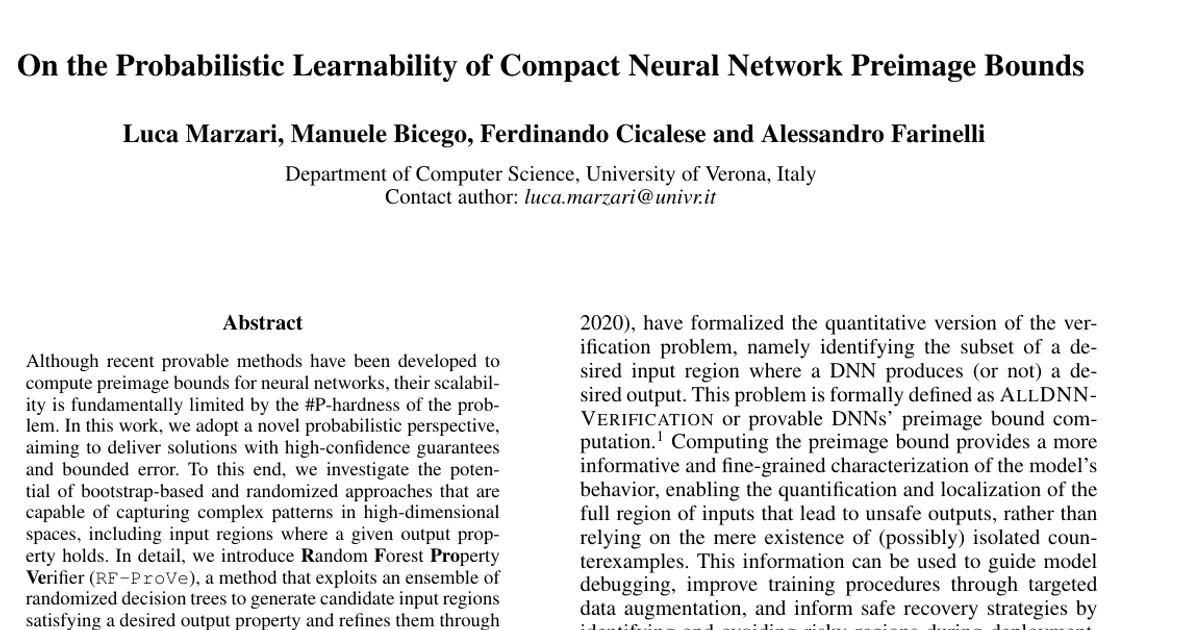
Although recent provable methods have been developed to compute preimage bounds for neural networks, their scalability is fundamentally limited by the #P-hardness of the problem. In this work, we adopt a novel probabilistic perspective, aiming to deliver solutions with high-confidence guarantees and bounded error. To this end, we investigate the potential of bootstrap-based and randomized approaches that are capable of capturing complex patterns in high-dimensional spaces, including input regions where a given output property holds. In detail, we introduce $\textbf{R}$andom $\textbf{F}$orest $\textbf{Pro}$perty $\textbf{Ve}$rifier ($\texttt{RF-ProVe}$), a method that exploits an ensemble of randomized decision trees to generate candidate input regions satisfying a desired output property and refines them through active resampling. Our theoretical derivations offer formal statistical guarantees on region purity and global coverage, providing a practical, scalable solution for computing compact preimage approximations in cases where exact solvers fail to scale.