Research
On propagation of chaos for the Fisher-Rao gradient flow in entropic mean-field optimization
On propagation of chaos for the Fisher-Rao gradient flow in entropic mean-field optimization Overview Research area: Mathematical optimization and probability theory — specifically mean-field optimiza
- arXiv
- 2602.15094
- Published
- 2026-02-16
- Authors
- Petra Lazić, Linshan Liu, Mateusz B. Majka
AI summary
On propagation of chaos for the Fisher-Rao gradient flow in entropic mean-field optimizationOverview
Research area: Mathematical optimization and probability theory — specifically mean-field optimization on spaces of probability measures, gradient flows (Fisher–Rao and Wasserstein), interacting particle systems, and propagation of chaos. The paper is posted under arXiv category math.OC.
Technical level: Advanced. The paper is a rigorous theoretical work in applied mathematics, built on measure-valued calculus, flat derivatives (first variations), Wasserstein distances on path space, lifts and projections of measures, and weak (distributional) formulations of PDEs.
Scope (one sentence): The paper builds a general framework for approximating Fisher–Rao gradient flows of entropy-regularized mean-field energies by interacting particle systems, and proves existence, uniqueness, and propagation of chaos for the kernelized version of these flows.
What This Paper Is About
Many optimization problems over probability measures — including those arising from mean-field models of neural network training and policy optimization — take the form of minimizing an energy V^σ(m) = F(m) + σ KL(m|π) over the space of probability measures. One way to solve them is to construct a continuous-time gradient flow (the Fisher–Rao gradient flow) that converges to the minimizer, and then implement it in practice. The problem is that the Fisher–Rao flow's right-hand side involves a relative entropy term that cannot be evaluated at an empirical measure of finitely many particles, so the flow cannot be turned into an algorithm directly. This paper fills that gap by rigorously constructing an interacting particle system that approximates the flow as its mean-field limit, using kernel smoothing to make the flow well-defined for particle systems.
Key Contributions
-
A general framework for particle approximations of Fisher–Rao flows (Section 2). The authors study the flow
∂_t μ_t = -μ_t a(μ_t, ·), replacing the flat derivativeδV^σ/δμwith a general functionasatisfying boundedness and Lipschitz assumptions (Assumption 1). This framework is stated to extend results from Cavil et al. (2017), Lu et al. (2019), Rotskoff et al. (2019), and Domingo-Enrich et al. (2020). -
Existence and uniqueness of the lifted and mean-field dynamics. Using lifts and projections of measures on the extended space
X × R_+(with the second coordinate representing a local mass weight), the authors prove that the Fisher–Rao flow is the projection of a lifted flow, construct a corresponding mean-field dynamic (in which particle positions are fixed and only weights evolve), and establish existence, uniqueness, and pathwise uniqueness of that dynamic. -
A non-quantitative propagation of chaos result. Theorem 2.10 shows that the empirical measure of the interacting particle system converges to the law of the mean-field solution in the 2-Wasserstein distance on path space as the number of particles goes to infinity; Corollary 2.11 gives the corresponding uniform-in-time statement for the projected measures.
-
A systematic comparison of four kernelization strategies and a practical algorithm (Sections 3 and 4). The authors describe four ways of smoothing the energy so that
abecomes bounded and Lipschitz — smoothing only the evolving measure (Lu et al., 2019), smoothing both evolving and target measures (Pampel et al., 2023), kernelizing the energy via Lu et al. (2023), and kernelizing the energy via Carrillo et al. (2019) — prove that all four satisfy Assumption 1 (Proposition 3.1), and propose a practical algorithm in Section 4 based on one of these methods.
Main Findings
-
The lifted formulation decouples mass from position. The mean-field system is
dX_t = 0,dw_t = -w_t a(hν_t, X_t) dt, with(X_0, w_0) ~ ν_0. The particle's spatial position is sampled once from the initial distribution and never moves; only its weight evolves. The authors state this reflects the geometry of the Fisher–Rao metric, which governs mass change without spatial transport. -
Well-posedness holds under Assumption 1. Theorem 2.9: if
ais bounded and Lipschitz, then for anyT > 0and initial lawν_0 ∈ P_2(X × R_+)there exists a unique solution to the mean-field system on[0, T], with pathwise uniqueness (two solutions with the same initial condition coincide almost surely). -
Propagation of chaos in 2-Wasserstein distance on path space. Under Assumption 1 and an initial-condition coupling condition,
lim_{N→∞} E[W_{2,T}(ν̃^N, ν)] = 0. The condition is automatically satisfied when the initializations for both systems are identical. -
The projected empirical measure converges uniformly in time. Corollary 2.11:
lim_{N→∞} sup_{t∈[0,T]} E[W_2(μ_t, μ̃_t^N)] = 0for any finiteT > 0. -
These results are explicitly non-quantitative. The authors state that Theorem 2.10 and Corollary 2.11 provide no convergence rates, and that obtaining such rates would require further work beyond the scope of the paper.
-
All four kernelizations fit the framework. Proposition 3.1: under Assumptions 2, 3, and 4, the functions
aarising from flows (25), (26), (27), and (28) all satisfy Assumption 1. The proof is in Appendix E. -
Kernelization (28) has a practical drawback. It involves nested convolutions and integrals — for example the term
K_ε * log(K_ε * μ_t / π)— which prevents full discretization into finite particle sums even whenμ_tis an empirical measure, and entails higher computational cost. This is the method the authors flag as harder to use computationally. -
Two of the kernelizations are "true" Fisher–Rao flows; two are not. Flows (27) and (28) preserve the structure of Fisher–Rao flows because they are genuine gradient flows of kernelized energy functions. The authors also note that they refer to all flows of the form
∂_t μ_t = -μ_t a(μ_t, ·)as Fisher–Rao flows for convenience, even though they are "true" Fisher–Rao flows only for some choices ofa. -
The framework extends beyond relative entropy. Section 3.3 discusses energies regularized by the
χ²-divergence,χ²(m|π) = ∫(dm/dπ − 1)² dπ, showing the framework applies to regularizers other than the KL divergence. -
Mass preservation is guaranteed by construction. The flow preserves the mass of the initial measure provided
∫_X a(μ,x) μ(dx) = 0for allμ; the authors check that all examples ofain Section 3 satisfy this. -
Standing assumptions on the ingredients. Assumption 2 requires
Fto be lower semi-continuous inP_2(X), bounded below byF_min, with flat derivative bounded byC_Fand Lipschitz with constantL_F. Assumption 3 requires a smooth, Lipschitz (constantL_ξ), radial probability densityξwith full support and finite second moment, withK_ε = ξ_ε * ξ_ε. Assumption 4 requiresπ(x) = e^{-U(x)}with continuousUandπglobally Lipschitz with constantL_π, implying bounds0 < π_min ≤ π(x) ≤ π_max < ∞on compactX. -
The Wasserstein–Fisher–Rao case is not covered. The authors explain that combining the Fisher–Rao part with the Wasserstein part of the entropy-regularized energy creates technical obstacles: on compact
Xthe diffusive behavior of the Wasserstein component is problematic, while onX = R^dthe functionabecomes unbounded because the flat derivative of the relative entropy is unbounded. They state they were unable to overcome these challenges and leave the Wasserstein–Fisher–Rao case to future work.
Methodology in Plain English
The authors begin from a variational problem over probability measures and write down the Fisher–Rao gradient flow that is supposed to solve it. The difficulty is that the flow's right-hand side depends on the density of the current measure relative to a reference measure, which is meaningless for an empirical measure made of finitely many atoms — so no finite particle system can match the flow exactly.
Their strategy is to lift the problem. Instead of tracking a probability measure on the state space alone, they track a measure on the product of the state space and the positive half-line, where the second coordinate is a weight. The original flow is recovered by projecting out the weight coordinate. This lifted picture has a clean particle interpretation: a particle keeps its position fixed and only its weight changes over time — which matches the intuition that Fisher–Rao geometry moves mass around without moving points.
To make the flow well-defined for particle systems, they replace the problematic density-dependent terms with smoothed (kernelized) versions, convolving measures with a mollifier kernel. They verify that each resulting coefficient function satisfies clean boundedness and Lipschitz conditions. Those conditions are exactly what is needed for standard arguments: existence and uniqueness of the single-particle mean-field dynamic follows from the Lipschitz property, and propagation of chaos follows by comparing the true interacting particle system against a system of independent copies of the mean-field dynamic, controlling the discrepancy in a 2-Wasserstein sense on path space. One caveat the authors highlight is that their propagation of chaos proofs use the evolving-weight formulation rather than a killing-replication mechanism with exponential clocks, and they report being unable to make those alternative proofs from prior work fully rigorous in their setting because the flat derivative of the relative entropy is unbounded.
Why This Matters
Impact on research. Fisher–Rao gradient flows have been studied extensively for well-posedness and convergence, but far less is known about how to approximate them with particles — the paper describes this as a gap in the literature, in contrast to the well-developed theory for Wasserstein gradient flows. This work makes Fisher–Rao flows algorithmically accessible and places several previously ad hoc smoothing approaches (from Lu et al., Rotskoff et al., Pampel et al., Carrillo et al., Domingo-Enrich et al.) under one common theoretical roof. It also extends the propagating-of-chaos idea to entropic energies with a nonlocal reaction term that preserves total mass, unlike the local reaction terms in Cavil et al. (2017), where the solution need not remain a probability density.
Real-world applications (as motivated in the paper or directly implied by the mean-field optimization setting):
-
Training neural networks in the mean-field regime, where the network's parameters are modeled as a distribution over parameter space and training becomes optimization over that distribution.
-
Policy optimization in reinforcement learning, specifically for entropy-regularized Markov Decision Processes with neural network approximation in the mean-field regime.
-
Implementing gradient-flow-based optimization in practice, since the paper's Section 4 provides an actual algorithm derived from the kernelization methods studied, and the propagation of chaos result is the theoretical justification for using particle systems as approximation algorithms.
-
Sampling and measure-transport methods, since Fisher–Rao and Wasserstein–Fisher–Rao flows are also studied in the sampling literature referenced by the authors.
Industry relevance. The paper is a pure mathematics contribution and does not report experiments, benchmarks, datasets, or model implementations. Its industry relevance is indirect: it supplies the theoretical justification for particle-based algorithms in mean-field optimization, which is the regime where large neural networks and entropy-regularized reinforcement learning policies are studied. The authors note that the convergence results are non-quantitative, which limits direct use for estimating how many particles or iterations an implementation would need — that would require the convergence rates the paper explicitly does not provide.
Future Directions
-
Quantitative convergence rates. The authors state that Theorem 2.10 and Corollary 2.11 are non-quantitative and that obtaining rates is beyond the scope of the paper. Deriving explicit rates in the number of particles (and, through discretization, in the number of iterations) is the most direct next step.
-
Wasserstein–Fisher–Rao flows with entropy regularization. The authors state they were unable to cover these flows for the entropy-regularized energy, and that they will attempt to treat this challenging case in future work. The obstacles are the diffusive behavior of the spatial component on compact domains and the unboundedness of the flat derivative of the relative entropy on
R^d. -
Rigorous killing-replication particle schemes. Prior work by Rotskoff et al. (2019) and Lu et al. (2019) uses killing-replication mechanisms with exponential clocks rather than evolving weights; the authors report they were unable to make those proofs fully rigorous in their own setting due to the unboundedness of the flat derivative of the relative entropy, leaving this as an open route.
-
Broader regularizers and domains. The paper's Section 3.3 shows the framework handles
χ²-divergence regularization; extending the general framework to other energy regularizers, and to non-compact domains with the technical issues those bring, are natural extensions hinted at by the structure of the results.
Target Audience
Who benefits most: researchers in applied mathematics, probability, and optimization who work on mean-field optimization, gradient flows on spaces of measures, and interacting particle systems. The paper assumes familiarity with Wasserstein distances, flat derivatives, weak formulations of continuity equations, and standard propagation-of-chaos arguments, so it is written for a mathematically mature audience — not for practitioners seeking an implementation guide. Readers specifically interested in mean-field neural network theory and entropy-regularized reinforcement learning will find the motivation relevant, but should expect a theoretical, proof-based treatment with no experimental results, benchmarks, or empirical validation reported.
Authors’ abstract
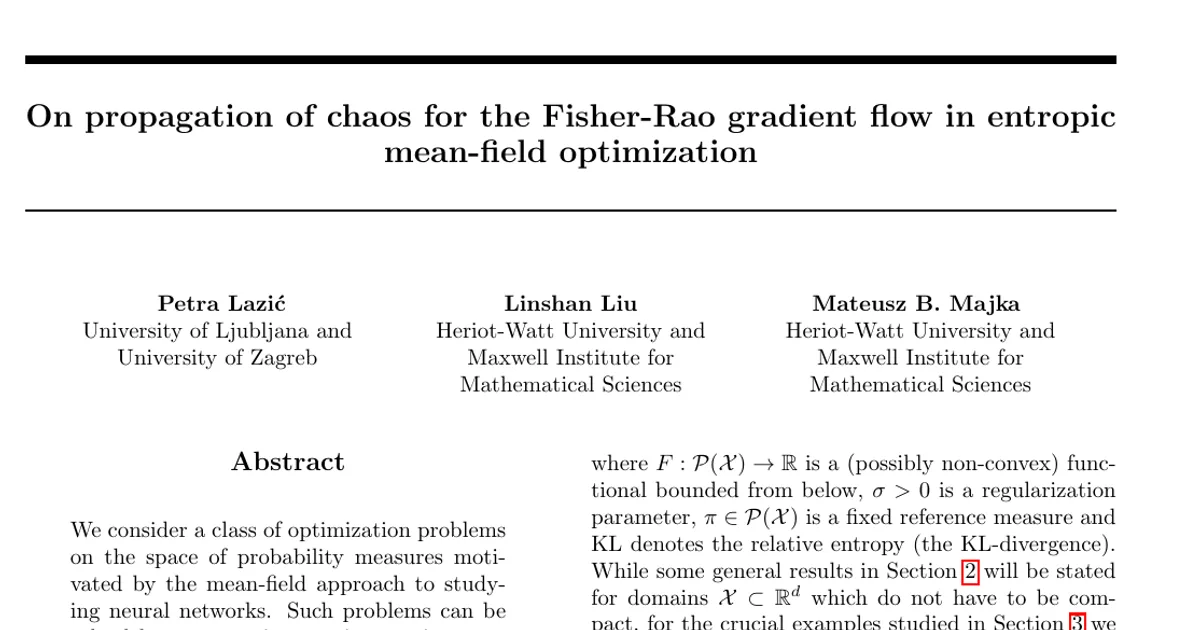
We consider a class of optimization problems on the space of probability measures motivated by the mean-field approach to studying neural networks. Such problems can be solved by constructing continuous-time gradient flows that converge to the minimizer of the energy function under consideration, and then implementing discrete-time algorithms that approximate the flow. In this work, we focus on the Fisher-Rao gradient flow and we construct an interacting particle system that approximates the flow as its mean-field limit. We discuss the connection between the energy function, the gradient flow and the particle system and explain different approaches to smoothing out the energy function with an appropriate kernel in a way that allows for the particle system to be well-defined. We provide a rigorous proof of the existence and uniqueness of thus obtained kernelized flows, as well as a propagation of chaos result that provides a theoretical justification for using the corresponding kernelized particle systems as approximation algorithms in entropic mean-field optimization.