Research
NutriScreener: Retrieval-Augmented Multi-Pose Graph Attention Network for Malnourishment Screening
Overview Research area: Medical computer vision — automated pediatric malnutrition screening from ordinary multi-pose smartphone photographs, combining vision-language embeddings, graph neural network
- arXiv
- 2511.16566
- Published
- 2025-11-20
- Authors
- Misaal Khan, Mayank Vatsa, Kuldeep Singh, Richa Singh
AI summary
Overview
Research area: Medical computer vision — automated pediatric malnutrition screening from ordinary multi-pose smartphone photographs, combining vision-language embeddings, graph neural networks, and retrieval augmentation.
Technical level: Advanced. The paper assumes familiarity with contrastive vision-language encoders (CLIP), Graph Attention Networks (GATs), FAISS nearest-neighbor retrieval, and multimodal fusion; the writing itself is accessible.
Scope: The paper proposes and clinically validates NutriScreener, a single end-to-end system that jointly classifies malnutrition status and regresses four anthropometric measurements (height, weight, MUAC, head circumference) from multi-pose images of children, with a released toolkit, knowledge base, and CampusPose dataset.
What This Paper Is About
Child malnutrition affects roughly 150 million stunted and over 42 million wasted children under five as of 2024, but screening still depends on manual tools such as MUAC tapes and weight-for-height charts, which are labor-intensive, error-prone, and slow to scale in low-resource settings. Prior image-based AI approaches either target elderly faces, need specialized infrared depth hardware (Microsoft's Child Growth Monitor), or suffer from majority-class bias that suppresses sensitivity to malnourished children. NutriScreener's goal is to make malnutrition screening robust, generalizable, and deployable using only routine multi-pose images plus age, while compensating for the severe class imbalance in available datasets.
Key Contributions
-
First retrieval-augmented multi-pose Graph Attention Network for malnutrition screening. The authors state this is the first effort to combine retrieval augmentation with multi-pose GATs for jointly performing anthropometric regression and binary classification from 2D image inputs.
-
Population-level knowledge base for cross-population generalization. A FAISS-indexed knowledge base (KB) of pose-level embeddings and ground-truth labels lets the model adapt to a new population by adding only a few representative samples, addressing class imbalance without retraining.
-
Context-aware gated fusion mechanism. A learned fusion layer combines GAT predictions with retrieval-based predictions, weighting them by model confidence (calibrated log-odds) and local embedding density, which the authors argue provides robustness under pose variability, domain shift, and label imbalance.
-
Real-clinician validation and released resources. A user study with practicing clinicians assessed accuracy, efficiency, and deployment readiness, and the toolkit, labeled KB, and CampusPose dataset were released to support field use and research.
Main Findings
-
Headline classification and regression performance: NutriScreener (Weighted) reaches 0.74 accuracy, 0.56 precision, 0.79 recall, 0.66 F1, 0.82 AUC, and 0.65 mAP on AnthroVision, with RMSEs of 6.38 cm (height), 5.32 kg (weight), 2.80 cm (MUAC), and 2.97 cm (head circumference). The abstract reports 0.79 recall and 0.82 AUC.
-
Outperforms the prior multitask benchmark: DomainAdapt achieves 0.67 recall, 0.64 F1, and 0.55 AUC, with a height RMSE of 22.00 cm, which the authors attribute to weak generalization under class imbalance.
-
Retrieval is what fixes minority-class sensitivity: A non-retrieval CLIP+GNN baseline has strong AUC (0.82) and regression (height 7.37 cm, weight 5.82 kg) but low recall (0.54). Adding retrieval with weighted BCE (BCE variant) raises recall to 0.81 but drops precision to 0.47 and worsens height RMSE to 10.93 cm, showing over-sensitivity to noisy retrieved neighbors. Focal loss keeps recall at 0.73 but lowers F1 to 0.53. Context features improve balance (F1 0.59, AUC 0.78), and the final temperature-scaled, class-boosted weighting gives the best overall trade-off.
-
Frozen CLIP beats fine-tuned CLIP: Fine-tuning both image and text encoders of RN50x64 degraded every metric — recall 38% versus 79%, height RMSE 8.87 cm versus 6.38 cm, ROC-AUC 0.72 versus 0.82, and mAP 0.54 versus 0.65. The authors link this to representational collapse when fine-tuning foundation models in low-resource settings.
-
Encoder choice matters: Among CLIP variants tested per-pose, RN50x64 achieved the highest ROC AUC (68%) and mAP (58%); RN50 overpredicted (recall 80%, precision 32%) and RN50x16 underfit (recall 15%).
-
Cohort generalization: On community versus clinical splits of AnthroVision, NutriScreener (Weighted) reaches AUC 0.78 and 0.74 and mAP 0.53 and 0.58, versus DomainAdapt's AUC 0.64 and 0.51 and mAP 0.40 and 0.35.
-
Cross-domain anthropometry comparison: Reported MAE for height and weight is 4.69 cm and 3.78 kg on AnthroVision (multi-pose), compared with 6.13 cm and 9.80 kg for the IMDB full-body dataset and 8.20 cm and 8.51 kg for the face-based VIP Attribute dataset.
-
Knowledge base choice drives results: Using the MalKB on the AnthroVision test set gives recall 0.79, F1 0.66, AUC 0.82, and the lowest RMSEs, while no retrieval or mismatched KBs (CampusPose, H2) give recall between 0.54 and 0.66. Partial augmentation (MalKB+H2) still improves recall to 0.73. For highly out-of-distribution KBs such as CampusPose, performance equals the no-retrieval setting.
-
Cross-dataset gains: The abstract reports up to a 25% recall gain and up to a 3.5 cm RMSE reduction when demographically matched knowledge bases are used.
-
Architecture sensitivity: The 2-layer, 8-head, 0.1-dropout GAT is optimal; a 2-layer 2-head model fails entirely on malnourished samples (recall 0), and an over-deep 4-layer variant collapses to 0.34 accuracy with 0.96 recall. Mahalanobis distance yields high sensitivity (TPR 0.98) but poor accuracy (0.36).
-
Pose nodes are not interchangeable: Removing the Frontal nodes sharply degrades F1 (0.36), and removing Lateral nodes hurts regression more than frontal removal, while removing Back nodes raises recall (0.82) but drops accuracy (0.58).
-
Retrieval hyperparameters are stable: Sensitivity analysis over neighbors (k = 3, 5, 7, 10), class temperature (0.30, 0.50, 0.70), boost factor (1.00, 1.50, 2.00), and regression temperature (0.05, 0.10, 0.20, 0.50) shows negligible metric changes.
-
Clinician acceptance: In a study with 12 medical professionals (mean experience 9.5 years) who each used the toolkit on an average of 15 pediatric cases, Likert ratings were 4.3/5 for clinical consistency, 4.6/5 for efficiency, 4.4/5 for trustworthiness, and 4.1/5 for deployment readiness. The abstract reports 4.3/5 for accuracy and 4.6/5 for efficiency.
Methodology in Plain English
Each child is represented as a graph. Their available photos (frontal, lateral, back, selfie) are passed through a frozen CLIP image encoder (the ResNet-50x64 variant), producing a 1024-dimensional feature per image. The child's age is appended, giving 1025-dimensional node features. A fully connected graph over these pose nodes is processed by a two-layer Graph Attention Network with multi-head attention, so the poses can exchange information and arrive at a single subject-level embedding used for both a classification head and a regression head.
In parallel, the pose embeddings are averaged into a single 1025-dimensional query that is looked up in a FAISS-indexed knowledge base of 1,984 multi-view images from 248 pediatric subjects with clinician-recorded height, weight, MUAC, and head circumference. The nearest neighbors contribute a retrieval-based prediction. For classification, the retrieval weights are temperature-scaled and then boosted for malnourished neighbors so the minority class is not drowned out. A small multilayer perceptron then decides, based on the GAT's confidence and how dense the retrieved neighborhood is, how much to trust the graph prediction versus the retrieval prediction; a similar learned scalar blends the two for regression.
The knowledge base images were captured with a consumer smartphone (OnePlus Nord, Sony IMX586 48MP sensor) at roughly 165 cm subject distance and a 50-inch camera height, across eight views per child (four frontal, one lateral-left, one lateral-right, one posterior, one frontal selfie). Training used a joint classification plus regression loss, four-fold cross-validation with seed 42, a batch size of 8, 50 epochs with early stopping, and the Adam optimizer at 1 × 10⁻³ on four NVIDIA A100 GPUs.
Evaluation covered AnthroVision (2,141 children), ARAN (512 children aged 16–98 months from two hospitals, H1: 404 and H2: 108), and CampusPose (80 college-aged subjects). Cross-dataset experiments swapped the retrieval knowledge base while keeping training fixed to AnthroVision.
Why This Matters
Impact on research. The paper argues that carefully engineered retrieval and fusion can close the gap between data-driven learning and real-world health deployment, and it provides a new benchmark for child malnutrition screening across cross-continent datasets. It also offers a counterintuitive, reusable result: freezing — rather than fine-tuning — a vision-language encoder can generalize better in low-resource medical settings, consistent with prior warnings about representational collapse.
Real-world applications
- Community health workers screening children with a smartphone and no specialized hardware, since the system runs on ordinary photographs.
- Clinical decision support, where clinicians in the user study valued the tool as an objective "second opinion" — one reported it flagged a visually ambiguous malnourishment case.
- Rapid population-level triage in low-resource regions, replacing labor-intensive MUAC tape and chart-based measurement workflows.
- Adaptation to new populations or regions by adding a small number of representative subjects to the retrieval knowledge base rather than retraining.
Industry relevance. The released toolkit and the privacy-by-design design (non-reversible CLIP embeddings, no personally identifiable information beyond age and anthropometrics, encrypted access-controlled storage, restricted research license) set a template for deploying health-screening AI from consumer devices. The retrieval-plus-fusion architecture is also directly transferable to other imbalanced clinical classification and measurement tasks.
Future Directions
- Expand knowledge base diversity. The authors explicitly state future work will expand KB diversity, which the cross-dataset results suggest is the main lever for improving generalization under large population shifts.
- Add interpretability. Clinicians in the open-ended feedback asked for uncertainty indication and visual cues highlighting key image regions; the authors list interpretability and uncertainty as future work.
- Resolve domain saturation. On the CampusPose cohort, all KB choices produced nearly identical results (recall 0.72–0.75, height RMSE 23.98 cm), leaving open how retrieval should behave under extreme domain shift.
- Move beyond a screening aid. With recall of 79% and an intended role as a research-oriented screening tool rather than a standalone diagnostic, establishing whether the system can be validated for routine clinical diagnosis remains an open question.
Target Audience
Researchers and graduate students in medical computer vision, multimodal retrieval, and graph neural networks; clinical informatics and public-health teams evaluating AI screening tools; and engineers building deployable, low-resource health applications who want a worked example of retrieval-augmented fusion under severe class imbalance. It will be hardest for readers without background in CLIP embeddings, attention mechanisms, or nearest-neighbor retrieval.
Authors’ abstract
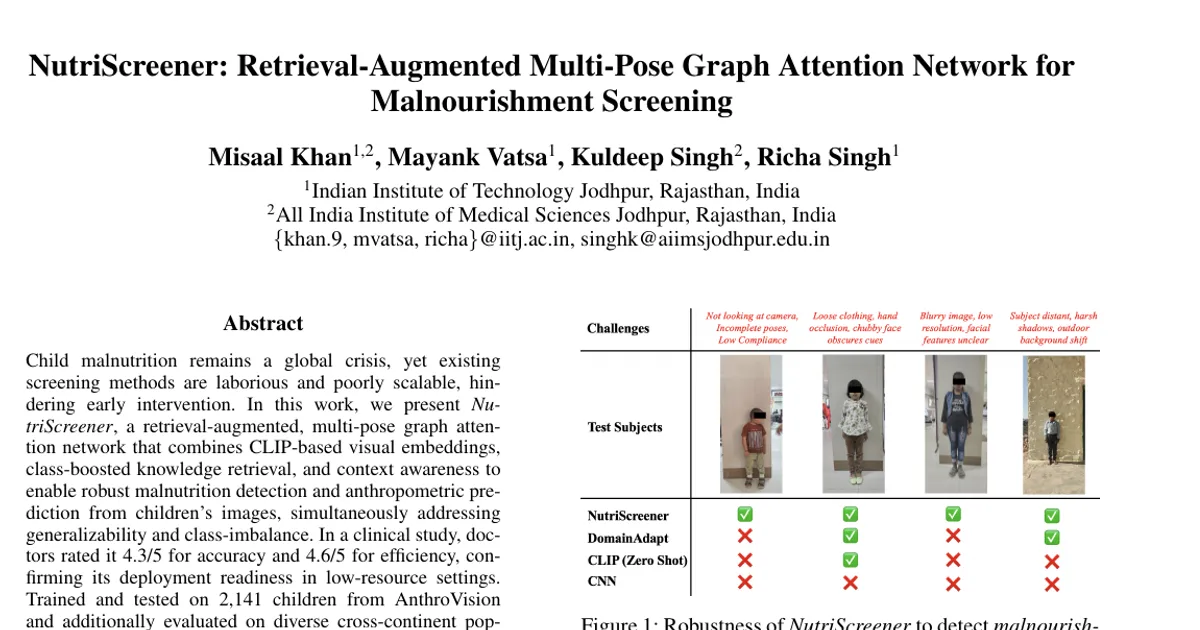
Child malnutrition remains a global crisis, yet existing screening methods are laborious and poorly scalable, hindering early intervention. In this work, we present NutriScreener, a retrieval-augmented, multi-pose graph attention network that combines CLIP-based visual embeddings, class-boosted knowledge retrieval, and context awareness to enable robust malnutrition detection and anthropometric prediction from children's images, simultaneously addressing generalizability and class imbalance. In a clinical study, doctors rated it 4.3/5 for accuracy and 4.6/5 for efficiency, confirming its deployment readiness in low-resource settings. Trained and tested on 2,141 children from AnthroVision and additionally evaluated on diverse cross-continent populations, including ARAN and an in-house collected CampusPose dataset, it achieves 0.79 recall, 0.82 AUC, and significantly lower anthropometric RMSEs, demonstrating reliable measurement in unconstrained pediatric settings. Cross-dataset results show up to 25% recall gain and up to 3.5 cm RMSE reduction using demographically matched knowledge bases. NutriScreener offers a scalable and accurate solution for early malnutrition detection in low-resource environments.