Research
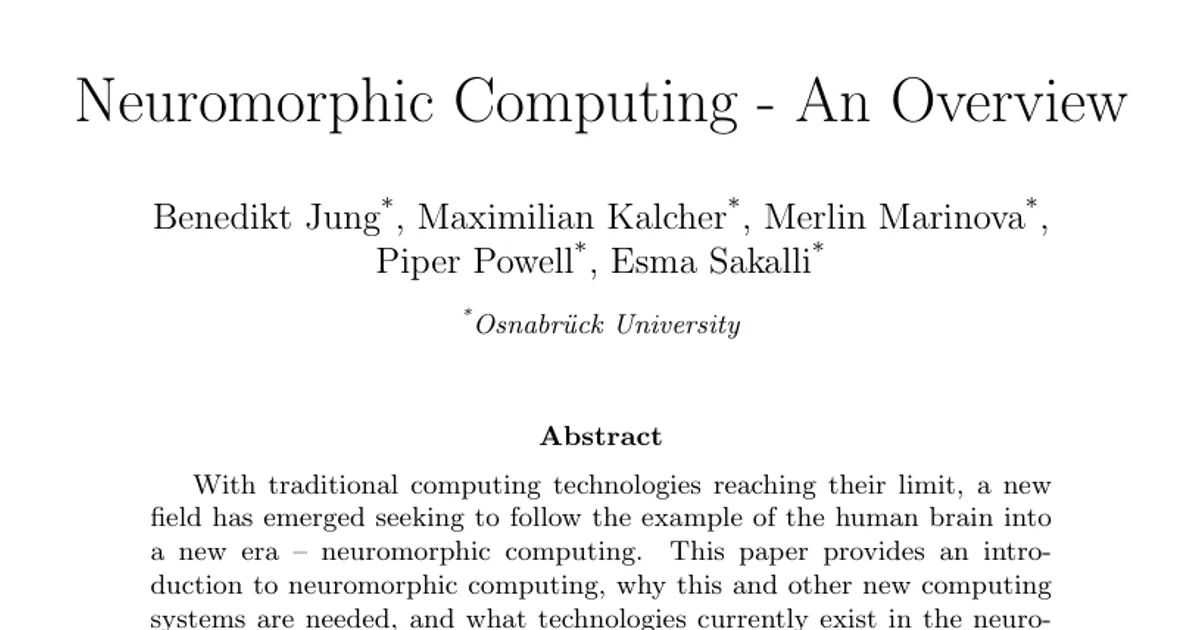
Neuromorphic Computing - An Overview
Overview Research area: Neuromorphic computing — biologically inspired hardware and algorithms spanning spiking neural networks (SNNs), neuromorphic chips, and neuromorphic photonics. The paper sits i
- arXiv
- 2510.06721
- Published
- 2025-10-08
- Authors
- Benedikt Jung, Maximilian Kalcher, Merlin Marinova, Piper Powell, Esma Sakalli
AI summary
Overview
- Research area: Neuromorphic computing — biologically inspired hardware and algorithms spanning spiking neural networks (SNNs), neuromorphic chips, and neuromorphic photonics. The paper sits in the arXiv category cs.NE (Neural and Evolutionary Computing) and originates from a cognitive science student journal.
- Technical level: Beginner-Friendly. The paper is explicitly framed as "an introduction," explaining foundational concepts before describing technologies; no prior hardware or neuroscience background is assumed.
- Scope: A survey-style introduction to why traditional von Neumann computing is hitting its limits and what neuromorphic alternatives — spiking computation on conventional GPUs, neuromorphic chips, and photonic/laser systems — currently exist.
What This Paper Is About
Traditional computers, built on the von Neumann architecture (VNA), separate memory from processing, and the digital bus connecting them creates a growing bottleneck as CPUs speed up and data volumes grow. The paper explains why this architecture is approaching physical and efficiency limits, and introduces neuromorphic computing — hardware that mimics the brain's neurons, synapses, and spiking behavior — as a promising alternative. Its goal is to give a readable overview of the main neuromorphic technologies in development and the trade-offs between them.
Key Contributions
-
A plain-language account of the von Neumann bottleneck and the end of scaling. The paper traces computing history from the ENIAC-era VNA design through Moore's Law and transistor scaling down to 5nm, arguing that traditional architecture is reaching a plateau in speed, power efficiency, and physical feasibility.
-
A quantitative efficiency comparison between supercomputers and the human brain. It frames the motivation for neuromorphic computing with concrete figures: the best traditional supercomputers are 8 orders of magnitude less computationally efficient than the brain, maxing out at 100 pJ/MAC, while the brain operates at less than 1 aJ/MAC and reaches 10^18 MAC/s on 20W of power.
-
A structured taxonomy of current neuromorphic approaches. The paper separates the field into three tiers: spiking computation run on conventional GPUs, neuromorphic chips (e.g., Intel's Loihi), and photonic systems — chiefly laser-based neuromorphic photonic systems (LNPSs) built on VCSELs — plus other photonic media such as silicon photonics, nanophotonics, metamaterials, and optically controlled phase change materials.
-
An explicit comparison of the benefits and drawbacks of chips versus photonics. The paper weighs chips (highly efficient, proven in applications, but physically limited in speed and scalability) against photonic systems (extremely power-efficient, faster and longer-range, but constrained by limited available wavelengths and hyper-precise component calibration).
Main Findings
- The von Neumann bottleneck is structural, not incidental: The digital bus between memory and processing limits both how much data can pass at once and how fast it can pass, and this constraint intensifies as CPU speeds and memory sizes grow.
- Traditional scaling is reaching physical limits: Transistor counts double roughly every two years per Moore's Law, and clock speeds and power efficiency have doubled at roughly the same rate since the mid-1900s — but transistors are now as small as 5nm (smaller than most viruses), and pushing to atom-size dimensions would be extremely expensive and vulnerable to random statistical fluctuations in transistor switching.
- Brain efficiency vastly exceeds conventional hardware: Best-in-class supercomputers reach 100 pJ/MAC, while the human brain operates below 1 aJ/MAC and achieves 10^18 MAC/s on 20W — about the power of an average light bulb.
- Spiking systems compute differently: Neuromorphic hardware uses sparse binary "spikes," is event-driven (units active only when receiving or emitting information), and uses non-volatile memory with analog processing circuits. Conventional systems keep all units active at all times regardless of input.
- GPUs are the current default for SNNs, with caveats: GPUs offer parallelism and high performance for spiking networks but at the cost of higher power consumption. The Nvidia Ampere A100 computes roughly 19.5 TFLOPS on double-precision operations, has 40 GB of on-chip HBM2 memory, more than 2 TB/s of memory bandwidth, draws up to 400W on maximal workloads, and costs 11.599,00€ MSRP — a barrier for regular consumers.
- Neuromorphic chips trade flexibility for brain-like efficiency: Chips like Intel's Loihi use physical artificial neurons and synapses with analog computation, event-driven computation, and mixed-signal integration. Loihi 2 includes up to 1 million integrated neurons, with 10x faster processing capability, 60x more inter-chip bandwidth, and 15x greater resource density than the first generation — but is not publicly available for purchase.
- Photonic systems can be far faster: Photonic hardware can clock 9 orders of magnitude faster than biological neurons and 6 orders of magnitude faster than electronic artificial neurons, depending on the medium. Optical systems can operate at up to 10 GHz and more, and the field, which began in 2010, repurposes existing telecommunications hardware designed for the 1310 and 1550nm wavelengths rather than requiring new technology.
- VCSELs act as artificial neurons: Vertical-cavity surface-emitting laser diodes exhibit threshold-and-fire operation, tonic and phasic spiking, and spike rate-encoding without modification, at sub-nanosecond speeds. A VCSEL "unlocks" from a steady light source when the light is interrupted — analogous to a biological spike — with events occurring on a 100ps timescale versus the millisecond timescale of biological neurons, and spikes can occur as close as 500ps apart.
- Reservoir-style laser networks train cheaply: In reservoir LNPS architectures with fixed internal connections, only output weights must be trained via a simple matrix computation incorporating target and actual output. This has proven successful in image classification tasks, and general VCSEL networks have modeled biological circuits such as bipolar and retinal ganglion cells.
- No neuromorphic platform is commercially settled: Neither neuromorphic chips nor photonic systems are publicly available or integrated into widespread commercial devices, and no single system is certain to be the platform of the future.
Methodology in Plain English
This is a review paper, not an experimental study. The authors surveyed the existing literature on computing architecture and neuromorphic hardware and organized it into a narrative: they begin with the history of von Neumann computing and its present problems, move to the general principles of spiking systems (sparse binary signals, event-driven operation, analog and mixed-signal processing), then walk through the three main technology tiers in order of increasing specialization — spiking computation on conventional GPUs, neuromorphic chips, and photonic systems, with laser-based systems covered in most depth. Within each tier they describe how the technology works, cite specific hardware examples and performance figures from prior work, and weigh benefits against drawbacks. The paper closes with a comparison and an outlook rather than new data.
Why This Matters
Impact on research: The paper consolidates the argument that continued progress in computing efficiency requires moving beyond the VNA, and it maps the landscape of competing neuromorphic approaches so readers can see where the open problems lie. It also highlights that more computing power accounts for half or more of the improvement in many deep learning domains — and that algorithms implicitly change to exploit that power — which ties hardware research directly to machine learning outcomes.
Real-world applications (as described in the paper):
- Robots that navigate complex environments and respond to changing conditions in real time.
- Intelligent systems that interpret sensory data from the surrounding world.
- Real-time image and video processing, which demands fast, efficient handling of large data volumes — a natural fit for the parallel, high-speed properties of optical systems.
- Visual data pre-processing and classification tasks demonstrated in laser-based photonic systems, plus brain-inspired models of biological circuits such as bipolar and retinal ganglion cells.
Industry relevance: The paper points to existing telecommunications hardware (designed for 1310 and 1550nm wavelengths) and low-cost, mass-produced VCSELs — already used in automotive sensors and barcode scanners — as foundations for neuromorphic photonics, meaning implementation builds on established supply chains rather than requiring entirely new fabrication. It also situates today's large-scale AI infrastructure around power-hungry conventional accelerators like the Nvidia Ampere A100 (up to 400W, 11.599,00€ MSRP), underscoring the economic incentive to find more efficient alternatives.
Future Directions
- Which architecture wins? The paper states that neither neuromorphic chips nor photonic systems is certain to become the dominant platform, and what future systems will look like is unknown — leaving platform selection an open question.
- Overcoming photonic limitations: Limited available wavelengths and the hyper-precise, challenging component calibration required to operate photonic systems are named as obstacles that must be resolved before photonics can scale.
- Overcoming chip limitations: Neuromorphic chips are already efficient and proven in applications, but their physical basis limits speed and scalability.
- Commercialization and availability: No LNPS is currently available for general purchase, and Intel's Loihi 2 is not publicly available for purchase either; bridging from research prototypes to publicly available, widely integrated hardware is an unresolved step.
Target Audience
This paper benefits readers who want an accessible entry point to neuromorphic computing without a hardware or neuroscience background — students in cognitive science, computer science, and related fields; researchers in adjacent areas seeking orientation on the field's main branches; and technical professionals or decision-makers who need a high-level understanding of why conventional computing is plateauing and what the neuromorphic alternatives are. It is less suited to specialists seeking new experimental results, since it synthesizes previously published work rather than reporting original findings.
Authors’ abstract
With traditional computing technologies reaching their limit, a new field has emerged seeking to follow the example of the human brain into a new era: neuromorphic computing. This paper provides an introduction to neuromorphic computing, why this and other new computing systems are needed, and what technologies currently exist in the neuromorphic field. It begins with a general introduction into the history of traditional computing and its present problems, and then proceeds to a general overview of neuromorphic systems. It subsequently discusses the main technologies currently in development. For completeness, the paper first discusses neuromorphic-style computing on traditional hardware, and then discusses the two top branches of specialized hardware in this field; neuromorphic chips and photonic systems. Both branches are explained as well as their relative benefits and drawbacks. The paper concludes with a summary and an outlook on the future.