Research
Neural Induction of Finite-State Transducers
Overview Research area: Natural Language Processing, specifically finite-state methods and neural sequence modeling for string-to-string rewriting. Technical level: Intermediate — the abstract assumes
- arXiv
- 2601.10918
- Published
- 2026-01-16
- Authors
- Michael Ginn, Alexis Palmer, Mans Hulden
AI summary
Overview
- Research area: Natural Language Processing, specifically finite-state methods and neural sequence modeling for string-to-string rewriting.
- Technical level: Intermediate — the abstract assumes familiarity with finite-state transducers and recurrent neural networks, though the core idea can be grasped without deep mathematical background.
- Scope: The paper proposes and evaluates a method for automatically building unweighted finite-state transducers from the internal state geometry of a trained recurrent neural network, tested on three string-rewriting tasks.
What This Paper Is About
Finite-state transducers are compact, efficient tools for mapping one string of symbols onto another, which makes them attractive for language tasks that must run fast. The problem is that building a transducer by hand requires expert knowledge and significant effort, and existing automatic learning algorithms do not always produce accurate transducers. This paper's goal is to construct transducers automatically by borrowing the internal structure a recurrent neural network has already learned, rather than deriving them from data with classical learning algorithms alone.
Key Contributions
- A novel method for automatically constructing unweighted finite-state transducers, guided by the hidden state geometry learned by a recurrent neural network.
- An approach that treats the neural network's learned internal representation as the source of structure for the transducer, rather than learning the transducer directly from input-output pairs in the classical manner.
- An evaluation spanning three distinct real-world string-rewriting problems: morphological inflection, grapheme-to-phoneme prediction, and historical normalization.
- A demonstrated comparison against classical transducer learning algorithms, which the proposed method substantially outperforms on held-out test sets.
Main Findings
- High accuracy and robustness: The constructed transducers are reported to be highly accurate and robust across many of the datasets tested.
- Substantial improvement over classical methods: The proposed method outperforms classical transducer learning algorithms by up to 87% accuracy on held-out test sets.
- Breadth across tasks: The gains are described across three different rewriting tasks — morphological inflection, grapheme-to-phoneme prediction, and historical normalization — rather than a single domain.
- Practicality of the output form: The result is an unweighted transducer, a lightweight representation rather than a neural model, which the abstract frames as valuable for high-performance applications.
Note: the abstract does not report per-task numbers, dataset sizes, or which specific classical algorithms were used as baselines; those details are not available in it.
Methodology in Plain English
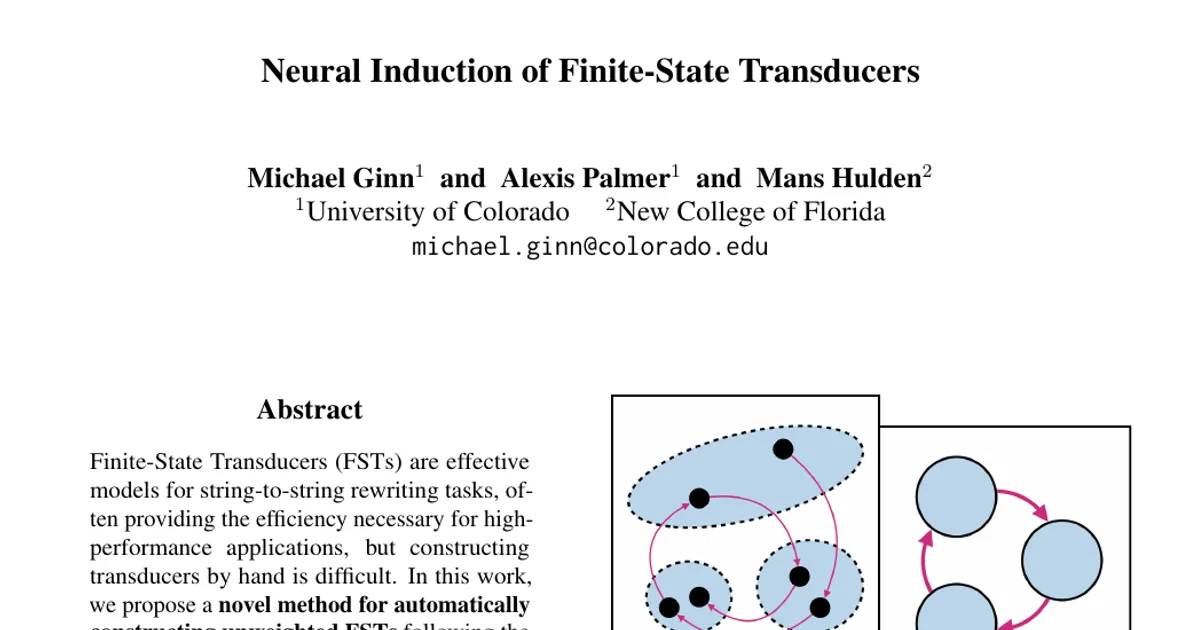
The researchers start with a recurrent neural network trained on a string-to-string rewriting task. Instead of treating that network as the final product, they inspect the geometry of its hidden states — the internal representation the network uses while reading and producing strings — and use that structure as a blueprint for building a finite-state transducer. The resulting transducer is unweighted and follows the same state organization the network discovered. The researchers then measure how well these constructed transducers perform on held-out test data and compare them against transducers produced by classical learning algorithms.
Why This Matters
- Research impact: The work connects two normally separate traditions — neural sequence modeling and finite-state methods — by using a neural network as a source of structure for a symbolic, efficient model. It suggests that neural training can be a route to building transducers rather than a replacement for them.
- Bridging a known bottleneck: Hand-building transducers is difficult and automatic learning is imperfect; this offers a third path that the abstract claims is considerably more accurate than the classical alternative.
Real-world applications (grounded in the tasks the abstract names):
- Morphological inflection — generating correctly inflected word forms, useful in grammar checkers, machine translation preprocessing, and language-learning tools.
- Grapheme-to-phoneme prediction — converting written text to pronunciations, a core component of text-to-speech and speech recognition systems.
- Historical normalization — standardizing historical or non-standard text so that modern NLP tools can process it, relevant to digital humanities and archival work.
- General string rewriting in constrained settings — any pipeline where a compact, fast transducer is preferable to running a neural network at inference time.
Industry relevance: Finite-state transducers are prized for efficiency in high-performance applications, and the abstract explicitly frames this motivation. A reliable automatic construction method lowers the expertise barrier for deploying transducers in production language pipelines, where speed and small model size often matter as much as accuracy.
Future Directions
- Whether the method extends to weighted transducers, given that this work constructs unweighted ones.
- How well the approach generalizes to rewriting tasks beyond the three evaluated here, and to languages or data conditions not represented in those datasets.
- Whether the hidden-state geometry of other neural architectures, not just recurrent networks, can serve the same blueprint role.
- The trade-off between the size or complexity of the constructed transducer and its accuracy, and how it compares on efficiency — not just accuracy — against classical learning and against the neural model itself.
Target Audience
Researchers and practitioners working at the intersection of finite-state methods and neural NLP; developers who need efficient string-rewriting components for tasks such as text-to-speech, morphological generation, or historical text processing; and anyone studying how knowledge stored in neural networks can be extracted into interpretable, efficient symbolic models.
Authors’ abstract
Finite-State Transducers (FSTs) are effective models for string-to-string rewriting tasks, often providing the efficiency necessary for high-performance applications, but constructing transducers by hand is difficult. In this work, we propose a novel method for automatically constructing unweighted FSTs following the hidden state geometry learned by a recurrent neural network. We evaluate our methods on real-world datasets for morphological inflection, grapheme-to-phoneme prediction, and historical normalization, showing that the constructed FSTs are highly accurate and robust for many datasets, substantially outperforming classical transducer learning algorithms by up to 87% accuracy on held-out test sets.