Research
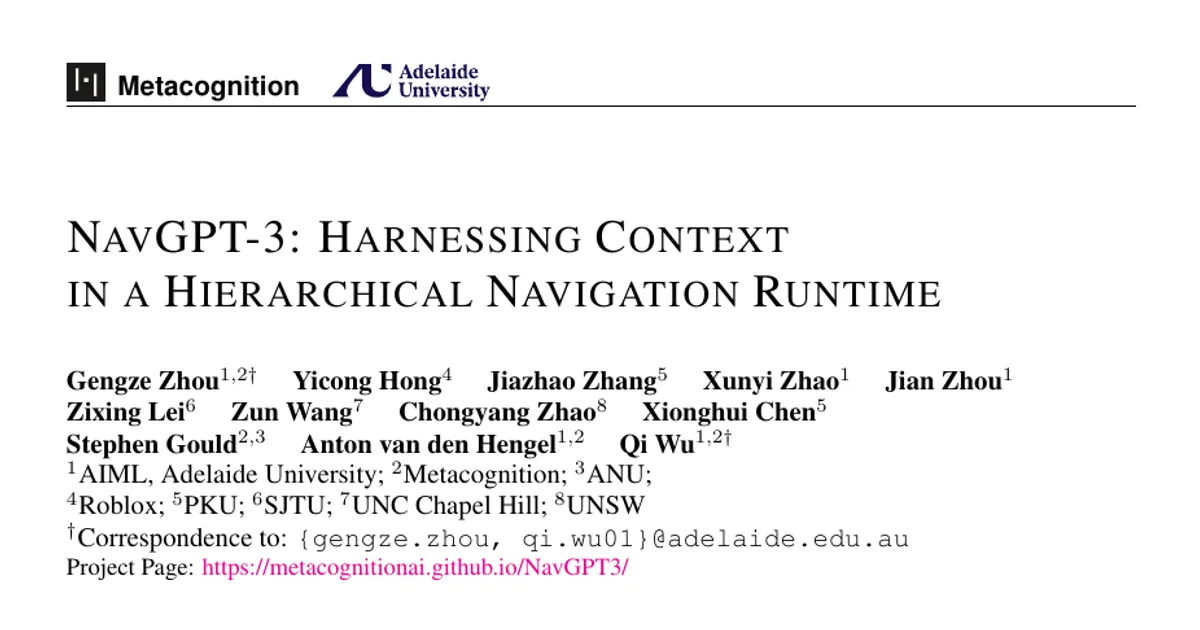
NavGPT-3: Harnessing Context in a Hierarchical Navigation Runtime
Overview Research area: Embodied AI and robot learning — specifically Vision-and-Language Navigation (VLN) in continuous environments, combining large language model reasoning with a trained vision-la
- arXiv
- 2610.10787
- Published
- 2026-10-07
- Authors
- Gengze Zhou, Yicong Hong, Jiazhao Zhang, Xunyi Zhao, Jian Zhou, Zixing Lei, Zun Wang, Chongyang Zhao, Xionghui Chen, Stephen Gould, Anton van den Hengel, Qi Wu
AI summary
Overview
Research area: Embodied AI and robot learning — specifically Vision-and-Language Navigation (VLN) in continuous environments, combining large language model reasoning with a trained vision-language-action (VLA) policy.
Technical level: Advanced. The paper assumes familiarity with VLN benchmarks (R2R-CE, RxR-CE), VLA training, token-budgeted visual context, and system-level scheduling abstractions.
Scope (one sentence): The paper describes NavGPT-3, a system that connects a reasoning LLM "Planner" to an 8B navigation action policy through a structured tool harness and an OS-like runtime that manages concurrent threads, motion authority, and interrupts, and reports state-of-the-art and human-level results on R2R-CE and RxR-CE.
What This Paper Is About
Language models trained with long-horizon agentic reinforcement learning can reason about goals over many steps, but they decide slowly — the paper measures 3–19 s per decision — while a robot must act continuously on the world's clock. Conversely, trained action policies give dense, low-latency control (0.5–1 s per step, 1–2 Hz) but are far weaker at following instructions and drift over long rollouts. The goal is to build the missing interface between these two kinds of models: a harness that supplies context, spatial tools, persistent state, and inspectable execution feedback, plus a runtime that decides which component is allowed to move the robot at any moment.
Key Contributions
-
A complete navigation harness uniting context management, spatial tools (observation, instruction delegation, spatial revision, semantic completion), persistent route state, structured execution returns, local route repair, and an explicit task-termination call, developed through automated recursive self-improvement (RSI) over tool definitions and visual prompts.
-
An OS-like runtime that runs reasoning, acting, and monitoring as threads with their own contexts, tools, and permissions, and that formalizes motion authority — a control-transfer rule with event priorities, where protective/safety events outrank routine review and stale events cannot restore an obsolete operation.
-
NavGPT VLA, a 4B and 8B navigation foundation model built on Qwen3-VL-Instruct with an MLP action head predicting eight waypoints, trained on a coverage-oriented taxonomy of 19.28M effective records per epoch across 83 sources — and using codec allocation, which assigns visual tokens to views in proportion to scene change (I-frame / P-frame scoring).
-
Empirical validation showing the harness alone changes LLM navigation performance substantially, that the benefit of the VLA depends on the strength of the Planner, and that the combined system reaches state of the art on R2R-CE (81.51 SR) and matches human followers on RxR-CE (90.43 vs. 90.4 SR).
Main Findings
-
Human-level navigation on RxR-CE: The full system reaches 90.43 SR versus 90.4 for human followers and 78.47 versus 77.7 nDTW, at 1 min 22 s per episode versus roughly 3 min for a human.
-
State of the art on R2R-CE: 81.51 SR with the complete harness. The 8B NavGPT VLA alone reaches 76.94 SR on R2R-CE and leads published methods on RxR-CE at 82.39 SR.
-
Reaction time drops by roughly an order of magnitude: Minimum reaction time falls from 3–19 s per language-model decision to 0.5–1 s per action-policy step (1–2 Hz) when the VLA executes the route.
-
The harness, not just the model, sets navigation quality: With only basic tools, GPT-6 Astra reaches 72 SR using 325.0k tokens per episode and Claude Opus 5 reaches 66 SR using 721.0k. Adding Map and Backtrack tools raises success to 83 and 73 SR respectively while cutting tokens by 41% and 33%. Astra's tools-only configuration (83 SR, 3.34 NE) is the most accurate in the ablation table.
-
Whether the VLA helps depends on the Planner: For Opus 5, delegation reduces turns (16.75 to 8.50–11.19) and raises success (73 to 76–81 SR) while lowering cost ($0.99 to $0.35–$0.40). For the stronger Astra, turns fall (10.71 to 3.37) but success drops to 75 SR and cost stays at $0.469, because tokens saved on navigation are spent supervising and correcting the VLA. The paper concludes the upper bound on success is set by the language model itself.
-
VLA-only baseline: On the 100-episode R2R-CE subset, NavGPT VLA alone scores 71 SR, 78 OSR, 4.23 NE, 66.14 SPL at 0.78 s reaction time.
-
Codec allocation shifts tokens to where change happens: At timestep t16 the four views (front, right, back, left) receive 80, 48, 24, and 35 tokens respectively. The rule is analyzed on 41,216 replayed image/context pairs from 13 recorded histories at a visual budget of 3072, and is shown to coincide with positional allocation when the budget-to-capacity ratio is at or above 1.
-
RSI produced a measurable harness trajectory: Of 14 candidate harnesses evaluated on all 100 episodes with SR ≥ 50%, progression runs from 66% SR (front-view observation and primitive stepping) to 72% (VLA delegation with the 4B policy), 76% (8B policy), and a development best of 81% (VLA execution plus spatial tools); an early place-graph interface scored 54% and the consolidated interface 77%.
-
Training mixture is action-heavy but grounding-rich: 65.6% of the 19.28M effective records supervise action regression and 34.4% supervise next-token prediction only; spatial reasoning plus grounding contribute about 18%, and general vision-language data 8.5%. Grounding data come from LocateAnything-Data (138M language queries, 785M boxes, 12M images), contributing 2.31M effective records, 12.0% of the mixture.
-
Transfer and real-robot deployment: The same runtime transfers to object-goal navigation (MP3D and HM3D v2) and embodied question answering, and is deployed on a Unitree Go2 robot. (Specific transfer and hardware numbers are reported in tables not included in the provided text.)
Methodology in Plain English
The system is split into two layers plus a policy underneath.
The harness defines what the Planner (a frontier LLM) can see and do. It assembles observations, history, and spatial state into a decision context, and exposes eight tools in four groups: basic tools (look forward, look around as a panorama, turn-and-move by a given angle and distance, terminate the episode), a VLA tool that hands the instruction — or the remaining part of it — to NavGPT VLA and returns up to eight route keyframes, endpoint views, and execution status, a Map tool returning a top-down map of observed area with visited places numbered in order, and Backtrack tools that return the robot to any numbered place and annotate places with recognized labels. A VLA stop ends only a delegation; only the Planner can end the episode.
The runtime treats reasoning, execution, and monitoring as concurrent threads and tracks which thread currently holds motion authority. Handoffs preserve each thread's context and only take effect after runtime authorization and execution acknowledgement. Two patterns are illustrated: a route-review interrupt that pauses execution for correction and then resumes, and a safety interrupt that revokes authority without waiting for LLM inference while reasoning continues, with resumption requiring fresh state and re-authorization.
The harness itself was designed by search, not by hand. The authors formulate harness development as a tree search over executable harness versions, with modules that propose edits, check them against interface constraints and past failures, run and score them, and record confirmed findings and dead ends. Search uses Claude Opus 5 on a fixed 100-episode subset of the R2R-CE training split (scenes disjoint from Val-Unseen) with success rate as the selection signal. The chosen interface is then frozen for evaluation, with no online weight updates.
The VLA predicts eight cumulative waypoints in the agent frame (x forward, y left, θ relative heading) from an instruction and up to 16 retained observations of four views, committing only the first waypoint before the next prediction. Because the visual budget is bounded, the first image of each view is a full-resolution I-frame, and later P-frames get tokens in proportion to a 64×64 thumbnail pixel-difference score multiplied by positional weights.
Training data is organized around coverage along four axes — capability (instruction following, exploration/object-goal, tracking, cross-embodiment driving), embodiment and camera interface (the same R2R-CE/RxR-CE episodes re-rendered as four-view panoramas and as front-camera sequences), conditions and edge cases (instruction rewriting, image stylization toward real camera appearance, SRDF data relabeled with shortest-path direction so off-path states teach recovery, geometry-aware resampling to reduce forward-motion bias, low-speed and open-space point-goal episodes), and visual-language understanding (grounding data trained with next-token prediction). All navigation sources are converted to the same eight-waypoint target, so coverage gained anywhere trains one shared action space. Training uses trajectory regression plus next-token prediction at unit weight on a 24-dimensional waypoint vector, with both 4B and 8B models trained under identical configurations.
Why This Matters
The paper argues that the interface between frontier language-model intelligence and low-level physical control — not either model alone — is the central engineering problem for embodied agents. It shows that a better harness alone can move a strong LLM from 72 to 83 SR on the same episodes while cutting token use by 41%, and that adding a faster executor is not automatically beneficial: the gain depends on how much of the task the Planner can already handle. The formalization of motion authority and prioritized interrupts gives a vocabulary for systems where a slow reasoner and a fast controller share one body — a coordination problem that becomes more pressing as reasoning models get slower and more capable.
Real-world applications implied by the work:
- Home and service robots that must follow natural-language requests ("bring me the cup from the kitchen") while reacting immediately to hazards such as a person stepping into the path.
- Assistive navigation for visually impaired users, where instruction-following fidelity (nDTW) and per-episode latency matter as much as success rate.
- Warehouse and last-mile delivery, where a slow cloud reasoner can set strategy while an on-robot policy executes at 1–2 Hz over long routes.
- Inspection and search in unseen buildings, where object-goal and exploration behavior — which the authors test as transfer tasks — replace step-by-step routes.
Industry relevance: The design maps cleanly onto commercial architectures where a hosted frontier model acts as planner over a small on-device policy, since the runtime explicitly budgets tokens, cost per episode, and turn counts (reported per configuration), and since the VLA is a modest 4B or 8B model. The dataset taxonomy and the codec-allocation trick are directly reusable by teams training navigation policies on mixed multi-embodiment data.
Future Directions
-
Closing the Planner–executor latency gap. The Planner still needs 3–19 s per decision, so the runtime's protective monitors carry the safety burden. How much autonomy a monitor should be granted, and how its revocations should be verified, is left as a systems question.
-
Better use of the VLA by stronger Planners. The finding that a stronger language model absorbs the VLA's benefit (Astra dropping to 75 SR with delegation) suggests the delegation interface and the supervision cost of correcting rollouts are not yet well matched to highly capable reasoners.
-
Generalizing the harness across embodiments and tasks. The paper demonstrates transfer to object-goal navigation, embodied question answering, and a Unitree Go2 deployment, but the tool set was developed and selected on R2R-CE training episodes; whether the same interface survives manipulation, outdoor driving, or human-robot interaction is untested.
-
Scaling and ablating the VLA corpus. The authors train additional models on cumulative scopes of the 19.28M-record mixture to study data and model scaling, but the mixture's composition — for example, the 15% SRDF subsample and the extensive grounding share — leaves open how much each axis of the taxonomy actually buys.
Target Audience
Researchers and engineers working on embodied AI, vision-and-language navigation, and LLM-agent system design; practitioners building planner-plus-policy robot stacks who need concrete numbers on token cost, reaction time, and when hierarchical delegation pays off; and readers interested in automated harness/interface engineering (RSI) as an alternative to hand-designed agent scaffolding. Beginners will find the system architecture readable but will need background in VLN benchmarks and VLA training to interpret the results.
Authors’ abstract
Language models trained with long-horizon agentic reinforcement learning can generalize knowledge through reasoning, express precise actions, and pursue goals over many steps, raising the ceiling on what an embodied agent can understand and decide. Physical interaction, however, remains the domain of action policies, which provide dense, low-latency control. We present NavGPT-3, a harness that connects the two models, with an OS-like runtime built above it: reasoning, acting, and monitoring run as threads with their own context, tools, and permissions, while the runtime schedules them and decides which thread controls the robot's motion, so that the robot can react to sudden real-world events through interruption and thread switching. Beneath it, our action policy NavGPT VLA, trained on 19.28M examples, allocates visual tokens using codec allocation, in proportion to scene change; its 8B model alone reaches 74.51 SR on R2R-CE and leads RxR-CE with 78.19 SR. With the complete harness, NavGPT-3 sets the state of the art on R2R-CE (81.51 SR) and, for the first time, brings an autonomous agent to human level: on RxR-CE it matches human followers in success (90.43 vs. 90.4 SR) and path fidelity (78.47 vs. 77.7 nDTW) at 1 min 22 s per episode, versus roughly 3 min for a human. We comprehensively ablate the harness design and the interaction between the two models, showing how tools and the action policy shape the path from language-model reasoning to physical control: when NavGPT VLA executes the route, the reasoning loop shortens and the system's minimum reaction time falls from 3-19 s per language-model decision to 0.5-1 s per action-policy step (1-2 Hz). These results show that designing this embodied interface is central to connecting frontier language-model intelligence with low-level physical control. We will release all models, code, and evaluation records.