Research
NaiLIA: Multimodal Nail Design Retrieval Based on Dense Intent Descriptions and Palette Queries
NaiLIA: Multimodal Nail Design Retrieval Based on Dense Intent Descriptions and Palette Queries Overview Research area: Computer vision / multimodal image retrieval, applied to the fashion and beauty
- arXiv
- 2603.05446
- Published
- 2026-03-05
- Authors
- Kanon Amemiya, Daichi Yashima, Kei Katsumata, Takumi Komatsu, Ryosuke Korekata, Seitaro Otsuki, Komei Sugiura
AI summary
NaiLIA: Multimodal Nail Design Retrieval Based on Dense Intent Descriptions and Palette QueriesOverview
- Research area: Computer vision / multimodal image retrieval, applied to the fashion and beauty domain (nail design), with connections to vision-language foundation models and contrastive learning.
- Technical level: Intermediate. The paper assumes familiarity with contrastive losses (InfoNCE), vision-language encoders (CLIP-style models), and retrieval metrics such as MRR and recall@K, though the core ideas are explained clearly enough for a reader with basic machine learning background.
- Scope: The paper proposes a retrieval method (NaiLIA) that ranks nail design images against long, multi-layered text descriptions plus optional continuous color palettes, and introduces the NAIL-STAR benchmark built for this task.
What This Paper Is About
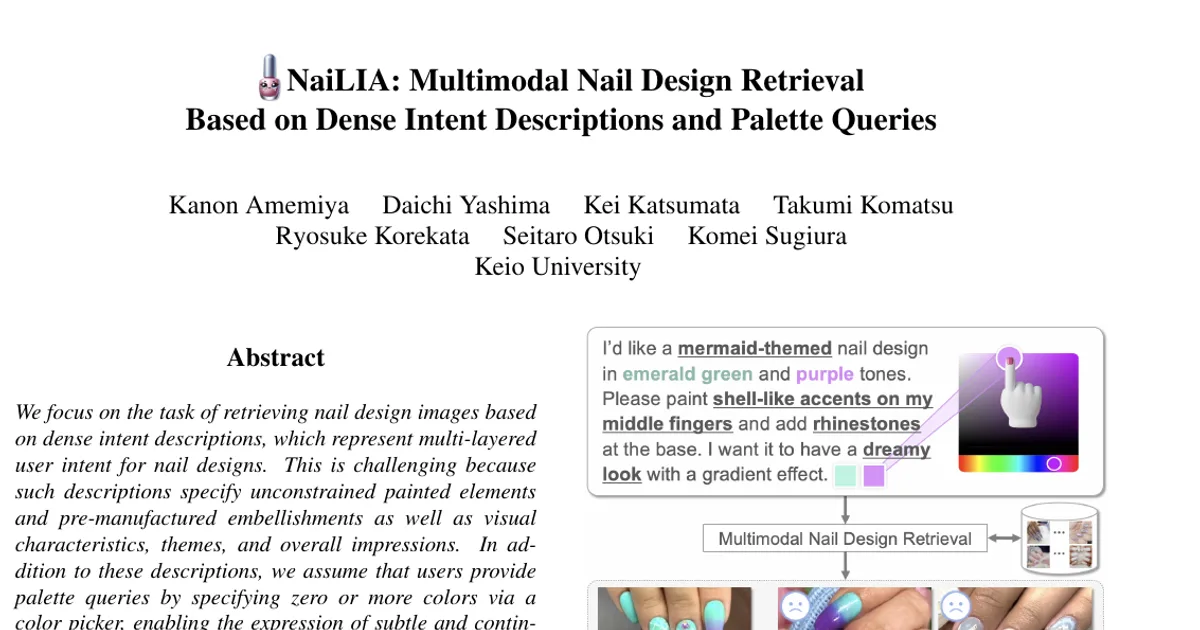
Clients describing a nail design to an artist tend to describe many things at once: painted patterns, pre-manufactured decorations like rhinestones, abstract themes such as "mermaid," overall impressions such as "dreamy," and specific color tones. The paper's goal is to let users search real nail design photographs using these dense intent descriptions, optionally supplemented by a palette query where they pick zero or more exact colors in a color picker. The authors argue that existing vision-language models fail here because they bias toward photorealistic interpretations and ignore continuous color input, so they build a method and a benchmark to address both problems.
Key Contributions
- Confidence-based Relaxed Alignment Module (CRAM): Estimates confidence scores for unlabeled positives — images that plausibly match a description but were not explicitly labeled as matching — and folds those scores into a relaxed contrastive (CRC) loss rather than treating every non-positive as a negative.
- Intent-Palette Fusion Module (IPFM): Structures the raw description into a multi-layered design description and a normalized noun phrase using an LLM, then uses the palette query to attention-weight color-related language elements.
- Visual Design Fusion Module (VDFM): Combines three visual representations — a unimodal visual representation, a multimodal aligned representation, and an img2txt intent structure representation generated by multiple MLLMs.
- NAIL-STAR benchmark: 10,625 nail design images with English descriptions and palette queries, annotated by 208 annotators, forming a new benchmark for the NAIL-STAR (Nail design Semantic Text-palette Aligned Retrieval) task.
Main Findings
- NAIL-STAR performance: NaiLIA (full) achieved the highest recall@1 of 56.4%, outperforming the best baseline, SigLIP, by 8.9 points. Its MRR was 67.6% and recall@10 was 88.0%.
- Description-only variant is still strong: NaiLIA (description-only) reached 49.5% recall@1, surpassing SigLIP by 2.0 points, indicating robust performance when no palette query is supplied.
- Marqo Fashion200K transfer: NaiLIA (full) achieved 74.6% recall@1, exceeding the best baseline (BLIP-2, 65.2%) by 9.4 points, with MRR 82.7% and recall@10 96.9%. The description-only variant improved over BLIP-2 by 8.6 points.
- Statistical significance: Performance differences between NaiLIA and baseline methods had a p-value < 0.01.
- IPFM ablation: Removing the multi-layered design description and/or the normalized noun phrase caused recall@1 decreases of 1.5, 1.9, and 4.8 points for Models (b), (c), and (d) relative to the full Model (a).
- VDFM ablation: Removing components of the visual representation caused recall@1 decreases of 1.3, 14.3, 2.4, and 3.3 points for Models (e), (f), (g), and (h). The largest drop (14.3 points) suggests the img2txt intent structure representation mattered most.
- CRC loss ablation: Replacing CRC with InfoNCE dropped recall@1 by 3.7 points; setting λ_UP = 0 dropped it 1.9 points; fixing c_ij = 0.7 instead of using estimated scores dropped it 1.3 points.
- CRC loss generalizes beyond NaiLIA: CLIP fine-tuned with CRC reached 16.5% recall@1 versus 15.5% with InfoNCE — a 1.0 point improvement.
- Palette queries help other models too: Adding palette queries improved CLIP by 5.8 points and SigLIP by 5.9 points on NAIL-STAR.
- Qualitative gap: On example queries, NaiLIA ranked target images at rank 1, while SigLIP ranked them at 24, 31, 137, and 37 across four shown cases.
Methodology in Plain English
The system takes three inputs: the user's long text description, a palette of zero or more RGB colors, and a pool of candidate nail images to rank.
On the text side, an LLM (GPT-4o) reformats the raw description into a structured "multi-layered design description" and condenses it into a "normalized noun phrase." These, along with the original text, are encoded by text encoders (BEiT-3 and SigLIP). The palette is converted from RGB into the CIELAB color space and passed through Transformer layers; the resulting palette representation then cross-attends over the language representations, letting the model emphasize the parts of the text that concern color.
On the image side, the model builds three complementary views of each candidate image: features from a unimodal image encoder (DINOv2) that capture raw visual properties like color, shape, and texture; features from multimodal image encoders (BEiT-3, SigLIP) that are already aligned to language; and a third view created by having MLLMs (GPT-4o and Qwen2-VL) describe the image in words — painted elements, decorations, themes, impressions — which are then encoded as text. Using multiple MLLMs is intended to reduce the harm of any single model's hallucinations. These three views are concatenated and passed through Transformer layers.
For training, the key insight is that many images in a batch may match a description even though only one is labeled as the positive. A separate MLLM (Qwen2-VL) scores how confident it is that each image is an unlabeled positive for a given description, using both the description's and the image's normalized noun phrases so the model focuses on design differences. If the confidence exceeds a threshold θ, the pair is added to a set of unlabeled positives. The CRC loss then has three parts: pull labeled positives toward similarity 1, penalize only those unlabeled-positive pairs whose similarity falls below their confidence score, and push negatives toward zero. At inference, images are simply sorted by cosine similarity between the language-palette representation and the visual representation.
Why This Matters
- Research impact: The paper challenges the default InfoNCE assumption that all non-positives are negatives — an assumption that is especially brittle in domains with many near-duplicate items. The CRC loss is shown to transfer to CLIP, suggesting it is a general-purpose contribution rather than a nail-specific trick. The paper also pushes multimodal retrieval toward richer query modalities, specifically continuous multi-color input, which the authors note has been largely overlooked in fashion AI.
- Real-world applications:
- Nail salon booking or design gallery search, letting clients describe what they want in their own words and pick exact colors.
- Beauty e-commerce and inspiration platforms (the paper notes several platforms have started restricting AI-generated imagery, making real-image retrieval attractive).
- Reference-matching for nail artists, avoiding the physically unrealizable accessories that AI-generated references often contain.
- Generalization to other fashion retrieval, as demonstrated on Marqo Fashion200K for clothing with long-form queries.
- Industry relevance: The global nail salon market is valued at approximately USD 11 billion according to the paper. The authors explicitly contrast retrieval with text-to-image generation, arguing that generated nail images frequently violate physical constraints and are being restricted by platforms.
Future Directions
- Extending the confidence-based relaxed alignment idea to other multimodal retrieval tasks with many similar images, which the authors themselves suggest as broadly applicable.
- Reducing dependence on multiple large models: the pipeline currently uses GPT-4o as an LLM, Qwen2-VL for confidence estimation, and multiple MLLMs for image explanations; the paper references a preprocessing method to speed up confidence estimation in its appendix but the efficiency question remains open.
- Examining LLM hallucination risk in the generated multi-layered descriptions and img2txt explanations, which the paper flags as a discussion point in its appendix rather than a solved problem.
- Broadening the benchmark beyond English descriptions and the 42 posting languages represented in the Pinterest-sourced images, and beyond the user-agnostic setting, since the authors explicitly state they do not incorporate user-specific personalization.
Target Audience
Researchers and practitioners in multimodal retrieval, vision-language modeling, and fashion/beauty AI who are interested in contrastive learning losses that handle noisy or incomplete labels, or in benchmarks for long-form and continuous-color queries. It is also relevant to product teams building visual search for beauty or e-commerce platforms, since the paper is motivated by a concrete commercial use case and reports results on both a purpose-built benchmark and a general fashion benchmark.
Authors’ abstract
We focus on the task of retrieving nail design images based on dense intent descriptions, which represent multi-layered user intent for nail designs. This is challenging because such descriptions specify unconstrained painted elements and pre-manufactured embellishments as well as visual characteristics, themes, and overall impressions. In addition to these descriptions, we assume that users provide palette queries by specifying zero or more colors via a color picker, enabling the expression of subtle and continuous color nuances. Existing vision-language foundation models often struggle to incorporate such descriptions and palettes. To address this, we propose NaiLIA, a multimodal retrieval method for nail design images, which comprehensively aligns with dense intent descriptions and palette queries during retrieval. Our approach introduces a relaxed loss based on confidence scores for unlabeled images that can align with the descriptions. To evaluate NaiLIA, we constructed a benchmark consisting of 10,625 images collected from people with diverse cultural backgrounds. The images were annotated with long and dense intent descriptions given by over 200 annotators. Experimental results demonstrate that NaiLIA outperforms standard methods.