Research
MultiCNKG: Integrating Cognitive Neuroscience, Gene, and Disease Knowledge Graphs Using Large Language Models
Overview Research area: Biomedical and cognitive-science knowledge graph construction, using large language models as the integration engine rather than traditional machine learning. Technical level:
- arXiv
- 2510.06742
- Published
- 2025-10-08
- Authors
- Ali Sarabadani, Kheirolah Rahsepar Fard
AI summary
Overview
Research area: Biomedical and cognitive-science knowledge graph construction, using large language models as the integration engine rather than traditional machine learning.
Technical level: Advanced. The work assumes familiarity with knowledge graphs, entity alignment, graph embeddings (TransE, RotatE), and link-prediction evaluation metrics.
Scope: The paper introduces MultiCNKG, a framework that fuses a cognitive-neuroscience knowledge graph with the Gene Ontology and Disease Ontology into a single multi-layered graph linking genes, diseases, and cognitive processes.
What This Paper Is About
Biomedical and cognitive-science knowledge is scattered across separate resources: genetic annotations, disease classifications, and cognitive-neuroscience findings live in different graphs with different schemas and vocabularies. Traditional machine learning methods struggle to capture the semantic links that would connect these domains. The authors build a framework, MultiCNKG, that uses large language models to align entities across three source graphs and merge them into one coherent structure spanning molecular through behavioral levels.
Key Contributions
-
A three-source integration framework. MultiCNKG merges the Cognitive Neuroscience Knowledge Graph (CNKG; 2.9K nodes, 4.3K edges, 9 node types, 20 edge types), the Gene Ontology (GO; 43K nodes, 75K edges, 3 node types, 4 edge types), and the Disease Ontology (DO; 11.2K nodes, 8.8K edges, 1 node type, 2 edge types).
-
An LLM-driven construction pipeline. The authors use models such as GPT-4 for entity alignment, semantic similarity computation, and graph augmentation, rather than relying on rule-based or classical ML matching.
-
A unified graph with cross-domain relation types. The resulting MultiCNKG contains 6.9K nodes across 5 types (including Genes, Diseases, and Cognitive Processes) and 11.3K edges across 7 types (including Causes, Associated with, and Regulates).
-
A multi-metric evaluation of graph quality. The framework is assessed with precision, recall, coverage, graph consistency, novelty detection, expert validation, and link-prediction benchmarks.
Main Findings
-
Quality metrics as claimed: The abstract reports precision of 85.20%, recall of 87.30%, coverage of 92.18%, graph consistency of 82.50%, novelty detection of 40.28%, and expert validation of 89.50%, presented as evidence of the graph's robustness and coherence.
-
Link prediction is competitive but mixed: TransE achieved mean rank (MR) 391 and mean reciprocal rank (MRR) 0.411, while RotatE achieved MR 263 and MRR 0.395. RotatE ranks correct answers higher on average (lower MR), while TransE scores slightly better on MRR.
-
Benchmark comparison is asserted, not quantified: The abstract states that these results are competitive against benchmarks such as FB15k-237 and WN18RR, but it does not report the corresponding benchmark numbers, so the size of any gap cannot be judged from the abstract alone.
-
A layered molecular-to-behavioral view: By combining genetic, disease, and cognitive-process nodes with relations like Causes and Regulates, the graph is intended to support reasoning that crosses biological and behavioral levels.
-
Novelty detection is the weakest reported metric: At 40.28%, it is by a wide margin the lowest of the reported assessment figures; the abstract does not explain what it measures or why the value is low.
-
Node count after merging is not explained: The three source graphs total roughly 57K nodes by the abstract's own figures, while the merged MultiCNKG is reported at 6.9K nodes. The abstract does not describe the filtering, deduplication, or entity-resolution steps that produce this reduction.
Methodology in Plain English
The researchers started with three existing knowledge sources — one about cognitive neuroscience, one about genes, and one about diseases. Each uses its own vocabulary and its own kinds of entities and relationships. Because a concept like a specific gene or a neurological disorder may appear under different names or identifiers in different sources, the team used large language models to decide which entries refer to the same thing (entity alignment) and to judge how semantically close different entries are (semantic similarity). They then added new connections to fill gaps (graph augmentation), producing one merged graph. Evaluation combined automated measures of alignment quality and graph coherence with human expert review, plus standard link-prediction tests using two common graph embedding models.
Why This Matters
Impact on research. Cross-domain knowledge graphs are a route to hypothesis generation: if genes, diseases, and cognitive processes sit in one graph with typed relations, queries can surface connections that no single source contains. Using LLMs for alignment also offers an alternative to hand-built ontologies and rule-based matchers, which are labor-intensive and brittle across vocabularies.
Real-world applications (as the abstract proposes):
- Personalized medicine, where genetic and disease layers inform treatment selection.
- Diagnostics for cognitive disorders, drawing on links between neurological conditions and cognitive processes.
- Hypothesis formulation in cognitive neuroscience, using graph structure to propose new gene–disease–cognition relationships.
- Cross-domain retrieval and reasoning, where queries spanning molecular and behavioral levels are otherwise difficult to answer.
Industry relevance. Pharma and biotech research groups, clinical decision-support vendors, and biomedical data-integration platforms all depend on linking heterogeneous ontologies. A pipeline that uses general-purpose LLMs for alignment is attractive because it can be adapted to new sources without writing bespoke matching rules. The reported expert-validation figure matters commercially, since domain experts remain the bottleneck in curating such resources. The link-prediction results also indicate the graph is structured well enough for embedding-based methods to be applied on top of it.
Future Directions
-
Explaining the merge. Clarify the entity-resolution and filtering steps that reduce three sources totaling roughly 57K nodes to a 6.9K-node graph, and quantify what information is retained or lost.
-
Interpreting novelty detection. At 40.28%, this metric is far below the others; understanding what it captures would show whether the graph is genuinely finding new relationships or failing to.
-
Benchmarking in full. Reporting the FB15k-237 and WN18RR figures alongside the TransE and RotatE results would let readers assess the "competitive" claim directly instead of taking it on assertion.
-
Validating the downstream uses. The abstract names personalized medicine, cognitive disorder diagnostics, and hypothesis formulation as applications, but describes no task-level evaluations; testing whether the graph actually improves decisions in those settings is the natural next step.
-
Assessing LLM dependence. Whether alignment quality depends on a specific model such as GPT-4, and how sensitive results are to the choice of LLM, is not addressed in the abstract.
Target Audience
Researchers and practitioners in biomedical knowledge engineering, neuroinformatics, and clinical data integration who are interested in LLM-assisted ontology merging. It will also suit data scientists building graph-based retrieval or reasoning systems in the life sciences, and cognitive neuroscientists curious about connecting their domain to genomic and disease data. Readers without a background in knowledge graphs, entity alignment, or embedding-based link prediction will find the evaluation framework hard to interpret without supplementary reading.
Authors’ abstract
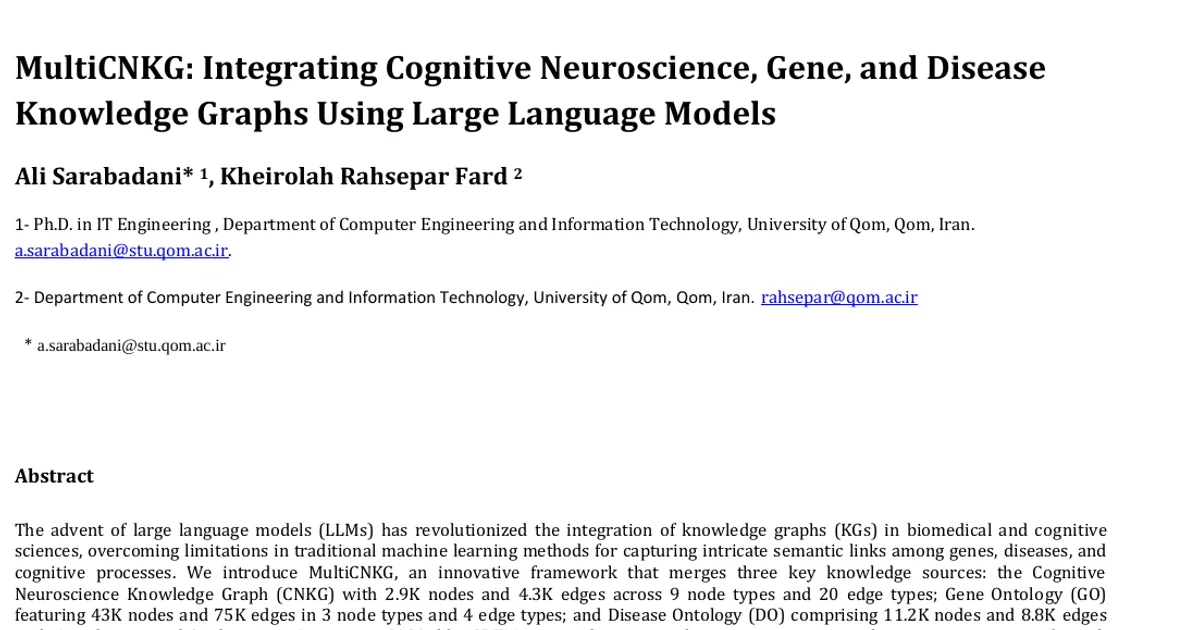
The advent of large language models (LLMs) has revolutionized the integration of knowledge graphs (KGs) in biomedical and cognitive sciences, overcoming limitations in traditional machine learning methods for capturing intricate semantic links among genes, diseases, and cognitive processes. We introduce MultiCNKG, an innovative framework that merges three key knowledge sources: the Cognitive Neuroscience Knowledge Graph (CNKG) with 2.9K nodes and 4.3K edges across 9 node types and 20 edge types; Gene Ontology (GO) featuring 43K nodes and 75K edges in 3 node types and 4 edge types; and Disease Ontology (DO) comprising 11.2K nodes and 8.8K edges with 1 node type and 2 edge types. Leveraging LLMs like GPT-4, we conduct entity alignment, semantic similarity computation, and graph augmentation to create a cohesive KG that interconnects genetic mechanisms, neurological disorders, and cognitive functions. The resulting MultiCNKG encompasses 6.9K nodes across 5 types (e.g., Genes, Diseases, Cognitive Processes) and 11.3K edges spanning 7 types (e.g., Causes, Associated with, Regulates), facilitating a multi-layered view from molecular to behavioral domains. Assessments using metrics such as precision (85.20%), recall (87.30%), coverage (92.18%), graph consistency (82.50%), novelty detection (40.28%), and expert validation (89.50%) affirm its robustness and coherence. Link prediction evaluations with models like TransE (MR: 391, MRR: 0.411) and RotatE (MR: 263, MRR: 0.395) show competitive performance against benchmarks like FB15k-237 and WN18RR. This KG advances applications in personalized medicine, cognitive disorder diagnostics, and hypothesis formulation in cognitive neuroscience.