Research
Multi-Scale Local Speculative Decoding for Image Generation
Overview Research area: Efficient inference for autoregressive (AR) text-to-image generation, specifically speculative decoding, multi-scale generation, and parallel decoding for multimodal large lang
- arXiv
- 2601.05149
- Published
- 2026-01-08
- Authors
- Elia Peruzzo, Guillaume Sautière, Amirhossein Habibian
AI summary
Overview
- Research area: Efficient inference for autoregressive (AR) text-to-image generation, specifically speculative decoding, multi-scale generation, and parallel decoding for multimodal large language models.
- Technical level: Advanced. The paper assumes familiarity with speculative decoding, draft-and-verify sampling, VQ-VAE latent token grids, and acceptance/threshold mathematics.
- Scope: The paper introduces MuLo-SD, a decoding framework that combines low-resolution drafting with spatially localized verification to accelerate autoregressive image synthesis while preserving semantic alignment and perceptual quality.
What This Paper Is About
Autoregressive image models generate one image token at a time, so producing a high-resolution picture requires thousands of sequential steps and creates severe latency. Standard speculative decoding can speed this up by drafting several tokens with a cheaper model and verifying them in parallel, but existing image-domain adaptations still treat tokens as a flat sequence, ignoring the spatial and multi-scale structure of images, which leads to low acceptance rates. This paper asks whether a low-resolution drafter plus a spatially aware rejection and resampling mechanism can deliver larger speedups without degrading image quality.
Key Contributions
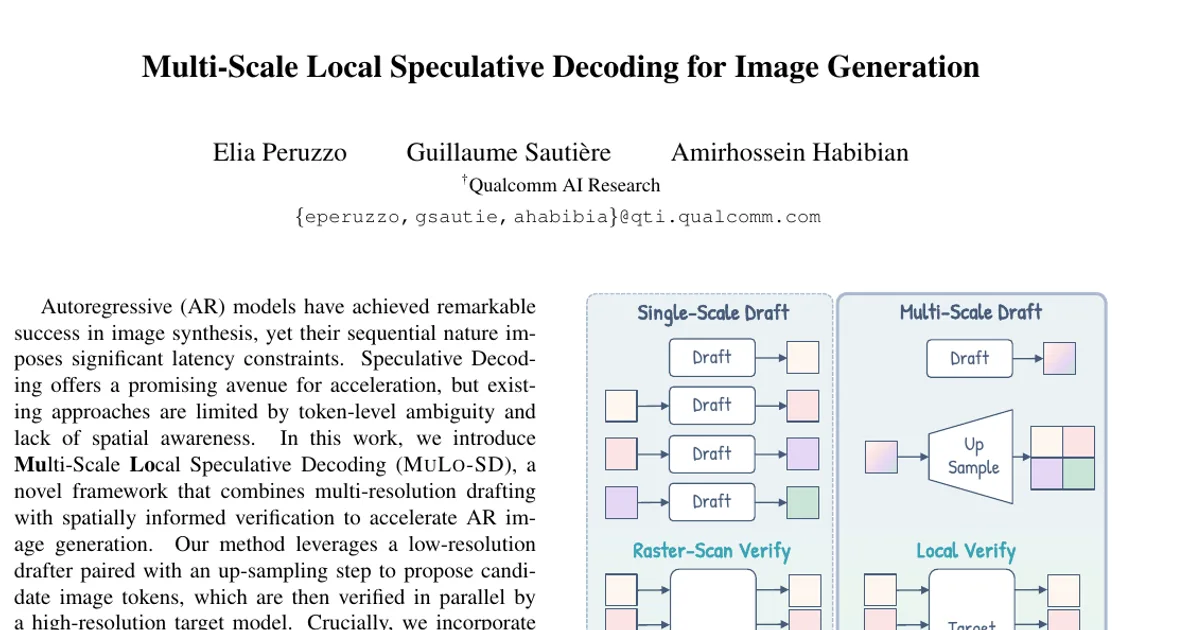
- Multi-scale drafting. A low-resolution draft model (the 256p AR checkpoint) proposes candidate tokens that are up-sampled by a factor r (2× for 512p, 4× for 1024p) before being verified in parallel by a high-resolution target model.
- Local verification with neighborhood expansion. Instead of rejecting everything after the first rejected token in raster-scan order, the method accepts a draft token when the pooled probability over its k nearest codebook neighbors exceeds a threshold τ, and re-samples only a local neighborhood of radius l around each rejected position (the locally expanded rejection set R_X).
- Integration with parallel decoding. Low-resolution drafting is done in one shot with ZipAR, and rejected positions are grouped into 8-connected "rejection islands" that are resampled concurrently, with ZipAR applied within each island.
- Empirical validation. The method is benchmarked against ZipAR-16, EAGLE-2, and LANTERN on GenEval, DPG-Bench, and FID/HPSv2 over the MS-COCO 2017 5k validation split, with ablations on upsampler design, probability pooling, local expansion, and parallel decoding.
Main Findings
- Speedups up to 5.33×. On Tar-7B at 1024p, MuLo-SD (4×) reaches 5.33× speedup with GenEval 85.4 (+0.2 vs. the 85.2 baseline), DPG-Bench 80.8 (+0.4), FID 34.8 (-3.1), and HPSv2 29.5 (-0.8). The paper summarizes this as speedups "up to 5×."
- Gains at 1024p on Tar-1.5B. MuLo-SD (4×) achieves 3.90× vs. 1.42× for LANTERN and 3.65× for ZipAR-16, with GenEval 76.8 (-0.3), DPG-Bench 82.2 (-0.1), FID 31.3 (+0.4), and HPSv2 28.7 (-0.3).
- Stronger than LANTERN at 512p on Tar. Tar-1.5B: MuLo-SD (2×) reaches 1.94× vs. 1.08× for LANTERN (GenEval 76.4 vs. 75.9). Tar-7B: 2.03× vs. 1.20× (GenEval 85.1 vs. 84.9).
- EAGLE-2 is not suited to images. It is described as producing "negative speedups" on image data, with reported values of 0.96× (LlamaGen-XL 512p), 0.72× (Tar-1.5B 512p), 0.76× (Tar-7B 512p), 0.78× (Tar-1.5B 1024p), and 0.83× (Tar-7B 1024p) — below the 1.00× baseline.
- Weaker results on LlamaGen-XL. At 512p, MuLo-SD (2×) reaches 1.40×, below LANTERN's 1.59× and ZipAR-16's 1.88×. The authors attribute this to weaker distributional alignment between independently trained draft and target checkpoints on LlamaGen.
- LANTERN is harder to apply to Tar than to LlamaGen. The paper reports lower LANTERN speedups on Tar than the original paper's LlamaGen figures, likely because Tar is a much stronger model (GenEval 77.7% vs. 37.1%).
- Latent-space vs. pixel-space upsampling. Learned latent-space upsamplers with MSE, LPIPS, and PatchGAN adversarial losses improve perceptual quality over a token-level classification loss, but an off-the-shelf pixel-space upsampler (training-free, model-agnostic) is competitive and is adopted as the default.
- Probability pooling helps modestly. Pooling probability over the k nearest VQ codebook neighbors improves acceptance and stabilizes performance, particularly beyond the 1.2× speedup regime, but the paper notes the gains remain modest because the pooling parameter behaves similarly to the acceptance threshold τ.
- Both local expansion and parallel decoding matter. Ablations show that raster-scan rejection and naive local verification (without expansion) both underperform the proposed expansion mechanism, and that parallel decoding yields consistent end-to-end latency gains at matched τ with negligible metric changes.
Methodology in Plain English
The researchers take a model that can already generate images at several resolutions and use the cheapest one as a "drafter." The drafter quickly sketches a small, low-resolution version of the image. That sketch is then enlarged — either by a small learned neural network that works in the compressed latent space or by an existing off-the-shelf pixel upscaler — into a full set of candidate tokens at the target resolution.
The full-resolution model then checks those candidates in parallel rather than one at a time. Instead of the standard rule that rejects everything after the first mistake, the method asks a softer question: does the probability mass around the drafted token, including its nearest codebook neighbors, clear a threshold τ? If yes, the token is kept.
When a token fails, the method does not restart the row. Because image models depend mostly on nearby pixels, it re-samples only a small neighborhood around the failure, radiating outward by a radius l, and never revisits positions before the first rejection. These rejected patches are grouped into connected "islands," and different islands are resampled at the same time, since the accepted tokens around them provide sufficient context. Within each island, parallel decoding fills in the gaps. This coarse-to-fine, check-locally, fix-locally loop repeats until the whole image is generated.
Why This Matters
Impact on research. The paper shows that the multi-scale structure of images — long exploited in diffusion models and next-scale-prediction AR models — is also a useful prior for speculative decoding under the next-token prediction objective. That matters because next-token prediction is what unified multimodal LLMs use; the paper claims to be the first speculative decoding method to leverage the multi-scale prior, and it does so without requiring a bespoke sampling schedule.
Potential real-world applications:
- Interactive text-to-image tools where users wait on screen for each generation and latency directly affects usability.
- On-device or edge image generation, where the paper notes memory constraints from loading two checkpoints and maintaining two KV-caches are a real practical limitation.
- High-resolution asset generation (the 1024p regime, where sequence length reaches 4096 tokens and base-model latency is about 80s).
- Batch or pipeline image production where throughput gains of multiple times reduce compute cost per image.
Industry relevance. The work comes from Qualcomm AI Research and targets the compute and latency cost of inference, which is a central concern for deploying large generative models at the edge. The default pixel-space upsampler is training-free and model-agnostic, which lowers the barrier to adopting the technique in existing codebases; the learned variant is model-specific and requires training on LAION-COCO-Aesthetic.
Future Directions
- Self-speculative decoding. The authors suggest a single checkpoint that drafts using internal layers and verifies with the full model, removing duplicate weights and KV-caches and improving cross-resolution alignment.
- Reducing memory overhead. Directly addressing the constraint that inference must load two checkpoint sets and maintain two caches, which the paper flags as prohibitive on memory-constrained devices.
- Robustness to distributional mismatch. Improving acceptance rates when drafter and verifier are trained independently or differ architecturally — the setting that produces the weaker LlamaGen results.
- Extension to video and other multimodal tasks. The conclusion lists video generation as future work.
Target Audience
Researchers and engineers working on efficient inference for generative models, particularly those building or deploying autoregressive text-to-image and unified multimodal LLM systems. It will also interest practitioners focused on speculative decoding, parallel decoding, and multi-scale generation who want to understand where token-level and raster-scan assumptions break down for visual data. Readers need a working grasp of draft-and-verify sampling and VQ-VAE latent token grids to follow the method and ablations in detail.
Authors’ abstract
Autoregressive (AR) models have achieved remarkable success in image synthesis, yet their sequential nature imposes significant latency constraints. Speculative Decoding offers a promising avenue for acceleration, but existing approaches are limited by token-level ambiguity and lack of spatial awareness. In this work, we introduce Multi-Scale Local Speculative Decoding (MuLo-SD), a novel framework that combines multi-resolution drafting with spatially informed verification to accelerate AR image generation. Our method leverages a low-resolution drafter paired with an up-sampling step to propose candidate image tokens, which are then verified in parallel by a high-resolution target model. Crucially, we incorporate a local rejection and resampling mechanism, enabling efficient correction of draft errors by focusing on spatial neighborhoods rather than raster-scan resampling after the first rejection. When integrated with parallel decoding resampling, MuLo-SD achieves substantial speedups -- up to $\mathbf{5\times}$ -- outperforming both speculative decoding and parallel decoding baselines in terms of acceleration, while maintaining comparable semantic alignment and perceptual quality. These results are validated using GenEval, DPG-Bench, and FID/HPSv2 on the MS-COCO 5k validation split. Extensive ablations highlight the impact of up-sampling design, probability pooling, and local rejection and resampling with neighborhood expansion. Our approach sets a new state-of-the-art in speculative decoding for image synthesis, bridging the gap between efficiency and fidelity. Project page is available at https://qualcomm-ai-research.github.io/mulo-sd-webpage/ .