Research
MotorMind: Scaffolding General Vision Language Models for Zero-Shot Robot Manipulation
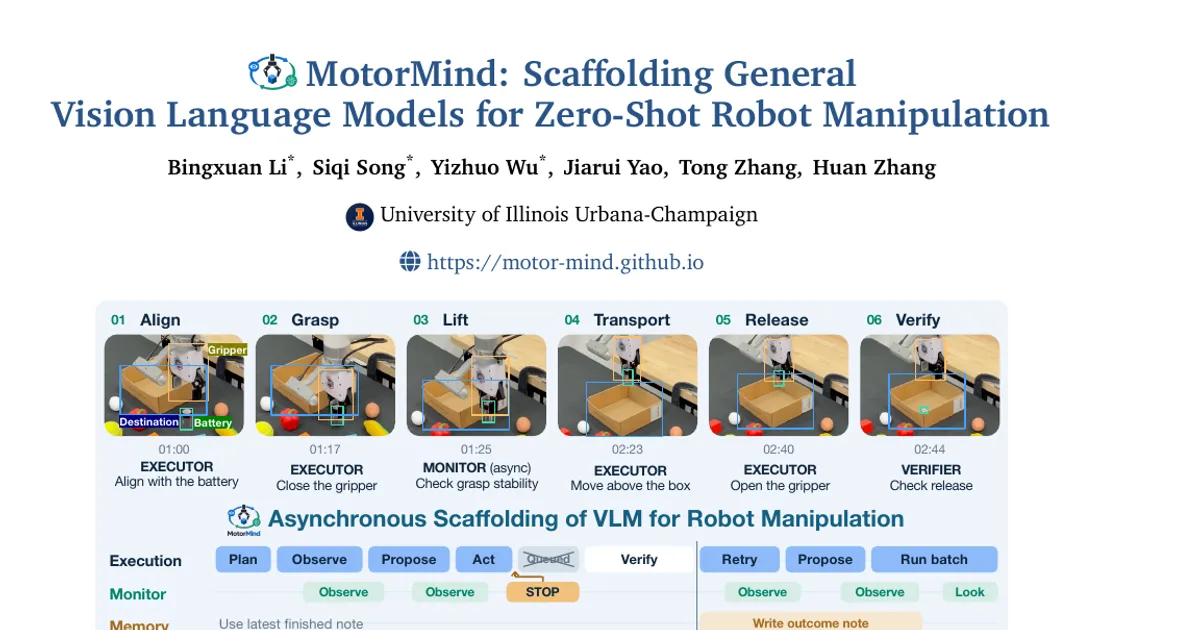
MotorMind: Scaffolding General Vision Language Models for Zero-Shot Robot Manipulation Overview Research area: Robotics — zero-shot robot manipulation, vision-language models (VLMs), and agentic robot
- arXiv
- 2609.38078
- Published
- 2026-09-29
- Authors
- Bingxuan Li, Siqi Song, Yizhuo Wu, Jiarui Yao, Tong Zhang, Huan Zhang
AI summary
MotorMind: Scaffolding General Vision Language Models for Zero-Shot Robot ManipulationOverview
- Research area: Robotics — zero-shot robot manipulation, vision-language models (VLMs), and agentic robotics.
- Technical level: Intermediate. The core idea is conceptually simple, but the paper assumes familiarity with vision-language-action (VLA) models, manipulation benchmarks, and control abstractions.
- Scope: The paper introduces a "harness" that lets a single frozen, general-purpose VLM act as the decision-making core of a robot arm — proposing mid-level actions, executing them through a deterministic controller, and correcting itself via asynchronous monitoring — evaluated on LIBERO-PRO in simulation and on a physical xArm6.
What This Paper Is About
Vision-language-action models can manipulate robots well on tasks they were trained on, but they generalize poorly to new tasks and environments, and they cannot directly absorb progress from general-purpose VLMs. Meanwhile, existing agentic systems that do use VLMs often bolt on many external components — learned action experts, coding agents, segmentation/grounding tools, motion planners. The authors ask whether a general-purpose VLM can operate a robot more like a human teleoperator: reasoning directly from observations, issuing actions, and continuously adapting to execution feedback, without any external models. MotorMind is their answer — a manipulation harness that connects VLM-proposed mid-level actions to deterministic robot control, with asynchronous monitoring and background memory updates, and no task-specific policy training.
Key Contributions
- A diagnostic benchmark for the local decisions manipulation requires. The authors build an embodied question-answering benchmark of 240 questions — 80 each for action selection, progress assessment, and subgoal completion — and evaluate six general-purpose VLMs on it to identify which capabilities are reliable and which are not.
- A VLM-centric manipulation harness with no external models. MotorMind assigns five reasoning roles to the same general-purpose VLM — Planner, Executor, Monitor, Verifier, and Memory — plus a deterministic Controller. It uses no learned action policy, no coding agent, no SAM-based perception, and no external inverse-kinematics solver.
- A mid-level action representation plus asynchronous scheduling. The VLM emits parameterized
move,rotate, andgripperactions in the robot's base frame; the Controller converts them into embodiment-specific motion. While motion proposals, outcome assessment, and replanning stay sequential, the Monitor runs on a background thread and can cancel pending commands at the next action boundary, and memory summaries are written without blocking the next subgoal. - Empirical evidence across simulation and a real robot. MotorMind achieves 66.7% success on the base LIBERO-PRO suites and 53.8% under perturbations as a zero-shot method, and 95% pooled success on a physical xArm6, while ablations show which reasoning roles sustain that performance.
Main Findings
- Action selection is the weakest VLM capability. Across the six evaluated models, action-selection accuracy ranges from 18.75% to 60.00%, lower than progress assessment and subgoal completion for every model. For Qwen3.8-Flash-Next, action accuracy is 36.25%, versus 55.00% for progress and 65.00% for completion.
- Stronger models are more accurate but much slower. GPT-6 Astra reaches the highest accuracy on all three diagnostics (60.00% action, 76.25% progress, 82.50% completion, 72.92% overall) but takes 8,724 ms per query, compared with 276 ms for Qwen3.8-Flash-Next (52.08% overall).
- Zero-shot LIBERO-PRO results. MotorMind attains 66.7% average base success (Goal 45.0%, Spatial 75.0%, Object 80.0%) and 53.8% under perturbations (Semantic 58.3%, Object 46.7%, Position 51.7%, Task 58.3%).
- A large margin over prior zero-shot methods. The prior zero-shot methods evaluated reach at most 13.3% on the base suites and 19.2% under perturbations — both from CaP-X running 10 loops. The zero-shot VLA policy baselines (π0.5, MolmoAct2, GR00T N1.5) score 0.0% on the base suites, and VoLoAgent with a zero-shot VLA scores 0.0%.
- Comparable to a task-fine-tuned policy under perturbations. Across 240 perturbed episodes, MotorMind (53.8%) is within 2.6 percentage points of fine-tuned OpenVLA/OFT (51.2%), despite using no task-specific policy training.
- Efficiency is reported explicitly. MotorMind's base evaluation averages 223.4 s per episode with a TimeScore of 17.91 pp/min, and the perturbation evaluation 248.5 s with 12.99 pp/min. The paper notes that time-normalized score is descriptive and not a measure of monetary or compute cost, and that short failed episodes do not indicate effective manipulation.
- Adapting to changes during execution. On adaptive tasks, MotorMind scores 70% on Dynamic Reasoning, 90% on Scene Shift, 80% on Dynamic Manipulation, and 60% on Prompt Shift, versus best baselines of 30%, 70%, 40%, and 60% respectively.
- Real-robot deployment works without fine-tuning. On a physical xArm6 with RealSense D455 cameras and the standard xArm6 SDK, MotorMind achieves a pooled 95% success rate across Direct Perception (98%) and Human Perturbations (92%). On four Semantic Understanding tasks evaluated over 5 trials each, success is 80%, 100%, 100%, and 60%.
- Backbone sensitivity. Swapping Qwen3.8-Flash-Next for GPT-6 Sol (Medium Reasoning) raises average base success from 66.7% to 83.3%, improving Spatial from 70% to 80%, Object from 80% to 100%, and Goal from 50% to 70% — at longer wall time in every suite, most notably Spatial at 370.4 s versus 199.0 s. The paper reports this comparison on a single seed.
- Ablations isolate the indispensable roles. Removing replanning drops success from 66.7% to 36.7% (a 30.0 percentage-point drop); removing the verifier yields 60.0% (a 6.7-point drop); removing the planner collapses success to 0.0%.
- Remaining failures cluster in two places. Excluding malformed outputs, grounding errors account for the largest share of failures overall, especially under Semantic, Object, and Position perturbations, while premature completion claims are a major source under Task and Object perturbations. Other categories are planning, progress checking, and failure monitoring.
Methodology in Plain English
The authors first diagnose the problem. They ask which semantic decisions a VLM actually needs to make during manipulation, settle on three — what to do next, whether the last action helped, and whether the current subgoal is done — and build a 240-question benchmark to measure how well current models handle each. Since action selection turns out to be the weakest, they design a system that never commits to long action sequences and can revise quickly.
The harness itself works like this. A Planner turns the natural-language instruction into an ordered list of subgoals, each with a target description and a success criterion. For the active subgoal, the Executor looks at current camera images, measured robot state (tool pose and gripper state), and recent cycle history, and proposes a short batch of actions drawn from a small vocabulary: move a given distance along a direction or axis, rotate by a given angle, or open/close the gripper — sometimes to a requested width. Because these are mid-level commands in the robot's base frame rather than joint torques, a deterministic Controller can validate them, convert them into motion, and record what actually happened. The VLM decides intent and magnitude; the controller handles physics.
Two roles keep the interaction honest. The Monitor watches the running subgoal on a background thread and can raise a STOP alert — for example, when the robot has grasped the wrong object — which cancels queued commands at the next action boundary. Crucially, the Monitor does not choose corrections; it only halts a continuation that looks wrong, and then normal outcome assessment decides what to do. The Verifier then judges the success criterion using both observations and measured robot evidence, where measurable facts like a lost grasp or a measured release can settle an attempt before a model verdict is even needed. Based on that, the harness either advances, retries the subgoal, or sends unresolved requirements back to the Planner. A Memory role condenses evidence and outcomes into a compact note on a background writer, so the next subgoal can start while the summary is still being generated.
Evaluation proceeds in three stages: LIBERO-PRO base and perturbed suites for task success and robustness; four groups of adaptive tasks (moving objects, scene shifts, conveyor manipulation, mid-execution instruction changes); and a physical xArm6 with direct, human-perturbed, and semantically specified instructions.
Why This Matters
The paper reframes zero-shot robotic control as a problem of aligning general-purpose model capabilities with control representation, rather than only learning specialized action policies from demonstrations. That is a meaningfully different bet from scaling VLA training data: if the bet holds, improvements in general multimodal models translate directly into better robot behavior — which the backbone-swap result (66.7% to 83.3%) is offered as evidence for, without any redesign of the architecture or retraining.
Real-world applications:
- Warehouse and logistics picking, where objects, layouts, and instructions change constantly and collecting in-domain demonstrations for every new arrangement is impractical.
- Home and service robotics, where a user can give a verbally specified instruction ("the food item," "the one in the middle") and the system must interpret it against the current scene.
- Laboratory and flexible manufacturing cells, where the same arm must handle changing target objects and destinations during a run, as in the conveyor setting.
- Human-collaborative environments, where a person may move or replace an object mid-task, as tested in the Human Perturbation setting.
Industry relevance: the design deliberately avoids dependency on learned action experts, coding agents, and grounding tools like SAM3, which reduces the number of components to maintain and the cost of running multiple external models. It also means the same VLM-facing interface works across simulation and a real xArm6 without policy adaptation, which lowers the barrier to deploying a new embodiment — the practical question most robotics teams face.
Future Directions
- Push on visual grounding. Grounding errors are the largest failure category overall, and stronger VLMs reduce them. The open question is whether better pretrained spatial understanding alone closes the gap, or whether some grounding scaffolding is still needed.
- Improve self-verification. Premature completion claims remain a major failure source, especially under Task and Object perturbations, which means a system can declare success without meeting the criterion. Better self-verification in future VLMs is the paper's own suggested remedy, and it is also an architectural question for the Verifier role.
- Resolve the accuracy–latency trade-off. GPT-6 Astra is the most accurate diagnostic model but 8,724 ms per query, and GPT-6 Sol raises success while slowing every suite (Spatial 370.4 s versus 199
Authors’ abstract
Vision-language-action (VLA) models have advanced robotic manipulation, but their zero-shot generalization in new tasks and environments remains limited, and their reliance on specialized training keeps them from benefiting directly from rapidly advancing general-purpose vision-language models (VLMs). In parallel, recent agentic robotic systems leverage VLMs for high-level reasoning or coding agents for robot control, but often depend on extensive external models and tools, introducing additional complexity and cost. This motivates us to ask: Can a general-purpose VLM itself operate a robot more like the human teleoperator by reasoning directly from observations, issuing actions, and continuously adapting to execution feedback, without relying on external models such as learned action experts, coding agents or grounding tools like SAM3? In this work, we introduce MotorMind, a robot manipulation harness that connects VLM-proposed mid-level actions to deterministic robot control and feedback, with asynchronous monitoring and background memory updates. Without task-specific policy training, coding agents, or additional grounding tools such as SAM3, MotorMind achieves 66.7% success on the base LIBERO-PRO suites and 53.8% under perturbations, compared with at most 13.3% and 19.2%, respectively, for the prior zero-shot methods we evaluate. The same interface reaches 95% average success on a real xArm6 robot across direct manipulation and human-perturbation settings. Replacing the backbone with a stronger VLM further improves performance, while the remaining failures - primarily due to visual grounding, embodied reasoning, and action knowledge - decrease as VLM capability improves. These results show that a general-purpose VLM, when equipped with an appropriate mid-level action representation and asynchronous execution harness, can perform effective zero-shot robotic manipulation.