Research
MonoCLUE : Object-Aware Clustering Enhances Monocular 3D Object Detection
MonoCLUE: Object-Aware Clustering Enhances Monocular 3D Object Detection Overview Research area: Computer vision, specifically monocular (single-image) 3D object detection for autonomous driving, eval
- arXiv
- 2511.07862
- Published
- 2025-11-11
- Authors
- Sunghun Yang, Minhyeok Lee, Jungho Lee, Sangyoun Lee
AI summary
MonoCLUE: Object-Aware Clustering Enhances Monocular 3D Object DetectionOverview
Research area: Computer vision, specifically monocular (single-image) 3D object detection for autonomous driving, evaluated on the KITTI benchmark.
Technical level: Advanced. The work assumes familiarity with DETR-style query-based detection, K-means clustering, cross-attention, deformable attention, and the Segment Anything Model (SAM).
Scope: The paper introduces MonoCLUE, a framework that injects object-level appearance cues into object queries through local K-means clustering and a dataset-wide "generalized scene memory," reporting state-of-the-art monocular results on KITTI.
What This Paper Is About
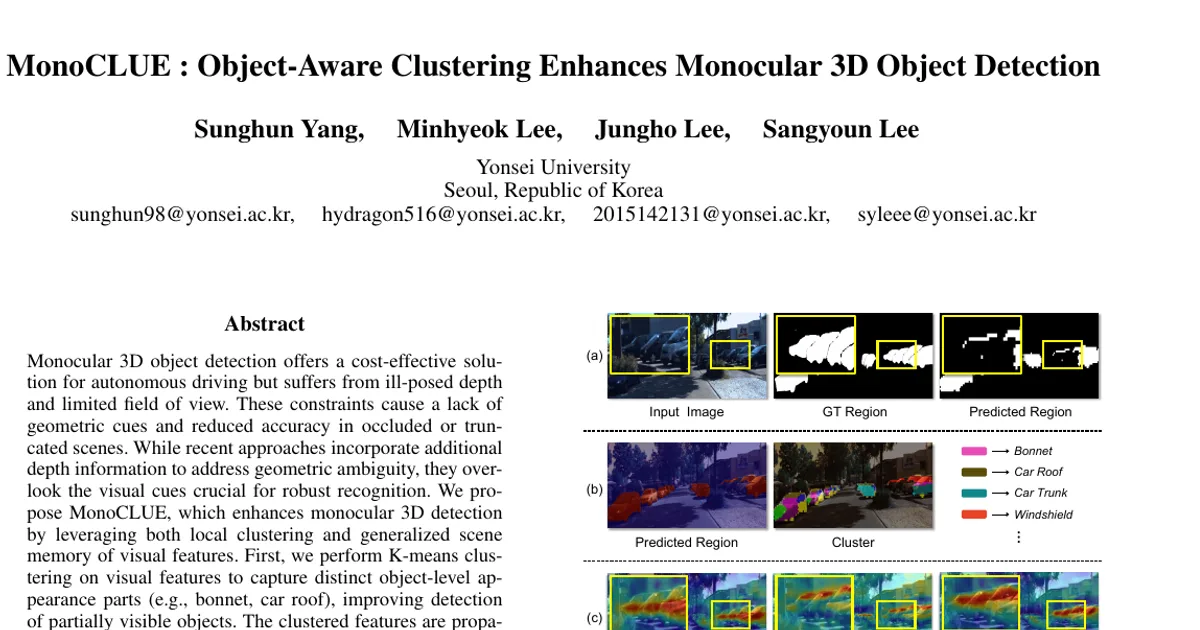
Monocular 3D detection must infer depth, location, size, and orientation from a single RGB image, which is a fundamentally ill-posed problem and also limits the observable field of view. Prior work has attacked this by adding depth cues (for example MonoDETR's foreground depth map and MonoDGP's geometric depth differences), but the authors argue these depth-focused approaches overlook visual appearance cues that are essential when objects are occluded, truncated, or overlapping. MonoCLUE instead clusters object-level visual features into appearance parts (such as a bonnet or a car roof), generalizes those clusters across the dataset into a shared memory, and feeds both into the detector's object queries.
Key Contributions
- Local clustering of object regions. K-means is applied to visual encoder features strictly inside SAM-guided, object-shaped segmentation masks, using masked average pooling to produce a set of local cluster features that capture diverse object-level visual patterns. This makes detection robust for partially visible instances.
- Generalized scene memory. Local cluster features from all images are aggregated, across the flattened batch dimension, into a shared memory of dataset-wide appearance patterns via cross-attention, providing consistent cues that generalize across scenes and stabilize predictions.
- Similarity-based re-localization. The local cluster features are used to compute pixel-wise cosine similarity maps, whose maximum over clusters produces a similarity map that is concatenated with visual features and used to initialize reference-point offsets for multi-scale deformable attention, re-localizing objects that the segmentation head misses.
- Query initialization with object, background, and scene features. Local cluster features, generalized scene memory, and additionally clustered background features are injected directly into the object queries before DETR-style decoding, giving object-aware priors and reducing memory cost by attending over a compact set of representative features rather than the full spatial map.
Main Findings
- KITTI test set, Car category (AP3D|R40): MonoCLUE achieves 27.94 (Easy), 19.70 (Moderate), and 16.69 (Hard), outperforming previous state-of-the-art methods by +1.59% and +0.86% for Easy and Moderate, respectively, without using extra information such as depth or LiDAR. It is best across all difficulty levels on both the test and validation sets except for the hard case on the test set.
- KITTI test set, Car category (APBEV|R40): 36.15 (Easy), 26.15 (Moderate), 22.81 (Hard).
- KITTI validation set, Car category (AP3D|R40): 33.74 (Easy), 24.10 (Moderate), 20.58 (Hard), an improvement of +2.98% (Easy) and +1.76% (Moderate). Corresponding APBEV|R40 values are 41.79, 29.91, and 26.00.
- Other categories (test set, Table 2): MonoCLUE reports the best performance for Pedestrian and the second-best for Cyclist. The reported values are 95.82 and 95.54 under Detection and Orientation, 10.45 for Pedestrian AP3D|Mod., and 3.20 for Cyclist AP3D|Mod., compared with MonoDGP's 94.35, 94.22, 9.89, and 2.28.
- Scene memory design matters (Table 3, validation AP3D|R40): with no generalized scene memory the model scores 30.66 / 23.03 / 19.71; a VQ-VAE-style codebook reaches 31.77 / 23.22 / 19.75; the cross-attention memory reaches 33.74 / 24.10 / 20.58. The paper reports gains of +3.08% and +1.11% for the cross-attention memory, and notes that the codebook struggles to find representative features using only the loss as guidance and that some codebook slots remain unused.
- Every core component helps (Table 4, validation AP3D|R40): no components 29.61 / 22.06 / 18.75; SAM guidance only 29.82 / 22.62 / 19.30; SAM guidance plus re-localization 31.14 / 23.20 / 20.02; SAM guidance plus query initializer 32.91 / 23.93 / 20.36; all three components 33.74 / 24.10 / 20.58. The paper attributes a +0.7% gain in the hard case to re-localization, and gains of +3.9% (Easy) and +1.31% (Moderate) to the query initializer compared with using only SAM; removing SAM guidance means training with box-shaped masks, which the authors state includes background noise in object regions and degrades performance.
- Favorable cost-performance trade-off (Table 5): MonoDETR uses 37.68M parameters, 59.72G FLOPs, scores 20.61 AP3D|R40 (Moderate) and runs in 35 ms; MonoDGP uses 42.16M parameters, 68.99G FLOPs, scores 22.34 and runs in 42 ms; MonoCLUE uses 44.17M parameters, 72.71G FLOPs, scores 24.10 and runs in 52 ms. The paper describes this as a performance gain of +1.76% with a much smaller increase in parameters (2.01M) and FLOPs (3.72G) than MonoDGP's 4.48M and 9.27G.
- Qualitative behavior: compared with MonoDETR and MonoDGP on the KITTI validation set, MonoCLUE is reported as more robust on small, distant, occluded objects, and consistent in BEV for rows of aligned cars that share similar orientation and therefore similar cluster features.
- Implementation setting: ResNet-50 backbone, 50 object queries, 8 attention heads, 4 sampling points in multi-scale deformable attention, depth range 0–60 m uniformly quantized into 80 bins, CUDA-implemented K-means, N_l = 10, N_g = number of classes, N_b = 3, trained for 250 epochs with batch size 8 on a single RTX 3090 using AdamW with initial learning rate 2×10⁻⁴ and step decay; at inference, queries below 0.2 confidence are filtered and no NMS is applied.
- Dataset and protocol: KITTI contains 7,481 training and 7,518 test images with Car, Pedestrian, and Cyclist categories; the training set is split into 3,712 training and 3,769 validation images, and results are reported as AP3D and APBEV at 40 recall positions per difficulty level.
Methodology in Plain English
The authors keep the standard two-branch monocular detector structure (a visual encoder and a depth encoder, following MonoDETR) and a DETR-style query decoder (following MonoDGP), then change how the visual features are summarized and handed to the queries.
First, a region segmentation head is trained using masks produced by SAM, and crucially the masks are object-shaped rather than the box-shaped masks used previously, so clustering is confined to actual object pixels. Inside each mask, K-means groups the visual encoder's features into a fixed number of clusters, and each cluster is summarized by masked average pooling into a local cluster feature. The idea is that these clusters should correspond to parts of an object, which helps when only part of the object is visible.
Second, because clusters computed from one image cannot express patterns shared across scenes, all local cluster features from the batch are flattened and used as keys and values in a cross-attention operation whose query is a set of learnable memory vectors. This memory is updated every training iteration, so it accumulates commonly recurring appearance patterns across the dataset and can act as a stable reference when a single image's clusters are ambiguous.
Third, the local cluster features are compared against every pixel's visual feature using cosine similarity. Taking the maximum similarity over clusters yields a single map that marks object-like candidate regions, including ones the segmentation head missed. That map is concatenated with the visual features and used to bias deformable attention sampling toward object centers, computed as a softmax-weighted average of grid locations.
Finally, the queries are initialized, not from scratch, but from the local cluster features, the generalized scene memory, and an additional set of background clusters obtained the same way from outside the object masks. Since these N_l + N_g + N_b features already summarize the scene, the decoder attends over this compact set instead of the full spatial feature map, which saves memory. Training uses the MonoDGP loss composition: 2D detection, 3D estimation, depth regression, and region segmentation terms combined with weighting factors.
Why This Matters
Impact on research. The paper argues that the monocular detection community has been optimizing geometric depth cues while neglecting the visual appearance cues that actually carry information about object centers, spatial position, and orientation under occlusion. The results suggest that object-level clustering plus a scene-level memory is a complementary direction to depth enhancement, and that it can be added on top of an existing DETR-style pipeline with modest parameter and FLOPs overhead (44.17M parameters, 72.71G FLOPs versus MonoDETR's 37.68M and 59.72G).
Real-world applications:
- Autonomous driving perception on vehicles where LiDAR or multi-camera rigs are too expensive to deploy, which the paper presents as the core motivation for monocular detection.
- Advanced driver assistance and safety systems that need to recognize partially occluded vehicles, pedestrians, and cyclists in traffic.
- Robotics and mobile platforms with a single camera that must reason about 3D object placement.
- Traffic monitoring and analysis from fixed single-camera installations, where extra viewpoints are unavailable.
Industry relevance. The cost argument matters commercially: a method that improves single-image detection without depth or LiDAR inputs targets the low-cost end of the autonomous driving sensor stack. The reported runtime of 52 ms on an RTX 3090
Authors’ abstract
Monocular 3D object detection offers a cost-effective solution for autonomous driving but suffers from ill-posed depth and limited field of view. These constraints cause a lack of geometric cues and reduced accuracy in occluded or truncated scenes. While recent approaches incorporate additional depth information to address geometric ambiguity, they overlook the visual cues crucial for robust recognition. We propose MonoCLUE, which enhances monocular 3D detection by leveraging both local clustering and generalized scene memory of visual features. First, we perform K-means clustering on visual features to capture distinct object-level appearance parts (e.g., bonnet, car roof), improving detection of partially visible objects. The clustered features are propagated across regions to capture objects with similar appearances. Second, we construct a generalized scene memory by aggregating clustered features across images, providing consistent representations that generalize across scenes. This improves object-level feature consistency, enabling stable detection across varying environments. Lastly, we integrate both local cluster features and generalized scene memory into object queries, guiding attention toward informative regions. Exploiting a unified local clustering and generalized scene memory strategy, MonoCLUE enables robust monocular 3D detection under occlusion and limited visibility, achieving state-of-the-art performance on the KITTI benchmark.