Research
Modality-Autoregressive World-Action Models
Overview Research area: Robotics — world-action models, robot imitation learning, and multimodal generative modeling. Technical level: Intermediate. Readers should be comfortable with diffusion/flow-m
- arXiv
- 2609.17524
- Published
- 2026-09-15
- Authors
- Adam Hung, Bardienus P. Duisterhof, Deva Ramanan, Jeffrey Ichnowski
AI summary
Overview
Research area: Robotics — world-action models, robot imitation learning, and multimodal generative modeling. Technical level: Intermediate. Readers should be comfortable with diffusion/flow-matching generative models, transformer architectures, and robot policy learning, though the paper explains its design choices accessibly. Scope: A controlled study introducing ModAR, a world-action model that sequentially generates multiple future-observation modalities (point tracks, DINO features, depth, RGB) before predicting robot actions, validated in simulation and on real bimanual hardware.
What This Paper Is About
World-action models (WAMs) learn robot policies by predicting both future observations and the actions that produce them. Almost all current WAMs predict the future as RGB images, but other representations — depth, pretrained visual features, point tracks — may capture the geometry, semantics, and motion that actually matter for manipulation more efficiently. The open question this paper addresses is how a WAM should combine several such modalities: whether to generate them jointly, independently, or in sequence, and which ones are worth predicting at all.
Key Contributions
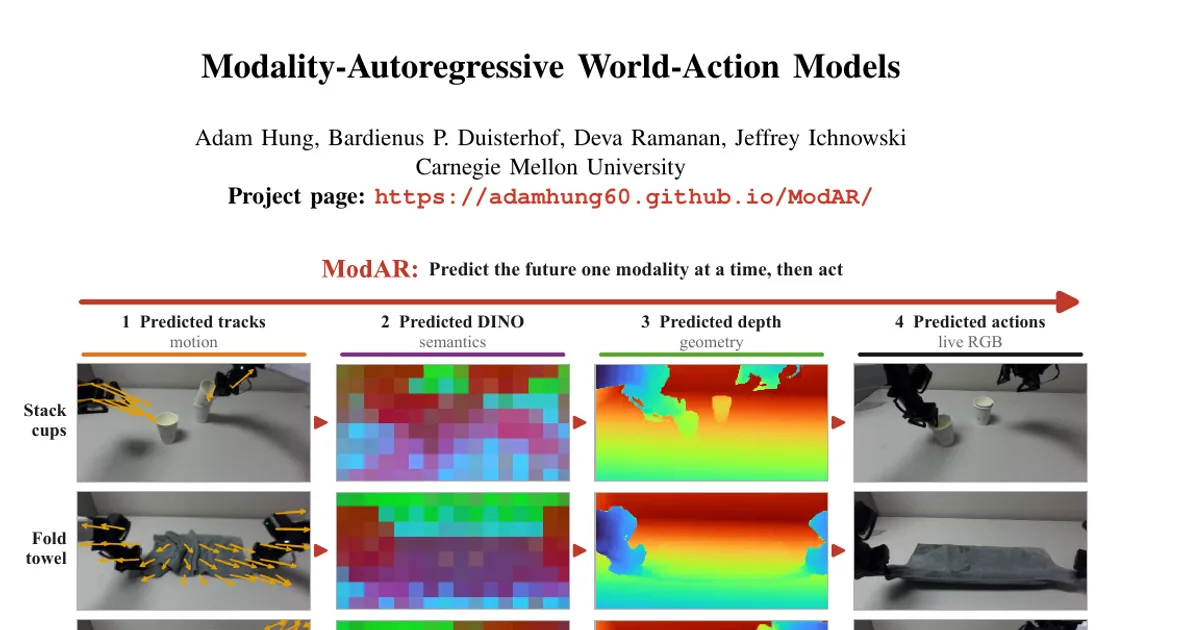
- ModAR architecture: The first world-action model that autoregressively denoises multiple future-observation modalities one at a time, conditioning each prediction on previously generated modalities, and generating actions last as an inverse-dynamics step.
- Controlled formulation study: Systematic comparison of five WAM designs (Action-only, Independent-noise, Disjoint, Unified, ModAR) under a shared backbone, data, and compute budget, plus a study of which modality subsets and how much actionless data help.
- Efficiency result against a large pretrained baseline: A 30.1M-parameter from-scratch ModAR slightly outperforms the 6B-parameter video-pretrained Flex-π (75% vs. 72% average success) while using roughly 20× fewer training FLOPs and no pretraining.
- Real-world validation with human video: Three bimanual manipulation tasks where ModAR beats baselines and improves progressively as in-domain and out-of-domain actionless human demonstrations are added.
Main Findings
- ModAR wins across all data scales: In RoboTwin simulation it achieves the highest average success rate at 50, 250, and 1,250 demonstrations (66%, 75%, 76%), beating Unified (63%, 67%, 64%), Disjoint (55%, 55%, 48%), Action-only (46% at D=50), and Independent-noise (37%, 34%, 33%).
- RGB is the least useful predicted modality: Point tracks, DINO features, and depth each contribute complementary gains, and stacking them improves performance, but adding future RGB prediction on top provides no consistent benefit. Ablating RGB leaves the score unchanged; ablating tracks, DINO, or depth drops it to 61%, 65%, and 70% respectively.
- ModAR scales best with actionless data: Adding 1,200 actionless demonstrations lifts ModAR from 66% to 76% (10 points), while Unified improves only 1 point. Disjoint actually degrades, suggesting negative transfer as its shared representation is shaped by the future-prediction objective.
- Context noise is essential: Removing the noise injected into previously generated modalities during training drops average success from 75% to 63%, confirming that the design prevents cascading autoregressive errors.
- Generation order matters: Reversing the modality order (RGB → depth → DINO → tracks) drops success from 75% to 65%, supporting the hypothesis that structured modalities act as "scratchpads" for detailed ones.
- Gains are not just from extra sampling steps: Matching ModAR's 40 Euler steps with Unified, Disjoint, and Independent-noise does not close the gap (Unified falls from 67% to 59%, Disjoint from 55% to 54%, Independent-noise rises from 34% to 37%).
- ModAR's predicted futures are intrinsically better: When both ModAR's and Unified's futures are passed to the same separately trained inverse-dynamics model, ModAR still wins — showing the advantage lies in the quality of the imagined future, not just the action head.
- Real-world results mirror simulation: With 100 robot demos per task plus actionless human and EgoDex data, ModAR reaches 83.3% overall success versus 66.7% for Unified and 52.2% for Action-only. Adding in-domain human demos then out-of-domain EgoDex demos raises success from 70.0% to 81.1% to 83.3%.
- Inference cost: Generating all four modalities plus actions takes 147.9 ms (6.76 Hz) on a single RTX 5090.
Methodology in Plain English
The researchers built a single transformer-based model that takes in the current camera view, the robot's joint configuration, and a task label, and generates a short imagined future followed by a chunk of actions.
The key design choice is ordering. Instead of denoising all future representations simultaneously, ModAR generates them one block at a time, in the order point tracks, then DINO features, then depth, then RGB, and finally actions. Each completed prediction becomes clean context for the next one, so later, more detailed predictions can lean on the structure already generated. A block-causal attention mask enforces this ordering during training, so no future modality can peek at later ones.
The model uses a shared diffusion transformer with cross-modal blocks for fusing information across modalities and small modality-specific expert blocks for specialization. It is trained with an x-prediction objective (predicting the clean target rather than the flow velocity), which the authors found more stable than velocity prediction.
To combat error compounding across the sequential chain, the model adds noise to the clean context blocks during training, mimicking the imperfections it will see at inference — but this noise is not applied at test time. The whole system is trained from scratch rather than initialized from a pretrained video model, allowing the authors to isolate the effects of formulation, modality choice, and data scale.
Evaluation used six RoboTwin simulation tasks with a multitask model per data scale, and three real-world bimanual tasks (cup stacking, towel folding, drawer placement) on YAM arms with teleoperated demonstrations and human video.
Why This Matters
This paper challenges a default assumption in robot learning: that richer futures mean predicting pixels. It shows that compact, semantically structured representations — motion tracks, self-supervised features, and geometry — carry more actionable information per unit of compute, and that a small from-scratch model can match a 6-billion-parameter video-pretrained system.
Real-world applications:
- Household and service robots performing bimanual manipulation such as stacking, folding, and drawer operation, where spatial reasoning matters more than photorealistic appearance.
- Low-compute robotics labs and startups that cannot afford to pretrain or fine-tune large video-generation models but can train a 30M-parameter policy from scratch.
- Learning from human video at scale, since ModAR demonstrably benefits from actionless human demonstrations, including out-of-domain EgoDex data, without requiring robot hardware for every hour of training data.
- Warehouse and industrial pick-and-place, where depth and motion cues dominate and appearance variation (lighting, packaging) is a nuisance rather than a signal.
Industry relevance: The result that a compact model beats a 20× larger pretrained one on in-distribution tasks has direct implications for deployment cost, inference latency budgets, and the economics of collecting robot data versus leveraging existing video corpora. It also suggests that architecture and modality design, not just scale, remain open levers in embodied AI.
Future Directions
- Scaling and generalization: The experiments cover only six simulated and three real tasks with a single camera and discrete task labels. Whether ModAR's advantages hold with language instructions, more object and scene diversity, and larger model sizes is untested.
- Optimal modality ordering: The paper uses one fixed order (tracks → DINO → depth → RGB) and only ablates the reverse. Whether the best ordering is task-dependent or learnable is left open.
- Reducing sequential inference latency: Autoregressive generation costs more wall-clock time than joint or action-only generation (147.9 ms), which may matter for high-frequency control; distillation or parallel decoding could help.
- Internet-scale heterogeneous actionless data: The authors call for training on broader, more varied unlabeled video to test whether the observed benefits from human demonstrations continue to compound.
Target Audience
Robotics and embodied-AI researchers working on world models, imitation learning, or visuomotor policies; graduate students studying multimodal generative modeling for control; and engineers evaluating whether to build on large pretrained video models or train compact task-specific policies from scratch. The paper is also useful for practitioners deciding which future representations to predict, since its modality-ablation results are directly actionable even without adopting the full ModAR architecture.
Authors’ abstract
World-action models (WAMs) jointly model future observations and actions, typically predicting the future as RGB images. Other visual modalities such as depth, pretrained visual features, and point tracks can more efficiently capture geometric, semantic, and motion features. However, how best to combine these modalities within WAMs remains an open question. We introduce ModAR, the first WAM to autoregressively denoise multiple future modalities before predicting actions. This allows each prediction to condition on previously generated modalities. We train from scratch to systematically study how training-data mixtures, predicted modalities, and WAM formulations affect performance. In our evaluations, WAMs benefit from predicting point tracks, DINO features, and depth maps, while additionally predicting future RGB does not provide a consistent benefit. We also find that ModAR's sequential generation outperforms existing WAM formulations, with the highest average success rate at all evaluated data scales. We also fine-tune the video-model-initialized WAM Flex-$π$ on the same data; ModAR achieves a slightly higher observed average success rate (75% vs. 72%) while using approximately $20\times$ fewer training FLOPs and no pretraining. On three real-world bimanual tasks, ModAR outperforms baselines and improves with human videos.