Research
MOBIUS: A Multi-Modal Bipedal Robot that can Walk, Crawl, Climb, and Roll
Overview Research area: Legged robotics, specifically multi-modal locomotion and mobile loco-manipulation (combining locomotion with grasping). Technical level: Advanced. The paper assumes familiarity
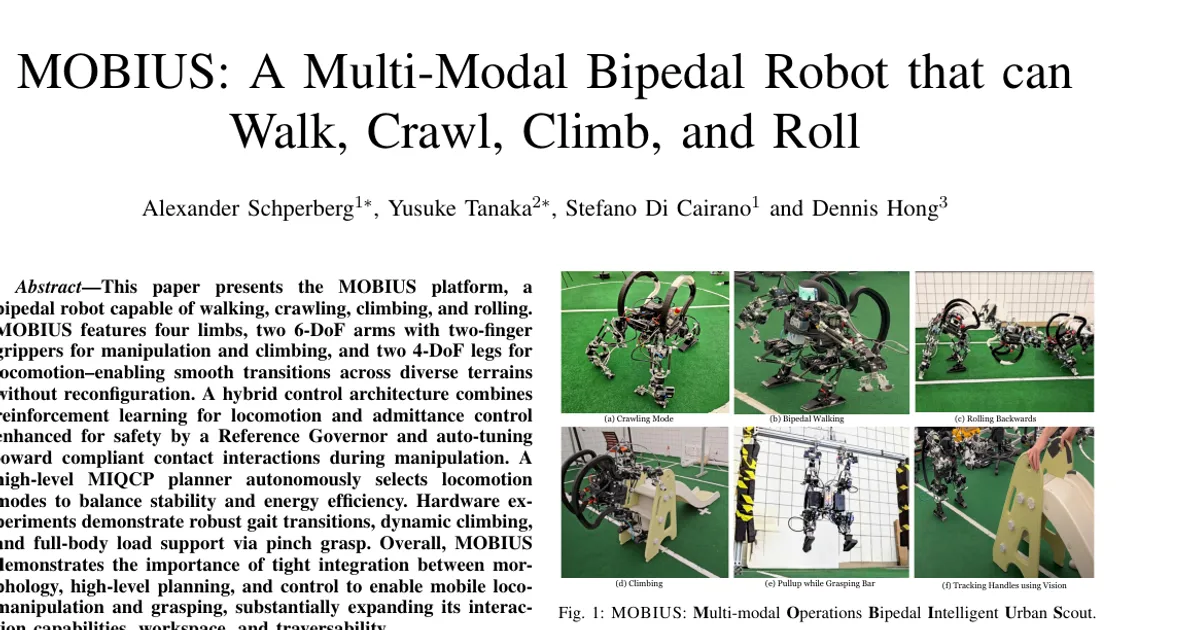
- arXiv
- 2511.01774
- Published
- 2025-11-03
- Authors
- Alexander Schperberg, Yusuke Tanaka, Stefano Di Cairano, Dennis Hong
AI summary
Overview
- Research area: Legged robotics, specifically multi-modal locomotion and mobile loco-manipulation (combining locomotion with grasping).
- Technical level: Advanced. The paper assumes familiarity with reinforcement learning (PPO), admittance/force control, Reference Governors, mixed-integer optimization, and legged robot hardware design.
- Scope: This paper presents MOBIUS, a single non-reconfigurable bipedal platform that walks, crawls, rolls, free-climbs, and performs pinch-grasp pull-ups, along with the hybrid control and high-level planning stack that coordinates those modes.
What This Paper Is About
Most legged robots are specialized: bipeds walk well, quadrupeds handle rough ground, and climbing robots rely on adhesion or passive spines that limit dexterity. MOBIUS (Multi-modal Operations Bipedal Intelligent Urban Scout) is built to do all of these within one hardware topology, with no part swapping or appendage attachment. The goal is a robot that can move across both continuous terrain (floors, rubble) and discrete vertical structures (ladders, bars, slides) while keeping its arms free for manipulation when needed.
Key Contributions
- A novel multi-modal robot design combining two 6-DoF dexterous arms with two-finger grippers and two 4-DoF legs, plus integrated back rails for fall protection and rolling, in a single non-reconfigurable morphology.
- A unified morphology demonstrated to perform bipedal walking, crawling, rolling, vertical free climbing, and pull-up maneuvers under Earth gravity, with extensive hardware validation.
- A system-level software stack consisting of adaptive, safety-enforced admittance control for contact-rich tasks, reinforcement learning for locomotion, and a MIQCP-based high-level planner for autonomous mode selection.
- A demonstration that a mid- to large-scale biped can perform a pinch-grasp pull-up from a full dead-hang configuration, which the authors state is a first for this class of robot.
Main Findings
- Disturbance rejection favors RL over model-based control: Under impulse velocity disturbances of 0.1 s duration applied to the robot's CoM while standing, the model-based MPC controller fails at approximately 0.05 m/s, while the RL policy remains stable up to 0.25 m/s. The authors attribute this to MOBIUS's complex asymmetric dynamics, which produce state propagation errors in MPC.
- Velocity tracking: On hardware, the robot achieves up to 0.1 m/s laterally and 0.25 rad/s in yaw in bipedal mode, and up to 0.4 m/s laterally and 0.6 rad/s in yaw in crawling mode. Across all tested motions, the model-based approach showed higher tracking error than RL.
- Asymmetric mass distribution is a central challenge: MOBIUS's forearms are 55% heavier than its lower body, which eases biped-to-crawl transitions but complicates bipedal locomotion through uneven mass distribution and arm-induced momentum.
- Maximum locomotion velocities (Table II): Biped 0.1 m/s, crawling 0.4 m/s, rolling 0.7 m/s.
- Rolling is fastest but least stable: Rolling reaches 0.7 m/s instantaneous speed, described as 600.0% and 75.0% faster than biped walking and crawling respectively. It is more energy-efficient than biped mode but the least stable, since the roll is passive (using the back rails) rather than actively controlled, which introduces state estimation errors.
- Energy per Visited Cell (EVC) favors crawling: In single-mode planning tests, crawling achieved the lowest EVC at 5.11 J/cell, versus biped at 26.89 J/cell and rolling at 21.96 J/cell. Cost of Transport was 0.104 for crawling, 0.548 for biped, and 0.448 for rolling.
- Per-distance energy: Using realistic COM heights, biped motion requires approximately 104 J/m compared to 65 J/m for crawling.
- Rolling reaches goals fastest but covers little ground: Rolling reached the goal fastest at T = 15, but only one cell is counted as visited during rolling because of onboard sensor limitations, a constraint encoded in the MIQCP formulation. Biped locomotion exhibited the highest failure rate due to its limited per-step distance requiring longer horizons.
- Planner behavior: The MIQCP assigns crawling the lowest mode penalty, biped a higher penalty, and rolling the highest, biasing the planner toward crawling by default. Low EVC was achieved when exploration and goal objectives were equally balanced, and with an average mode-switch rate of approximately 25% per time step.
- Planner solve time: The MIQCP optimization takes approximately 10-11 seconds to solve on a 20 m by 20 m map for a 20 second trajectory, using Gurobi.
- Climbing a children's slide: Across 10 trials, 8 were successful; failures occurred when a foot failed to advance to the next step (e.g., toe entrapment). A visual-servo controller aligns the end-effectors to the vertical handles, after which an open-loop trajectory is executed for climbing and descent.
- Pinch-grasp pull-up: Across 10 trials, 9 were successful; the single failure matched the slide-climbing failure mode (foot advancement error). The robot lifts its full body from a straight-arm dead-hang configuration on aluminum bars.
- Grasp force is dominated by spine engagement, not friction: On a slippery aluminum bar, the grasp generates a dominant shear force of 124.2 N perpendicular to the groove (z-axis, with standard deviation of 24.5 N), while frictional force along the groove (x-axis) remains low at 23.6 N (standard deviation 4.1 N).
- Auto-tuning improves force control: Auto-tuning the admittance controller improves force tracking error by 45% while maintaining controller stability.
- Reference Governor enforces safety: Without the Reference Governor, the end-effector violates position constraints and violates velocity limits at 0.0 s, 2.5 s, and 10.0 s. With the Reference Governor, the trajectory remains within the admissible set, and the reference is only modified when necessary (for example, left unchanged from 10.0 to 17.5 s).
- Hardware spec: The total weight of the robot is 10.3 kg. The limb workspace has a 210° range in the top view, and the leg workspace has a 105° foot pitch in side view.
- Zero-shot sim-to-real: Policies were trained in MuJoCo with domain randomization and transferred without additional fine-tuning on hardware.
Methodology in Plain English
The researchers built a robot with four limbs that does double duty: the two arms end in two-finger grippers that serve both as manipulators and as load-bearing contact points when the robot crawls or climbs. Because the arms are much heavier than the legs (55% heavier), accurate analytical models of the robot's dynamics are hard to obtain, so the team avoided a purely model-based approach for locomotion.
Instead, they split control by task. For bipedal walking, which is where stability is hardest, they trained a model-free reinforcement learning policy with Proximal Policy Optimization, treating locomotion as a partially observable Markov decision process. The policy takes in estimated trunk state, joint encoder values, the previous action, desired linear and angular velocities, and a history of 15 observations (giving observation dimensions of R^416 for bipedal mode and R^608 for crawling). It outputs target joint positions, smoothed with a moving average. Training happened in two stages: first on flat terrain, then fine-tuned on rough terrain in MuJoCo with domain randomization over mass, friction, actuator gains and biases, and observation delays.
For contact-rich tasks such as pull-ups, they used an admittance controller with auto-tuning gains, which maps measured wrench to desired motion — suitable for position-controlled actuators that still need to behave compliantly. Because prior auto-tuning work lacked formal safety guarantees, they added a Reference Governor on top. The Reference Governor uses a Maximal Output Admissible Set computed offline by simulating trajectories and retaining only those that satisfy position, velocity, and wrench constraints. These samples are stored in a KD-Tree so that online feasibility checks run in logarithmic time, and when a queried state lies outside the admissible set, the nearest admissible point is used to modify the reference.
For deciding which mode to use, they formulated a Mixed Integer Quadratic Constraint Programming problem that jointly optimizes a grid-based path and a discrete mode sequence over a 2D map, using big-M constraints to encode if-then logic for terrain types, obstacles, and per-mode step sizes. Energy usage in the planner is computed from each mode's maximum velocity and travel distance, over 0.5 x 0.5 m grid cells, with crawling and biped traversing 1-2 cells per action and rolling constrained to exactly 3 cells per action.
Why This Matters
Impact on research. The paper argues that a single morphology can cover ground locomotion and vertical free climbing without reconfiguration, which challenges the assumption that legged robots should be specialized to one locomotion regime. It also provides a concrete comparison showing that model-free RL outperforms a model-based MPC baseline on a robot with poorly characterized asymmetric dynamics, and it demonstrates adding a Reference Governor to an auto-tuning admittance controller to obtain safety guarantees that prior auto-tuning work did not provide.
Real-world applications.
- Search and rescue in human-made environments that mix floors, rubble, ladders, and railings.
- Industrial inspection of structures that require both walking to a site and climbing discrete features such as ladders or bars.
- Maintenance tasks where the robot must traverse rough terrain and then manipulate objects with its grippers.
- Exploration of confined or debris-filled spaces where crawling offers higher stability than walking.
Industry relevance. The work is relevant to developers of legged and humanoid platforms, particularly those weighing whether to add dedicated climbing appendages or rely on dexterous grippers for load-bearing contact. The paper's energy-per-visited-cell accounting (crawling 5.11 J/cell versus biped 26.89 J/cell) and its comparison of 104 J/m for biped motion versus 65 J/m for crawling give practical numbers for planning and mode-selection decisions in deployed systems.
Future Directions
- Closing the loop on free climbing. The paper states that climbing and descent on the slide use an open-loop trajectory after visual-servo alignment, with no closed-loop control for the robot base. Adding feedback during climbing is a natural next step.
- Improving rolling state estimation. Rolling is described as the least stable mode, performed passively with the back rails, and the paper notes the robot cannot be tracked accurately during the roll. Better estimation or active control during rolling could make this mode usable for autonomous planning.
- Better contact modeling for the grippers as front limbs. The paper suggests the RL policy's weaker velocity tracking in crawling may stem from the simulator not accurately modeling gripper contact behavior, and that crawling's higher speeds make tracking harder. Closing this sim-to-real gap is an open problem.
- Extending the high-level planner. The MIQCP planner currently operates on 2D maps and takes approximately 10-11 seconds to solve on a 20 m by 20 m map for a 20 second trajectory, which limits how quickly modes can be replanned online. The paper's own limitations discussion is truncated in the provided content, so additional limitations are not reported here.
Target Audience
This paper is most useful to robotics researchers and graduate students working on legged locomotion, loco-manipulation, hybrid learning- and model-based control, and optimization-based task planning. It is also relevant to engineers building humanoid or bipedal platforms who need concrete design trade-offs on limb degrees of freedom, actuator selection, and arm-to-leg mass distribution, and to practitioners interested in safety-enforced force control for grasps that must support a robot's full body weight.
Authors’ abstract
This paper presents the MOBIUS platform, a bipedal robot capable of walking, crawling, climbing, and rolling. MOBIUS features four limbs, two 6-DoF arms with two-finger grippers for manipulation and climbing, and two 4-DoF legs for locomotion--enabling smooth transitions across diverse terrains without reconfiguration. A hybrid control architecture combines reinforcement learning for locomotion and force control for compliant contact interactions during manipulation. A high-level MIQCP planner autonomously selects locomotion modes to balance stability and energy efficiency. Hardware experiments demonstrate robust gait transitions, dynamic climbing, and full-body load support via pinch grasp. Overall, MOBIUS demonstrates the importance of tight integration between morphology, high-level planning, and control to enable mobile loco-manipulation and grasping, substantially expanding its interaction capabilities, workspace, and traversability.