Research
MMMMM: A Unified Taxonomy for Investigating the Mechanisms of Multilingual MultiModal Misinformation
Overview Research area: AI safety and ethics; computational social science; multilingual, multimodal misinformation analysis using vision-language models (VLMs). The paper is published on arXiv under
- arXiv
- 2608.29681
- Published
- 2026-08-30
- Authors
- Nadav Borenstein, Greta Warren, Desmond Elliott, Isabelle Augenstein
AI summary
Overview
Research area: AI safety and ethics; computational social science; multilingual, multimodal misinformation analysis using vision-language models (VLMs). The paper is published on arXiv under cs.CY (arXiv:2608.29681v1, 30 Aug 2026) by Nadav Borenstein, Greta Warren, Desmond Elliott, and Isabelle Augenstein at the University of Copenhagen, under a CC BY 4.0 license.
Technical level: Intermediate. The paper is readable without deep machine-learning background, but it assumes familiarity with taxonomy/annotation concepts, inter-annotator agreement metrics, and what a VLM is.
Scope: The paper builds a unified six-axis taxonomy of the mechanisms by which image-text pairs spread misinformation, curates a large multilingual dataset from X's Community Notes, operationalises the taxonomy through an automated VLM annotation pipeline, and validates it against expert humans and the AMMeBa fact-checking dataset.
What This Paper Is About
Multimodal misinformation — false claims accompanied by images — is more convincing than text alone, but it is poorly understood because existing taxonomies are fragmented, ambiguous, and leave many real cases unclassified (the paper notes that roughly 40% of images annotated with the taxonomy of Dufour et al. (2024) could not be classified into that taxonomy's own subcategories). The authors ask how images are actually combined with text to mislead in the wild, across languages and topics, and how such patterns can be measured at scale rather than through slow, expensive expert annotation. Their goal is a single, empirically grounded taxonomy plus an automated pipeline that can be applied to large, contemporary, multilingual misinformation data.
Key Contributions
-
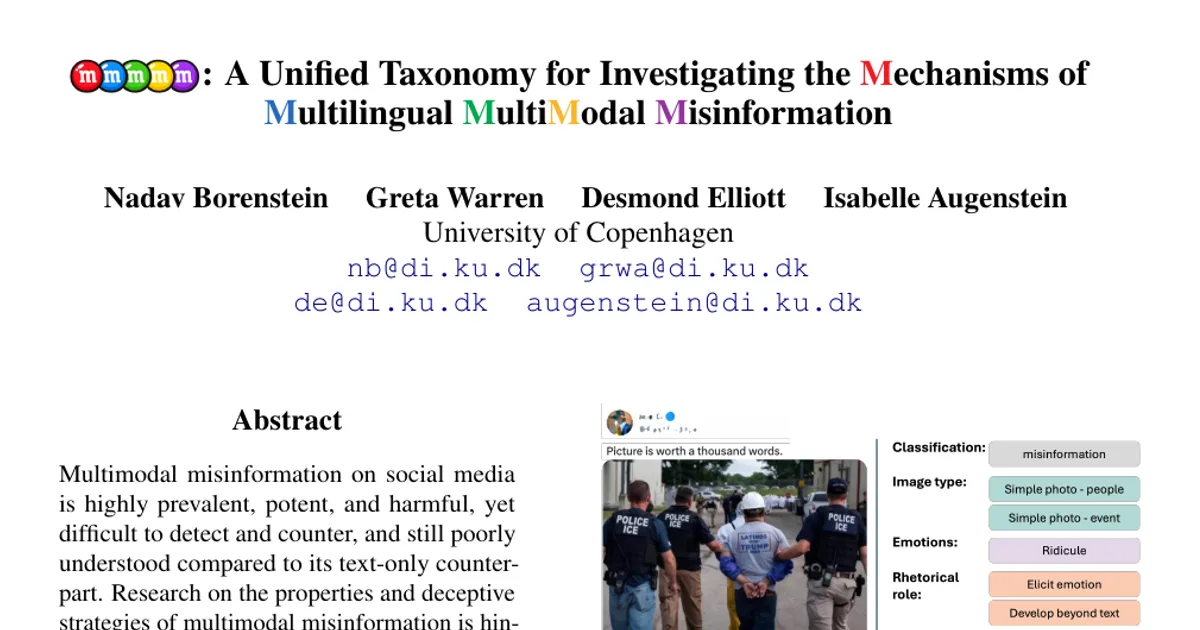
A unified taxonomy of multimodal misinformation mechanisms. The authors consolidate disparate prior schemes (including McCulloh (2022), Newman and Schwarz (2024), Dufour et al. (2024), Wardle and Derakhshan (2017), and others) into one hierarchical taxonomy of 25 mechanisms, enriched with six orthogonal axes: Classification, Image Type, Emotion, Rhetorical Role, Topic, Message, and Multimodal Mechanism. Three illustrative new categories were added based on data: scientific errors or conspiracies and exaggeration (both under Slanted), and a top-level Textual claim category for claims carried by the image itself.
-
A large, multilingual, real-world dataset. The authors curate 26,979 (username, claim, image, note) tuples from X's Community Notes, spanning January 2021 to January 2026 and seven languages (English, Spanish, Portuguese, Japanese, French, German, Hebrew), built on the COMMUNITYNOTES collection of over 100k (post, note) pairs.
-
An automated VLM annotation pipeline with human validation. A six-stage pipeline using Qwen3.5 27B applies the taxonomy at scale, with agreement measured against expert human annotators, across three pipeline runs, and against existing labels in the AMMeBa dataset.
-
Empirical findings about how misinformation mechanisms vary by topic, narrative, and language, including previously undocumented patterns such as the prevalence of AI-generated content in technology and science, and the use of news-outlet imagery in vaccination misinformation.
Main Findings
- Slanted imagery dominates. In Community Notes, Slanted is the most common mechanism, with over 7,000 samples, followed by Decorative and Mismatch. Fake image occurs as frequently as Manipulated image, while Unreliable source, Other mechanism, and Deny authenticity are rare, with fewer than 800 samples combined.
- AI-generated and forged images rival manipulations. At the sub-mechanism level, AI-generated and forged images (e.g., fake documents) occur at comparable rates, and both exceed any form of image manipulation except textual manipulation. Within context mismatch, identity mismatch and event mismatch are frequent.
- Language-specific patterns. The Decorative mechanism is overrepresented in Portuguese, which the authors link to Portuguese-language misinformation concentrating on Sports, Celebrities, and Entertainment. Japanese-language misinformation disproportionately uses Slanted, attributed to the scientific errors and conspiracies sub-mechanism — largely pseudoscientific earthquake-prediction posts, a topic relevant in Japan.
- Topic-mechanism links. Using Fisher's exact test with Benjamini–Hochberg FDR correction (cells with p ≥ 0.05 omitted), Mismatch — especially Place, Time, and Event mismatch — co-occurs strongly with Conflict, and Textual claim is over-represented in Law, Economics, Health, and Science, where documents often serve as evidence.
- The two datasets differ substantially. In AMMeBa, Mismatch is the dominant mechanism (driven by the Event and Identity subcategories), Decorative is considerably less common (a consequence of sampling only instances where the image plays an active role), and AI-generated images are rarer, likely because AMMeBa's collection period predates the recent surge in AI image generation.
- Vaccination misinformation borrows journalistic authority. In a vaccination narrative case study, News screenshot image types are particularly over-represented, suggesting appropriation of journalistic credibility is a common deception strategy; the narrative is otherwise dominated by scientific errors and conspiracies and text-based claims.
- Athletic rivalry relies on fake numbers. Where the image plays an active role, athletic-rivalry narratives disproportionately involve text-based mechanisms (Manipulated image: textual and Textual claim in image), driven by images containing fake statistics or fabricated performance metrics.
- Anti-immigration narratives use text-in-image and negative emotion. These narratives over-represent Textual claim in image, Slanted representation, and Mismatch: time/place, with a clear reliance on negative emotions such as Anger and Fear.
- Human validation shows high coverage. Two expert annotators labeled 100 Community Notes samples using the full taxonomy; annotator A labeled only one instance as Other mechanism and annotator B only three, confirming high coverage.
- Human agreement varies by axis. Agreement is high on Image Type (Mean Jaccard 0.6074) and Topic (0.7047), lower on Emotion (0.4002) and Rhetorical Role (0.3547). Mechanism and Sub-mechanism reach 65.2% and 56.8% agreement respectively.
- VLM agreement is close to human-human agreement. Inter-run VLM agreement follows the same pattern as human inter-annotator agreement (Image Type Mean Jaccard 0.8021, Emotion 0.6394, Rhetorical Role 0.5720, Topic 0.8029, Mechanism 71.9%, Sub-mechanism 86.1%) — with the Sub-mechanism axis reversing the human trend by scoring higher than Mechanism. VLM-human agreement is comparable to, though lower than, human-human agreement.
- Model accuracy is good but uneven. On 630 sampled instances (up to 20 English instances per predicted label, half of labels replaced with random distractors), inter-annotator agreement was a Cohen's kappa of 0.67 with 82.3% raw agreement across all 630 samples, and 0.44 with 80.3% on non-distractor samples. After disagreement resolution, 79.3% of predictions were judged correct; Manipulated image – removal and Unreliable source – satire exceeded 90%, while Slanted – misrepresentation of relevance and Fake image – staged fell below 60%.
- Generalisation to fact-checked data. Across six of the seven aligned AMMeBa categories, F1 scores range from 0.61 to 0.83, with Time mismatch the exception at 0.26 — which the authors suggest may be an artefact of their prompt instructing the model to select Place mismatch whenever both time and place mismatches apply, whereas AMMeBa selects both labels.
- Mitigation should be targeted, not uniform. The authors state that misinformation mechanisms differ systematically across domains and narratives, implying that mitigation efforts should be developed and applied strategically rather than uniformly.
Methodology in Plain English
The authors worked in three stages. First, they built a dataset. Starting from the COMMUNITYNOTES collection of over 100k (post, note) pairs, they discarded notes rated "unhelpful" by the community and kept only posts in seven languages, then used web scraping to find posts containing images, yielding 24,596 samples. They supplemented this with the official Community Notes release, removing deleted notes, unhelpful notes, notes attached to posts labeled "not misleading", and notes in other languages; because that public release lacks the original posts, they used the tool Twikit to recover and scrape 25k instances, keeping only posts with an image. The merged dataset contains 26,979 tuples spanning January 2021 to January 2026. They also sampled AMMeBa, keeping only instances where the image plays an active role.
Second, they built the taxonomy iteratively rather than purely conceptually. They aligned exact matches between prior taxonomies, consolidated near-matches so that categories would not have ambiguous boundaries, and organised the remainder hierarchically. Annotating data during development exposed definitions that were too vague, categories that occurred too rarely (like Mirrored, which was excluded), and pairs that were theoretically distinct but indistinguishable in practice. Gaps in the data prompted new categories.
Third, they automated annotation. They chose Qwen3.5 27B for its strong performance at its size, support for over 200 languages, and a release date after their dataset's cutoff (so its training data plausibly covers the relevant events). The pipeline has six stages: image type (image only), emotion (username, claim, image — deliberately excluding the note), classification (misinformation vs. ad, scam, or stolen content, with only misinformation proceeding), topic and message, rhetorical role (multi-label, following Marsh and White (2003)), and mechanism. The mechanism stage is a multi-turn conversation: first deciding whether the image actively participates (otherwise Decorative), then predicting the top-level mechanism, then a sub-mechanism for instances labeled Mismatch, Slanted, Fake image, Manipulated image, or Unreliable source. The pipeline was run three times for stability, each run taking approximately 24 hours on a single L40S GPU using the default model and sampling parameters recommended by Qwen's creators for non-thinking mode. Dataset-specific prompt variants were used for Community Notes and AMMeBa.
Why This Matters
Impact on research. The paper replaces a fragmented landscape of mismatched, ambiguous taxonomies with one unified scheme grounded in real social media data rather than fact-checking articles, which are narrower by construction. It also demonstrates that current VLMs can apply a fine-grained taxonomy with reliability approaching that of expert annotators, which opens analysis at a scale and speed that expert-only annotation cannot reach — including for emerging events and underrepresented languages.
Real-world applications:
- Platform trust-and-safety triage: knowing which mechanisms dominate which topics lets platforms prioritise scarce review and countermeasure capacity instead of applying uniform defences.
- Fact-checking and journalism: the vocabulary of Mismatch, Slanted, Fake image, and Textual claim gives newsrooms a structured way to characterise and explain misleading image-text pairings.
- Public health and crisis communication: the vaccination case study shows that credibility-borrowing via news screenshots is a distinct strategy, while Japanese earthquake-prediction content illustrates recurring pseudoscientific narratives that communicators can pre-empt.
- Monitoring emerging harms: because the pipeline runs on new data, the same setup could track AI-generated content trends and language-specific narratives as they shift.
- AI governance and policy: evidence that mechanisms differ systematically across topics and narratives supports more targeted regulatory and platform-level interventions.
Industry relevance. Social media platforms with community moderation systems, VLM developers, and fact-checking organisations are the immediate beneficiaries. The authors deliberately avoided proprietary systems, choosing an open model, which lowers the barrier for smaller organisations and publicly funded monitoring efforts to replicate the pipeline.
Future Directions
- Restore the excluded taxonomy axes. Several axes from prior work were dropped because they were too ambiguous to annotate reliably, required external sources, or fell outside scope (for example Intent and Recipient). Incorporating them is left open.
- Expand the data. The Community Notes dataset, though sizable, is not large enough for robust analysis of every narrative, and the AMMeBa sample is only a subsample; improving the collection scheme would support fine-grained analysis of more narratives.
- Improve the models. The authors note that Qwen3.5 27B does not match state-of-the-art VLMs and that a larger or fine-tuned model would likely yield better predictions; they also flag that multilinguality was handled naively via the model's built-in support, suggesting translation pipelines or language-specific VLMs may perform better. A retrieval-augmented approach with internet access is named as a natural extension.
- Move to multi-label mechanisms. The Multimodal Mechanism axis is currently single-label, though some instances exhibit more than one mechanism (for example, being misattributed with respect to both time and place); extending to multi-label assignment is a stated direction.
- Better quality filtering. Manual inspection revealed low-quality instances in both datasets, so a filtering mechanism independent of the datasets' own quality annotations would help ensure more robust results.
Target Audience
Misinformation and computational social science researchers will benefit most, particularly those studying multimodal deception, annotation methodology, or taxonomy design. NLP and vision-language researchers will find the pipeline design and the human-versus-model agreement analysis informative, including for choosing which axes are realistically automatable. Trust-and-safety practitioners, fact-checkers, and policy analysts working on platform moderation can use the mechanism categories and the topic-level findings to target interventions. Researchers focused on multilingual and non-English misinformation will find the seven-language dataset and the language-specific findings, such as the Portuguese and Japanese patterns, especially relevant.
Authors’ abstract
Multimodal misinformation on social media is highly prevalent, potent, and harmful, yet difficult to detect and counter, and still poorly understood compared to its text-only counterpart. Research on the properties and deceptive strategies of multimodal misinformation is hindered by a lack of taxonomies grounded in real-world contexts and by the limitations of current multimodal machine learning models, which prevent the automation of annotation and analysis at scale. We address these shortcomings in three steps. First, we collect a large-scale, high-quality dataset of real-world misinformation instances from Twitter/X in seven languages. Second, we develop a novel, comprehensive taxonomy of multimodal misinformation grounded in an in-depth qualitative analysis of the data and prior theoretical work. Finally, we operationalise the taxonomy through an automated multi-step annotation pipeline using a Vision-Language Model (VLM), and perform human-validation. Our novel approach leads to previously undocumented insights about how social media users combine images with text to spread misinformation in the wild, e.g., that AI-generated content is particularly prevalent in technology and science, while vaccination misinformation disproportionately utilises images from news outlets to assert credibility. Our method and findings provide guidance for targeted approaches for detecting multimodal misinformation, and suggest that mitigation efforts should be developed and applied strategically rather than uniformly.