Research
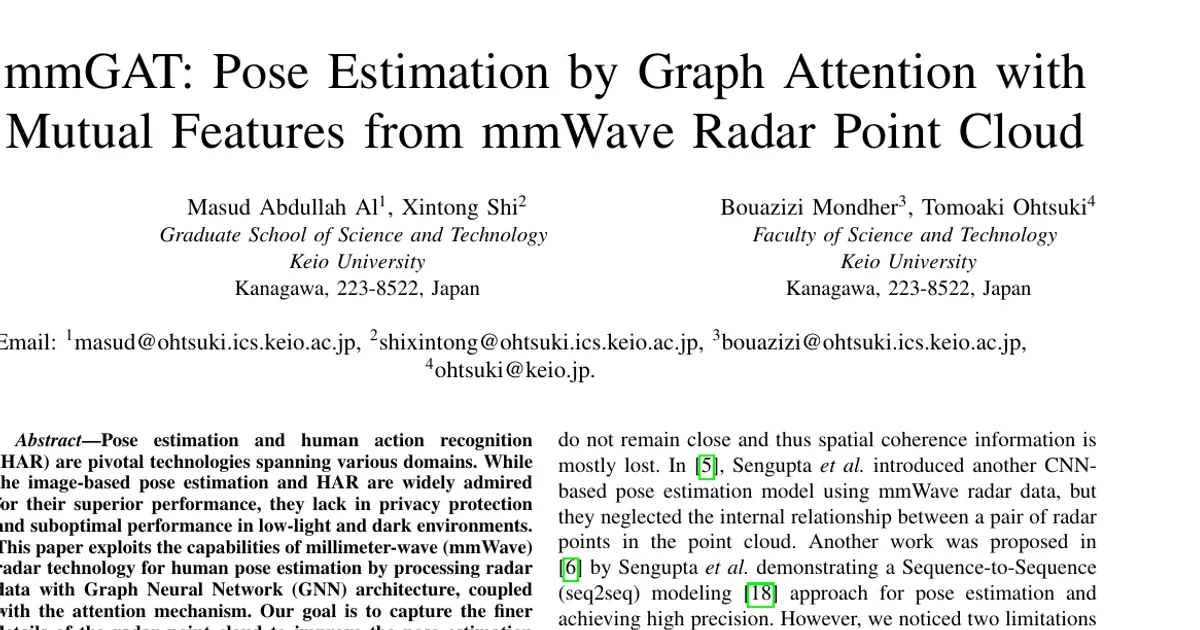
mmGAT: Pose Estimation by Graph Attention with Mutual Features from mmWave Radar Point Cloud
Overview Research area: Computer vision / wireless sensing — human pose estimation from millimeter-wave (mmWave) radar point clouds using graph neural networks. Technical level: Intermediate. The conc
- arXiv
- 2603.08551
- Published
- 2026-03-09
- Authors
- Abdullah Al Masud, Shi Xintong, Mondher Bouazizi, Ohtsuki Tomoaki
AI summary
Overview
Research area: Computer vision / wireless sensing — human pose estimation from millimeter-wave (mmWave) radar point clouds using graph neural networks.
Technical level: Intermediate. The concepts are explained without requiring radar signal-processing expertise, but the modeling section relies on familiarity with graph neural networks and attention mechanisms.
Scope: The paper introduces mmGAT, a graph-attention model that combines per-point radar features with pairwise "mutual" features to regress 3D human pose keypoints, evaluated on two public mmWave datasets (MARS and mRI). Published as arXiv:2603.08551v1 [cs.CV], 09 Mar 2026, by authors at Keio University, Kanagawa, 223-8522, Japan.
What This Paper Is About
Camera-based pose estimation performs poorly in low light and raises privacy concerns, so the authors turn to mmWave radar, which works in darkness and captures less identifying detail. Radar point clouds are sparse and unordered, and previous deep-learning approaches treated them as image-like grids, discarding the relationships between individual radar points. The goal is to represent each radar frame as a graph and learn from both the properties of each point and the relationships between pairs of points, improving keypoint accuracy.
Key Contributions
- Graph formulation of the radar frame. Each radar frame is treated as a directed graph G(V, E), where V is the set of radar points in the frame and E is the set of connections among point pairs. Each point is connected to its K nearest neighbors by Euclidean distance, which keeps the method scalable for high-density point clouds (K = 20 in the experiments).
- A novel mutual-feature extraction mechanism. Six edge (mutual) features are computed between point pairs: Euclidean distance, direction angles with respect to the x, y, and z axes, relative Doppler velocity, and relative reflective intensity. Node features are the five values reported per point: x, y, z location, Doppler velocity, and intensity.
- Use of Graph Attention (GAT) to fuse node and edge features. An edge-processing block (three FCN layers of 64 units, ReLU on the second and third) refines edge features, then four consecutive GAT layers (128 neurons each, dropout 0.5) produce updated node representations that combine both feature types.
- New state-of-the-art results in most scenarios on two public mmWave benchmarks, with a reported average reduction of MPJPE by 35.6% and PA-MPJPE by 14.1% relative to the prior state of the art in this domain.
Main Findings
- MARS dataset (MAE/RMSE): mmGAT with consecutive-frame data fusion reaches an average MAE of 3.42 cm, improving on the 3.6 cm average MAE reported for the CNN-based model that introduced the data fusion technique.
- mRI dataset (MPJPE/PA-MPJPE): The model performs significantly better in most of the four evaluation scenarios (S1P1, S1P2, S2P1, S2P2), reducing MPJPE by 35.6% and PA-MPJPE by 14.1% on average. Per-scenario table values are referenced as Tables II, III, and V but the individual numbers are not given in the provided text.
- Mutual features matter: Training without mutual features (K = 0) produced higher MPJPE and PA-MPJPE in every scenario than the full model (K = 20), indicating the edge features are genuinely useful.
- Smaller MPJPE-to-PA-MPJPE gap: The difference between the two metrics is relatively much smaller for mmGAT than for the mRI CNN baseline, which the authors interpret as fewer rotated and poorly scaled predicted skeletons.
- Data fusion interacts with the model: Without consecutive-frame fusion, mmGAT performed only about the same as the CNN-based model on MARS (marginally better or worse depending on the case). Adding fusion pushed it clearly ahead of both, suggesting the gain is a combined effect of data fusion and the mmGAT feature processing.
- Denoising by volume restriction: Some mRI ground-truth keypoints are noisy and far from the skeleton. Restricting valid keypoint positions to (-5 m, +5 m) along all three axes removed less than 0.01% of data from train, validation, and test sets but had a significant effect on model performance (Table V).
- Ground-truth statistics: In a cumulative density function over keypoint positions from -5 m to +5 m, the x-mean at -5 m is 0.002, meaning 0.002% of samples on average fall below -5 m along the x-axis for all subjects in the mRI dataset.
- Limitations acknowledged by the authors: The model predicts keypoints for only a single individual; it struggles when the person is not fully within the radar monitoring range; and it will erroneously predict human keypoints for frames that contain no people but do contain reflections from objects.
Methodology in Plain English
The researchers take raw radar point clouds — each point described by a 3D location, a Doppler velocity, and an intensity — and build a graph per radar frame. Each point becomes a node, and it is linked to its 20 nearest neighbors rather than to every other point, which keeps the computation manageable. Along each link they compute six relationship values: how far apart the two points are, which direction one lies from the other along the x, y, and z axes, and how much their velocities and intensities differ. These six values per link are the "mutual features."
Those six-value link descriptors pass through a small stack of fully connected layers before entering the graph attention network. Inside the attention network, the model learns how much weight to give each neighbor when updating a point's representation — including a self-connection weight — so points that matter more contribute more. Four attention layers in sequence refine the node vectors. Average pooling then collapses all node vectors in a frame into a single frame-level vector, which a five-layer regression head converts into a flattened list of keypoint coordinates (51 values for mRI, which equals 3 × 17 keypoints).
Training used MSE loss on MARS and MPJPE loss on mRI. On mRI the setup followed the original paper's four modes: random splitting (S1) and subject-wise splitting (S2), crossed with protocol-1 (P1, 12 activities) and protocol-2 (P2, 10 activities). An 80%/20% train-test split was used, and for the S2 mode the test subjects were randomly selected as subjects 1, 4, 7, and 15 out of 20 participants. Hyperparameters were a batch size of 128 and 250 epochs with the Adam optimizer for mRI, and a batch size of 32 with 160 epochs for MARS; both used an initial learning rate of 0.001 and a lambda scheduler multiplying the rate by 0.995 each epoch. The authors also adopted existing preprocessing ideas — sorting points along spatial axes and fusing points from three consecutive frames to increase density — but note that sorting adds no value to graph processing and is kept only for consistency.
Why This Matters
Impact on research: The paper argues that previous CNN-based radar pose estimators lost spatial coherence by stacking points into image grids and ignored pairwise relationships entirely. Framing the point cloud as a graph with explicit geometric and Doppler-based edge features is a distinct alternative, and the reported accuracy gains suggest this representation is worth pursuing for radar sensing more broadly. The result also indicates that model architecture and data preprocessing (consecutive-frame fusion) compound each other rather than acting independently.
Real-world applications:
- Privacy-preserving pose monitoring in homes or care facilities, since radar does not capture identifiable imagery the way cameras do.
- Low-light or completely dark environments where cameras fail, such as nighttime monitoring or unlit rooms.
- Rehabilitation and elderly-care motion tracking, building on radar's existing use for heartbeat detection, vitality analysis, and rehabilitation.
- Human action recognition for activity detection in smart environments, an area where related radar GNN work already exists.
Industry relevance: mmWave radar hardware is already present in consumer and automotive devices, and the paper notes the 77 GHz to 80.2 GHz operating band. A model that squeezes more accuracy from the same commodity sensor output could improve gesture interfaces, occupancy-aware room systems, and health-monitoring products without adding cameras or compromising privacy.
Future Directions
- Multi-person support. The current model predicts keypoints for a single individual only; extending it to scenes with multiple people is an explicit goal of future work.
- Handling partial and out-of-range subjects. Performance degrades when a person is not fully inside the radar monitoring range, and the authors aim to refine the method to address this.
- Empty-frame robustness. Frames with no people but with object reflections cause the model to hallucinate human keypoints. Distinguishing human returns from clutter is an open problem the authors flag.
- Extending to adjacent radar tasks. The authors envision applying mmGAT to human action recognition, vitality analysis, and heartbeat detection, suggesting the mutual-feature graph representation may transfer beyond pose estimation.
Target Audience
Researchers and engineers working on radar-based human sensing, graph neural networks, or privacy-preserving perception systems. It is also relevant to practitioners in ambient assisted living, remote health monitoring, and human-computer interaction who want an alternative to camera-based pose estimation. Readers should have some background in deep learning; the graph attention formulation will be most accessible to those familiar with attention mechanisms or message-passing networks.
Authors’ abstract
Pose estimation and human action recognition (HAR) are pivotal technologies spanning various domains. While the image-based pose estimation and HAR are widely admired for their superior performance, they lack in privacy protection and suboptimal performance in low-light and dark environments. This paper exploits the capabilities of millimeter-wave (mmWave) radar technology for human pose estimation by processing radar data with Graph Neural Network (GNN) architecture, coupled with the attention mechanism. Our goal is to capture the finer details of the radar point cloud to improve the pose estimation performance. To this end, we present a unique feature extraction technique that exploits the full potential of the GNN processing method for pose estimation. Our model mmGAT demonstrates remarkable performance on two publicly available benchmark mmWave datasets and establishes new state of the art results in most scenarios in terms of human pose estimation. Our approach achieves a noteworthy reduction of pose estimation mean per joint position error (MPJPE) by 35.6% and PA-MPJPE by 14.1% from the current state of the art benchmark within this domain.