Research
Mi-Ripple: Restoring Images Degraded by Iterative AI Editing
Overview Research area: Computer vision / image restoration, specifically artifacts introduced by iterative reference-conditioned generative image editing. Technical level: Intermediate. The paper is
- arXiv
- 2609.11317
- Published
- 2026-09-10
- Authors
- Jiayin Chen, Yicheng Xu, Muting Wang
AI summary
Overview
Research area: Computer vision / image restoration, specifically artifacts introduced by iterative reference-conditioned generative image editing.
Technical level: Intermediate. The paper is written accessibly, but its core machinery depends on frequency-domain analysis (log-amplitude spectra, local medians, autocorrelation, band-pass filtering) and a set of numeric acceptance thresholds that reward careful reading.
Scope in one sentence: The paper defines, diagnoses, and treats "digital ripple" — periodic lattice and granular textures that accumulate when a generated image is repeatedly fed back as the reference for the next edit — using a three-stage workflow of diagnosis, treatment, and verification.
What This Paper Is About
Iterative reference-conditioned image editing lets a user take an existing image, apply a text instruction, and then reuse the result as the reference for the next edit. This is convenient, but it can propagate unwanted texture that becomes visible at native resolution as grids, honeycomb-like patterns, or granular surfaces — collectively called "digital ripple." The paper's goal is to recover clean surfaces and coherent detail without erasing legitimate texture, by first determining whether an artifact is spectrally removable or entangled with real scene content, and then applying the appropriate treatment.
Key Contributions
-
Restoration beyond denoising. The authors combine isolated-peak spectral notching, structure-aware smoothing, and cleaned-reference regeneration to repair both spectral contamination and degraded texture, rather than treating the problem as ordinary noise removal.
-
Diagnosis-driven treatment. Spectral and spatial probes distinguish lattice artifacts from granular artifacts and route each case to filtering, regeneration, or human review.
-
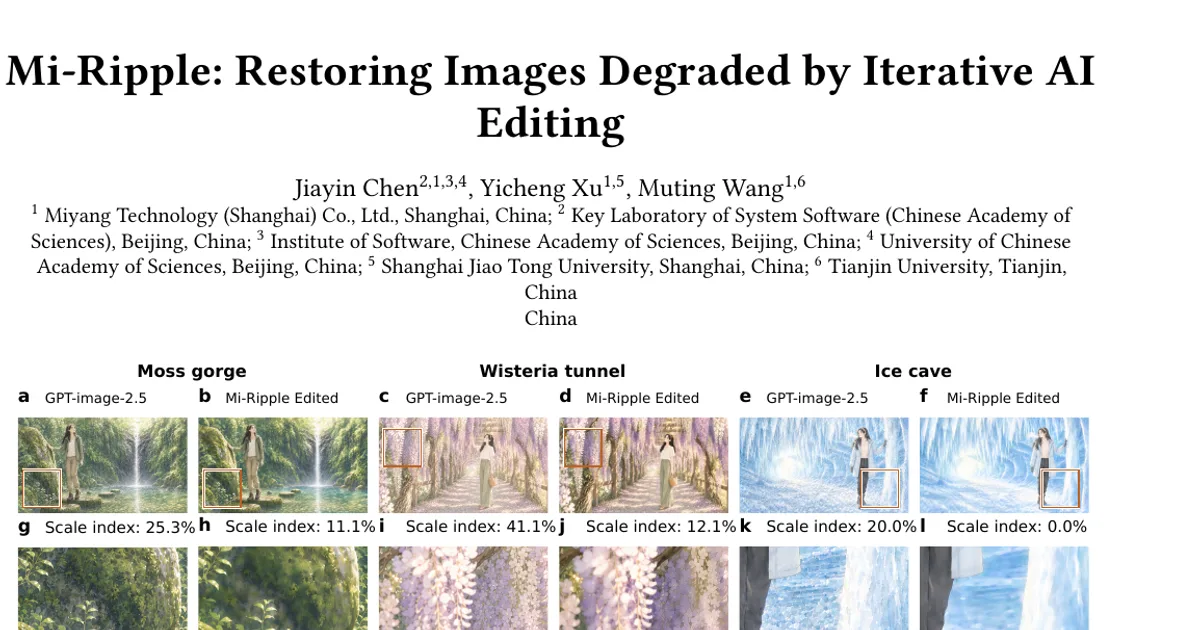
Visual and measured evidence. Restoration pairs (including an eight-scene comparison and a six-portrait case series) demonstrate the workflow's benefits, while aligned residuals independently check for filtering damage.
-
A separation of two output grades. The workflow distinguishes "deliverable-grade" filtering, which preserves pixel alignment, from "reference-grade" cleaning, which prepares an input for regeneration — allowing stronger reference preparation without presenting it as a finished image.
Main Findings
-
Lattice and granular artifacts need different treatments. Isolated spectral peaks — retained as connected components above a 21×21 local spectral median by 1.2, outside radius 24, with at most 80 bins of support, and requiring at least two components with largest excess of at least 2.5 — permit selective notch filtering. Granular texture has no isolated peak to notch, so it calls for masked suppression, cleaned-reference regeneration, or human review.
-
Selective notching achieves small measured distortion. Across fourteen notch-only executions, whole-image residual standard deviation spans 0.08–0.44 in CIELAB lightness units. The paper notes this range includes repeated use of one candidate rather than fourteen independent images. On the garden-tilt example, the selected pre-feather mask covers 0.11% of frequency bins; a background patch's anomaly decreases from 3.49 to 1.77 with whole-image residual SD 0.18.
-
Soft clipping spreads its damage more broadly. In the radial-baseline soft-clipping comparison, more than 85% of removed energy lies within the lowest quarter of the spectral radius, which the authors contrast with compact-peak selection.
-
Reference cleaning reduces texture carried into a new generation. In a paired example using radial soft clipping for reference preparation, output debris density falls from 1,842 to 1,020 components per megapixel — a 45% reduction. A separate dense-moss comparison gives scale indices of 35.3% with the untreated reference and 15.8% with the cleaned reference on the common canvas. These are described as single-draw comparisons, not average treatment effects.
-
Structure-aware cleaning is region-dependent. Output band-pass SD falls from 1.05 to 0.87 in sea and from 2.61 to 1.77 in railing, while sky changes from 0.20 to 0.25 — lower energy is not a universal outcome.
-
Portrait candidates pass distortion checks. Across six initial portrait candidates, all detect a lattice and two additionally receive masked suppression; all six pass with whole-image residual SD 0.21–0.49 and high-frequency retention 98.9–99.8%. Six additional hair-constrained candidates pass after notching with residual SD 0.25–0.44.
-
Local grain suppression reduces band-pass SD. Strict masked suppression lowers sky and sea band-pass SD from 0.38 to 0.18 and from 1.21 to 0.71 in one degraded example, while the mask protects hair and facial structure.
-
Scene-dependent reduction, not a universal restoration rate. In the eight-scene comparison on the gpt-image-2.5 route, the restoration path reduced six of eight gen4 endpoints to the "none" grade. Moss gorge fell from 25.3% to 11.1% and wisteria from 41.1% to 12.1% but remained structured, while ice cave fell from 20.0% to 0.0%.
-
Spectral anomaly is not specific to generated images. Patch-based survey medians are 1.73 for photographs (n = 3, range 1.70–3.12), 1.95 for web references (n = 5, range 1.61–2.36), and 4.61, 4.17, and 4.13 for the three generation sources. One photograph reaches 3.12 because of JPEG blocking and repeated structures.
-
The artifact depends on access configuration, not vendor name. In a 69-image channel survey, Channel B is lattice-positive in 43/43 outputs across the tested scenes and resolutions, while Channel A is negative in 20/20 outputs at 1280×720 and positive in 6/6 at 1536×1024. Four fixed-prompt, fixed-reference draws yield max A of 4.41, 4.49, 4.25, and 4.61, with a coefficient of variation of 3.4%.
-
Repetition drives granular coverage in some scenes. Across five same-scene Channel B chains at native resolution, moss canyon climbs 0.9% → 3.1% → 5.2% → 8.3% → 23.7% from gen0 to gen4, and rainforest moves 9.5% → 7.7% → 19.4% → 18.8% → 16.9%. Face and beach remain at 0.0% throughout, which the authors state indicates the probe did not detect this texture, not that face restoration is unnecessary.
-
Granular texture varies across independent initial draws. Four moss-scene draws span 0.0–16.8% on the common canvas, while four rainforest draws span 9.5–12.6%. The low-scoring moss draw contains broad leaves instead of dense fine vines.
-
Scene-change sequences do not isolate a causal effect. The rainforest sequence returns to 1.1–2.1% after a 7.9% intermediate output, and the glacier counterpart stays at 0.0–0.5%, but the authors note that scene-change and same-scene sequences also differ in channel and that several same-scene chains mix resolutions.
-
External sequences show persistence separable from accumulation. In the Banana100 more_models subset, five families exhibit persistent or late-emerging characteristic periods while four show strong positive step correlations in autocorrelation strength; these sets overlap but are not identical. Qwen maintains a six-pixel horizontal period at all ten steps without increasing strength.
-
Prompt constraints do not provide consistent control. Across eight same-reference pairs, a foliage-texture constraint increases the scale index in five pairs and decreases it in three. For the decomposed noun, property, and negation passages, mean paired differences are +3.3, −1.3, and −0.3 percentage points, with two-sided sign-test p-values of 0.29, 0.73, and 0.73.
-
Regeneration replaces rather than recovers. In one restoration without access to a clean ancestor, a sharpness measure rises from 3.18 to 4.34, while the unseen ancestor scores 5.54 — a descriptive ratio, since the ancestor has different composition. The paper repeatedly states that regeneration reconstructs plausible detail and does not recover a known pixel-level ground truth.
Methodology in Plain English
The authors treat iterative editing as a diagnosis problem before a repair problem.
Step one: diagnose. They look at the lightness channel of an image in CIELAB and convert it to the frequency domain. By subtracting a local median baseline from the log-amplitude spectrum, they isolate peaks that stand out from their surroundings. Peaks that are compact, outside a low-frequency radius, and limited in extent suggest a periodic lattice — an artificial texture with a repeatable period. A second, whole-image version of this probe uses a 21×21 local median and requires multiple retained components. In parallel, a spatial probe examines 96-pixel flat windows for band-pass strength, excess kurtosis, blob coverage, and isotropy, and a whole-frame scale index reports the percentage of qualifying 128-pixel tiles at stride 64, based on blob coverage, area consistency, circularity, and anisotropy. Autocorrelation of the high-passed lightness supplies a separate period estimate without the band-pass, because granular regions show weak maxima at inconsistent displacements while a lattice produces repeatable period vectors.
Step two: treat. For a lattice, they notch only the retained isolated peaks in the spectrum, applying Gaussian feathering of 1.5 bins, preserving phase and normally modifying lightness alone, with reflection padding to reduce boundary effects. For granular texture, a strict mask based on edge strength, orientation coherence, and texture density permits local band reduction in unstructured regions. Where artifacts overlap legitimate foliage or material texture, the pipeline requests human review instead of increasing filtering strength. When content reconstruction is acceptable, reference-grade cleaning applies broader suppression before regeneration, with explicit face protection, and the regenerated output is diagnosed again.
Step three: verify. Acceptance uses image differences rather than the anomaly score the filter optimizes. Structural windows must have residual SD of at most 0.6 lightness units and high-frequency retention of at least 90%; flat-window band-pass SD must not increase by more than 0.02; whole-image residual SD must not exceed 1.0. Rule-based routing is the default, with an optional language-model layer that selects among permitted actions without changing numerical thresholds. Regeneration requires explicit permission and a bounded retry count.
Evaluation setup. The study uses two commercial editing channels without access to weights, seeds, or sampling parameters. Channel A is a desktop integration advertised as OpenAI Image 2; Channel B is an OpenAI-compatible gateway including routes identified as gpt-image-2 and gpt-image-2.5, and is operated by the authors' institution. Experiments comprise five five-generation same-scene chains on Channel B, two five-generation scene-change chains on Channel A, prompt comparisons on two foliage-rich scenes, and an eight-scene comparison of the gpt-image-2 and gpt-image-2.5 routes, plus four photographs, five web references, fifteen generated images for a spectral survey, four fixed-condition repeats, and six watercolour portrait originals. For external evidence, they analyze the Banana100 more_models subset: one starting photograph and 110 edited outputs from seven model families across eleven ten-step sequences.
Why This Matters
Impact on research. The paper reframes a generative-artifact problem as a restoration problem with an explicit decision policy: measure, classify, treat, and verify. It argues that a lower spectral score is not the same as a better image, and that a "none" scale grade is not a certificate of colour, identity, or lattice fidelity. That distinction — between optimizing a metric and improving a picture — is the paper's most portable idea.
Real-world applications:
- Quality control for studios and pipelines that iteratively refine AI-generated assets across many editing rounds.
- Preparing clean reference images before a regeneration step, so carried-over texture does not compound into the next generation.
- Triage tooling that flags content-entangled regions for human review instead of silently over-filtering them.
- Diagnostic reporting for archives or asset libraries that need to record which images received which treatments and why.
Industry relevance. Anyone running iterative reference-conditioned editing at scale faces the same practical trade-off the paper names: filter too little and artifacts persist, filter too much and legitimate detail — hair, foliage, material texture — disappears. The paper's actionable implication is organizational as much as technical: preserve approved references and avoid unnecessary output-to-input chains, since a star-shaped workflow removes direct dependence on the previous output. The authors also note that the regenerated outputs remain identified as AI-generated and that filtering is intended for quality control on their own assets, not concealment of provenance.
Future Directions
-
Broader threshold calibration. The study-specific thresholds serve within-study triage rather than a validated universal classifier; the paper states they require broader calibration.
-
Matched-channel, matched-resolution studies. Mixed-channel and mixed-canvas chains do not isolate causal editing effects, and a channel-matched, resolution-matched factorial comparison of scene change remains unperformed.
-
Population-level treatment success rates. Single-draw regeneration comparisons demonstrate restoration routes rather than average gains; matched-channel studies and independently annotated images would establish treatment success rates beyond the reported cases.
-
Benchmarking the star-shaped workflow. The paper recommends avoiding unnecessary same-scene recursion but notes that the star-shaped workflow's quality advantage remains unbenchmarked.
-
Separating persistence from accumulation externally. Seven families and eleven sequences in the Banana100 subset do not supply independent replication across starting scenes, so no population prevalence estimate or between-vendor quality ranking is inferred.
Target Audience
This paper suits computer-vision researchers working on generative image artifacts and restoration; engineers building or operating iterative image-editing pipelines; quality-control and post-production specialists handling large volumes of AI-generated or AI-edited assets; and readers interested in the methodology of separating measurable artifact reduction from genuine visual improvement. It is most useful to those comfortable with frequency-domain reasoning and numeric acceptance criteria, though the diagnostic and routing logic is explained without heavy notation.
Authors’ abstract
Iterative reference-conditioned image editing can introduce grid-like and granular textures, commonly described as digital ripple. We present Mi-Ripple, a diagnosis-guided restoration workflow that suppresses this digital ripple while protecting image structure. Mi-Ripple separates periodic lattice artifacts from content-entangled granular texture, then combines selective spectral notching, structure-aware smoothing, and cleaned-reference regeneration. This separation enables low-distortion filtering when artifacts are spectrally isolated and visual reconstruction when filtering would erase legitimate detail. Across fourteen notch-only executions, whole-image residual standard deviation is 0.08--0.44 in CIELAB lightness units. In a paired regeneration example, reference cleaning reduces output debris density by 45\%. Mi-Ripple links measurable artifact reduction to visibly cleaner generated images, rather than optimizing a spectral score alone.