Research
Meta Dynamic Graph for Traffic Flow Prediction
Meta Dynamic Graph for Traffic Flow Prediction Overview Research area: Spatio-temporal machine learning, specifically deep-learning-based traffic flow prediction on road networks. The paper sits at th
- arXiv
- 2601.10328
- Published
- 2026-01-15
- Authors
- Yiqing Zou, Hanning Yuan, Qianyu Yang, Ziqiang Yuan, Shuliang Wang, Sijie Ruan
AI summary
Meta Dynamic Graph for Traffic Flow PredictionOverview
Research area: Spatio-temporal machine learning, specifically deep-learning-based traffic flow prediction on road networks. The paper sits at the intersection of graph neural networks (GNNs), recurrent models (GRU/RNN), meta-learning, and attention mechanisms.
Technical level: Intermediate. The paper assumes familiarity with graph convolution, gated recurrent units, cross-attention, and the standard encoder-decoder formulation of traffic forecasting. The mathematics is dense but the underlying ideas are described in plain terms.
Scope (1 sentence): The paper proposes MetaDG, a framework that generates a dynamic adjacency matrix, dynamic meta-parameters, and a learned edge-weight adjustment matrix at every time step, and tests it against 11 baselines on four real-world traffic datasets.
Authors are affiliated with Beijing Institute of Technology, Beijing, China. Code is released at https://github.com/zouyiqing-221/MetaDG. The paper content provided is truncated at the end of the Related Work section, so downstream sections are not available for summary.
What This Paper Is About
Most traffic forecasting models are built by pairing a temporal model (such as a GRU or temporal convolution) with a separate spatial model (such as a graph convolution), which the authors call "ST-isolated" modeling and argue makes cross-dimensional spatio-temporal dependencies hard to capture. A second limitation is that existing work that does model dynamics usually restricts dynamics to the spatial topology alone (for example, generating a changing adjacency matrix), ignoring the possibility that dynamics could also shape model parameters. MetaDG addresses both problems by using dynamic graph structures of node representations to simultaneously produce dynamic adjacency matrices and dynamic meta-parameters, pushing the base model from ST-isolated toward what the authors call "ST-unification."
Key Contributions
- Dynamic node embedding with spatio-temporal correlation enhancement. For each time step, MetaDG generates raw dynamic node embeddings and enriches them using spatio-temporal correlations across time steps, bridging the spatial and temporal dimensions and moving the base model from ST-isolated toward ST-unification.
- Reliability-aware graph refinement. The authors argue that message-passing reliability is critical in GNN-based models and that the recurrent nature of RNN-based models can accumulate errors. They therefore introduce a Dynamic Graph Qualification module that produces an edge-weight adjustment matrix, strengthening edges whose current-history interactions are reliable and weakening the rest.
- Broader use of dynamics. Enhanced dynamic node representations and the edge-weight adjustment matrix are used to generate meta-parameters and an adjacency matrix for each time step, incorporating both dynamics and spatio-temporal heterogeneity in a single, ST-unifying formulation rather than in separated spatial and temporal treatments.
- Empirical validation. Experiments on four real-world datasets demonstrate the effectiveness of modeling dynamics and heterogeneity simultaneously, supported by an ablation study over six variants.
Main Findings
- MetaDG outperforms all 11 baselines across all four datasets. Baselines are STGCN, DCRNN, GWNet, AGCRN, STSGCN, STID, PDFormer, MegaCRN, DGCRN, HimNet, and ST-SSDL. On PEMS03 MetaDG reports MAE 14.29, RMSE 24.93, MAPE 14.64; on PEMS04 MAE 17.80, RMSE 29.46, MAPE 11.70; on PEMS07 MAE 18.79, RMSE 32.29, MAPE 7.89; on PEMS08 MAE 13.04, RMSE 22.53, MAPE 8.58.
- Both meta-learning and dynamic baselines are surpassed. The authors group AGCRN, MegaCRN, and HimNet as meta-learning methods and STSGCN, PDFormer, and DGCRN as dynamic methods, and state that MetaDG beats both groups by generating model components dynamically at each time step and by extending dynamics to meta-parameters, raw adjacency matrix, and edge-weight adjustment matrix.
- Removing any enhancement module degrades performance. Ablations that drop spatial correlation enhancement (w/o SCE), temporal correlation enhancement (w/o TCE), or the combined module (w/o STCE) all reduce effectiveness, which the authors read as evidence that spatio-temporal correlations are critical for generating meta-parameters and the adjacency matrix.
- Removing graph qualification also hurts. The w/o DGQ variant performs worse, supporting the claim that refining the adjacency matrix based on estimated message-passing reliability matters in a GCRU-based model.
- Order of operations matters. The MetaDG-TSCE variant, which reverses the SCE and TCE order to "smoothing-before-fusion," deteriorates on most metrics, validating the paper's choice of fusion-before-smoothing. On PEMS03 MAPE, TSCE records 14.40 versus MetaDG's 14.64.
- Separate components benefit from separate representations. The MetaDG-Joined variant, which replaces the three separately enhanced node embeddings with a single joined embedding, is described as showing that in most cases the meta-parameters, raw adjacency matrix, and edge-weight adjustment matrix need different kinds of correlations. MetaDG-Joined records 22.47 RMSE on PEMS08 versus MetaDG's 22.53.
- Advantage grows for longer horizons. A per-time-step comparison on PEMS03 and PEMS04 shows MetaDG has a larger advantage in long-term prediction.
- Embedding dimensions show softer inflection points than typical. On PEMS04, performance curves for embedding dimensions exhibit sharp inflection points as in prior work, but for MetaDG, once the node dimension d_s reaches 16, further increases slightly improve performance; the time dimension d_t still inflects at d_t = 16, though the change around the inflection is relatively slight. The authors attribute this to dynamic graph learning improving the organizational capability of embeddings.
- Efficiency is competitive, not dominant. On PEMS03, MetaDG uses 666K parameters with 250s training and 23s inference, versus DGCRN at 208K parameters, 287s training, 33s inference; HimNet at 2742K parameters, 175s training, 19s inference; ST-SSDL at 234K parameters, 172s training, 19s inference; and MetaDG-Joined at 649K parameters, 197s training, 20s inference. MetaDG reduces time relative to DGCRN and parameters relative to HimNet, while MetaDG-Joined reaches inference time comparable to ST-SSDL.
Methodology in Plain English
The framework keeps the standard sequence-to-sequence skeleton — a Graph Convolutional Recurrent Unit (GCRU), which combines a GRU with graph convolution — for both encoder and decoder. What changes is that nothing inside the graph convolution stays fixed. Three modules feed it fresh components at every time step.
First, the Dynamic Node Generation (DNG) module blends a learnable static node embedding with the previous hidden state, using a time-based gate computed from time-of-day and day-of-week embeddings. The gate decides, per dimension and per time step, how much to rely on the static representation versus the evolving hidden state. A low gate value means more flexibility. The static embedding is not a predefined road adjacency matrix; instead, a 0-1 adjacency is derived from the inner product of this static embedding.
Second, the Spatio-Temporal Correlation Enhancement (STCE) module cleans up these raw node embeddings in two steps. Spatial Correlation Enhancement (SCE) uses cross-attention, letting each node pull useful historical information from all nodes at the previous time step. Temporal Correlation Enhancement (TCE) then reuses the GRU's own update gate to blend the current representation with the previous one, smoothing abrupt changes. The two are chained fusion-first, smoothing-second. Variational Dropout is used in the MLP layers instead of standard Dropout because standard Dropout between time steps is harmful to RNN-based models.
Third, the Dynamic Graph Qualification (DGQ) module inspects how trustworthy each edge's information flow is. It measures the cross-time-step similarity of enhanced node representations, computes a per-node threshold from the diagonal of that similarity matrix (so self-connections are never weakened), and then splits edges into a positive mask and a negative mask. Reliable edges are scaled up and unreliable ones down, with the scaling factor derived by exponentiating an instance-normalized mask. The resulting edge-weight adjustment matrix multiplies the raw adjacency matrix, which is then row-normalized.
The outputs of the three modules become the meta-parameters, adjacency matrix, and edge-weight adjustment matrix used in the graph convolution at each time step, giving the MetaDG Convolutional Recurrent Unit. To counter the low-rank nature of adjacency matrices built from low-dimensional node embeddings, the paper also incorporates continuous time features based on cosine and sine terms, producing a higher-dimensional node representation that further refines the adjacency matrix.
Setup details. All experiments use PyTorch on a workstation with one GeForce RTX 4090. Input and output horizons T and T' are both 12. Huber loss is used, with 200 training epochs and early stopping after 20 epochs without validation-loss improvement. Batch size is 8 for PEMS07 and 16 for the others; d_H and the query/key/value dimension d' are 64; delta is 2. Embedding dimensions (d_s, d_tod, d_dow, d_c) are 12, 8, 8, 8 for PEMS03; 16, 12, 4, 6 for PEMS04; 16, 8, 8, 8 for PEMS07; and 12, 10, 2, 8 for PEMS08. Inputs are Z-score normalized, and data is split 6:2:2 into training, validation, and test sets.
Datasets. PEMS03 (358 sensors, 26,185 timesteps, 09/2018–11/2018), PEMS04 (307 sensors, 16,992 timesteps, 01/2018–02/2018), PEMS07 (883 sensors, 28,224 timesteps, 05/2017–08/2017), PEMS08 (170 sensors, 17,856 timesteps, 07/2016–08/2016), all at a 5-minute time interval. Evaluation uses MAE, RMSE, and MAPE (%).
Why This Matters
Impact on research. The paper reframes "dynamics" in spatio-temporal forecasting. Prior dynamic methods such as DGCRN use dynamics mainly to produce a changing adjacency matrix; MetaDG argues dynamics should also drive meta-parameters and message-passing reliability. If the argument holds, the ST-isolated versus ST-unification framing offers a new axis for comparing and designing spatio-temporal architectures, and the residual gap between MetaDG and MetaDG-Joined suggests a companion design principle: different model components may deserve differently enhanced representations.
Real-world applications.
- Urban traffic management and signal timing, where forecasting congestion minutes ahead supports adaptive control.
- Route planning and navigation services that need reliable short- and long-horizon travel-time estimates; the paper's per-time-step results suggest the largest gains at longer horizons.
- Fleet operations and logistics, including dispatch and delivery scheduling that depend on predicted road conditions.
- Public transit and shared-mobility planning, where sensor-level flow forecasts inform capacity allocation.
Industry relevance. The efficiency table reports 666K parameters, 250s training, and 23s inference on PEMS03, meaning the method is not dramatically heavier than the compact baselines despite its added machinery. That positions it as a plausible upgrade for production forecasting stacks, especially since it avoids a predefined adjacency matrix and can be trained directly on sensor data. The released code lowers the barrier to replication.
Future Directions
The paper content provided does not include an explicit future work section, so the following are open questions the work raises rather than stated plans.
- Does ST-unification hold for architectures other than GCRU? The framework is built on GCRU for both encoder and decoder; whether the same dynamic-qualification machinery transfers to, say, transformer-based or MLP-based spatio-temporal backbones is untested here.
- What is the right granularity of separation among the p, g, and m node representations? The MetaDG-Joined ablation shows separate enhancement helps in most cases but is not uniformly better, leaving open how many separately enhanced embeddings are optimal and how they should be shared.
- Can the qualification mechanism handle data beyond traffic? The datasets are all sensor-based traffic flow from PEMS; the paper does not report evaluation on other spatio-temporal domains, so generalizability is unestablished.
- What is the cost-accuracy frontier at larger scale? PEMS07, the largest dataset at 883 sensors, is the only one trained with batch size 8, and the efficiency comparison is reported only on PEMS03; behavior on larger or streaming deployments is not reported.
Target Audience
Researchers and graduate students working on spatio-temporal forecasting, graph neural networks, and traffic prediction will get the most from this paper, particularly those already familiar with GCRU-based meta-learning methods such as AGCRN, MegaCRN, and HimNet. Practitioners building production traffic forecasting systems will find the efficiency comparison and the released code useful. Readers without a background in graph convolution and recurrent encoder-decoder models will need to consult the cited background work first.
Authors’ abstract
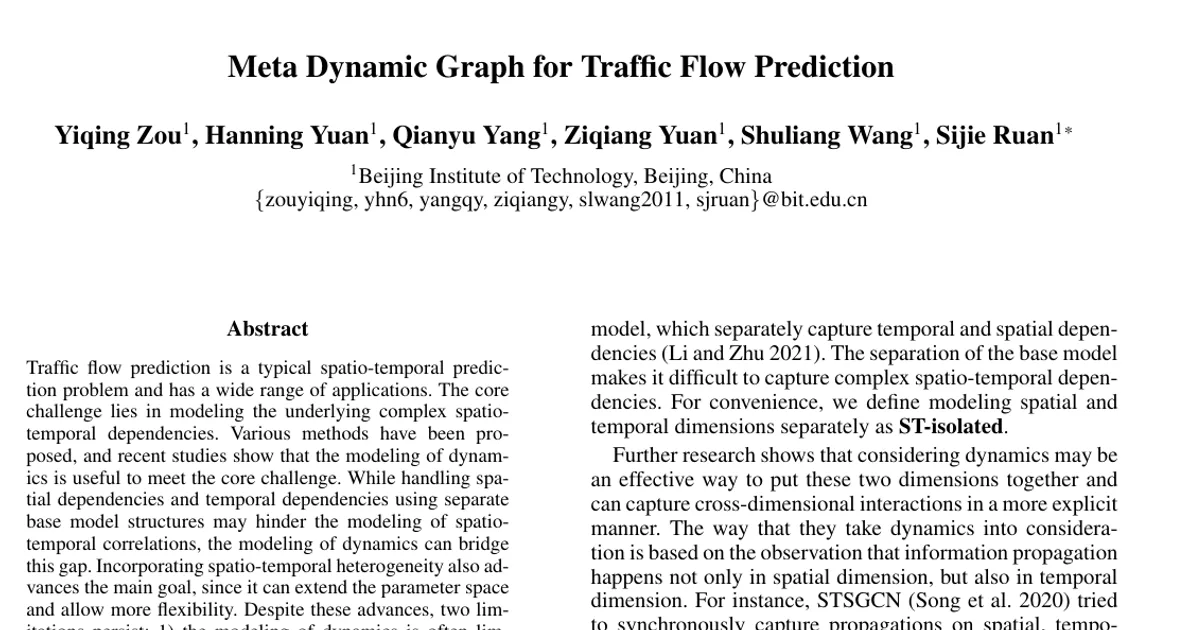
Traffic flow prediction is a typical spatio-temporal prediction problem and has a wide range of applications. The core challenge lies in modeling the underlying complex spatio-temporal dependencies. Various methods have been proposed, and recent studies show that the modeling of dynamics is useful to meet the core challenge. While handling spatial dependencies and temporal dependencies using separate base model structures may hinder the modeling of spatio-temporal correlations, the modeling of dynamics can bridge this gap. Incorporating spatio-temporal heterogeneity also advances the main goal, since it can extend the parameter space and allow more flexibility. Despite these advances, two limitations persist: 1) the modeling of dynamics is often limited to the dynamics of spatial topology (e.g., adjacency matrix changes), which, however, can be extended to a broader scope; 2) the modeling of heterogeneity is often separated for spatial and temporal dimensions, but this gap can also be bridged by the modeling of dynamics. To address the above limitations, we propose a novel framework for traffic prediction, called Meta Dynamic Graph (MetaDG). MetaDG leverages dynamic graph structures of node representations to explicitly model spatio-temporal dynamics. This generates both dynamic adjacency matrices and meta-parameters, extending dynamic modeling beyond topology while unifying the capture of spatio-temporal heterogeneity into a single dimension. Extensive experiments on four real-world datasets validate the effectiveness of MetaDG.