Research
Masked Diffusion Language Agents for Tool-Integrated Chemical Reasoning
Overview Research area: Artificial intelligence for scientific discovery — specifically tool-integrated agent systems for chemistry, built on masked diffusion language models (dLLMs) rather than autor
- arXiv
- 2610.13330
- Published
- 2026-10-09
- Authors
- Mengdi Liu, Chenghao Jia, Hong Chang, Shiguang Shan
AI summary
Overview
Research area: Artificial intelligence for scientific discovery — specifically tool-integrated agent systems for chemistry, built on masked diffusion language models (dLLMs) rather than autoregressive (AR) models.
Technical level: Advanced. The paper assumes familiarity with diffusion language models, evidence lower bounds (ELBO), block-wise attention, reinforcement-learning-style preference optimization, and tool-calling agent protocols.
Scope: The paper introduces ChemDiffAgent, a masked diffusion language agent whose reasoning and tool-use trajectories are generated by iterative denoising rather than left-to-right decoding, and evaluates it on a new six-task chemistry benchmark in single-turn and multi-turn tool-use settings (arXiv:2610.13330v1 [cs.AI], 09 Oct 2026).
What This Paper Is About
Existing chemistry agents that call external tools (molecular property predictors, reaction engines, cheminformatics libraries) are all built on the autoregressive paradigm, which commits to one token at a time from left to right. The authors argue this is a poor fit for chemistry, where molecular strings such as SMILES have bidirectional dependencies, where tool choice, tool arguments and the reasoning goal are mutually dependent, and where several sources of evidence must be fused into one answer.
ChemDiffAgent reformulates tool-integrated chemical reasoning as iterative denoising over interleaved reasoning-and-tool-use trajectories, so that thinking steps, tool-use decisions, tool names, arguments and evidence can be jointly refined within a block under full-trajectory context. The goal is to align the agent's tool-use decision boundary with its actual knowledge boundary, and to show this paradigm beats matched autoregressive agents.
Key Contributions
- ChemDiffAgent, described as the first masked diffusion language agent for tool-integrated chemical reasoning, which models chemical reasoning as iterative denoising over interleaved reasoning and tool-use trajectories, allowing global attention and coordination.
- A theoretical analysis of why the diffusion paradigm helps agentic reasoning: harder block-infilling subproblems during training, flexible arbitrary-order decoding at inference, a risk decomposition over decoding paths (Eq. 5), and an ordering result showing the risk gap between AR ordering and reversed ordering equals (w_Z − w_R)·I(Z;R|C) (Eq. 6).
- A two-stage post-training framework: Agentic Supervised Fine-Tuning (Agentic SFT) and Agentic Variance-Reduced Preference Optimization (Agentic VRPO), built on a modified Agentic ELBO that supervises only agent-controlled positions and excludes tool_response regions.
- A benchmark covering six chemistry tasks (composition inference, name conversion, property prediction, retrosynthesis, molecular optimization, forward synthesis) across single-turn and multi-turn tool-use scenarios, with multi-turn difficulty split into Easy, Medium and Hard (2, 3–5 and 6–7 tool-calling rounds respectively).
Main Findings
- Diffusion beats autoregressive under matched conditions (single-turn): With the same SFT data, training epochs, context length and tool interface, SDAR-8B + SFT scored 89.0 overall versus 69.1 for Qwen3-8B + SFT — an overall improvement of 19.9%. SDAR-8B without SFT scored 23.3.
- RL stage transfers to single-turn: Although Agentic VRPO is trained on multi-turn data, it raised the single-turn total from 89.0 to 91.8 (+2.8). Per-task RL gains: composition inference 91.8 (+0.5), name conversion 97.1 (+18.7), property prediction 95.8 (+1.0), retrosynthesis 96.9 (+0.0), molecular optimization 79.2 (+3.7), forward synthesis 98.3 (+0.0).
- Best single-turn overall score reported: ChemDiffAgent (SDAR-8B + SFT + RL) reached 91.8, above Claude Opus 4.7 with ReAct (90.9), ChemCrow with Claude Opus 4.7 (89.6), DeepSeek-V3.2 (77.0), S1-NexusAgent with GPT-5.5 (76.7), GPT-5.5 (70.6), Gemini 2.5 Flash (59.8) and GLM-5.1 (32.8).
- Multi-turn advantage: SDAR-8B + SFT scored 62.3 versus Qwen3-8B + SFT at 44.0, an 18.3% gap. After RL, ChemDiffAgent reached 64.6 (Easy 78.2, +2.3; Medium 69.9, +3.1; Hard 44.9, +1.9), surpassing GPT-5.5 (61.1) and approaching Claude Opus 4.7 (72.8). The strongest multi-turn baseline was ChemCrow with Claude Opus 4.7 at 73.5.
- Tool selection accuracy: The paper reports that ChemDiffAgent consistently surpasses frontier models such as GPT-5.5 and Claude Opus 4.7 in tool selection accuracy, particularly as task complexity increases (Fig. 3).
- Tool-use efficiency: ChemDiffAgent (RL) averaged 3.93 executed tool rounds versus 5.60 for Qwen3-8B (SFT), 6.00 for Gemini 2.5 Flash and 4.84 for DeepSeek-V3.2; Claude Opus 4.7 averaged 3.90 and GPT-5.5 3.42. Average trajectory length for ChemDiffAgent (RL) was 548.2 tokens single-turn and 1747.7 multi-turn, compared with 648.8 / 1769.4 for Qwen3-8B (SFT).
- Qualitative behaviour: The paper reports three advantages from case studies — global tool selection instead of redundant repeated calls, slot-level fusion of multi-source evidence instead of lossy aggregation, and self-refinement that validates intent and corrects uncertain arguments before execution.
- Decoding order is not left-to-right: In the visualized example, tool-call delimiters and argument structure are established relatively early while selected tokens in the SMILES argument stay masked until later, so chemical details are conditioned on a more stable global action structure.
Methodology in Plain English
The backbone is SDAR-8B, a block diffusion language model continually pretrained from Qwen3-8B, so the diffusion and autoregressive baselines share the same parameter scale and pretraining lineage.
At training time, a strong teacher model generates candidate chemistry-agent trajectories. A trajectory is kept only if the final answer is correct, the reasoning is clear and complete, and every tool selection and argument is correct and follows the required format. The query, the clean teacher trajectory and a noised copy are concatenated into one sequence so all noised blocks are supervised in a single forward pass using block-level bidirectional attention.
Noising is applied selectively: only agent-controlled regions such as think and tool_call steps are perturbed, while tool_response spans are left as grounded context, and any tool_response token visible inside the same bidirectional block is fully masked to prevent train-inference leakage. The training loss — the Agentic ELBO — is computed only at masked positions that are not external tool observations, since the agent does not generate those.
The second stage, Agentic VRPO, contrasts a successful trajectory with a failed one for the same query. Each trajectory is scored by sampling M corrupted contexts with Agentic Noising, using the same corrupted input for the policy and a fixed reference model, then averaging the Agentic ELBO differences and feeding the result through a sigmoid preference objective with scale β.
For data, four resources were used — SMolInstruct, ChemToolBench, MT-Mol and T5Chem-style reaction data — normalized into a schema with task type, query, raw chemical input, reference output and an anchor tool. Single-turn examples convert each seed directly into a tool-use query. Multi-turn examples are built as graph-conditioned tool-use tasks: a chemistry tool graph is constructed with tools as nodes and input–output compatibility as edges, random walks sample subgraphs, a teacher composes a query combining the original task with the sampled tools, and a candidate is retained only if its executed tool chain matches the sampled subgraph, followed by manual inspection.
Evaluation uses two metrics: answer correctness, judged by GPT-4o, and tool selection accuracy, the fraction of the m expected tools in the gold chain that the model invokes. All experiments ran on 8 NVIDIA A100 GPUs with block size and denoising steps both set to 64.
Why This Matters
Impact on research: The paper positions masked diffusion, rather than autoregression, as a foundation for scientific agents, and argues the benefit is structural — bidirectional understanding of chemical modalities, globally coupled tool planning, and multi-source evidence fusion — not just a training-trick effect. It also provides the first diffusion-agent benchmark in a scientific domain, since prior dLLM agents (DLLM-Agent, DLLM-Searcher) were confined to web search.
Real-world applications:
- Computational chemistry assistance, such as composition inference, name conversion, property prediction and retrosynthesis, where the agent decides when it needs a tool rather than guessing from parametric memory.
- Reaction planning and forward synthesis, where a chain of tools must be executed in a valid order.
- Molecular optimization workflows, where multiple evidence sources must be reconciled into one answer.
- Lowering the expertise barrier to cheminformatics libraries by letting users issue natural-language queries instead of hand-building tool pipelines.
Industry relevance: The paper reports an 8B model reaching performance comparable to, and in some cases surpassing, much larger frontier models such as GPT-5.5 and Claude Opus 4.7 under matched budgets, which is directly relevant to cost-sensitive deployment. It also notes that dLLM serving infrastructure (caching, speculative decoding, inference optimization) is less mature than the AR ecosystem, making AR models more practical for current production deployments despite the accuracy results.
Future Directions
- Scaling ChemDiffAgent beyond the 8B parameter scale to larger backbones, since the evaluation is constrained to 8B.
- Extending the framework beyond a fixed toolset and beyond purely computational chemistry to wet-lab-grounded workflows and broader scientific domains.
- Building dLLM serving infrastructure — efficient caching, speculative decoding and inference optimization — to make diffusion agents competitive for production deployment.
- Addressing the training difficulty of dLLMs as model size and agentic reasoning horizon grow, and determining where flexible arbitrary-order decoding yields the largest gains.
Target Audience
Researchers and engineers working on LLM agents, diffusion language models, or AI for science will benefit most. Chemists and computational chemistry practitioners interested in tool-using assistants can follow the benchmark design and the efficiency/tool-selection analyses without the theoretical sections. The paper is also relevant to practitioners weighing non-autoregressive architectures against mature autoregressive stacks for deployment, since it explicitly discusses the infrastructure gap and its 8B-scale comparison against frontier models.
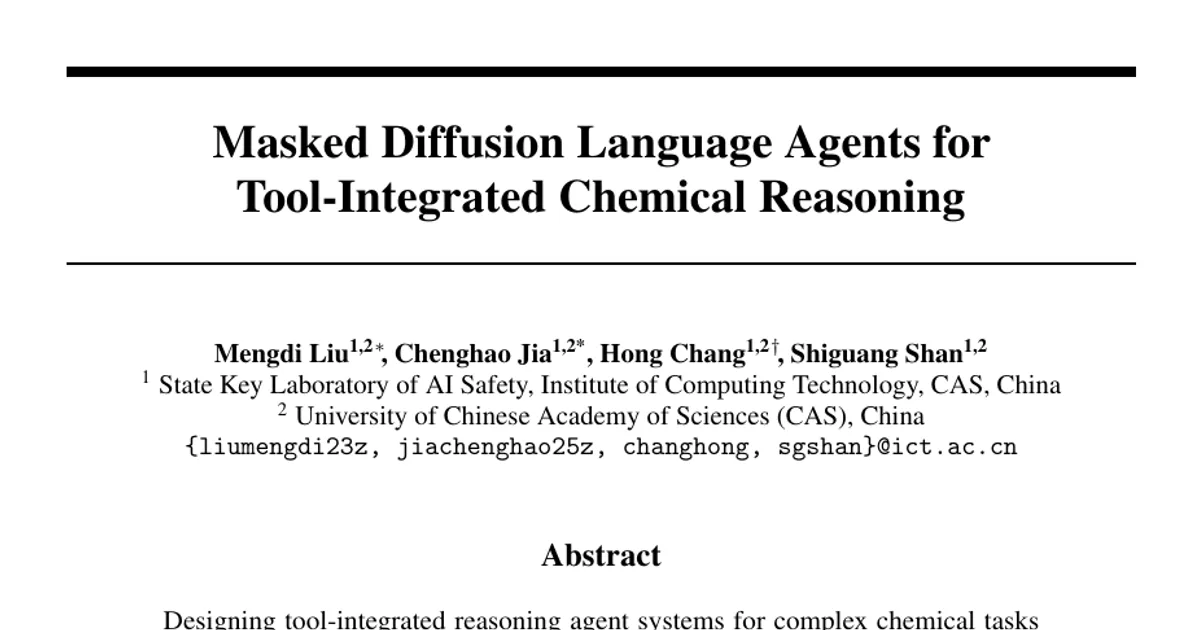
Authors’ abstract
Designing tool-integrated reasoning agent systems for complex chemical tasks remains a fundamental challenge. Although recent chemical agents have demonstrated promising performance through the integration of external tools, they are still built on the autoregressive paradigm, which is inherently constrained by causal attention and left-to-right generation. As a result, they often struggle with bidirectional molecular understanding, global coordinated tool planning and multi-source evidence integration. To address this challenge, we introduce ChemDiffAgent, the first masked diffusion language agent for tool-integrated chemical reasoning. It reformulates chemical reasoning as iterative denoising over interleaved reasoning and tool-use trajectories, enabling tool-use decisions to be jointly determined under full-trajectory context and thereby better aligning the agent's decision boundary with its knowledge boundary. We further analyze how this paradigm benefits agentic reasoning through harder infilling subproblems during training and flexible arbitrary-order decoding during inference. Then we develop a two-stage post-training framework, comprising agentic supervised fine-tuning and variance-reduced preference optimization, to enhance tool-use and reasoning capabilities. We also construct a comprehensive benchmark covering six chemistry tasks across both single-turn and multi-turn tool-use scenarios. Under matched budgets and evaluation, ChemDiffAgent consistently outperforms autoregressive agents, achieving an overall improvement of approximately 20%. Notably, our 8B model achieves performance comparable to, in some cases surpassing, significantly larger frontier models, such as GPT 5.5 and Claude Opus 4.7. Code is available at https://github.com/bilemond/ChemDiffAgent.