Research
Mask the Redundancy: Evolving Masking Representation Learning for Multivariate Time-Series Clustering
Multivariate Time-Series (MTS) clustering discovers intrinsic grouping patterns of temporal data samples. Although time-series provide rich discriminative information, they also contain substantial re
- arXiv
- 2511.17008
- Published
- 2025-11-21
- Authors
- Zexi Tan, Xiaopeng Luo, Yunlin Liu, Yiqun Zhang
Authors’ abstract
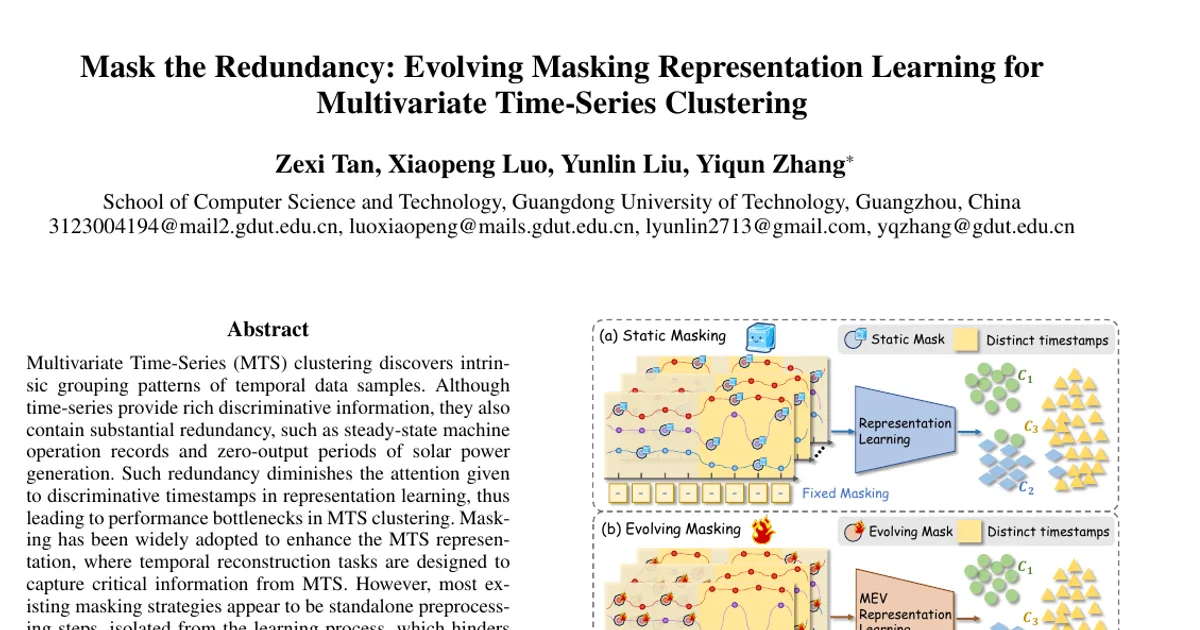
Multivariate Time-Series (MTS) clustering discovers intrinsic grouping patterns of temporal data samples. Although time-series provide rich discriminative information, they also contain substantial redundancy, such as steady-state machine operation records and zero-output periods of solar power generation. Such redundancy diminishes the attention given to discriminative timestamps in representation learning, thus leading to performance bottlenecks in MTS clustering. Masking has been widely adopted to enhance the MTS representation, where temporal reconstruction tasks are designed to capture critical information from MTS. However, most existing masking strategies appear to be standalone preprocessing steps, isolated from the learning process, which hinders dynamic adaptation to the importance of clustering-critical timestamps. Accordingly, this paper proposes the Evolving-masked MTS Clustering (EMTC) method, whose model architecture comprises Importance-aware Variate-wise Masking (IVM) and Multi-Endogenous Views (MEV) generation modules. IVM adaptively guides the model in learning more discriminative representations for clustering, while the reconstruction and cluster-guided contrastive learning pathways enhance and connect the representation learning to clustering tasks. Extensive experiments on 15 benchmark datasets demonstrate the superiority of EMTC over eight SOTA methods, where the EMTC achieves an average improvement of 4.85% in F1-Score over the strongest baselines.