Research
MALTopic: Multi-Agent LLM Topic Modeling Framework
Overview Research area: Natural Language Processing — topic modeling, with a focus on survey response analysis and multi-agent LLM system design. Technical level: Advanced. The work assumes familiarit
- arXiv
- 2601.15299
- Published
- 2026-01-07
- Authors
- Yash Sharma
AI summary
Overview
- Research area: Natural Language Processing — topic modeling, with a focus on survey response analysis and multi-agent LLM system design.
- Technical level: Advanced. The work assumes familiarity with topic modeling approaches (LDA, BERTopic) and with LLM-based agent architectures.
- Scope: The paper proposes a multi-agent LLM framework, MALTopic, that combines structured and free-text survey data to produce more coherent, diverse, and human-readable topics than established baselines.
What This Paper Is About
Topic modeling extracts latent themes from large collections of unstructured text, and it is especially useful for making sense of open-ended survey responses. Traditional approaches, however, typically use only the free-text answers, ignoring the structured or categorical questions answered alongside them, and they tend to output abstract topic representations that require substantial human interpretation. The paper's goal is to address both gaps by building a framework in which separate LLM agents enrich the text with structured context, extract themes, and clean up the results.
Key Contributions
- A multi-agent decomposition of topic modeling. MALTopic splits the topic modeling task into specialized subtasks, each handled by a dedicated LLM agent rather than a single monolithic model.
- An enrichment agent that integrates structured survey data. This agent uses categorical or structured responses to enhance the free-text responses before topic extraction, so information outside the free text is not discarded.
- A topic modeling agent plus a deduplication agent. The first extracts latent themes; the second refines the output, addressing the redundancy problem common in topic lists.
- A comparative evaluation on a survey dataset. The framework is compared against LDA and BERTopic, with claims of improved topic coherence, diversity, and interpretability, and of producing human-readable topics with greater contextual relevance.
Main Findings
- Improved topic coherence: The abstract states that MALTopic significantly improves topic coherence relative to LDA and BERTopic. No coherence metric, score, or effect size is reported in the abstract.
- Improved topic diversity: Diversity of the extracted topics is also claimed to improve over the two baselines. The abstract gives no diversity measurement or figure.
- Improved interpretability: Topics are described as human-readable, reducing the need for extensive human interpretation that traditional abstract topic representations demand. The abstract does not describe how interpretability was assessed or whether human raters were involved.
- Enhanced contextual relevance via structured data: Incorporating structured or categorical survey responses into the pipeline is credited with making topics more contextually relevant than text-only approaches allow.
- Deduplication as a refinement step: A separate agent is used to refine results, implying that raw LLM-generated topics contain redundancy that needs explicit handling. The abstract does not quantify how much redundancy the agent removes.
- Evaluation context: The comparative analysis is described as being conducted on a survey dataset. The size, domain, language, and composition of that dataset are not stated in the abstract, and no baseline configurations are described.
Methodology in Plain English
The authors break the topic modeling problem into a sequence of narrow jobs and assign each job to its own LLM agent. First, an enrichment agent reads the structured or categorical parts of the survey and uses them to augment the free-text answers, so a short or ambiguous comment can be interpreted alongside the demographic or multiple-choice information that came with it. Second, a topic modeling agent reads the enriched text and extracts the underlying themes. Third, a deduplication agent reviews those themes and merges or removes overlapping ones. The output is a set of topics intended to be readable and contextually grounded rather than abstract word lists.
To judge whether this helps, the authors run the framework on a survey dataset and compare its output against two widely used topic modeling methods, LDA and BERTopic, along three dimensions: coherence, diversity, and interpretability. Because only the abstract was available, the specifics of the agent prompts, the LLM used, the comparison setup, and the evaluation procedure are not described here.
Why This Matters
- Research impact: The work argues that topic modeling should not treat survey data as text-only. If structured and free-text responses can be jointly modeled, the standard practice of discarding categorical variables during theme extraction becomes a questionable default, and multi-agent LLM pipelines become a candidate replacement for statistical topic models in this setting.
- Reduced human burden: Traditional topic models produce abstract representations that analysts must interpret manually. Generating topics that are already human-readable changes who does the interpretive work and how quickly results can be acted on.
- Real-world applications:
- Analyzing open-ended survey questions in market research, where respondents also answer demographic and rating questions that could inform the themes.
- Employee engagement and internal culture surveys, where department, role, or tenure data can contextualize free-text comments.
- Customer experience and product feedback analysis, where structured metadata such as product line or customer tier accompanies written complaints.
- Social science and public opinion research, where structured respondent attributes are routinely collected but rarely fed into topic extraction.
- Industry relevance: Organizations that already collect structured and unstructured feedback together — market research firms, HR and people-analytics teams, and customer insights platforms — are the natural adopters. The framework's value proposition is fitting more of the data they already have into the analysis, while the multi-agent design implies added inference cost and engineering effort that the abstract does not discuss.
Future Directions
- Quantifying the gains. The abstract claims significant improvements but reports no metrics. Reporting standard coherence and diversity scores, plus a documented human interpretability evaluation, is the obvious next step.
- Testing across domains and datasets. The evidence comes from a single survey dataset that the abstract does not describe. Whether the framework generalizes to other survey types, languages, and text lengths remains open.
- Characterizing cost, latency, and failure modes. A three-agent LLM pipeline is more expensive than LDA or BERTopic. The trade-off between quality gains and computational or financial cost is unaddressed in the abstract.
- Understanding what the enrichment agent actually adds. An ablation isolating the contribution of structured-data enrichment versus the multi-agent decomposition itself would clarify which design choice drives the reported improvements.
- Handling sensitive survey data. Feeding respondent-level structured attributes into LLM calls raises privacy and data-governance questions that a deployed system would need to answer.
Target Audience
Researchers and practitioners working on topic modeling, text analytics, and survey methodology who want an alternative to LDA and BERTopic; NLP engineers building multi-agent LLM systems who want a concrete task-decomposition example; and analysts in market research, people analytics, or customer insights who deal with mixed structured and free-text survey data. Readers seeking reproducible numbers, ablation studies, or implementation details will not find them in the abstract as provided — the full paper would be needed for those.
Authors’ abstract
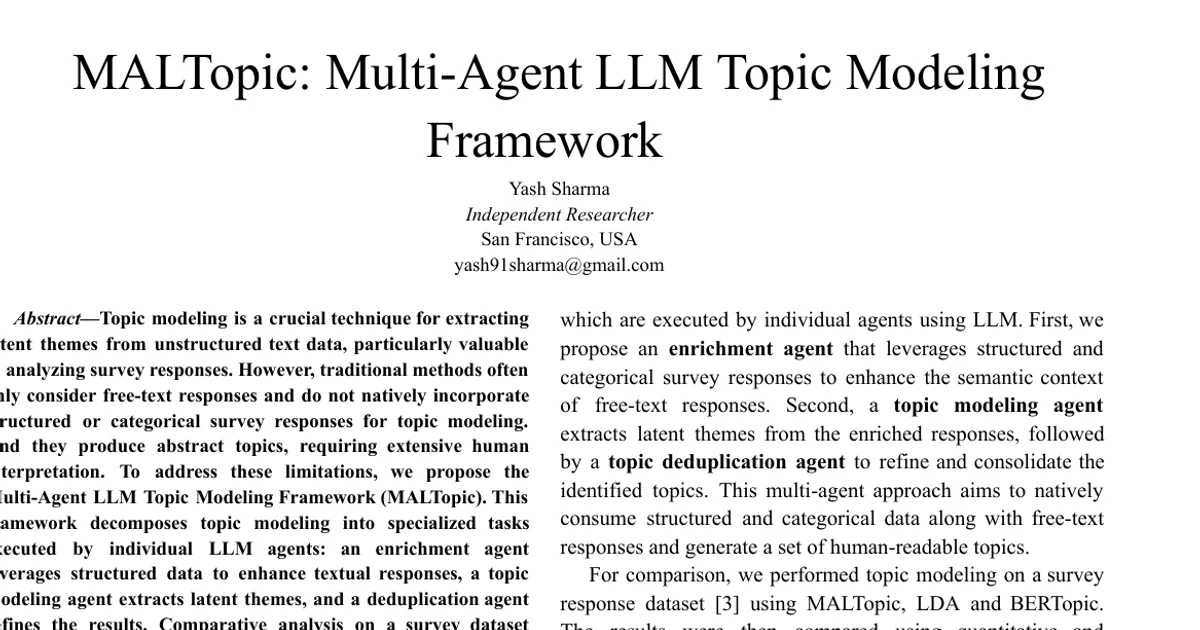
Topic modeling is a crucial technique for extracting latent themes from unstructured text data, particularly valuable in analyzing survey responses. However, traditional methods often only consider free-text responses and do not natively incorporate structured or categorical survey responses for topic modeling. And they produce abstract topics, requiring extensive human interpretation. To address these limitations, we propose the Multi-Agent LLM Topic Modeling Framework (MALTopic). This framework decomposes topic modeling into specialized tasks executed by individual LLM agents: an enrichment agent leverages structured data to enhance textual responses, a topic modeling agent extracts latent themes, and a deduplication agent refines the results. Comparative analysis on a survey dataset demonstrates that MALTopic significantly improves topic coherence, diversity, and interpretability compared to LDA and BERTopic. By integrating structured data and employing a multi-agent approach, MALTopic generates human-readable topics with enhanced contextual relevance, offering a more effective solution for analyzing complex survey data.