Research
MALeR: Improving Compositional Fidelity in Layout-Guided Generation
Overview Research area: Computer vision / generative AI — specifically layout-guided text-to-image (T2I) generation with diffusion models. Technical level: Intermediate. The paper builds on latent dif
- arXiv
- 2511.06002
- Published
- 2025-11-08
- Authors
- Shivank Saxena, Dhruv Srivastava, Makarand Tapaswi
AI summary
Overview
Research area: Computer vision / generative AI — specifically layout-guided text-to-image (T2I) generation with diffusion models.
Technical level: Intermediate. The paper builds on latent diffusion models, cross- and self-attention maps, and inference-time latent optimization, so familiarity with diffusion sampling is assumed, though the ideas are explained conceptually here.
Scope: The paper proposes MALeR, a training-free method that adds three regularization and binding losses to layout-guided diffusion sampling in order to fix background semantic leakage, out-of-distribution artifacts, and incorrect attribute binding in multi-subject, multi-attribute scenes.
What This Paper Is About
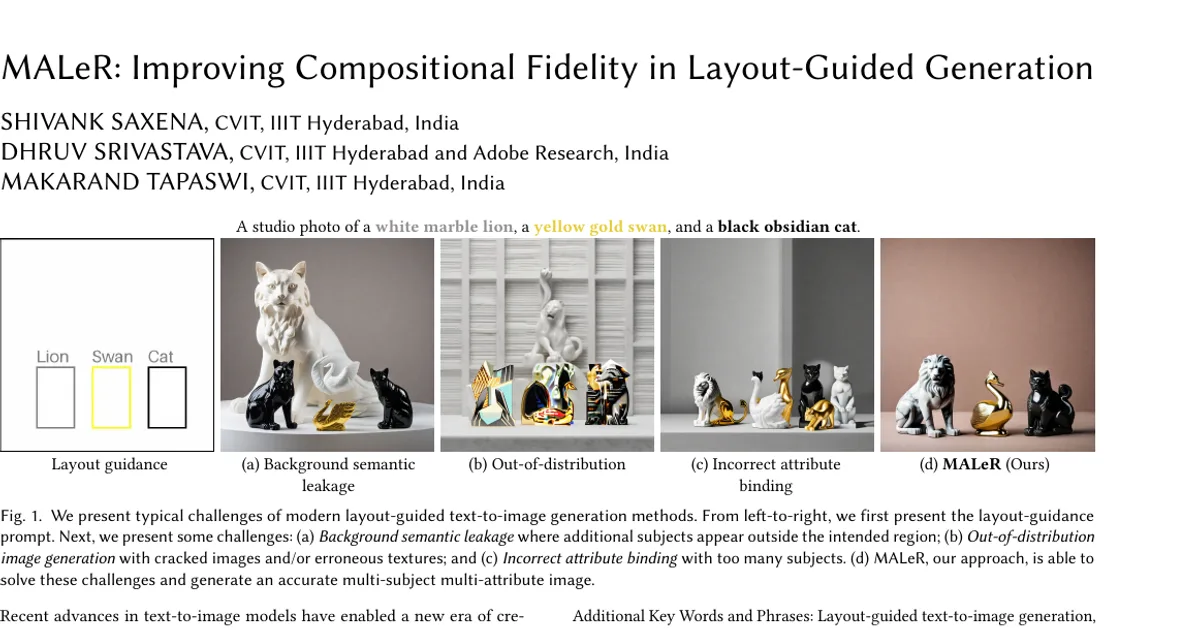
Text-to-image diffusion models still fail on complex prompts containing several subjects, each with several attributes, and existing layout-guided methods (which let users place subjects with bounding boxes) inherit those failures: extra subjects appear outside the boxes, images become unnatural or cracked, and attributes bleed onto the wrong subjects. This paper introduces MALeR (Masked Attribute-aware Latent Regularization), a training-free approach that constrains the latent optimization step so that subjects stay inside their boxes, the latent stays close to a stable noise distribution, and each attribute's attention pattern is pulled toward its own subject and pushed away from the others.
Key Contributions
-
Identification and remedy of background semantic leakage. The authors name the problem where unintended subjects appear outside the provided bounding boxes, and propose masked latent regularization, which penalizes deviations of background latents from their pre-update reference values.
-
In-distribution latent alignment. A KL-divergence term pulls the optimized latent back toward the prior Gaussian distribution during the early denoising steps, preventing the out-of-distribution artifacts (tiling, cracking, texture-less subjects) that latent optimization can cause.
-
A subject-attribute association loss. A symmetric-KL similarity loss aligns cross-attention maps of paired nouns and adjectives inside their shared box, while a dissimilarity loss maximizes distance between unpaired subject-attribute combinations. This supports multiple attributes per subject, not just one.
-
A controlled empirical study. All comparisons use identical random seeds, two backbones (SD-1.5 and SDXL), two benchmarks (DrawBench and HRS), plus two user studies covering human ranking and error-type frequency.
Main Findings
-
Beats prior methods on compositional accuracy. On DrawBench, MALeR improves spatial accuracy over the strongest baseline (GLIGEN) by +6.0%, and on HRS by +3.7% over R&B. Color accuracy improves by +17% on DrawBench and +3.8% on HRS.
-
Best counting F1. MALeR achieves the highest counting F1 score of 0.88 on DrawBench, matching the previous best baseline (R&B) while outperforming the rest.
-
Clear margin over the closest baseline. Against Bounded Attention (BA) with the same SDXL backbone, MALeR reaches 0.81 spatial accuracy vs 0.69, 0.61 color accuracy vs 0.44, and 0.88 F1 vs 0.83. With SD-1.5 on DrawBench, MALeR achieves 0.78 (+10%) spatial, 0.42 (+8%) color, and 0.85 (+1%) counting F1 compared to BA.
-
HRS results. With SD-1.5, MALeR reaches 31.8% (+0.9%) on HRS spatial and 40.4% (+7.4%) on HRS color. Its weakest result is the HRS size task, where the authors attribute lower performance to inaccurate and confusing aspect ratios of the guiding boxes.
-
Perceptual quality is preserved. FID on DrawBench: Vanilla SDXL 161.03, BA 164.59, MALeR 163.02 — MALeR slightly outperforms BA and is comparable to SDXL.
-
Ablation confirms all three losses matter. Applying masked regularization alone drops performance (spatial 0.69 to 0.63), while KL alignment alone gives small consistent gains (0.74 spatial). Combining both gives the highest spatial and counting results (0.81 spatial, 0.88 F1), and adding the attribute loss raises color accuracy from 0.47 to 0.61.
-
Human raters prefer MALeR. In an average human ranking study across four challenging prompts, 10 seeds, 80 images and 400 ratings on a 1–5 Likert scale, MALeR averages 3.13 versus BA's 2.15.
-
Fewer observed errors. Across the same 400 ratings, MALeR reduces background semantic leakage from 0.445 to 0.240 (+46% relative improvement), out-of-distribution images from 0.305 to 0.230 (+25%), attribute leakage from 0.590 to 0.400 (+32%), and other errors from 0.325 to 0.185 (+43%).
Methodology in Plain English
The method starts from an existing inference-time technique: during sampling, the latent state is nudged by gradient descent so that attention maps line up with the user's bounding boxes (an IoU-based loss, which the authors call L_iou). MALeR keeps that base loss and adds three terms to the update rule.
First, a mask marks which latent pixels lie inside any box and which lie outside. Before each update, the authors keep a frozen copy of the latent, and penalize any change to the pixels outside the boxes. That stops the model from inventing subjects in the background.
Second, because pushing the latent around can send it off the manifold of realistic noise, they add a KL-divergence term that measures how far the current latent's mean and standard deviation sit from a standard normal distribution, and pull it back. This applies only in the first 5 denoising steps, when the latent is still close to pure noise.
Third, they parse the prompt into nouns (subjects) and adjectives (attributes), each paired with a box. Inside each subject's box, they force the cross-attention map of the subject token and the attention map of its own attribute to be similar, using a symmetric KL divergence. Simultaneously, they force the subject's attention map to be dissimilar to the attributes belonging to other subjects. The authors note that similarity alone is insufficient — attributes still leak across subjects — which is why the dissimilarity term exists. They also report empirically that symmetric KL works better than JS-divergence here.
The final objective adds all terms with weights: L_iou + λ_mask·L_mask + λ_KL·L_KL + λ_att·L_att, with λ_mask = 0.01, λ_KL = 5, and λ_sim = λ_dis = λ_att = 1. Masked regularization and KL alignment run for the first 5 denoising steps, the attribute loss for the first 18 of 50 steps, with k = 5 gradient descent iterations per step and a step size linearly decayed from 30 to 8. Everything runs on A6000 GPUs; DrawBench results are averaged over seeds 0, 42, 2718, and 31415, and HRS uses seed 0.
Why This Matters
The work targets a practical bottleneck: users can already draw boxes to place subjects, but the resulting images are frequently wrong in exactly the ways that matter for real composition — extra objects, broken textures, mismatched colors. MALeR makes latent optimization behave predictably without retraining the underlying model, which means it can be layered onto existing checkpoints.
Real-world applications:
- Graphic design and advertising: assembling product or character compositions where each element must carry specific colors and materials.
- Storyboarding and concept art: placing several characters or props at precise positions in a frame, including unusual combinations like metallic or crystal-textured animals.
- E-commerce catalog imagery: generating scenes with multiple items whose attributes (color, material) must match the catalogue exactly.
- Synthetic data generation: producing controlled, spatially annotated image sets for training or evaluating detection and captioning models.
Industry relevance: the method is training-free and works with both SD-1.5 and SDXL, so it fits into existing inference pipelines rather than requiring the fine-tuning or external modules used by GLIGEN, ReCo, and similar approaches — a meaningful cost advantage for deployment. The IIIT Hyderabad and Adobe Research affiliation underscores the commercial interest in controllable generation.
Future Directions
-
The HRS size task remains weak. MALeR scores 59.9 (SDXL) and 56.3 (SD-1.5) there, below BA's 64.7 on SDXL; the authors point to inaccurate and confusing aspect ratios in the guiding boxes, so better box processing or size-aware supervision is an open problem.
-
Better use of the early denoising steps. The authors observe that layout is essentially decided in the first 5 steps and that over-optimization beyond that degrades images, while prior work optimizes for 15 to 25 steps. A principled schedule for when to apply each loss is not derived.
-
Attribute binding beyond a single modality. The paper demonstrates color, material, shape, and quantity, and shows a two-dimensional color variation study, but the limits of the similarity/dissimilarity formulation with many attributes per subject or ambiguous prompts are not established.
-
Robustness of automatic layout input. Boxes come from GPT-4 via the protocol of Phung et al., and the reported size failures suggest that method performance is entangled with the quality of automatically generated boxes.
Target Audience
Researchers and practitioners working on controllable generative models — particularly those building on latent diffusion, attention manipulation, or inference-time optimization. It is also relevant to applied engineers who need multi-subject composition in production image pipelines, and to students studying how training-free constraints can be layered onto diffusion sampling. Readers without a background in diffusion attention maps will find the problem framing and the qualitative comparisons accessible, but the loss formulations require intermediate familiarity.
Authors’ abstract
Recent advances in text-to-image models have enabled a new era of creative and controllable image generation. However, generating compositional scenes with multiple subjects and attributes remains a significant challenge. To enhance user control over subject placement, several layout-guided methods have been proposed. However, these methods face numerous challenges, particularly in compositional scenes. Unintended subjects often appear outside the layouts, generated images can be out-of-distribution and contain unnatural artifacts, or attributes bleed across subjects, leading to incorrect visual outputs. In this work, we propose MALeR, a method that addresses each of these challenges. Given a text prompt and corresponding layouts, our method prevents subjects from appearing outside the given layouts while being in-distribution. Additionally, we propose a masked, attribute-aware binding mechanism that prevents attribute leakage, enabling accurate rendering of subjects with multiple attributes, even in complex compositional scenes. Qualitative and quantitative evaluation demonstrates that our method achieves superior performance in compositional accuracy, generation consistency, and attribute binding compared to previous work. MALeR is particularly adept at generating images of scenes with multiple subjects and multiple attributes per subject.