Research
LTGS: Long-Term Gaussian Scene Chronology From Sparse View Updates
LTGS: Long-Term Gaussian Scene Chronology From Sparse View Updates Overview Research area: Computer vision / novel-view synthesis, specifically 3D Gaussian Splatting (3DGS) and temporal scene reconstr
- arXiv
- 2510.09881
- Published
- 2025-10-10
- Authors
- Minkwan Kim, Seungmin Lee, Junho Kim, Young Min Kim
AI summary
LTGS: Long-Term Gaussian Scene Chronology From Sparse View UpdatesOverview
Research area: Computer vision / novel-view synthesis, specifically 3D Gaussian Splatting (3DGS) and temporal scene reconstruction from sparse-view captures.
Technical level: Advanced. The paper assumes familiarity with NeRFs, 3D Gaussian Splatting, camera pose estimation, and vision foundation models such as SAM, DINO, and MASt3R.
Scope: The paper proposes a pipeline (LTGS) that updates an existing 3DGS reconstruction of a real-world scene across multiple time steps using only a few casually captured images per time step, modeling object-level changes such as insertions, removals, replacements, and relocations, and evaluates it on a synthetic CL-NeRF dataset and a newly captured real-world dataset.
What This Paper Is About
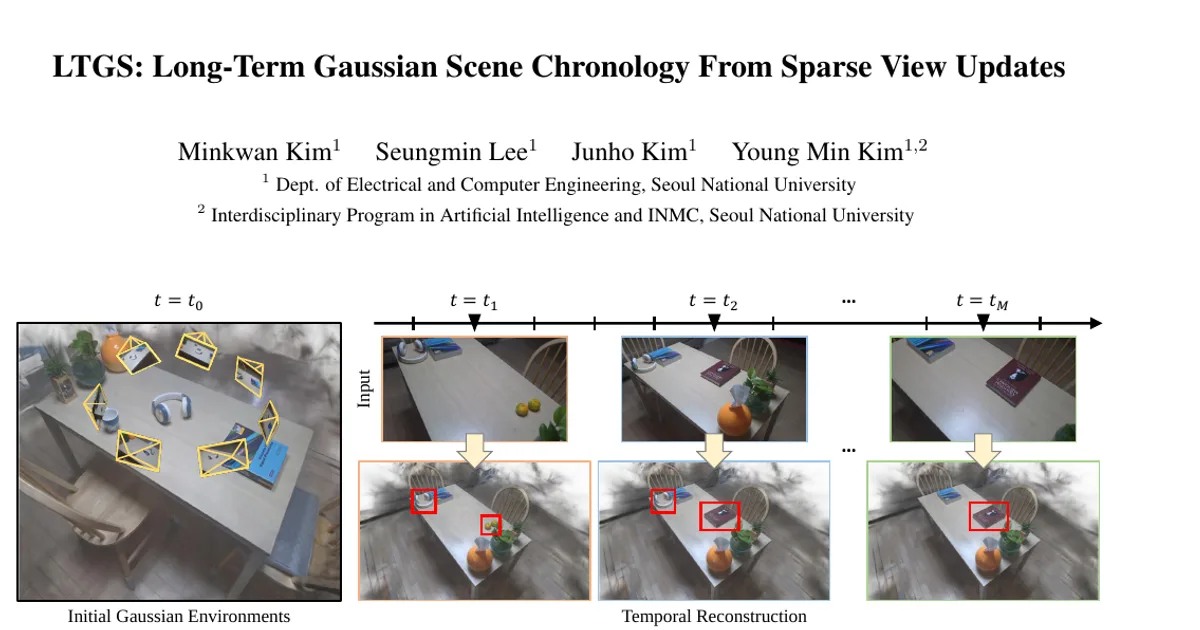
Everyday environments change: people add, remove, move, or replace objects, which quickly makes a previously captured 3D reconstruction outdated. Re-running reconstruction from scratch throws away prior information, and dynamic 4D representations require continuous dense observation of smooth motion, which ordinary casual captures cannot provide. The paper's goal is to detect object-level changes in an initial 3D Gaussian Splatting reconstruction from a small number of sparsely captured images at each of several time steps, and to produce consistent, photorealistic reconstructions of the scene at each time step without expensive retraining. The authors state that the existing datasets "do not explicitly represent the long-term real-world changes with a sparse capture setup," so they also collect their own real-world dataset.
Key Contributions
- The authors address updating an initial 3DGS reconstruction "in a highly efficient manner" using a set of spatio-temporally sparse images that capture long-term changes.
- They present LTGS, an integrated strategy that tracks, associates, and relocalizes objects and reconstructs the evolving scenes, built around reusable object-level Gaussian templates.
- They propose a new real-world dataset consisting of casual captures of environments with dynamic object-level changes across multiple time steps, to evaluate the framework.
- They demonstrate, through comparative and ablation studies, that the combined components improve reconstruction quality while enabling fast, light-weight updates (the paper's Table 1 positions LTGS as the only compared method marked as handling discontinuous motion, temporal reconstruction, few-shot input, and fast speed).
Main Findings
- Best quantitative results on both datasets. On the synthetic CL-NeRF dataset, LTGS reaches PSNR 27.17, SSIM 0.795, LPIPS 0.376 in 6 min, compared with 4DGS at PSNR 26.13 / SSIM 0.786 / LPIPS 0.411 (24 min), CL-Splats at 25.84 / 0.772 / 0.416 (3 min), CL-NeRF at 25.53 / 0.730 / 0.465 (2 hours), 3DGS at 24.53 / 0.789 / 0.392 (6 min), 3DGS-CD at 23.61 / 0.727 / 0.437 (2 min), NSC at 20.63 / 0.698 / 0.465 (>10 hours), and InstantSplat at 18.98 / 0.601 / 0.466 (3 min).
- Best quantitative results on the authors' real-world dataset. LTGS reaches PSNR 23.46, SSIM 0.889, LPIPS 0.230 in 7 min, versus 4DGS at 21.49 / 0.850 / 0.322 (29 min), CL-Splats at 21.12 / 0.829 / 0.312 (3 min), CL-NeRF at 20.95 / 0.815 / 0.379 (2 hours), 3DGS-CD at 20.94 / 0.774 / 0.348 (2 min), 3DGS at 19.56 / 0.857 / 0.272 (8 min), InstantSplat at 19.36 / 0.785 / 0.343 (3 min), and NSC at 17.52 / 0.755 / 0.439 (>10 hours).
- Fast total processing time. The total processing time is approximately 6.5 minutes (2.5 min for change detection, 0.5 min for instance matching, 3.5 min for 5000 iteration updates), measured on an NVIDIA RTX 4090. Separately, the paper reports that tracking and reconstructing templates for five discrete timesteps takes only 30 seconds.
- Ablations confirm each component helps. On the real-world dataset, the full model scores PSNR 23.46 / SSIM 0.889 / LPIPS 0.230, compared with 23.26 / 0.885 / 0.234 without object tracking, 23.33 / 0.886 / 0.232 without pose optimization, 23.29 / 0.885 / 0.233 without background initialization, and 23.11 / 0.885 / 0.240 without training views. The authors note that image-quality metrics alone do not fully reveal the improvement because the components target changing objects rather than overall initial scene quality, so they also show qualitative comparisons focused on change regions.
- Baselines struggle in this setting. InstantSplat is described as unable to maintain performance on free-viewpoint settings covering the full scene; 4DGS and NSC "struggle to precisely model the discrete changes, such as added or removed objects," with overly smooth results in change regions; CL-NeRF performs well on synthetic data but cannot track complex real-world changes; and CL-Splats' mask estimation becomes unreliable with sparse-view inputs (visible in the Lab scene).
- Clean object-level templates. After optimization, the framework disentangles individual objects with consistent geometry and appearance across time steps; even with few-shot observations, the optimized object templates show well-defined shapes without severe artifacts along object boundaries.
- Handles articulation as separate templates. For non-rigid transformations or articulations, LTGS defines separate object Gaussian templates for objects in different articulation states; these are all identified as a single object instance by the 2D matching pipeline. This is demonstrated on the MAC scene from the world-across-time (WAT) dataset introduced in CLNeRF.
- Robust to foundation-model noise. Injecting random noise with varying standard deviations into MASt3R descriptors and SAM embeddings still yielded reliable reconstruction without severe degradation, which the authors attribute to contour-based aggregation, graph-based instance matching across time steps, and the long-term optimization compensating for noisy descriptors.
- Stated limitation. The framework primarily targets scenes with geometric variations and "poses challenges for scenes with significant lighting changes or severe appearance changes with fixed geometries, such as monitors, if these are not captured as changes."
Methodology in Plain English
The input is an existing 3D Gaussian Splatting reconstruction of a scene plus a handful of images taken later from arbitrary viewpoints. The pipeline has four stages.
First, the system figures out where the new photos were taken and renders the original reconstruction from those same viewpoints, so the two can be compared. Change detection combines two cues: semantic difference, measured by cosine similarity between SAM features of the rendered and captured images, and photometric/structural difference, measured with SSIM. The combined difference map is binarized using Otsu's method to pick the threshold automatically (with gamma = 0.7 balancing the two cues), giving a coarse change mask. SAM's automatic mask generation then proposes object-shaped masks; those that sufficiently overlap the coarse mask and are semantically dissimilar from the original image are kept as the detected changed objects. Detected masks are dilated by 3 pixels to tolerate small misalignments.
Second, objects are matched across images. Within the same time step, MASt3R dense geometric features are used to match image pairs, and a graph is built with object masks as nodes and match counts as edges; connected components (found by depth-first search) define individual instances so unmatched or artifact-driven detections can be filtered out. Across time steps, pooled SAM features and cosine similarity build a similarity matrix, and Hungarian matching assigns correspondences.
Third, object templates are built. The initial Gaussian reconstruction is split into template objects and a static background by solving a per-splat label assignment problem as in FlashSplat. Objects that first appear after the initial reconstruction are initialized from MASt3R point clouds (positions and colors from the points, with uniform opacity, identity rotation, and uniform scaling as in InstantSplat). The background is a single global Gaussian set, augmented with MASt3R point maps where previously occluded regions become visible. Templates are tracked in 3D by augmenting points with DINO features and applying a robust point cloud registration pipeline (rather than ICP or RANSAC), yielding 6DoF relative poses per object; Chamfer distance thresholds determine whether templates are geometrically consistent, and a single template is kept per matched instance to avoid redundancy.
Fourth, everything is optimized together. Templates are transformed into each time step using the registration poses (with spherical-harmonic coefficients rotated accordingly), and a per-object temporal opacity filter makes transient objects invisible. Camera poses from the initial stage are reused to render the scene at the original viewpoints and enforce consistency, guarding against overfitting to the post-change views. The loss is the standard L1 plus D-SSIM loss from the original 3DGS implementation. Because the initial templates are a reasonable approximation, 5000 iterations suffice to refine parameters without densifying or cloning Gaussians, and opacity resetting is skipped.
Datasets and baselines. Evaluation uses the synthetic CL-NeRF dataset with three scenes (Whiteroom, Kitchen, Rome) captured at different time steps, plus the authors' real-world dataset of five scenes (Cafe, Diningroom, Hall, Lab, Livingroom) at 5 different time steps. Three images are used at each time step from various angles. Baselines are 3DGS, InstantSplat, 4DGS, Neural Scene Chronology (NSC), 3DGS-CD, CL-NeRF, and CL-Splats.
Why This Matters
Research impact. The paper defines and formalizes a practical middle ground between static reconstruction and full 4D dynamic capture: long-term change modeling from sparse, casual, non-continuous observations. It shows that object-level, reusable Gaussian templates act as an effective structural prior that resolves the ambiguity of few-shot views, and it contributes a new real-world benchmark because the authors found that existing datasets do not represent long-term real-world changes under sparse capture.
Real-world applications (as the paper frames them):
- Location-based services, where a mapped indoor space must stay current as furniture and objects move.
- Digital twins of everyday environments that need low-cost, repeated updates rather than full recapture.
- Robotic setups that need an up-to-date representation of a scene that people rearrange.
- Object-level scene composition and temporal reasoning, since the learned Gaussian templates can be directly reused and recombined.
Industry relevance. The reported capture requirements are lightweight (a few images per time step) and the reported update cost is small (about 6.5 minutes total on an NVIDIA RTX 4090, with 5000 refinement iterations and no Gaussian densification), which matters for applications where scenes change constantly and full re-scans or long training runs are impractical. Table 1 explicitly frames speed and few-shot capability alongside handling of discontinuous motion and temporal reconstruction as the differentiators.
Future Directions
- Heavy lighting changes. The authors state that modeling significant lighting changes with shadows is left for future work, and note that scenes with severe appearance changes but fixed geometry (for example monitors) are challenging unless such changes are captured as changes.
- Articulated object modeling. The paper suggests that tracked object templates could be combined with recent works on modeling object articulation for more detailed tracking, which is explicitly left as future work.
- Longer temporal horizons. The authors describe their object-level reconstruction as highlighting the potential for modeling object-level changes "in scenes with longer temporal variances," and present the framework as a foundation for a coherent structural representation reusable over a long temporal horizon.
- Overcoming sparse-view artifacts in unseen regions. The ablation notes that with only few-shot images, some unseen regions (such as under a table or behind a chair) contain sharp artifacts that degrade some renderings, indicating room to improve background and occluded-region completion.
Target Audience
Researchers and practitioners working on novel-view synthesis, 3D Gaussian Splatting, and neural scene representations, particularly those interested in temporal/change-aware reconstruction under sparse input; engineers building digital twins, mapping or location-based services, and robotics applications that need continuously updated 3D scene models; and readers looking for a benchmark and baseline comparison for long-term scene-change tasks, including the newly captured real-world dataset of five scenes at 5 time steps (Cafe, Diningroom, Hall, Lab, Livingroom).
Authors’ abstract
Recent advances in novel-view synthesis can create the photo-realistic visualization of real-world environments from conventional camera captures. However, the everyday environment experiences frequent scene changes, which require dense observations, both spatially and temporally, that an ordinary setup cannot cover. We propose long-term Gaussian scene chronology from sparse-view updates, coined LTGS, an efficient scene representation that can embrace everyday changes from highly under-constrained casual captures. Given an incomplete and unstructured 3D Gaussian Splatting (3DGS) representation obtained from an initial set of input images, we robustly model the long-term chronology of the scene despite abrupt movements and subtle environmental variations. We construct objects as template Gaussians, which serve as structural, reusable priors for shared object tracks. Then, the object templates undergo a further refinement pipeline that modulates the priors to adapt to temporally varying environments given few-shot observations. Once trained, our framework is generalizable across multiple time steps through simple transformations, significantly enhancing the scalability for a temporal evolution of 3D environments. As existing datasets do not explicitly represent the long-term real-world changes with a sparse capture setup, we collect real-world datasets to evaluate the practicality of our pipeline. Experiments demonstrate that our framework achieves superior reconstruction quality compared to other baselines while enabling fast and light-weight updates. Project page is available at: https://mkjjang3598.github.io/LTGS.