Research
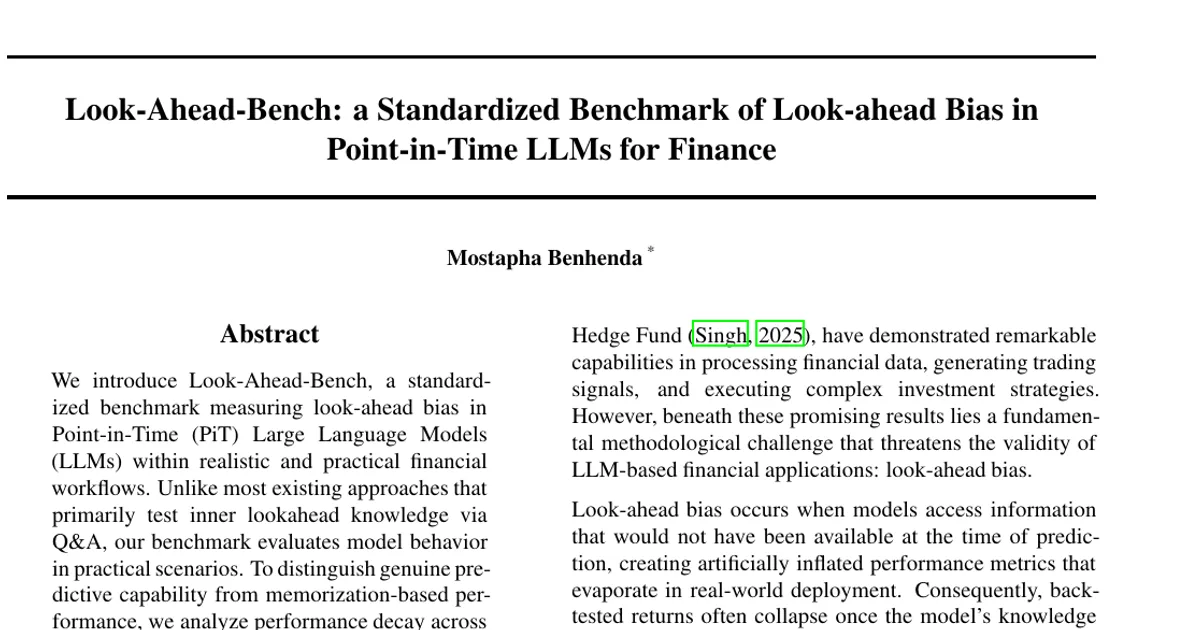
Look-Ahead-Bench: a Standardized Benchmark of Look-ahead Bias in Point-in-Time LLMs for Finance
Overview Research area: Evaluation of large language models for finance, specifically the measurement of look-ahead bias (future information leakage) in LLM-driven trading agents. Technical level: Int
- arXiv
- 2601.13770
- Published
- 2026-01-20
- Authors
- Mostapha Benhenda
AI summary
Overview
Research area: Evaluation of large language models for finance, specifically the measurement of look-ahead bias (future information leakage) in LLM-driven trading agents. Technical level: Intermediate. The paper uses standard finance concepts (alpha, buy-and-hold benchmarks, backtesting) and an existing open-source agent framework, so it is readable without deep machine learning background, but some familiarity with quantitative finance and LLMs helps. Scope in one sentence: The paper introduces Look-Ahead-Bench, a standardized benchmark that compares standard foundation LLMs against Point-in-Time (PiT) LLMs inside a realistic agentic trading workflow across two matched six-month market periods.
What This Paper Is About
Large language models are pre-trained on web-scale data that includes retrospective explanations of market events and historical prices, so a model asked about "NVIDIA's performance in 2023" may simply recite an outcome it memorized rather than predict it. This creates look-ahead bias: performance that looks strong in a backtest but collapses once the model is tested on data that did not exist during training. The paper's goal is to measure that collapse in a practical trading workflow rather than through question-and-answer probes, and to compare standard models against models specifically built with temporal cutoffs.
Key Contributions
- Practical trading workflow integration: Instead of knowledge-based Q&A benchmarks, the evaluation embeds models in realistic agentic trading systems that make actual portfolio decisions, using the open-source AI Hedge Fund framework (Singh, 2025), described as having 45.3k stars on GitHub as of January 2026.
- Explicit evaluation of Point-in-Time LLMs: The benchmark tests the commercial Pitinf family from PiT-Inference — Pitinf-Small (under 10B parameters), Pitinf-Medium (under 100B parameters), and Pitinf-Large (over 500B parameters) — alongside standard foundation models, and includes a family of quantitative baselines to set performance thresholds.
- The alpha decay metric: The paper defines alpha decay as the difference in excess return over buy-and-hold between the out-of-sample period (P2) and the in-sample period (P1), giving a single-number bias indicator.
- The "Scaling Paradox" observation: The results separate standard models, whose out-of-sample performance degrades as parameter count grows, from PiT models, whose performance improves with scale.
Main Findings
- Standard models show large alpha decay: Llama 3.1 8B decayed -17.23 percentage points (P1 alpha +13.81pp, P2 alpha -3.42pp), Llama 3.1 70B decayed -15.25pp (P1 +19.27pp, P2 +4.02pp), and DeepSeek 3.2 decayed -21.77pp (P1 +20.73pp, P2 -1.04pp). The abstract summarizes this as alpha decay exceeding -15 percentage points between periods for standard LLMs.
- Pitinf models stay stable across regimes: Pitinf-Small recorded alpha decay of +0.31pp (P1 -0.25pp, P2 +0.06pp), Pitinf-Medium +0.85pp (P1 +2.44pp, P2 +3.29pp), and Pitinf-Large +1.30pp (P1 +6.02pp, P2 +7.32pp).
- The Scaling Paradox (the "Memory Trap"): Among standard models, DeepSeek 3.2 produced the highest P1 alpha (+20.73pp) but the most severe P2 collapse (-21.77pp decay). The paper interprets this through the "Inverse Scaling" phenomenon (McKenzie et al., 2023), arguing that larger models build stronger, more brittle priors from training data that conflict with reality after a regime shift and produce confident hallucinations.
- The "Reasoning Dividend" for PiT models: Because the distractor of future memory is removed, scaling the Pitinf family improves genuine financial reasoning — such as sentiment interpretation and macro analysis — rather than the capacity to memorize historical price paths.
- Momentum was the strongest quantitative baseline: The 3-month Momentum strategy produced +7.96pp alpha in P1 and +5.75pp in P2, a decay of only -2.21pp. Mean Reversion was the worst, decaying -10.78pp (P1 -4.62pp, P2 -15.40pp).
- Both evaluation periods had similar passive returns: Buy-and-hold returned +25.32% in P1 (April 1 to September 30, 2021) and +24.75% in P2 (July 1 to December 31, 2024), which the design intends to make the comparison fair. The Buy & Hold alpha decay is therefore +0.00pp by construction.
- Other baseline results: Equal Weight decayed -2.78pp (P1 +0.36pp, P2 -2.42pp), the 50/100-day Moving Average Crossover decayed +9.94pp (the only baseline with positive decay: P1 -27.78pp, P2 -17.84pp), and the Random Noise control decayed -10.30pp (P1 -13.89pp, P2 -24.19pp).
Methodology in Plain English
The researchers pick two six-month windows with similar overall market direction but different information availability. P1 (April–September 2021) sits inside the likely training window of Llama 3.1 (cutoff December 2023) and DeepSeek 3.2 (cutoff July 2024), while P2 (July–December 2024) falls after those cutoffs. Both are tested on the same five large-cap technology stocks: AAPL, MSFT, GOOGL, NVDA, and TSLA.
For each period, they run the AI Hedge Fund framework, a multi-agent setup where specialized LLM agents (Valuation, Sentiment, Fundamentals, Technicals, and others modeled after investors such as Warren Buffett) generate signals, a Risk Manager agent sets position limits, and a Portfolio Manager agent turns those signals into allocations. The protocol is monthly rebalancing: at the start of each month the agents see historical data up to that point, propose target weights for the five stocks, and the weights are normalized and executed with fractional shares allowed and equal initial capital. Trades are simulated only.
Excess return (alpha) is computed as the model's return minus the buy-and-hold return. Bias is then read off the difference in alpha between P2 and P1: a negative alpha decay means the model did relatively worse once it moved past its training window. To know whether a given result is actually good, the agents are also compared against a set of simple quantitative strategies — passive buy-and-hold, equal-weight monthly rebalancing, 3-month momentum on the top half, 3-month mean reversion on the bottom half, a 50/100-day moving average crossover with daily rebalancing, and a random-noise control that applies random weights (±40% long, ±40% short, 20% zero per ticker, normalized) to daily returns.
Why This Matters
Impact on research: Most prior work detects lookahead bias through question-answering or fact-recall tests, such as FinLeak-Bench and the FactFin framework (Li et al., 2025b) or the Lookahead Propensity (LAP) measure based on membership inference techniques (Gao et al., 2025). This paper argues those do not capture the practical consequences of bias and offers an end-to-end alternative: measure whether the trading system's edge survives a change of regime. That reframes bias as an operational property of the deployed system, not just a property of the model's stored knowledge. The paper positions itself as a proof-of-concept and a diagnostic foundation rather than a settled standard.
Real-world applications:
- Selecting LLMs for live or semi-live portfolio strategies, by checking whether a model's apparent edge survives an out-of-sample period before capital is committed.
- Due diligence and model risk review of LLM-based trading products, where alpha decay figures give a concrete, comparable number across vendors.
- Upgrading existing multi-agent trading frameworks — the AI Hedge Fund project or comparable systems — so that temporal integrity is a design requirement rather than an afterthought.
- Choosing between a standard foundation model and a Point-in-Time model when backtesting, since a contaminated backtest can make a strategy look viable when it is not.
Industry relevance: The finding that bigger standard models can perform worse out-of-sample cuts against the common assumption that scaling up always improves a trading agent. For firms weighing a frontier general-purpose model against a smaller PiT model, the paper suggests the PiT model may generalize better despite relying on less raw capacity. The result also has a direct cost dimension: the largest standard model produced the highest in-sample alpha and the worst decay, which is precisely the failure mode that inflates backtests and misleads allocation decisions.
Future Directions
- Broaden the universe beyond five stocks: The current evaluation covers only five large-cap US technology names. The paper calls for at least 20–30 stocks across multiple sectors, including small-cap stocks (less likely to be memorized), non-tech sectors such as Healthcare and Industrials, and diverse assets like commodities or FX, while noting that LLM applicability differs there.
- Use more time periods: Testing four or more periods of varying lengths, rather than the two matched six-month windows used here.
- Add more models and trading agents: The paper lists FinMem, FinGPT, FinRL-DeepSeek, TradingAgents, and Hedge-Agents, plus specialized agents such as FinAgent, FinRobot, StockAgent, QuantAgent, and CryptoTrade (to extend to cryptocurrency markets). It also names factor-discovery and forecasting models (LLMFactor, TradingGPT, AlphaGPT, MarketGPT, StockGPT), evaluation frameworks (PIXIU, FinPos), multi-agent reinforcement learning environments (Language Model Guided RL), and tools such as AutoTrader.
- Improve validation methodology: Moving beyond historical price paths using synthetic data and counterfactuals — testing how models react to market events that could have happened but did not — and applying the Rademacher Anti-Serum (RAS) approach (Paleologo, 2025) to rigorously test for backtesting overfitting.
Target Audience
Quantitative researchers and practitioners building or evaluating LLM-based trading systems; model risk and due diligence teams assessing whether an LLM strategy's backtest is trustworthy; LLM researchers working on temporal awareness, memorization, and contamination; and engineers maintaining multi-agent trading frameworks who need a concrete protocol for testing temporal integrity. Readers looking for a finished, large-scale benchmark will find this explicitly framed as a proof-of-concept with a small scope (five tickers, two periods), so it is most useful as a methodology template and a starting reference point.
Authors’ abstract
We introduce Look-Ahead-Bench, a standardized benchmark measuring look-ahead bias in Point-in-Time (PiT) Large Language Models (LLMs) within realistic and practical financial workflows. Unlike most existing approaches that primarily test inner lookahead knowledge via Q\\&A, our benchmark evaluates model behavior in practical scenarios. To distinguish genuine predictive capability from memorization-based performance, we analyze performance decay across temporally distinct market regimes, incorporating several quantitative baselines to establish performance thresholds. We evaluate prominent open-source LLMs -- Llama 3.1 (8B and 70B) and DeepSeek 3.2 -- against a family of Point-in-Time LLMs (Pitinf-Small, Pitinf-Medium, and frontier-level model Pitinf-Large) from PiT-Inference. Results reveal significant lookahead bias in standard LLMs, as measured with alpha decay, unlike Pitinf models, which demonstrate improved generalization and reasoning abilities as they scale in size. This work establishes a foundation for the standardized evaluation of temporal bias in financial LLMs and provides a practical framework for identifying models suitable for real-world deployment. Code is available on GitHub: https://github.com/benstaf/lookaheadbench