Research
LongLive-Plug: Once-for-All Distillation for Video Generation
Overview Research area: Efficient video generation — knowledge distillation of video diffusion transformers into reusable, plug-and-play adapters. Technical level: Advanced. The paper assumes familiar
- arXiv
- 2609.38154
- Published
- 2026-09-29
- Authors
- Shuai Yang, Luozhou Wang, Wei Huang, ZhiFei Chen, Bohan Zhang, Xiao Fu, Qianli Ma, Chen-Hsuan Lin, Weian Mao, Bryan Chu, Song Han, Yukang Chen
AI summary
Overview
Research area: Efficient video generation — knowledge distillation of video diffusion transformers into reusable, plug-and-play adapters.
Technical level: Advanced. The paper assumes familiarity with diffusion/flow-matching sampling, classifier-free guidance (CFG), LoRA adapters, distribution matching distillation (DMD/DMD2), and autoregressive (AR) video generation.
One-sentence scope: The paper proposes LongLive-Plug, a framework that distills CFG, few-step sampling, and long-context error correction once per base model into LoRA adapters that can be attached to compatible downstream video models without any target-specific training.
What This Paper Is About
Video diffusion models are increasingly specialized into downstream variants (world models, robotics simulators, editors, avatar generators), and each specialized model usually needs its own distillation pass to speed up sampling or improve long-video quality — an expensive, repeated process requiring per-task data collection, teacher supervision, and optimization. LongLive-Plug's goal is to distill those capabilities once on a base model and then reuse them, training-free, across compatible descendants. The paper verifies this "once-for-all" idea on 54 downstream models drawn from three backbone families.
Key Contributions
- A once-for-all distillation framework. Capabilities are isolated as functional LoRAs learned on a frozen base model and merged into downstream models via a simple additive update, with no downstream training or re-distillation.
- Decoupled guidance control. Instead of jointly distilling CFG and few-step generation (as in causally-oriented methods such as CausVid and Self Forcing), the paper trains a separate CFG-only LoRA whose inference weight acts as a guidance dial, so downstream tasks with different guidance preferences can be accommodated while the few-step adapter stays fixed.
- Coverage across three backbone families and 54 downstream models. Deployment is verified on Wan2.1-14B, Wan2.2-TI2V-5B, and MiniMax-H3, spanning eight task categories including world modeling, robotics, controllable generation, editing, and multimodal generation.
- A long-context error-correction adapter. Using Streaming Long Tuning with distribution matching distillation, a LoRA is trained on a causal AR base model to correct accumulated rollout errors, then transferred to AR world models without target training.
Main Findings
- Four-step transfer beats naive four-step sampling. On SCOPE, LongLive-Plug reduces FVD from 805.5 (naive four-step) to 478.7, close to SCOPE-specific distillation at 502.1, while native 30-step inference scores 382.9. It also improves JEPA (0.792 vs. 0.732 naive, vs. 0.782 SCOPE-specific, vs. 0.868 native).
- Competitive control fidelity without downstream training. On Wan2.2-Fun-5B-Control, LongLive-Plug improves all six reported metrics over naive four-step sampling — for example depth si-RMSE from 2.135 to 1.641 and DOVER from 8.90 to 10.11 — with metric-dependent trade-offs relative to ControlNet-specific distillation (si-RMSE 1.515, DOVER 10.25).
- Large cumulative cost savings. Both strategies share a one-time base distillation cost of approximately 80 H100 GPU-hours (700 iterations on 32 GPUs for about 2.5 hours). Task-specific distillation adds 83.9, 150.0, 86.8, and 56.1 H100 GPU-hours for depth-conditioned generation, world modeling, pose-conditioned generation, and robotics simulation respectively — 376.8 additional GPU-hours and about 456.8 total. LongLive-Plug reuses the base adapters at a fixed cost of about 80 GPU-hours and requires no downstream training data.
- Step reduction at scale. For downstream models with 20–50-step native schedules, attaching the base-distilled LoRA enables four-step, CFG-free inference, reducing denoising steps by 5–12.5 times.
- Guidance remains adjustable after fixed-scale training. With the teacher scale fixed at w_train = 5 and the native 50-step FlowUniPC schedule, raising the CFG LoRA weight λ_cfg from 1 to 2 or 3 strengthens the prompted effect (e.g., a milk splash) at runtime CFG 1, with one conditional forward pass per step. Matched native CFG scales are not exactly reproduced.
- Decoupled CFG control transfers; global scaling does not. On SCOPE, adding a separately weighted CFG LoRA strengthens requested prompt attributes as λ_cfg rises from 1 to 3 and 5 while the few-step weight stays at 1. Globally scaling the coupled LoRA instead darkens and distorts the scene, with severe collapse at weight 5.
- Adapter rank matters for transfer, not just source fit. Across three rank doublings from 16 to 128, transfer to SCOPE improves monotonically by 21 percent (measured by FVD on the full CrossFPS test set).
- Broader prompt coverage improves transfer. With teacher, rank, target layers, optimization budget, and number of training lines fixed, FVD rises by 12 percent as prompt diversity falls (measured by mean pairwise cosine similarity in centred UMT5 embedding space).
- Long-context transfer improves long rollouts. On ReWorld, trained on approximately 8 s windows, four-step +Long over 16–64 s raises the seven-dimension VBench mean from 73.51 to 75.77 at 64 s (mean exceeds the base at all tested lengths, up to 8 times the training duration). Background consistency drops from 88.87 to 80.81. On Matrix-Game 3.0, at 62.18 s the seven-dimension means are 83.73 (50-step native), 84.30 (official three-step task-specific distillation), and 84.34 (four-step +Long), with metric-dependent trade-offs.
- MiniMax-H3 behaves differently. H3 natively supports inference without CFG, so its transfer experiments omit the CFG LoRA by default; a CFG-only LoRA trained on the H3 base model supports distilled CFG inference with adjustable guidance, evaluated over 34 prompts, seven native reference conditions, and six adapter weights per prompt (442 videos).
- Qualitative trade-off on camera control. In the reported H3 camera examples, one case retains clearer architectural detail and a visible upward-camera response, while another remains sharp but shows attenuated framing change relative to native and naive four-step inference.
- Explicit limitations. Long-context transfer requires existing causal AR inference (LoRA updates alone do not change attention masks), reuse requires compatible descendants of each base model, transfer quality involves task-dependent trade-offs, and the CFG LoRA provides only approximate guidance control that may need adjustment after transfer.
Methodology in Plain English
The approach starts from a frozen base video diffusion model per backbone family. Each desired capability is trained as a small LoRA adapter on that base model and then, at deployment, simply added to the corresponding layers of a downstream model that keeps its own task-specific weights. No downstream data, fine-tuning, or re-distillation is used.
Three capabilities are distilled separately:
- CFG distillation. Normally classifier-free guidance requires two model evaluations per step (conditional and unconditional). Here, the student adapter is trained to reproduce the teacher's guided prediction in a single conditional pass, using a fixed teacher guidance scale as the regression target.
- Few-step distillation. Using the DMD2 distribution-matching objective, a generator adapter enables four-step sampling with a trainable fake-score network that is discarded at inference. The generator is updated once every five fake-score updates.
- Long-context distillation. Using Streaming Long Tuning, an adapter is trained on a causal AR base model; the student generates each short clip from its own cached history while a teacher provides distribution-matching supervision on each new clip, with preceding history detached so gradients stay local as rollouts lengthen.
Because CFG and few-step are trained as separate adapters, their weights can be set independently at inference and merged into the target weights before sampling. The CFG adapter's weight acts as an approximate guidance dial, following a near-linear response derived in the paper and validated empirically. Default LoRA rank is 128, training uses mixed precision, FSDP, and gradient checkpointing, and the paper states that code, trained LoRA checkpoints, and evaluation configurations will be publicly released.
Why This Matters
Impact on research. The work reframes acceleration and long-video correction as reusable, transferable capabilities rather than per-checkpoint engineering. It provides evidence that adapter rank and distillation prompt diversity — not just fit to the source teacher — determine whether an adapter transfers, and it shows a way to keep guidance controllable after distillation rather than freezing it at the training scale. It also positions distillation as composable with downstream task modules, including added conditioning branches and expanded output channels.
Real-world applications:
- Robotics and physical AI simulation, where action-conditioned world models (for example LIBERO-based and DROID-planner entries in the coverage table) need fast, long-horizon rollouts.
- Video editing and restoration, including streamed editing, super-resolution, inpainting, and effect pipelines that currently require per-tool distillation.
- Subject- and avatar-centric generation, such as talking-head, virtual try-on, and character animation models that inherit a base backbone.
- Structure- and camera-conditioned generation, such as depth-conditioned or trajectory-controlled video, where four-step inference with preserved control fidelity is demonstrated on the 600 depth-conditioned PAI-Bench-C cases.
Industry relevance. The headline cost argument is concrete: approximately 80 H100 GPU-hours once versus roughly 456.8 GPU-hours after four added tasks, plus the downstream data collection that task-specific distillation requires (the depth-specific adapter alone needs 5,000 paired prompts and dynamic depth videos). For teams shipping many derivatives of one video foundation model, this shifts distillation from a per-product expense to a per-backbone one.
Future Directions
- Extending coverage beyond the verified set. The paper states the approach may support additional compatible downstream models beyond the 54 verified entries and the three backbone families, but this is not demonstrated.
- Removing the causal-AR prerequisite. Long-context error correction currently requires downstream models that already support causal attention and AR inference, since LoRA updates cannot change attention masks.
- Tightening guidance control. The CFG LoRA weight provides only approximate, uncalibrated guidance control that may need adjustment after transfer; a more precise or adaptive mapping from adapter weight to effective guidance is an open problem.
- Strengthening evaluation rigor. The ten MiniMax-H3 comparisons are single-seed cases with no repeated-run confidence intervals, pose regression is not measured for the camera cases, and runtime accounting differs across H3 backends so timings are only comparable within a task — all of which invite follow-up measurement.
Target Audience
Researchers and engineers working on efficient generative video — specifically those involved in diffusion/flow-matching acceleration, guidance distillation, LoRA-based adaptation, or serving many specialized video models from a shared foundation. It is most useful to readers already comfortable with diffusion sampling and distillation objectives; readers looking for an introduction to video generation should treat the distillation details as advanced material. Practitioners building robotics world models, video editors, avatar systems, or controllable generation products are the most likely to benefit from the cost and deployment arguments.
Authors’ abstract
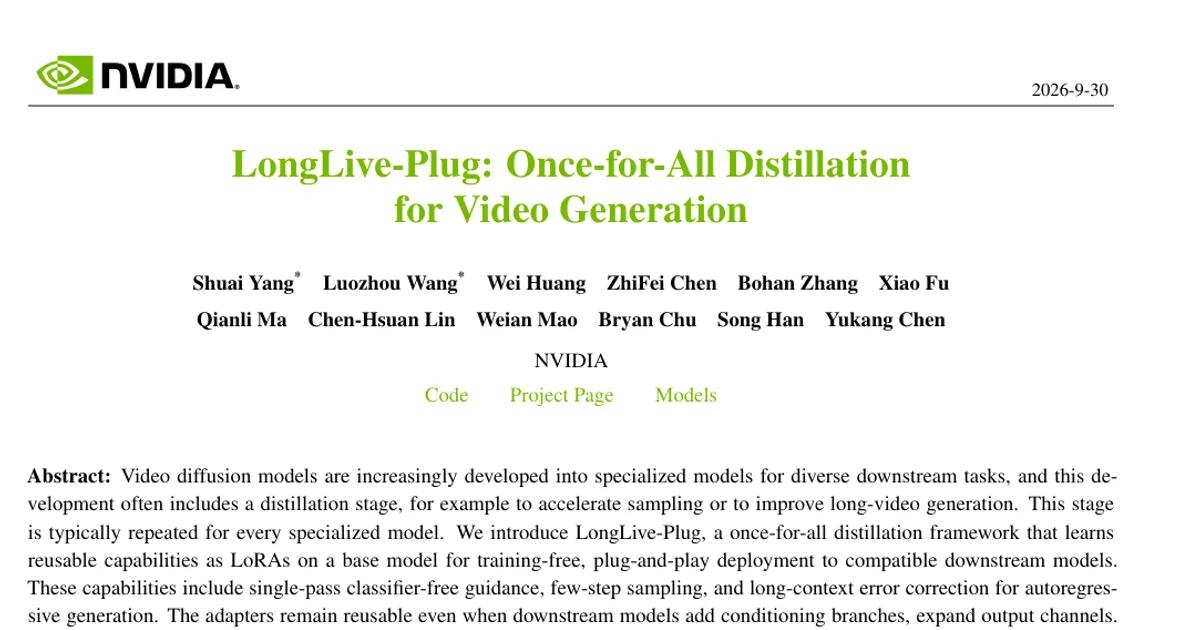
Video diffusion models are increasingly developed into specialized models for diverse downstream tasks, and this development often includes a distillation stage, for example to accelerate sampling or to improve long-video generation. This stage is typically repeated for every specialized model. We introduce LongLive-Plug, a once-for-all distillation framework that learns reusable capabilities as LoRAs on a base model for training-free, plug-and-play deployment to compatible downstream models. These capabilities include single-pass classifier-free guidance, few-step sampling, and long-context error correction for autoregressive generation. The adapters remain reusable even when downstream models add conditioning branches, expand output channels. Despite training at a fixed guidance scale, our dedicated CFG LoRA provides text guidance control through its inference weight. Combining it with a few-step LoRA simultaneously preserves few-step generation and CFG controllability on downstream tasks. We verify training-free deployment on 54 downstream models across three backbone families and eight task categories, including world modeling, robotics, editing, and multimodal generation. The approach may support additional compatible models. Each capability can thus be distilled once per backbone family and reused without per-target retraining.