Research
Localized, High-resolution Geographic Representations with Slepian Functions
Overview Research area: Geospatial machine learning, specifically geographic location encoders (learnable functions that map longitude/latitude on the sphere to feature vectors), with a focus on posit
- arXiv
- 2602.00392
- Published
- 2026-01-30
- Authors
- Arjun Rao, Ruth Crasto, Tessa Ooms, David Rolnick, Konstantin Klemmer, Marc Rußwurm
AI summary
Overview
- Research area: Geospatial machine learning, specifically geographic location encoders (learnable functions that map longitude/latitude on the sphere to feature vectors), with a focus on positional encoding bases.
- Technical level: Advanced. The paper builds on spherical harmonics, the Slepian spatial concentration problem, eigen-decomposition of a concentration matrix, and sphere-native signal processing, though the core idea is explainable without that background.
- One-sentence scope: The paper proposes Slepian functions, and a hybrid Slepian–spherical-harmonic variant, as positional encoders that concentrate representational capacity inside a region of interest while scaling to high resolution, and evaluates them on five geographic classification, regression, and image-augmented tasks.
What This Paper Is About
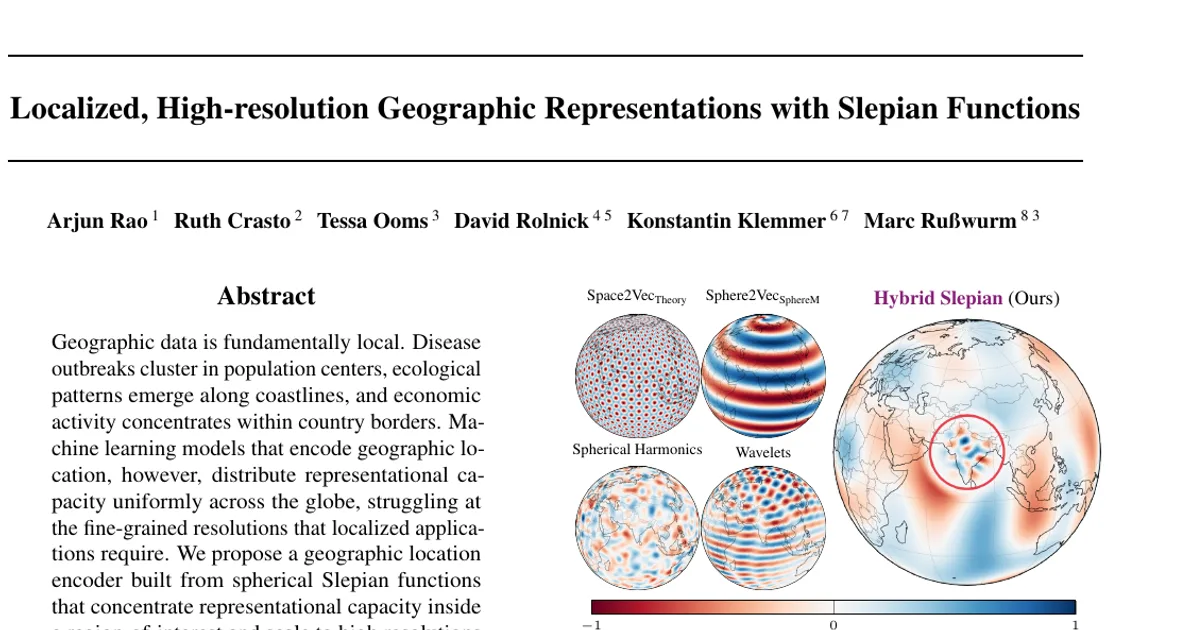
Geographic data is fundamentally local — disease outbreaks cluster in population centers, ecological patterns follow coastlines — but existing location encoders spread a fixed resolution budget uniformly over the whole globe, so they cannot resolve fine detail in a small area. The authors solve this by using Slepian functions, a basis designed to concentrate band-limited energy inside a chosen region, as the positional encoder, and by adding a coarse global spherical-harmonic component when global context is still needed. The goal is a location encoder that is high-resolution where it matters, computationally feasible, pole-safe, and faithful to spherical surface distance.
Key Contributions
- A Slepian-based regional positional encoder. The authors use the eigenfunctions of the spherical concentration problem to build an encoder whose dimension is set by the regional Shannon number, the intrinsic "information budget" inside a region, rather than by the full spherical-harmonic dimension.
- A hybrid Slepian–spherical-harmonic (SH) encoder. High-resolution Slepian modes for a region of interest are concatenated with a coarse global SH basis, bridging the local–global tradeoff while retaining pole-safety and spherical-surface-distance preservation.
- Practical high-resolution computation via spherical Slepian caps. Because cap concentration matrices block-diagonalize by order m, the eigenproblem reduces to blocks of at most L_r × L_r instead of a dense D_{L_r} × D_{L_r} matrix, making high bandlimits feasible.
- A one-dimensional generalization to time. Discrete Prolate Spheroidal Sequences (DPSS), the temporal analogue of spatial Slepians, are used as a temporal encoder combined with a global SH spatial encoder for spatio-temporal prediction.
Main Findings
- Slepians win across five tasks. Across classification, regression, and image-augmented prediction, Slepian encodings outperform baselines and retain the advantage across a wide range of neural network architectures (the paper reports top results regardless of network choice in its Appendix Table 5).
- California Housing regression (R²): Slepian L=120 reaches 0.69 ± 0.01 and Hybrid L_r=120 reaches 0.71 ± 0.01, compared with 0.64 ± 0.01 for SH L=40, 0.57 ± 0.01 for Deep RFF, 0.53 ± 0.00 for SphereC, and 0.05 ± 0.08 for Direct coordinates.
- Japan Prefectures classification (accuracy): Hybrid L_r=120 reaches 0.92 ± 0.00, Slepian L=120 reaches 0.89 ± 0.00, versus 0.88 ± 0.01 for SH L=40 and 0.46 ± 0.03 for Direct. The test splits are deliberately hard — only points within 2 km of a prefecture boundary among 47 prefectures are included.
- Arctic Mean Sea Surface interpolation (R²): Hybrid L_r=80 and L_r=120 both reach 0.98 ± 0.00 and Slepian L=120 reaches 0.97 ± 0.00, versus 0.91 ± 0.00 for SphereM and 0.86 ± 0.00 for SH L=10. SH at L=40 and the wavelet baseline diverge on this task.
- Higher dimensionality alone does not explain the gains. Planar RFF with 2000 dimensions scores 0.42 ± 0.00 on California Housing, and SH L=40 with 1681 dimensions scores 0.64 ± 0.01, while the best Slepian encoders use only 186 to 785 embedding dimensions — the paper describes this as roughly one-tenth to four-tenths the embedding size.
- Numerical instability caps global SH. The SH normalization constant decays rapidly as N ~ ℓ^{−m} for m > 0 while the associated Legendre recursion propagates growing coefficients; in 32-bit precision this produces non-finite values beyond L ≳ 40, and mixed-precision training (FP16/BF16) lowers the threshold further.
- Memory sparsity is intrinsic. For Sri Lanka (area fraction f_R ≈ 1.29 × 10⁻⁴) at bandlimit L_r = 256, only K ≈ 9 regional modes are retained versus D_{L_r} ≈ 6.6 × 10⁴ for a global basis.
- Capacity concentrates inside the region of interest. Varying cap radius to cover 10 to 100 percent of test points, R² improves monotonically while a matched-dimension global SH encoder stays flat (labeled R² = 0.45 for California Housing and R² = 0.93 for MSS reconstruction). Just 3 well-concentrated Slepian modes at 25 percent cap coverage (cap radius 2.26°) give a 19 percent relative improvement over global SH on California Housing.
- Global context helps local tasks. The hybrid encoder beats a Slepian-only encoder (L_g = 0) on all three supervised geographic prediction tasks, even though those tasks contain only data inside a localized region; the Slepian-only encoder still beats most baselines.
- Local context helps global tasks. On presence-only species distribution modeling, the multi-cap hybrid encoder is strongest, especially with reduced network capacity (the linear LinNet model): 0.704 mAP on S&T Birds and 0.479 on IUCN at L_r = 30 and L_r = 40 respectively, versus 0.637 and 0.342 for SH L_g = 10. The S&T benchmark has 535 bird species and the IUCN benchmark 2418 species.
- Temporal DPSS improves climate prediction. On the AI2 ACE task, DPSS (NW = 15) achieves mean RMSE 1.344 ± 0.012 across eight pressure levels, ahead of Fourier (1.477 ± 0.128), Legendre (1.532 ± 0.285), Monomial (2.033 ± 0.178), Triangle (3.092 ± 0.003), Time Copy (2.428 ± 0.018), and No Time (5.703 ± 0.001) — a 9 percent improvement over the Fourier baseline.
- Building density regression improves at moderate fine scales. At σ = 5 km, Slepian L=120 exceeds SH L=40 by 7 to 14 percent in R² depending on region and image encoder; at σ = 40 km all location-aware methods converge to about R² ≈ 0.99, while image-only embeddings stagnate or degrade.
- Pole-safety is preserved. Slepian functions are finite linear combinations of spherical harmonics and therefore analytic everywhere including the poles, unlike spherical wavelets based on stereographic projection; Arctic MSS reconstructions qualitatively recover sharper gradients and localized anomalies with reduced polar artifacts.
- The degenerate case recovers SH. When the region is the full sphere, the concentration matrix becomes the identity, all eigenvalues are 1, and Slepian functions reduce to the global SH basis.
Methodology in Plain English
The authors start from the standard setup for location encoders: a non-parametric positional encoder turns coordinates into a feature vector, and a neural network maps those features to predictions. The usual positional encoder is spherical harmonics, which is well-behaved on the sphere but spreads detail evenly over the globe and becomes numerically unstable at high bandlimits.
Instead, the authors ask a different question: among all band-limited functions up to some resolution, which ones put most of their energy inside a chosen region rather than leaking elsewhere? The answer is the Slepian functions, obtained as eigenvectors of a "concentration matrix" whose entries measure how much overlap each pair of spherical harmonics has with the region. The corresponding eigenvalues say how well concentrated each function is, and they fall off sharply: the first N(R, L_r) modes are near 1, and the rest near 0. That number, the regional Shannon number, is approximately the region's area fraction times (L_r + 1)², and the authors simply keep that many modes, discarding the rest. Doing so makes the encoder dimension scale with the size of the region rather than the whole sphere.
To make this computationally practical, they restrict the region shape to spherical caps. For a cap, the concentration matrix splits into independent blocks by harmonic order m, so the eigenproblem shrinks from a dense matrix in the full spherical-harmonic space to blocks of size at most L_r × L_r. In practice they compute cap Slepians once at high resolution, rotate them to the desired center, and keep the top modes.
For tasks that need global context as well, they concatenate the regional Slepian basis at high bandlimit L_r with a standard spherical harmonic basis at a coarse bandlimit L_g, giving a hybrid encoder. This extends to multiple regions by concatenating several cap bases. For time, they swap in the one-dimensional analogue of Slepians (DPSS sequences), which concentrate energy in a target frequency band over a finite number of timesteps, and concatenate that with a spatial SH encoder.
Evaluation covers five tasks: California Housing price regression; Japan Prefectures classification restricted to points within 2 km of a boundary; Arctic Mean Sea Surface interpolation built from multi-year CryoSat-2 measurements gridded at 5 km; spatio-temporal air temperature prediction at 8 pressure levels on one year of 6-hourly AI2 ACE simulated atmospheric data; and two image-augmented tasks using frozen image encoders — building density regression on OpenBuildings over four regions (South Florida, Dhaka, Mexico City, Maharashtra) with AlphaEarth and Galileo embeddings and Gaussian-smoothed targets at σ from 0 to 40 km, and presence-only species distribution modeling following the SINR setup on iNaturalist with a frozen Xception classifier. Baselines include Direct, Cartesian3D, Wrap, Grid, Theory (Space2Vec), SphereC, SphereM, SphereC+, SphereM+, spherical wavelets, Planar RFF, and Deep RFF. Results are averaged over 5 random seeds with 1× standard deviation. Slepian caps are computed with the shtools library, with cap center and radius chosen manually to encompass all data splits. Code is available at https://github.com/arjunarao619/SlepianPosEnc.
Why This Matters
Impact on research. The paper reframes positional encoding for geographic coordinates as a resource-allocation question: where should representational capacity be spent? By tying the encoder dimension to the regional Shannon number, an information-theoretic quantity, it offers a principled alternative to the common practice of simply raising spherical-harmonic degree, which is both memory-hungry and numerically unstable beyond modest bandlimits. It also connects a mature geophysics tool — spherical Slepians used in satellite geodesy — to mainstream geospatial machine learning, where it had previously been used to analyze measured geophysical signals rather than as a position encoder.
Real-world applications.
- Environmental and climate monitoring, such as air quality forecasting and interpolating Arctic sea surface height from satellite altimetry, where pole-safety and fine-scale reconstruction both matter.
- Agriculture and food security, for example crop yield estimation at field-relevant scales.
- Biodiversity conservation, where species distribution models must resolve fine ecological boundaries on one continent while remaining valid globally for out-of-region evaluation.
- Urban and infrastructure analytics, such as building density regression and asset mapping from satellite imagery, where localized high-resolution detail drives value.
Industry relevance. The authors are affiliated with Microsoft, LGND AI, University College London, McGill, Mila, the University of Bonn, Wageningen, and CU Boulder, indicating
Authors’ abstract
Geographic data is fundamentally local. Disease outbreaks cluster in population centers, ecological patterns emerge along coastlines, and economic activity concentrates within country borders. Machine learning models that encode geographic location, however, distribute representational capacity uniformly across the globe, struggling at the fine-grained resolutions that localized applications require. We propose a geographic location encoder built from spherical Slepian functions that concentrate representational capacity inside a region-of-interest and scale to high resolutions without extensive computational demands. For settings requiring global context, we present a hybrid Slepian-Spherical Harmonic encoder that efficiently bridges the tradeoff between local-global performance, while retaining desirable properties such as pole-safety and spherical-surface-distance preservation. Across five tasks spanning classification, regression, and image-augmented prediction, Slepian encodings outperform baselines and retain performance advantages across a wide range of neural network architectures.