Research
LightNav-0: Eliciting VLM Spatial Intelligence for Generalist Embodied Navigation
Overview Research area: Robotics — generalist embodied navigation using vision-language models (VLMs), spanning instruction following (VLN), object-goal navigation, and embodied visual tracking. Techn
- arXiv
- 2608.30935
- Published
- 2026-08-31
- Authors
- Shaoan Wang, Aocheng Luo, Fei Huang, Jingyi Xu, Xiaoyang Wang, Yueyu Wang, Qianli Ma, Fan Yang, Ran Mei, Jia Wei, Jiangpeng Hu, Xuhao Liu, Hongming Chen, Yuanbin Shao, Yiyang Lin, Ziliang Li, Liang Pan, Xinhang Liu, Yuntao Ma, Tingxiang Fan
AI summary
Overview
Research area: Robotics — generalist embodied navigation using vision-language models (VLMs), spanning instruction following (VLN), object-goal navigation, and embodied visual tracking.
Technical level: Advanced. The paper assumes familiarity with VLM architectures, autoregressive token generation, residual vector quantization, group-relative reinforcement learning, and standard navigation benchmarks.
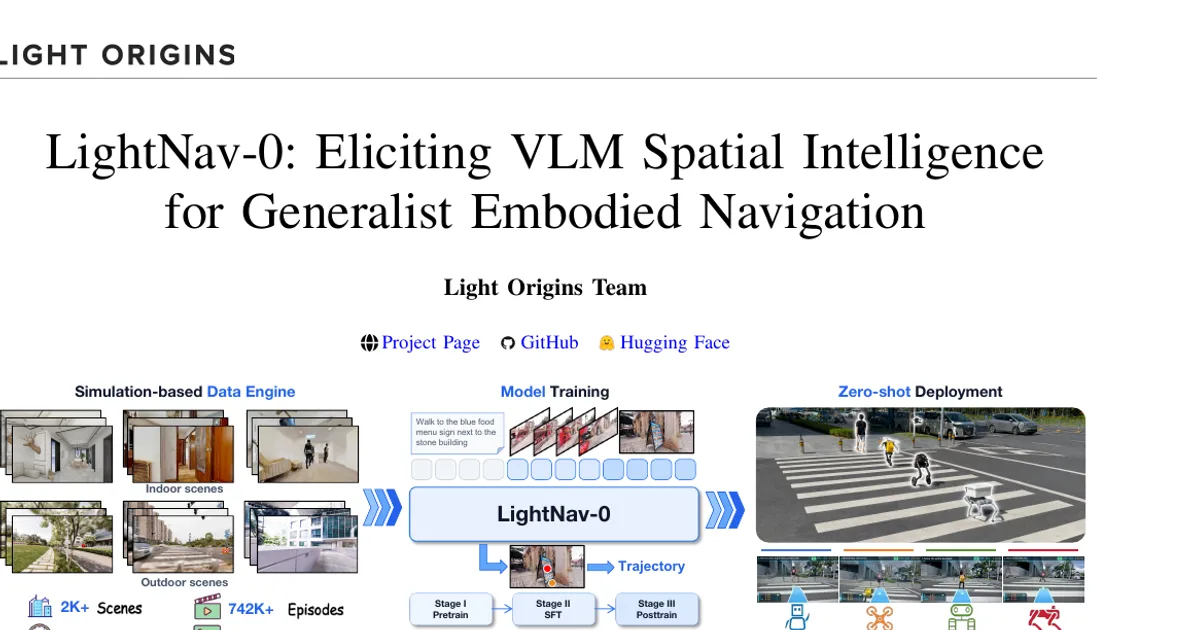
Scope: The paper introduces LightNav-0, a compact 4B-parameter VLM repurposed as a single unified navigation policy through a pointing-based token interface and a residual vector-quantized action tokenizer, and reports simulation and real-world evaluations across tasks and embodiments.
What This Paper Is About
Most navigation systems are built for one task, one environment, or one robot, using separate modules such as waypoint predictors, topological maps, or task-specific action heads. That fragmentation prevents them from reusing the spatial reasoning that modern VLMs already have. LightNav-0's goal is to show that a single compact VLM, with no task-specific prediction heads, can serve as a general navigation backbone — grounding goals as image-plane points and decoding those points into precise trajectories for instruction following, open-vocabulary object search, and target tracking across robot embodiments.
Key Contributions
-
A unified token interface for heterogeneous navigation. Dual-channel pointing represents spatial intent with two tokens: an affordance point (
⟨apos_i⟩) for feasible local motion or free space, and an object point (⟨opos_i⟩) localizing a target object or goal location. Both are encoded as channel-specific image-grid tokens on a shared lattice, so the same representation covers instruction following, object navigation, and tracking without a task-identification token. -
A hierarchical residual vector-quantized (RVQ) action tokenizer. A 10-step SE(2) trajectory is quantized by three 256-entry codebooks. The whole trajectory costs three tokens emitted by the original language-model head, yet decodes to 10 continuous waypoints. Any non-empty token prefix decodes to an executable coarse trajectory, letting deployment trade precision for latency.
-
Temporally aware visual history compression. Recent frames are sampled more densely and pooled less aggressively than old frames, following the qualitative form of the Ebbinghaus forgetting curve, with configurable pixel budgets of 256K, 576K, and 1M. This bounds visual-token count while keeping both recent detail and long-horizon context.
-
A staged training recipe and data corpus. A two-stage embodied-reasoning (ER) mid-training curriculum, supervised fine-tuning with DAgger, and online reinforcement learning align perception, reasoning, and control. The navigation corpus spans 2K+ scenes and 4K+ hours, with ER mid-training drawing from 36 sources.
Main Findings
- State-of-the-art monocular navigation in simulation: LightNav-0 achieves state-of-the-art monocular success rates across all 10 public navigation simulation settings the paper evaluates. It uses one checkpoint with no benchmark-specific fine-tuning.
- Strong embodied-reasoning checkpoint: LightNav-ER, the embodied-reasoning checkpoint used to initialize LightNav-0, attains the highest complete-set average across 8 embodied-reasoning benchmarks.
- Precise trajectories from few tokens: Full 3-level RVQ decoding represents up to 256³ code combinations with only 3 tokens and achieves an average displacement error of 0.72 cm, compared with 2.48 cm for a single-level K=4096 VADv2-style planning vocabulary.
- Zero-shot real-world transfer: Real-world evaluations demonstrate zero-shot generalization across robot embodiments, diverse scenes, and both static and dynamic targets. Quantitative real-world success rates are not reported in the paper content provided.
- Tractable reinforcement learning: Because trajectories are three RVQ tokens from the same head that produces language, their log-probabilities are exact and group-relative updates apply without an auxiliary MDP, denoising reformulation, or separate critic, and the credit-assignment horizon stays short.
- Efficient inference and training: Autoregressive decoding served with vLLM runs at approximately 4 ms per generated token on an NVIDIA GeForce RTX 4090. Training dynamically packs approximately 8.6 samples into each 8,192-token sequence.
- Balanced task mixture: Under the active sampling schedule, 77.6% of optimization samples carry navigation-action supervision and 22.4% rehearse perception and reasoning from ER mid-training. The ER mixture allocates 35.14% to pointing, 25.05% to single-image VQA, 19.81% to video reasoning, and 20.00% to general visual and abstract reasoning.
- A new benchmark, INSIGHT-Bench: It contains 1,683 scenes and 53,090 training episodes, plus 210 scenes and 1,097 evaluation episodes drawn from HM3D/MP3D, Habitat-GS, InteriorGS, and VLNVerse, mixing mesh-based and 3D Gaussian-splatting environments.
Methodology in Plain English
The team starts from an off-the-shelf compact VLM (Qwen3-VL-4B-Instruct, a native-resolution vision transformer plus a 36-layer language model) and keeps its architecture intact. Instead of bolting on navigation modules, they extend the model's vocabulary with new tokens and let the existing autoregressive head produce everything.
At each decision step the model sees a short history of egocentric RGB frames, compressed so that recent frames keep fine detail and older frames are sampled less often and pooled more coarsely, plus a natural-language goal. It then emits a fixed-length output: first an affordance point and an object point, expressed as single tokens naming a grid cell in the current image, then three action tokens. Those three tokens index three codebooks — one coarse, two residual — and summing the selected codewords reconstructs a 10-waypoint SE(2) trajectory, which an embodiment-specific low-level controller turns into robot commands. Because the intermediate step is expressed in the image plane rather than in any robot's control space, the same interface works across tasks and platforms.
Supervision is generated automatically. A pipeline projects navigation targets into the pointing grid for the affordance and object channels. INSIGHT-Bench scenes are pre-annotated by rendering multiple views of navigable viewpoints, using Molmo2 for open-set pointing, lifting predictions into 3D with metric depth, and keeping a merged instance only when it is supported by at least two observations from at least two distinct viewpoints with a 3D localization spread below 0.6 m. Instructions are then drafted either from recorded geometry via rule templates or by a video-VLM route, rewritten by an LLM, and confirmed by a goal-arrival check on the final frames.
Training proceeds in stages: embodied-reasoning mid-training on spatial, video, pointing, and general reasoning data; supervised fine-tuning on the navigation mixture plus a rebalanced ER component; and online reinforcement learning with group-relative updates. Camera randomization during data generation varies field of view over [90°, 130°], height over [0.5, 1.5] m, and pitch over [−15°, 15°]. Quality controls cap stop samples at 2% of the mixture and limit any trajectory cluster to 5% share.
Why This Matters
The paper argues that generalist navigation does not require panoramic front ends, task identifier tokens, or separate action experts — a compact VLM with a carefully designed token interface can do the job. That reframes the design question from "which extra modules do we add?" to "how do we elicit spatial priors the model already has?" It also shows that precise continuous control can remain inside the language model's own token distribution, which is what makes standard reinforcement learning recipes applicable without reworking them.
Real-world applications:
- Service and delivery robots that must follow spoken instructions, find named objects, and follow people in the same deployment.
- Assistive or companion robots that respond to open-vocabulary requests and track moving targets such as a specific person.
- Warehouse and industrial inspection platforms where different robot bodies share one policy and one training pipeline.
- Rapid retargeting of a navigation policy to a new robot or sensor suite without collecting a new task-specific dataset.
Industry relevance: The results point to lower engineering cost, since one compact model replaces fragmented perception, mapping, and planning components, and to cheaper deployment, since the model is small enough to run at millisecond-scale per-token latency rather than requiring a large slow planner paired with a separate fast policy. Open-sourcing signals (project page, GitHub, Hugging Face) and a public benchmark lower the barrier for teams that cannot train large navigation foundation models from scratch.
Future Directions
- Scale and precision limits: The paper leaves open how far the approach scales beyond a 4B backbone and a 3-level, 256-entry RVQ codebook, and whether longer horizons per decision step remain tractable.
- Quantitative real-world evaluation: Real-world results are described qualitatively across embodiments, scenes, and static versus dynamic targets; systematic success-rate reporting on physical robots is a natural next step.
- Reasoning depth: The pointing prefix is a fixed-length two-token trace. Whether richer explicit reasoning — the kind prior work explored with free-form chains of thought or a second slow planning system — can be added without losing the constant-token cost is unresolved.
- Robustness of automatic annotation: The INSIGHT-Bench pipeline depends on a separate model (Molmo2) for open-set pointing plus geometric consistency gates. How annotation errors propagate into the navigation policy, and whether the pipeline transfers to new scene sources, is not settled.
Target Audience
Robotics and embodied-AI researchers, especially those working on navigation foundation models and vision-language-action systems; VLM practitioners interested in token interfaces for spatial grounding and continuous action; reinforcement learning researchers studying verifiable-reward post-training for multimodal policies; and engineering teams evaluating compact, deployable navigation backbones that generalize across tasks and robot embodiments. Readers without background in VLM tokenization or navigation benchmarks will find the architecture section demanding.
Authors’ abstract
Embodied navigation requires agents to translate heterogeneous goals and visual observations into actions across tasks, environments, and robot embodiments. Modern vision-language models (VLMs) already encode spatial priors for visual grounding, spatial reasoning, and pointing, but these capabilities are rarely elicited directly for robot control. Existing navigation systems instead rely on task- or embodiment-specific components, fragmenting perception, reasoning, and action while offering limited generalization. Here we present LightNav-0, a compact generalist embodied navigation model that elicits the spatial intelligence of a pretrained VLM and aligns it with navigation, without task-specific prediction heads. LightNav-0 represents diverse navigation tasks through a unified token interface: dual-channel pointing expresses task-, scene-, and embodiment-agnostic spatial intent, while a residual vector-quantized action tokenizer maps this intent to precise, embodiment-specific trajectories. Together with temporally aware visual history compression, ER mid-training, supervised fine-tuning, and reinforcement learning, this formulation supports instruction following, open-vocabulary object navigation, and visual tracking within a single model. The navigation training corpus spans 2K+ scenes and 4K+ hours of embodied navigation data. LightNav-ER, the embodied-reasoning checkpoint used to initialize LightNav-0, attains the highest complete-set average across 8 embodied-reasoning benchmarks, while LightNav-0 achieves state-of-the-art monocular success rates across all 10 public navigation simulation settings. Real-world evaluations further demonstrate zero-shot generalization across robot embodiments, diverse scenes, and static and dynamic targets. These results establish compact VLMs as a unified and transferable backbone for generalist embodied navigation.