Research
Less from More: Reinforcing Sparse Video Reasoning from Dense References
Overview Research area: Computer vision and multimodal large language models — specifically efficient video understanding and reinforcement-learning post-training for video-language models. Technical
- arXiv
- 2610.10893
- Published
- 2026-10-07
- Authors
- Wenfang Sun, Yingjun Du, Cees G. M. Snoek
AI summary
Overview
Research area: Computer vision and multimodal large language models — specifically efficient video understanding and reinforcement-learning post-training for video-language models.
Technical level: Advanced. The paper assumes familiarity with multimodal LLM post-training, reinforcement learning with KL-regularized objectives, and temporal grounding metrics such as temporal intersection-over-union (tIoU).
Scope: The paper introduces SAVER, a dense-to-sparse reinforcement post-training framework that uses dense video views as training-time references so that a video-language model can reason reliably from sparsely sampled frames at inference.
What This Paper Is About
Video-language models generally assume that showing more frames yields more reliable reasoning, but dense frame sampling is expensive in visual tokens, memory, and latency. The authors argue that the real problem is not just processing frames efficiently, but training a model to remain reliable when only a few frames are available. SAVER addresses this by pairing a dense view and a sparse view of the same video during reinforcement post-training — using the dense view as a training-time reference only — and then running inference purely on sparse frames.
Key Contributions
-
A dense-to-sparse post-training framework. SAVER samples a dense view and a sparse view from the same video, feeds both into the same MLLM policy, and optimizes both with temporal grounding rewards, so that dense frames act as training-time scaffolds that are absent at inference.
-
A reliability-gated reference reward. A reward term
R_ref = w^d · tIoU(τ̂^s, τ̂^d)pulls sparse predictions toward dense predictions, but the gatew^dactivates only when the dense view's grounding reward exceeds the sparse view's on that same sample, preventing the sparse view from imitating worse dense outputs. -
A grounding-only training recipe that transfers. SAVER is trained on only 1,250 randomly sampled temporal grounding examples from Time-R1, with no video-QA annotations, yet it improves performance on six video-QA benchmarks, indicating cross-task transfer from evidence localization to broader video understanding.
-
A controlled frame-budget evaluation. The authors evaluate at frame rates of 0.1, 0.2, 0.5, 1, and 2 fps with a per-video frame cap of [4, 256], reporting both accuracy and the average number of sampled frames for three Qwen3.5 model scales (0.8B, 2B, 4B).
Main Findings
-
Sparse frames break dense-trained baselines. Reducing from 2.0 fps to 0.1 fps drops Qwen3.5-2B average temporal grounding mIoU from 34.9% to 18.4%, confirming that sparse-frame grounding is a genuinely hard setting rather than a trivial input reduction.
-
Large grounding gains at very low frame rates. At 0.1 fps (7 average frames on the grounding benchmarks), SAVER raises average mIoU from 18.4% to 30.0% for the 2B model and from 19.7% to 28.2% for the 4B model; the 0.8B model improves from 18.7% to 26.5%.
-
Gains also appear at dense frame rates. At 2.0 fps (110 average frames), SAVER improves average grounding mIoU from 34.9% to 45.4% for the 2B model, from 36.1% to 41.4% for the 0.8B model, and from 35.7% to 46.6% for the 4B model.
-
Transfer to video-QA. At 2.0 fps, average accuracy over six video-QA benchmarks rises from 51.0% to 54.6% (2B) and from 60.8% to 64.4% (4B); at 0.1 fps the 2B model improves from 45.9% to 50.8%. SAVER-2B at 0.1 fps (50.8%) nearly matches dense Qwen3.5-2B at 2.0 fps (51.0%).
-
Uneven, task-dependent transfer with some regressions. Video Reasoning benchmarks gain the most — for example, VideoMMMU for the 4B model at 0.1 fps rises from 52.4% to 72.7% — while regressions occur, such as VideoMME for the 2B model (62.6% to 61.1% at 2.0 fps) and MVP for the 0.8B model (25.0% to 23.4% at 2.0 fps).
-
Reduced input budget. Moving from 2.0 to 0.1 fps cuts the average number of observed frames across the six video-QA benchmarks from 139 to 38, a 72.7% reduction. Profiling the original Qwen3.5-2B reports 86.8% fewer visual tokens, 49.3% lower peak GPU memory, and 63.6% lower end-to-end latency averaged over nine benchmarks; the authors explicitly note these characterize the profiled input settings on the base model rather than a SAVER-specific speedup.
-
Each component adds incremental gains. At 0.1 fps with Qwen3.5-2B, sparse-only training reaches 19.0 mIoU / 48.5% QA, dense-only 24.2 / 48.3, joint dense+sparse 27.4 / 48.7, adding the ungated reference reward 29.1 / 49.3, and the gated SAVER variant 30.0 / 50.8.
-
SAVER outperforms alternative post-training strategies. Under the same 2B initialization, 1,250 grounding examples and 0.1 fps evaluation, Time-R1 RL obtains 21.0 mIoU / 49.1% QA, sparse SFT with ground-truth segments 20.3 / 48.1, sparse SFT with dense pseudo-labels 19.6 / 49.5, SAVER with a ground-truth reference 29.5 / 50.1, and SAVER with the dense reference 30.0 / 50.8.
-
Sparse view weighting matters. A small sparse-view reward weight
λ_sgives insufficient pressure for sparse robustness, while an overly large weight weakens the dense-scaffold/sparse-optimization balance;λ_s = 2is used as the default, and the reference reward weightλ_refshows an optimal intermediate setting rather than monotonic gains.
Methodology in Plain English
For every training video, the researchers create two versions: a dense one with many frames and a sparse one with few frames. Both go to the same model, which is asked to output a start and end timestamp for an instructed event.
Three rewards guide training. A format reward checks that the output contains a parseable start and end timestamp. A grounding reward scores each timestamp pair against the ground-truth segment using tIoU minus a penalty on how far the predicted boundaries are from the true boundaries, normalized by video duration. A reference reward then compares the sparse prediction to the dense prediction: if the dense prediction scored better on the grounding reward than the sparse one, the sparse prediction is rewarded for agreeing with it; otherwise the reference reward is zero. The total objective combines the dense reward with a weighted sparse reward and a KL penalty keeping the policy near a reference policy; each training example uses four paired dense and sparse rollouts with advantages normalized over their combined rewards.
The training data is deliberately narrow: 1,250 temporal grounding examples randomly sampled from Time-R1, with no video-QA annotations. Models are instantiated on Qwen3.5 at 0.8B, 2B, and 4B, trained with global batch sizes of 64, 64, and 128 on 16, 16, and 32 A100 GPUs for roughly 4, 7, and 13 hours respectively. A sparse-view reward coefficient of 2.0 is used, with all other reward coefficients set to 1.0.
At test time only the sparse view exists. The input video is uniformly sampled at a prescribed fps, and the model predicts directly — no dense pre-scanning, adaptive frame selection, or test-time optimization. The authors also offer a simple risk-decomposition argument: the sparse-view risk is upper-bounded by the dense-view risk plus the total variation distance between the two predictive distributions, which frames both rewards as targeting the two terms of that bound.
Why This Matters
Impact on research. The paper reframes video efficiency: instead of compressing, selecting, or retrieving from a rich visual input at inference, it asks whether the model can be post-trained to be reliable under a fixed low-frame-rate budget. It also shows that a narrow, grounding-only supervision signal can transfer to unrelated video-QA tasks, and it reports honest limitations — regressions on individual benchmarks and an open question about why the cross-task transfer occurs.
Real-world applications:
- Streaming and mobile video assistants that can only decode a low frame rate on device.
- Robotics and embodied agents operating under tight compute and latency budgets.
- Surveillance and monitoring systems processing long recordings where dense sampling is infeasible.
- Long-form video search and indexing, where reducing per-video token cost directly lowers serving expense.
Industry relevance. The reported profiling of Qwen3.5-2B under sparse input — 86.8% fewer visual tokens, 49.3% lower peak memory, 63.6% lower latency — maps onto the dominant cost drivers in deployed video LLM services. A post-training recipe that needs only 1,250 examples and runs on 16 A100s for about 4 hours at the 0.8B scale is comparatively cheap to adopt.
Future Directions
-
Adaptive online sampling. The authors propose letting the model request additional frames when sparse observations are insufficient, as a way to address failures where sparse frames miss the key event entirely.
-
Disambiguating repeated actions. A documented failure mode is alignment to the wrong occurrence when visually similar actions appear multiple times in a video, especially at very low frame rates.
-
Understanding the transfer mechanism. The paper reports that grounding-only post-training improves video-QA, but states that the mechanism underlying this cross-task transfer remains an open question.
-
Extending beyond temporal grounding as the proxy task. The current design uses grounding as an evidence-localization proxy on 1,250 examples; whether other proxy tasks or larger grounding sets yield larger or more consistent QA gains is untested.
Target Audience
Researchers and engineers working on video-language models, multimodal reinforcement post-training, and efficient inference. It is most useful to readers already comfortable with MLLM architectures and RL fine-tuning who want a training-side alternative to frame selection and token compression, and to practitioners who need to deploy video understanding under fixed latency or memory budgets.
Authors’ abstract
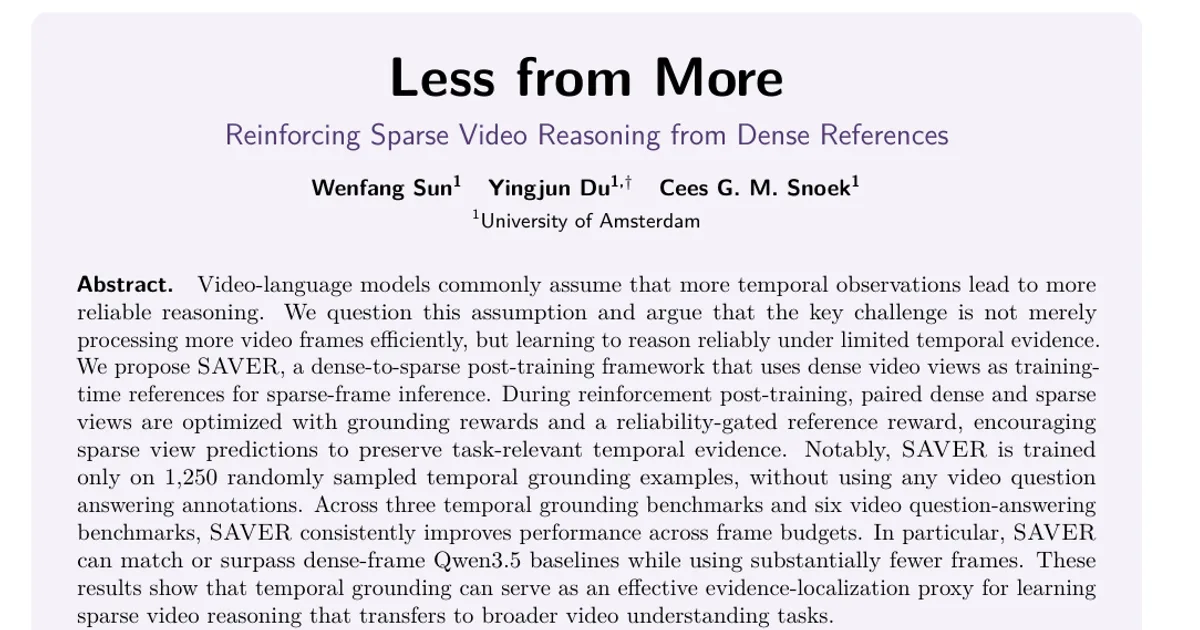
Video-language models commonly assume that more temporal observations lead to more reliable reasoning. We question this assumption and argue that the key challenge is not merely processing more video frames efficiently, but learning to reason reliably under limited temporal evidence. We propose SAVER, a dense-to-sparse post-training framework that uses dense video views as training-time references for sparse-frame inference. During reinforcement post-training, paired dense and sparse views are optimized with grounding rewards and a reliability-gated reference reward, encouraging sparse view predictions to preserve task-relevant temporal evidence. Notably, SAVER is trained only on 1,250 randomly sampled temporal grounding examples, without using any video question answering annotations. Across three temporal grounding benchmarks and six video question-answering benchmarks, SAVER consistently improves performance across frame budgets. In particular, SAVER can match or surpass dense-frame Qwen3.5 baselines while using substantially fewer frames. These results show that temporal grounding can serve as an effective evidence-localization proxy for learning sparse video reasoning that transfers to broader video understanding tasks.