Research
LEGO: A Lifting-Free Approach for Exocentric-to-Egocentric Video Generation
Overview Research area: Computer vision, specifically novel view synthesis and camera-controlled video diffusion — generating a first-person (egocentric) video from a single third-person (exocentric)
- arXiv
- 2610.12442
- Published
- 2026-10-08
- Authors
- Suhwan Cho, Yonwoo Choi, Soongjin Kim, Jicheol Park, Taegyu Lim
AI summary
Overview
Research area: Computer vision, specifically novel view synthesis and camera-controlled video diffusion — generating a first-person (egocentric) video from a single third-person (exocentric) recording.
Technical level: Advanced. The paper assumes familiarity with transformer attention, diffusion/flow-matching sampling, Plücker ray embeddings, and view-synthesis literature such as LVSM.
Scope in one sentence: LEGO replaces the depth-estimation-and-point-cloud pipeline used by prior exocentric-to-egocentric systems with a fine-tuned learned view synthesizer whose render — gated by an attention-derived confidence map and reinforced during early denoising — conditions an unmodified video diffusion generator.
What This Paper Is About
Given one third-person video of a scene plus a target first-person camera trajectory, the goal is to synthesize the video a camera on that trajectory would have captured. The two viewpoints share little overlap, so most of the target view cannot be copied and must be generated. The current state of the art (EgoX) handles this by estimating depth, lifting the video into a point cloud, and re-rendering it from the egocentric camera as a condition for a video diffusion model — a deterministic mapping whose depth errors appear as sharply misplaced content.
Key Contributions
- LEGO, a lifting-free exocentric-to-egocentric video generation framework that conditions a video diffusion model on the confidence-gated render of a learned view synthesizer instead of a point-cloud reconstruction — with no depth estimation, point cloud, or reprojection at any stage.
- Evidence for a conditioning principle: a structurally aligned but soft (blurry) condition serves the generator better than a sharp but misaligned one, because denoising training teaches a diffusion model to restore detail but not to relocate misplaced content.
- Adaptive Rendering Consistency (ARC), training-free guidance that reuses the synthesizer's correspondence-distribution confidence to steer the early, layout-forming denoising steps toward the render, replacing the training-time depth-derived attention bias that prior work requires.
- State-of-the-art results on Ego-Exo4D (seen and unseen splits) plus generalization to EgoHumans and Nymeria without any retraining.
Main Findings
-
LEGO outperforms EgoX on all image criteria and FVD. On the Ego-Exo4D seen split, LEGO records PSNR 20.28, SSIM 0.689, LPIPS 0.310, CLIP-I 0.925, and FVD 155.56, versus 16.05 / 0.556 / 0.498 / 0.896 / 184.47 for EgoX and 15.57 / 0.556 / 0.466 / 0.903 / 197.95 for the rerun EgoX † checkpoint. On the unseen split, LEGO records PSNR 15.91, SSIM 0.505, LPIPS 0.504, CLIP-I 0.897, and FVD 404.77, versus 14.38 / 0.457 / 0.552 / 0.877 / 440.64 for EgoX.
-
The other baselines fall well behind both. Exo2Ego-V, TrajectoryCrafter, Wan Fun Control, and Wan VACE score between 12.17 and 14.53 PSNR on seen and unseen splits, with FVD values up to 1283.50.
-
Video-quality scores are near saturation. Temporal flickering, motion smoothness, and dynamic degree are close to ceiling for every method; LEGO reaches 0.989 / 0.994 / 0.987 on seen and 0.990 / 0.995 / 1.000 on unseen.
-
The fine-tuned synthesizer render is the strongest single conditioning input. In the ablation, it scores PSNR 18.24 / LPIPS 0.364 / CLIP-I 0.904 / FVD 183.40 on seen, versus 15.59 / 0.478 / 0.895 / 195.80 for the point-cloud render, 15.71 / 0.503 / 0.888 / 212.94 for the untuned synthesizer render, and 12.30 / 0.591 / 0.862 / 310.00 for no condition.
-
The gain comes from adaptation, not architecture. The untuned LVSM checkpoint performs on par with the point-cloud render; fine-tuning to the fisheye egocentric camera is what produces the improvement.
-
Confidence gating helps despite discarding rendered area. Adding gating to the synthesizer render lowers FVD from 183.40 to 166.86 on seen and from 581.90 to 502.47 on unseen while leaving the other metrics essentially unchanged. Restoring the exocentric tokens then brings further gains (18.91 / 0.340 / 0.921 / 159.04 on seen).
-
ARC beats the trained attention bias. ARC on top of the full conditioning reaches the final 20.28 / 0.310 / 0.925 / 155.56 on seen and 15.91 / 0.504 / 0.897 / 404.77 on unseen, whereas the depth-guided attention bias (GGA) applied at training and inference scores 18.62 / 0.356 / 0.915 / 194.98 on seen and 15.20 / 0.525 / 0.896 / 429.42 on unseen.
-
ARC is only as good as the render it is anchored to. Applying ARC to the point-cloud render, with its hole mask as binary confidence, degrades results to 13.96 / 0.586 / 0.801 / 735.50 on seen and 13.72 / 0.618 / 0.795 / 812.88 on unseen — worse than no guidance at all.
-
The synthesizer render trades sharpness for alignment. On the unseen split, the synthesizer render is the blurriest condition (Laplacian-variance ratio 0.28 versus ground truth, compared with 0.50 for the untuned render and 0.97 for the point-cloud render) but the best aligned: ZNCC 0.169 / 0.217 / 0.275 at patch sizes 16 / 32 / 64, versus 0.034 / 0.047 / 0.059 for the point-cloud render, with DINO similarity 0.586 versus 0.476. The blur does not persist — generations from the two renders reach the same sharpness.
-
The synthesizer render is far cheaper. It takes 4.7 seconds per clip versus 69.2 seconds for depth estimation plus point-cloud rendering.
-
Confidence indicates where the render is trustworthy. Sorting generated video windows by confidence, the most confident windows have error well below the average over all windows at every cut-off, on both seen and unseen scenes.
-
Generalization without retraining. Using Ego-Exo4D-trained weights on EgoHumans and Nymeria (200 test clips each), LEGO scores PSNR 15.52 / SSIM 0.530 / LPIPS 0.545 / CLIP-I 0.819 / FVD 332.41 and 15.23 / 0.534 / 0.561 / 0.821 / 210.27, versus 13.74 / 0.460 / 0.573 / 0.806 / 421.83 and 11.64 / 0.451 / 0.637 / 0.804 / 296.98 for EgoX †.
-
The gate behaves consistently across datasets. It keeps roughly 15% of the render on the new datasets as well as on unseen Ego-Exo4D scenes, suggesting confidence does not depend on scene familiarity.
-
Fine-tuning is inexpensive. Adapting the view synthesizer takes 10,000 steps, about 3.5 hours on four NVIDIA H200 GPUs, and the model is frozen afterwards.
Methodology in Plain English
The system has two parts that are trained separately and then coupled.
The view synthesizer. Instead of estimating depth and lifting pixels into 3D, the researchers fine-tune an existing feed-forward view-synthesis transformer (LVSM-style) to map an exocentric frame plus camera rays directly to the egocentric image. Geometry enters only through per-pixel Plücker ray embeddings computed from the two calibrated cameras; every camera-specific quantity, including the fisheye lens, is expressed that way, so no architectural change is needed to switch from a pinhole viewpoint to a headset camera. The only supervision is the real egocentric recording, so no depth or correspondence labels are used. Because the attention inside this transformer tells it which source locations to look at for each output pixel, averaging those attention weights over heads and the last layers yields a per-pixel distribution over source locations — the paper's "correspondence distribution."
Why this condition instead of a point cloud. A point-cloud render assigns each output pixel one reprojected source, so depth errors produce sharply misplaced content. The learned render averages over candidate sources, which blurs wherever the distribution is spread but keeps content near its correct location. Since diffusion training is essentially the art of recovering detail from corrupted input, the authors argue that blur is the easier failure to hand the generator, and alignment should take priority over sharpness in a condition.
Confidence gating. The learned render fills in every pixel, including regions with no exocentric evidence, so it cannot signal its own uncertainty. The concentration of the correspondence distribution supplies that signal: the confidence of a location is the probability mass of its k most likely sources, and locations below a threshold are replaced with neutral gray that the VAE encodes near zero.
Guiding the sampling trajectory. Layout is fixed in the early, high-noise steps and detail appears later. ARC exploits this at inference only: during the first 80% of the denoising schedule, the generator's current estimate of the clean egocentric video is blended toward the render in proportion to the squared confidence, and the implied velocity is passed to the existing solver. The correction is deterministic, adds no noise, and is not applied in the remaining steps, which are free to add detail the render lacks. No retraining is required, and the generator itself is left unmodified.
Evaluation. Experiments follow the EgoX protocol on Ego-Exo4D with seen and unseen splits, using PSNR, SSIM, LPIPS, CLIP-I, and FVD on generated egocentric frames, plus VBench temporal flickering, motion smoothness, and dynamic degree on the full canvas. All ablations share the same backbone, LoRA rank, training schedule, random seed, and camera trajectories, differing only in the conditioning input and the denoising guidance. Because the official evaluation code was not public, the authors reimplemented the metrics and calibrated them so the released EgoX checkpoint approximately reproduces its published numbers.
Why This Matters
The paper reframes a design question that other work in this area treats as settled: not how to reconstruct a scene more accurately, but what representation a video diffusion model actually wants as input. Its answer — alignment before sharpness — is a general claim about conditional generation, supported by a controlled ablation and by measurements of alignment and sharpness for each condition. It also removes an expensive and fragile pipeline stage (monocular depth plus point-cloud rendering), cutting condition-generation time from 69.2 to 4.7 seconds per clip, and shows that the confidence signal needed for gating and guidance comes free from the synthesizer's own attention rather than from an extra trained mechanism.
Real-world applications:
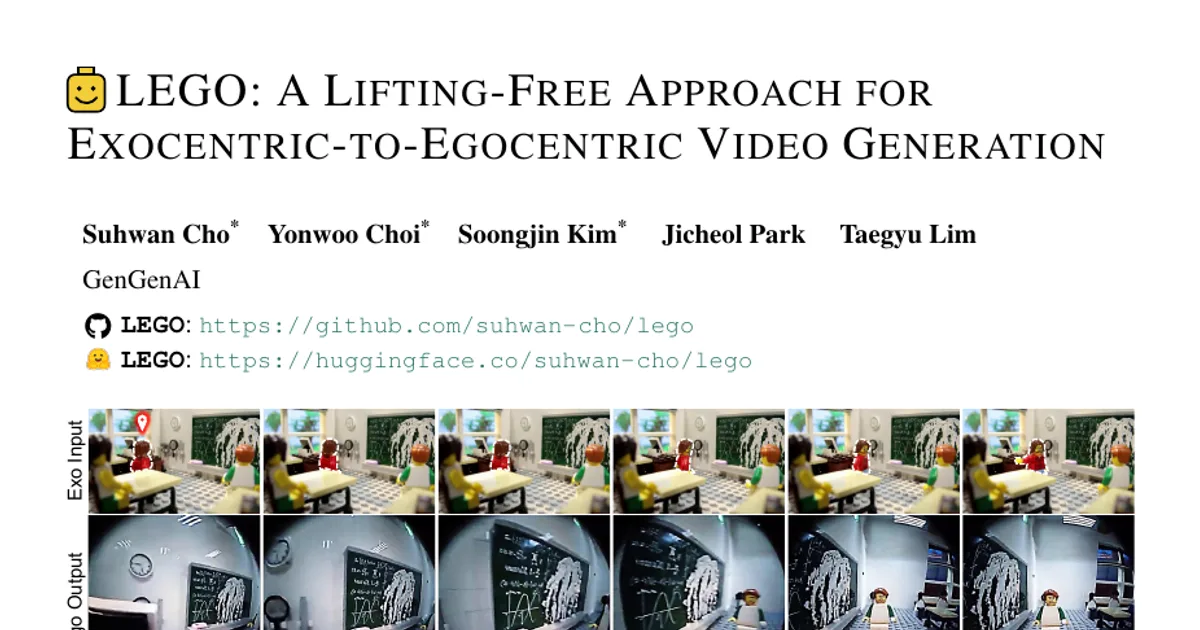
- AR and VR headset content. The egocentric target here is a fisheye Aria headset camera, and the method produces plausible first-person views along user-specified trajectories on domains far from the training data (Figure 1).
- Robotics and embodied learning from third-person demonstrations. The paper frames the task as valuable "wherever first-person data is scarce and third-person footage abundant," which describes most instructional and demonstration video.
- Automated conversion of third-person footage. Sports, cooking, and instructional recordings captured by a fixed observer could be re-rendered from a participant's viewpoint.
- Synthetic egocentric dataset generation. The unmodified generator plus a frozen synthesizer can produce first-person training data for models that need it, and the design allows a stronger synthesizer to be substituted later without retraining.
Industry relevance: The method is lifting-free, training-free at guidance time, and modular — a frozen synthesizer contributes only a render and a confidence map, so the same weights transfer across scenes and recordings, and the video backbone is a standard open model (Wan2.1-I2V-14B) fine-tuned with LoRA. The cost profile (3.5 hours of synthesizer fine-tuning, 4.7 seconds per clip of condition generation) is far more deployable than per-clip depth estimation and point-cloud rendering.
Future Directions
- A stronger synthesizer as a drop-in upgrade. The authors note explicitly that because the frozen synthesizer enters only through its render and confidence, a better view synthesizer can be substituted as one appears.
- Removing the remaining dependence on the ARC hyperparameters. The number of guided steps and the squared confidence weighting were chosen on the unseen split because Ego-Exo4D provides no separate validation split; how sensitive the method is to these choices is not reported.
- Extending the transfer evaluation. Generalization is demonstrated on EgoHumans and Nymeria, but only on Ego-Exo4D-trained weights and only at the two-split benchmark level; broader cross-domain behavior on in-the-wild footage is shown qualitatively, without ground truth.
- Object-level evaluation. The paper's object-level metrics (LocErr, IoU, Contour) require a detection-and-matching pipeline that is not part of the public EgoX release, so the authors fix and validate their own protocol; the reported results for these metrics are not available in the truncated content.
Target Audience
Researchers and engineers working on video diffusion, novel view synthesis, and egocentric vision, particularly those building systems that condition generative models on geometry-derived representations. It is also relevant to practitioners in AR/VR and robot learning who need first-person video where only third-person footage exists, and to anyone interested in the general question of what form of conditioning a diffusion model benefits from. Readers without background in view synthesis, ray embeddings, and diffusion sampling will find the method sections demanding.
Authors’ abstract
Generating an egocentric video from a single exocentric recording is a challenging case of novel view synthesis, as the two cameras share little overlap and much of the target view is unobserved. Current state-of-the-art methods reconstruct the scene explicitly by estimating depth, lifting the video into a point cloud, and re-rendering it from the egocentric camera to condition a video diffusion model. This deterministic mapping assigns each pixel to a single reprojected location, which preserves texture but translates depth errors into misplaced content. We ask what a video diffusion model should receive as its condition and propose a lifting-free answer: a learned view synthesizer, an LVSM-style transformer fine-tuned to render the egocentric view directly without depth, point clouds, or reprojection, resolving cross-view correspondence internally. In contrast, its probabilistic mapping averages each region over candidate source locations according to a learned correspondence distribution, preserving structure while fine texture is averaged away. We argue that this trade-off suits a diffusion generator, whose denoising training excels at restoring detail, so an effective condition should prioritize structural alignment over sharpness. This distribution's concentration also yields a per-region confidence, used both to mask low-confidence regions and to guide the generator toward high-confidence areas during early layout-forming denoising steps. Our approach consistently outperforms the state-of-the-art explicit pipeline and generalizes to other datasets without retraining. The synthesizer thus supplies view structure, and the diffusion model its detail.