Research
Learning Foresight without Explicit Trajectories for 3D Diffusion Policies
Overview Research area: Robot manipulation and imitation learning, specifically 3D diffusion policies (the DP3 family) that map point-cloud observations directly to dense action sequences. Technical l
- arXiv
- 2609.20669
- Published
- 2026-09-17
- Authors
- Zhongbo Zhang, Zaibin Zhang, Yifan Wang, Changbo Yan, Lijun Wang, Huchuan Lu
AI summary
Overview
Research area: Robot manipulation and imitation learning, specifically 3D diffusion policies (the DP3 family) that map point-cloud observations directly to dense action sequences.
Technical level: Advanced. Comfort with diffusion models, UNet architectures, feature-wise modulation (FiLM), and point-cloud-based imitation learning is assumed.
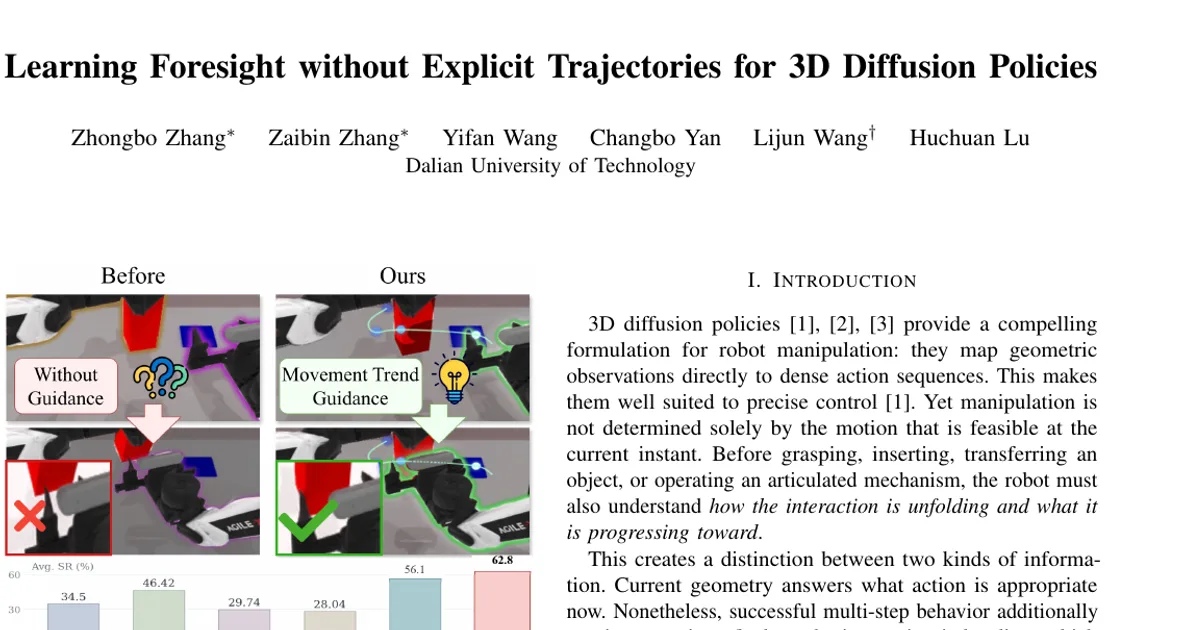
Scope: The paper proposes a lightweight module, Movement Trend Guidance, that gives a 3D diffusion policy a compressed sense of where an interaction is heading, learned from sparse future gripper states but never decoded into an explicit plan at test time.
What This Paper Is About
Diffusion policies for robot manipulation are good at answering "what motion is feasible right now" from current geometry, but they have no explicit mechanism for anticipating where a multi-step interaction is going. The authors argue that predicting waypoints, keyframes, or trajectories overshoots what a controller needs: a trajectory specifies exactly where to move, and errors in that prediction can constrain later behavior even when new observations suggest a correction is needed. Their goal is to give the policy foresight in the form of a compact latent representation rather than a plan, so future information shapes the internal representation without becoming an intermediate control target.
Key Contributions
-
A formulation of foresight that avoids explicit planning. The policy learns a compact latent of interaction evolution from observation history, trained to encode where the interaction is heading, with no waypoint or trajectory produced at inference.
-
A minimal architectural intervention. The trend latent enters the standard global-conditioning pathway, while its only additional direct influence is a gated FiLM branch restricted to the UNet bottleneck. This adds 3.52% more parameters and roughly 1.23% more inference latency over DP3, preserving dense action prediction and receding-horizon execution.
-
Training signal via sparse future gripper states. An auxiliary decoder supervises the latent with 4 future gripper targets (Cartesian position plus gripper state, at offsets 5, 10, 15, 20). The decoder's outputs are discarded at inference; only the latent is retained.
-
Broad empirical validation. Consistent gains across RoboTwin2.0 (50-task mixed training), LIBERO-40, DexArt, and five real-robot SO101 tasks, plus a controlled ablation that separates the contribution of future supervision from added representation capacity.
Main Findings
-
RoboTwin2.0 mixed training: 62.8% overall success versus 56.1% for the matched DP3 baseline, a +6.7-point gain with improvements on 38 of 50 tasks. Largest gains appear on contact-rich, multi-stage tasks such as rotate_QRcode (+37), place_shoe (+26), move_pillbottle_pad (+22), and move_playingcard_away (+21).
-
LIBERO-40: 71.93% ± 0.49% versus 37.08% ± 1.21% at epoch 1000, a +34.85-point gain. Gains appear across all four suites, with the largest absolute improvement on LIBERO-Goal (77.53% vs 8.73%). Low seed variance indicates the advantage is not driven by one rollout stream.
-
DexArt: 59.25% average over four dexterous articulated-object tasks versus 52.0% for DP3 (+7.25), the highest average among compared methods.
-
Real robot: 72.0% average on five SO101 dual-arm tasks (push cube, stack bowls, stack cubes, lift basket, handover bottle) versus 49.0% for DP3 and 43.0% for SimpleDP3.
-
Future supervision drives the gain, not capacity: A parameter-matched variant with the same latent architecture but no future loss reaches 44.87% on LIBERO-40, only +7.79 over DP3. Adding future supervision contributes a further +27.06 points. Explicit future-point conditioning reaches 65.28%, which the full latent approach exceeds by +6.65 points.
-
Conservative injection works best: Bottleneck-only gated FiLM reaches 62.8% on RoboTwin2.0, versus 55.8% for all-block gated FiLM and 52.9% for cross-attention. Restricting direct modulation to the compressed bottleneck prevents the high-level trend from perturbing layers responsible for local action refinement.
-
Default future offsets balance the horizon: Offsets {5, 10, 15, 20} outperform seven-offset, short-range {2, 4, 6, 8}, long-range {20, 30, 40, 50}, and single-offset configurations. Short ranges are redundant with the observation window; long ranges dilute the compact representation.
-
Transfer to non-diffusion architectures: Adding movement-trend conditioning to ACT in a six-task RoboTwin2.0 validation raises mean success from 24.00% to 51.67% (+27.67), suggesting the trend signal is not specific to the DP3 UNet.
-
Failure mode is geometric occlusion: Tasks with limited improvement share a common cause: the robot arm occludes the manipulated object, producing an incomplete point cloud. This degrades both the action policy and the trend estimate, consistent with the design intent that the latent provides only soft guidance.
Methodology in Plain English
The system takes a short window of three recent observations, each a point cloud plus robot state, and runs them through an encoder to produce a 256-dimensional latent vector. A small MLP turns this latent into a "trend" feature that is fused with the point-cloud and robot-state features from each frame in the window. The fused result becomes the global condition for the diffusion policy's action denoiser, which works exactly as in DP3.
During training, an auxiliary head attached to the latent predicts four future gripper states at offsets 5, 10, 15, and 20 frames ahead. These are just Cartesian positions and a gripper open/close scalar, taken from the demonstration. The loss on these predictions backpropagates into the latent, teaching it to summarize where the interaction is going. After training, the prediction head is thrown away. At inference, the policy computes the latent from the observation window, uses it as conditioning, denoises an action sequence, and executes six actions before re-observing and recomputing everything.
A second, more delicate piece is how the latent reaches the denoiser. The main pathway is the ordinary global condition. On top of that, a gated FiLM branch adds a scale and bias to the UNet bottleneck features, with the gate initialized so the branch starts as an exact identity and a negative bias limits how much it can grow. Because this extra modulation lives only at the bottleneck, the trend shapes global action structure without overriding the observation-driven local refinement happening in the down-sampling and up-sampling blocks.
Why This Matters
Impact on research: The paper makes a clean empirical case that how future information is used matters more than how much of it is predicted. Parameter-matched and explicit-point-conditioning ablations show that a future-supervised latent outperforms both extra capacity alone and direct conditioning on predicted coordinates. That is a useful design principle for anyone building future-aware policies, and it stands in contrast to methods that predict future visual latents (FLARE, ForeDiffusion) or explicit trajectories (DTP) or use contact structure (HDP).
Real-world applications:
- Industrial assembly and pick-and-place: Multi-stage tasks where a robot must sequence contacts, such as inserting a part then securing it, benefit from anticipating the next interaction rather than reacting step by step.
- Bimanual and handover manipulation: The RoboTwin2.0 bimanual categories, including handover_block and handover_mic, are exactly the settings where coordinating two effectors requires knowing where the interaction is heading.
- Dexterous articulated-object handling: Operating laptops, faucets, toilets, and buckets, as in DexArt, requires foresight about joint configurations and contact transitions.
- Household and service robots: Tasks like stacking bowls, lifting baskets, and handing over bottles on a low-cost SO101 platform suggest the method transfers to realistic hardware budgets.
Industry relevance: The cost of adoption is low by design: +9.23M parameters and about 0.6 ms of added latency on an RTX 4090 with 10 DDIM steps. It is a drop-in addition to an existing DP3 pipeline, does not require a separate planner or tracking interface, and needs no ground-truth future states at deployment. For teams already running diffusion policies in production, that combination is unusually cheap.
Future Directions
- Handling occlusion and incomplete geometry. The authors identify arm occlusion as the dominant failure cause. Recovering missing geometry via multi-view fusion, active sensing, or occlusion-aware point-cloud encoders is a natural extension.
- Broader real-robot validation. The real-robot evidence covers five tasks on one SO101 platform. Extending to more objects, scenes, and perturbations, plus different robot morphologies, remains open.
- Characterizing when trend conditioning helps most. The gains are uneven across tasks. A predictive account of which task structures benefit, perhaps keyed to contact richness or multi-stage horizon length, would make the method more targeted.
- Architecture generalization beyond ACT and DP3. The six-task ACT result is encouraging but limited in scope. Testing the trend signal on vision-language-action models and other policy families would clarify how general the mechanism is.
Target Audience
Robotics researchers working on imitation learning and manipulation policies, particularly those familiar with Diffusion Policy and DP3 and interested in future-aware or goal-conditioned control. Practitioners deploying diffusion policies on real hardware will find the low overhead and drop-in compatibility directly relevant. Graduate students studying representation learning for control will benefit from the ablation design, which cleanly separates representation capacity from the training signal that shapes it.
Authors’ abstract
3D diffusion policies are strong at generating geometrically grounded actions from current observations, but successful manipulation requires not only knowing what motion is feasible now, but also anticipating where the interaction is heading. Existing policies largely leave such foresight to emerge implicitly from action learning. We introduce Movement Trend Guidance, a simple but effective way to provide this foresight without introducing an explicit plan. From a short observation history, the policy learns a compact latent representation of interaction evolution. During training, sparse future gripper states supervise this representation; at inference, only the latent is retained as future-oriented conditioning alongside the current observation. The latent provides global conditioning for action generation, while an additional gated FiLM branch is used only at the UNet bottleneck. Despite adding only 3.52% more parameters to DP3, our method preserves the original dense-action and receding-horizon formulation and consistently improves upon DP3 across RoboTwin2.0, LIBERO-40, and DexArt. It reaches 62.8% vs. 56.1% in 50-task RoboTwin2.0 mixed training, 71.93% vs. 37.08% on LIBERO-40, and 72.0% vs. 49.0% on five real-robot tasks. These results show that a diffusion policy can benefit substantially from knowing where an interaction is heading, without being told exactly where to move.