Research
Learning Domain-Invariant Representations for Cross-Domain Image Registration via Scene-Appearance Disentanglement
Overview Research area: Computer vision and medical image analysis, specifically deformable image registration under domain shift, approached through disentangled representation learning. Technical le
- arXiv
- 2601.08875
- Published
- 2026-01-12
- Authors
- Jiahao Qin, Yiwen Wang
AI summary
Overview
Research area: Computer vision and medical image analysis, specifically deformable image registration under domain shift, approached through disentangled representation learning.
Technical level: Advanced. The paper combines a U-Net-based latent factorization with two formal propositions about identifiability and geometric correspondence, plus a multi-term training objective; readers will want familiarity with image registration metrics (rTRE), instance normalization, and feature modulation.
Scope: The paper proposes and evaluates SAR-Net (Scene-Appearance Registration Network), a framework that separates domain-invariant scene content from domain-specific appearance so that cross-domain registration can be performed in a shared latent space rather than by matching raw intensities, validated on the ANHIR multi-stain histopathology benchmark.
What This Paper Is About
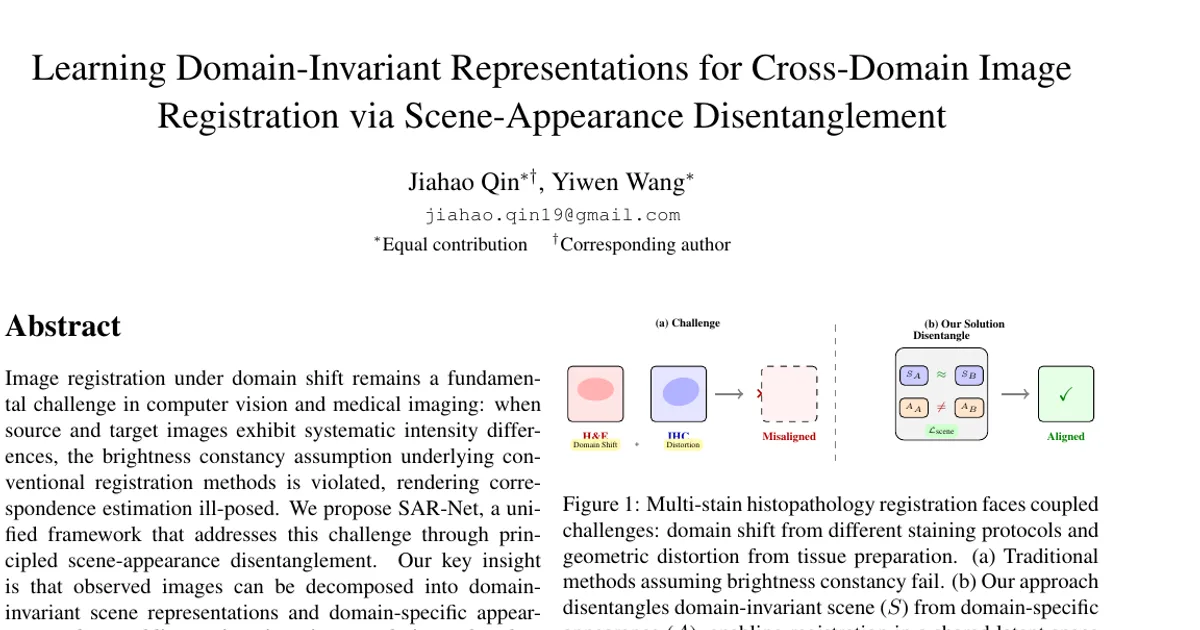
Conventional registration methods assume brightness constancy: that corresponding points in two images have similar intensities. When images come from different staining protocols, sensors, or imaging physics, this assumption breaks and intensity-based correspondence estimation becomes ill-posed. The authors' goal is to make registration robust to these systematic intensity differences by learning to decompose an image into a domain-invariant "scene" (geometry and structure) and a domain-specific "appearance" (intensity characteristics), then aligning images in the scene space where brightness constancy effectively holds.
Key Contributions
- Theoretical framework: The authors formalize registration under domain shift as scene-appearance disentanglement and state conditions under which the decomposition is identifiable. Proposition 1 shows that if the forward model G is injective in its first argument and cross-domain reconstruction is exact, then the two scene representations must be equal in latent space; Proposition 2 shows that driving the scene consistency loss to zero bounds the difference of any L-Lipschitz task applied to the two scene codes.
- Algorithmic innovation: A scene consistency loss that explicitly enforces geometric correspondence between the scene codes S_A and S_B in latent space, combining a squared L2 term with a cosine term weighted by lambda_cos = 0.1, which the paper presents as a sufficient condition for cross-domain alignment.
- A unified architecture: SAR-Net combines a scene encoder using instance normalization, a lightweight appearance encoder using global average pooling, and a forward model that re-synthesizes images through feature modulation, with cycle consistency and domain alignment losses added in training.
- Empirical validation: On the ANHIR benchmark, SAR-Net reports 0.25% median rTRE and 0.991 robustness, which the paper states outperforms MEVIS (0.27%) by 7.4% and ANTs (0.72%) by 65.3%.
Main Findings
- State-of-the-art accuracy on ANHIR: SAR-Net reaches 0.25% median rTRE with 0.991 robustness. For comparison in the paper's table: MEVIS 0.27% / 0.988, UPENN 0.29% / 0.990, AGH 0.32% / 0.982, ANTs 0.72% / 0.789, Elastix 0.74% / 0.848, VoxelMorph 0.89% / 0.756, and the unregistered initial condition 2.48% rTRE.
- Intensity-based optimization fails under domain shift: bUnwarpJ produces 2.90% rTRE, worse than the 2.48% unregistered baseline, with robustness 0.790 — the paper cites this as direct evidence that brightness-constancy methods break down when staining protocols differ.
- Every loss component matters: Removing the domain alignment loss degrades rTRE from 0.25% to 1.85% (reported as a 7.4x degradation) and robustness to 0.724. Removing scene consistency gives 0.38% rTRE and 0.952 robustness; removing cycle consistency gives 0.41% and 0.943; removing the appearance encoder E_A gives 0.52% and 0.912.
- Fast inference: On 4096x4096 patches, SAR-Net runs in 1.2 seconds versus 2.1 seconds for MEVIS and 45.2 seconds for ANTs, which the authors present as enabling high-throughput digital pathology workflows.
- Instance normalization is the invariance mechanism: The paper attributes the scene encoder's stain-invariance to instance normalization removing domain-specific channel statistics, an argument it supports with the ablation showing that dropping the appearance encoder harms accuracy.
- Limitations are acknowledged: Validation is confined to ANHIR; the authors state that extension to 3D volumetric data and to gigapixel whole-slide images without patch-based processing remains challenging.
Methodology in Plain English
The authors start from the idea that a stained tissue image is produced by two factors: the underlying tissue structure, which is shared between two adjacent sections, and the staining protocol, which differs. They write this as I = F(S, A) plus noise, where S is scene and A is appearance, and then train three networks to invert and replay this process.
A scene encoder, built as a U-Net with instance normalization and producing 64 channels, extracts a structure map S from an image, with instance normalization intended to strip out stain-specific statistics. A small CNN with global average pooling compresses each image into a 32-dimensional appearance code A. A forward model then re-renders an image by modulating the scene features with learned affine parameters gamma(A) and beta(A) derived from the appearance code.
Training uses three losses that are weighted together: a scene consistency loss that pulls the scene codes of the two images together (weight 1.0), a cycle consistency loss that requires each image to be reconstructable from its own scene and appearance (weight 0.5), and a domain alignment loss that measures how well the re-rendered image matches the target (weight 2.0, with an NCC term). The network has 3.5M parameters, uses 32 base channels and 3 downsampling levels, and is trained for 200 epochs with Adam at a learning rate of 10^-4 and batch size 4 on an NVIDIA RTX 4090.
They evaluate on the ANHIR challenge benchmark — 481 image pairs from 355 whole-slide images across 8 tissue types and 18 staining protocols, split into 230 training pairs with ground-truth landmarks and 251 test pairs scored by the official server — reporting median relative Target Registration Error (rTRE), the registration error as a percentage of the image diagonal.
Why This Matters
Impact on research: The paper reframes registration under domain shift as a disentanglement problem and ties it to two formal propositions, offering a theoretical bridge between two previously separate literatures: content-style decomposition methods that optimize for visual quality and registration methods that optimize for geometry. It also provides a concrete counterexample to the assumption that intensity-driven optimization always helps — bUnwarpJ worsens the error relative to the unregistered baseline.
Real-world applications (as described in the paper):
- Multi-stain biomarker quantification in digital pathology.
- Tumor microenvironment analysis.
- Longitudinal studies tracking morphological changes over time.
- General settings where coupled intensity variation and geometric distortion violate brightness constancy, which the paper lists as multi-modal medical imaging and satellite imagery under varying illumination.
Industry relevance: The 1.2-second inference on 4096x4096 patches, compared with 45.2 seconds for ANTs and 2.1 seconds for MEVIS, points to throughput that matters for clinical and commercial digital pathology pipelines. The authors release code at https://github.com/D-ST-Sword/SAR-NET, and the framing of the method as a general remedy for brightness-constancy violations suggests applicability beyond histopathology to any imaging pipeline with systematically varying acquisition conditions.
Future Directions
- Extension to 3D volumetric data, which the authors explicitly name as an unaddressed challenge beyond the 2D ANHIR setting.
- Gigapixel whole-slide images without patch-based processing, identified as a limitation of the current approach.
- Testing the propositions' assumptions in practice: Proposition 1 requires the forward model to be injective in its first argument and cross-domain reconstruction to be exact, while Proposition 2 covers only tasks that are L-Lipschitz — how closely real-trained networks satisfy these conditions is left open.
- Broadening the empirical validation beyond ANHIR to the other application domains the paper invokes, such as multi-modal medical imaging and satellite imagery under varying illumination, where the degree of domain shift and the availability of landmarks differ.
Target Audience
Researchers and practitioners in medical image analysis and computer vision working on registration, domain adaptation, or disentangled representation learning; digital pathology engineers and clinical imaging scientists who need multi-stain alignment for downstream biomarker or microenvironment analysis; and machine learning researchers interested in how formal identifiability arguments can be connected to a trainable registration architecture. Readers without a background in registration metrics or latent-variable modeling will find the theoretical section demanding, but the problem framing and ablation results are accessible to a broader technical audience.
Authors’ abstract
Image registration under domain shift remains a fundamental challenge in computer vision and medical imaging: when source and target images exhibit systematic intensity differences, the brightness constancy assumption underlying conventional registration methods is violated, rendering correspondence estimation ill-posed. We propose SAR-Net, a unified framework that addresses this challenge through principled scene-appearance disentanglement. Our key insight is that observed images can be decomposed into domain-invariant scene representations and domain-specific appearance codes, enabling registration via re-rendering rather than direct intensity matching. We establish theoretical conditions under which this decomposition enables consistent cross-domain alignment (Proposition 1) and prove that our scene consistency loss provides a sufficient condition for geometric correspondence in the shared latent space (Proposition 2). Empirically, we validate SAR-Net on the ANHIR (Automatic Non-rigid Histological Image Registration) challenge benchmark, where multi-stain histopathology images exhibit coupled domain shift from different staining protocols and geometric distortion from tissue preparation. Our method achieves a median relative Target Registration Error (rTRE) of 0.25%, outperforming the state-of-the-art MEVIS method (0.27% rTRE) by 7.4%, with robustness of 99.1%. Code is available at https://github.com/D-ST-Sword/SAR-NET .