Research
Learning 3D Editing without Paired Supervision via Generative Prior Distillation
Learning 3D Editing without Paired Supervision via Generative Prior Distillation Overview Research area: Computer vision, specifically native 3D generative modeling and instruction-guided 3D asset edi
- arXiv
- 2609.04942
- Published
- 2026-09-04
- Authors
- Hao Wen, Weibin Yun, Hongxing Fan, Haotian Lu, Rui Chen, Zehuan Huang, Lu Sheng
AI summary
Learning 3D Editing without Paired Supervision via Generative Prior DistillationOverview
Research area: Computer vision, specifically native 3D generative modeling and instruction-guided 3D asset editing.
Technical level: Intermediate. The paper assumes familiarity with diffusion/flow-matching models, 3D Gaussian Splatting, vision-language models, and distillation objectives such as Distribution Matching Distillation (DMD).
Scope: The paper introduces PriorEdit3D, a feed-forward 3D editing framework trained without any paired 3D source/edited supervision, by distilling priors from a pretrained 2D image editor, a frozen vision-language model, and a pretrained 3D generative model (UniLat3D).
Publication venue: arXiv:2609.04942v1 [cs.CV], 04 Sep 2026, and SIGGRAPH Asia 2026 Conference Papers (December 01–04, 2026, Kuala Lumpur, Malaysia), published in TOG, DOI 10.1145/3829340.3842352. Authors are affiliated with Beihang University, the Central University of Finance and Economics, VAST, and the Beijing Key Laboratory of Intelligent Creative Content Generation and Immersive Experience. Project page: https://github.com/thiamine128/PriorEdit3D.
What This Paper Is About
Instruction-guided 3D editing requires models that follow a text edit, keep the source object's identity, and stay consistent across views. The central obstacle is that paired 3D training data (a source asset and its correctly edited counterpart) is prohibitively scarce, so existing methods either optimize slowly per asset or train on synthetic pseudo-pairs that introduce structural drift and geometric artifacts. This paper's goal is to learn a fast, feed-forward 3D editor using only unpaired 3D assets, by distilling the editing knowledge of foundation models into a 3D editing network.
Key Contributions
-
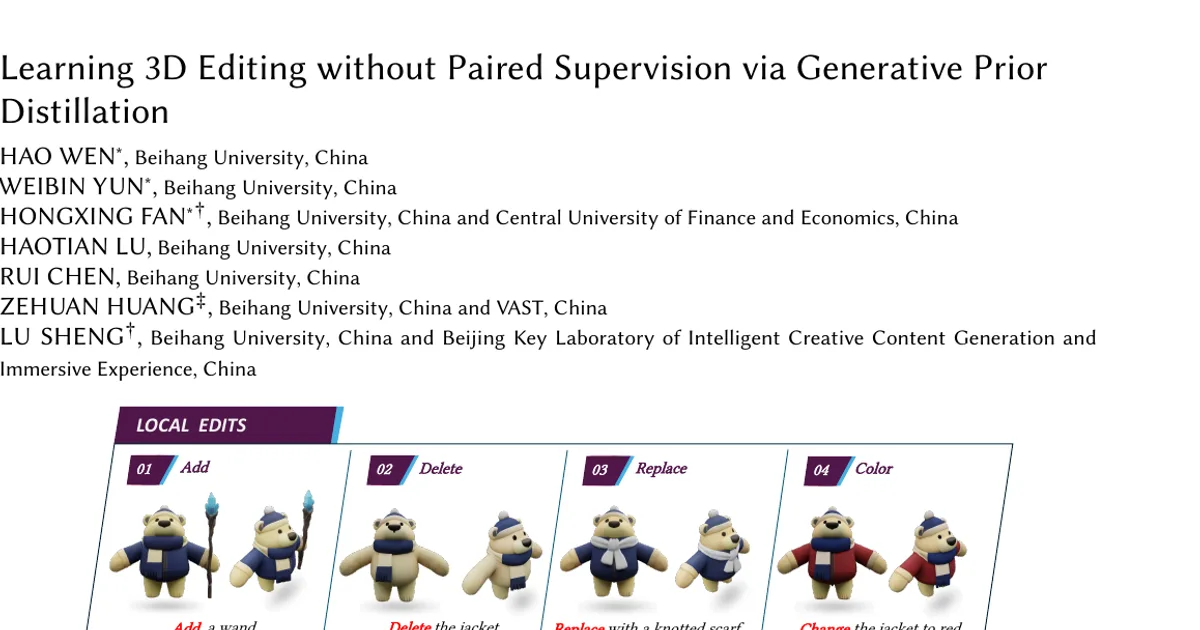
PriorEdit3D framework. The first feed-forward 3D editing framework that requires no paired 3D supervision, using Generative Prior Distillation to combine a 2D visual prior from an image editing model with VLM-based semantic feedback, achieving fast, mask-free, inversion-free editing in native 3D space.
-
3D-aware Distribution Matching regularization. A DMD-based geometric prior that operates in the 3D latent space, anchoring edited outputs to the manifold of realistic 3D assets defined by a pretrained image-to-3D teacher (UniLat3D), mitigating geometric collapse and multi-view inconsistency caused by 2D-only projection supervision.
-
A curated dataset and evaluation protocol. A large-scale 2D editing dataset built from 73,451 Objaverse objects with automated instruction generation and hybrid quality filtering, yielding 73,121 high-quality editing instances and 150,482 annotated operations, plus an evaluation setup spanning in-distribution, ABO, and GSO test sets.
-
State-of-the-art results and system-level gains. Experiments show superior instruction fidelity and cross-view consistency versus SOTA baselines, with a 7-second-per-edit runtime on a single A100 GPU.
Main Findings
-
Best overall quantitative performance. On the in-distribution held-out set, PriorEdit3D reports PSNR 24.37, SSIM 0.94, LPIPS 0.12, FID 71.96, FVD 195.77, CLIP-T 0.31, LLM-Id 93.13%, and LLM-Inst 86.92%. Comparisons were EditP23 (PSNR 16.74, LLM-Inst 64.71%), Instant3DiT (PSNR 15.45, LLM-Inst 25.22%), 3DEditFormer (PSNR 18.89, LLM-Inst 53.39%), VoxHammer (PSNR 16.87, LLM-Inst 51.74%), and Nano3D (PSNR 19.90, LLM-Inst 60.37%).
-
Fastest inference. PriorEdit3D edits an asset in 7 seconds on a single A100 GPU, versus 14 s for Nano3D, 18 s for EditP23, 20 s for Instant3DiT, 74 s for 3DEditFormer, and 133 s for VoxHammer.
-
Out-of-distribution generalization holds. On ABO and GSO, PriorEdit3D reports PSNR 20.59, SSIM 0.89, LPIPS 0.13, FID 117.11, FVD 168.78, CLIP-T 0.23, LLM-Id 91.14%, and LLM-Inst 68.41%, compared with EditP23 (LLM-Inst 11.90%), 3DEditFormer (67.86%), and Nano3D (63.26%).
-
Each loss term is complementary. Leave-one-out ablations show pixel-only supervision gives LLM-Id 88.35% and FVD 307.58; pixel+VLM gives LLM-Id 90.10% and LLM-Inst 86.92; pixel+DMD gives LLM-Id 90.92% and FVD 193.44; DMD+VLM without pixel supervision drops to PSNR 20.99 and LPIPS 0.14; the full combination gives the best LLM-Id (93.13%) and best FID (71.96).
-
A larger VLM teacher helps slightly. Qwen3-VL-4B outperforms Qwen3-VL-2B on LLM-Id (93.13 vs 91.50) and LLM-Inst (86.92 vs 85.77), with FID 71.96 vs 74.34.
-
Both VLM prompts matter. Edit-fidelity-only prompting yields LLM-Id 90.21 / LLM-Inst 83.85; identity-only prompting yields LLM-Id 91.94 / LLM-Inst 82.31; the full two-prompt scheme yields the best LLM-Id 93.13 and LLM-Inst 86.92.
-
Ranking is consistent across VLM judges. Recomputing LLM-Id and LLM-Inst with Qwen2.5-VL-72B, Gemini3-Flash, and GPT-5.4, the method ranks first across all three judges.
-
Human raters agree. In a user study with 50 participants each evaluating 20 randomly sampled editing scenarios on a 1–5 Likert scale, the method scores highest on Instruction Following, Identity Preservation, and 3D Quality and Consistency, outperforming mask-based VoxHammer on identity preservation and 3D quality.
-
Qualitative failure modes of baselines. Lifting-based EditP23 over-smooths geometry and removes unedited details; Instant3DiT produces severe artifacts and unstable topology; 3DEditFormer over-constrains new geometry; VoxHammer depends on precise manual 3D masks and clips edits that change object footprint; Nano3D's edits are often incomplete or weakly localized.
-
Reported limitations. The method struggles with fine-grained edits such as precise text and dense or small instances, can exhibit unintended texture or geometric drift in non-edited regions, propagates errors from the pretrained 2D editor, and is constrained by the UniLat3D prior and differentiable rendering, making large pose or topology changes difficult and limiting compatibility with non-differentiable 3D architectures.
Methodology in Plain English
The paper reframes unpaired 3D editing as a distillation problem. Instead of collecting source/edited 3D pairs, the authors use a pretrained 3D generator (UniLat3D) as the base of a student editor, then supervise it only through rendered images.
Training data comes from rendering canonical frontal views of 73,451 Objaverse objects, generating editing instructions with Gemini3-Flash, and applying them with Qwen-Image-Edit-2511-Lightning. A hybrid curation pipeline uses Qwen3-VL as a multimodal judge to discard failures, background corruption, subject cropping, and semantic implausibility, and discards source/edited pairs with SSIM greater than 0.995 as trivial. The surviving dataset contains 73,121 instances and 150,482 operations split into part-level edits (addition 46,472; removal 22,194; replacement 31,241; shape/style modification 1,774; color modification 27,868) and global-level edits (pose/style/shape changes 10,744; texture changes 10,189).
At training time, the student takes a source latent plus an edited image as the condition and predicts an edited latent. This latent is decoded and rendered with a frozen differentiable 3D Gaussian Splatting renderer, so gradients flow back into the 3D representation. Three signals are combined:
- Pixel-level supervision at the main editing view, comparing the render against the 2D editor's output using a masked L1 loss, an opacity regularizer that suppresses density outside the foreground, and an LPIPS perceptual term. Masks are extracted with rembg but are only used in training, leaving inference mask-free.
- VLM semantic feedback at two novel views: an Instruction Following question on a side view and an Identity Preservation question on the back view. The frozen VLM's "Yes"/"No" logits are converted to probabilities and optimized with a negative log-likelihood loss.
- 3D-aware Distribution Matching regularization, where the original frozen UniLat3D acts as the "real" teacher velocity and a trainable "fake" denoiser estimates the student's velocity. The difference approximates the gradient of the KL divergence between the student distribution and the pretrained 3D prior, keeping edits on the manifold of realistic 3D assets while resisting over-contraction. An identity warm-up stage first enforces that the editor reproduces the source latent when conditioned on the unedited image.
The total objective is L_pixel + λ_vlm·L_vlm + λ_DMD·L_DMD. Training uses AdamW (lr = 10⁻⁵, β₁ = 0.0, β₂ = 0.9) for 18K iterations on 8 A100 GPUs with 10 fake-model updates per editor step; inference takes 20 sampling steps. Evaluation aligns all assets to a unified coordinate system and renders with Blender Cycles at 512×512 over three fixed views (front, back, and an angled conditional view), plus 24-frame 360° turntable videos at 8 FPS. Test sets contain 130 curated in-distribution samples, 236 ABO samples, and 239 GSO samples.
Why This Matters
Impact on research. The paper offers a concrete alternative to the two dominant paths in 3D editing: slow per-instance optimization with 2D priors, and supervised feed-forward training on synthetic pseudo-pairs. Its claim is that neither paired 3D data nor test-time optimization is strictly necessary. If the approach generalizes, unpaired distillation reframes dataset bottleneck problems in 3D as prior-transfer problems, and the DMD-based 3D manifold regularizer is a reusable technique for any setting where 2D projection supervision under-constrains 3D geometry. Table 1 in the paper positions it as the first paradigm to be simultaneously inversion-free, native 3D, paired-data-free, prior-distilling, and mask-free.
Real-world applications (framed by the paper's stated motivation of interactive content creation and flexible modification of existing 3D assets):
- Editing game and interactive media assets by text command without rebuilding geometry from scratch.
- Modifying product models in e-commerce and AR/VR catalogs, where editing speed directly affects iteration cycles.
- Rapid previsualization and look development in animation and film pipelines.
- Interactive 3D authoring tools where a 7-second feed-forward edit is compatible with live user feedback, unlike minute-scale per-scene optimization.
Industry relevance. The 7-second runtime, mask-free inference, and inversion-free pipeline reduce the engineering friction of deploying 3D editing in production tools, where VoxHammer's 133 s runtime and manual 3D mask annotation are practical blockers. The method's stated dependence on the UniLat3D prior and on differentiable rendering also means adopting it is a commitment to a particular 3D backbone family.
Future Directions
- Breaking the backbone and renderer constraint. The authors state that being tied to the UniLat3D prior and to differentiable rendering limits large pose or topology changes and blocks compatibility with non-differentiable 3D architectures. Extending distillation to those representations is an open problem.
- Closing the fine-detail gap. The paper reports that global consistency is prioritized over high-frequency details, leaving precise text and dense or small instances poorly handled. Improving localized, fine-grained fidelity without sacrificing cross-view consistency is a natural next target.
- Preventing drift in non-edited regions. Unintended texture and geometric drift in untouched regions remains unsolved, alongside propagation of errors from the pretrained 2D editing teacher.
- Scaling edit diversity. Because the approach is free of synthetic pseudo-pair pipelines, a logical extension is broadening the instruction taxonomy and dataset scale beyond the 150,482 annotated operations, and testing whether other 3D generative priors substitute cleanly for the one used here.
Target Audience
Researchers and graduate students in 3D computer vision, generative modeling, and graphics who work on 3D asset generation and editing. It is also relevant to practitioners building 3D content pipelines who need feed-forward editing speed, and to readers interested in distillation from 2D and multimodal foundation models into structured 3D latents. Readers without background in diffusion or flow matching will find the method sections dense, though the problem framing and experimental comparisons are accessible.
Authors’ abstract
Instruction-guided 3D editing is essential for interactive content creation, yet it faces a significant bottleneck: the severe scarcity of high-quality paired training data. Existing approaches attempt to bypass this by either relying on slow test-time optimization or training on pseudo-pairs constructed via complex pipelines, which often introduce structural drift and geometric artifacts. In this paper, we propose a novel framework that learns feed-forward 3D editing without paired 3D supervision via Generative Prior Distillation. Instead of relying on ground-truth 3D pairs, our core idea is to distill visual, semantic, and geometric knowledge from powerful foundation models directly into a 3D editing model. Specifically, through a differentiable rendering pipeline, we supervise the 3D representation using two complementary signals: a 2D visual prior from an image editing model at the main editing view, and a semantic prior from a Vision-Language Model at novel views to ensure strict instruction following and source identity preservation. Crucially, to address the geometric collapse and multi-view inconsistencies inherent in 2D projection supervision, we introduce a 3D-aware Distribution Matching regularization. Acting as a geometric prior, this term operates in the 3D latent space, constraining the edited output to remain within the manifold of realistic 3D assets defined by a pretrained image to 3D teacher model. Extensive experiments demonstrate that our method achieves superior instruction fidelity and cross-view consistency, significantly outperforming state-of-the-art baselines. Our project is available at: https://github.com/thiamine128/PriorEdit3D.