Research
Learnable Total Variation with Lambda Mapping for Low-Dose CT Denoising
Overview Research area: Medical image processing and computer vision (cs.CV), specifically low-dose computed tomography (LDCT) denoising that combines classical variational optimization with deep lear
- arXiv
- 2511.10500
- Published
- 2025-11-13
- Authors
- Yusuf Talha Basak, Mehmet Ozan Unal, Metin Ertas, Isa Yildirim
AI summary
Overview
- Research area: Medical image processing and computer vision (cs.CV), specifically low-dose computed tomography (LDCT) denoising that combines classical variational optimization with deep learning.
- Technical level: Advanced. The paper assumes familiarity with total variation regularization, primal–dual (Chambolle–Pock) optimization, unrolled/algorithm-unrolling networks, and U-Net architectures.
- Scope: The paper proposes and evaluates a Learnable Total Variation (LTV) framework that couples a 20-step unrolled TV solver with a U-Net-based LambdaNet predicting a per-pixel regularization map (λ-map), trained end-to-end for image-domain LDCT denoising.
What This Paper Is About
Classical Total Variation (TV) denoising suppresses noise well and preserves edges, but it depends on a single scalar regularization parameter (λ), so the same smoothing strength is applied everywhere in the image. The authors' goal is to keep TV's interpretable, physically grounded structure while making the regularization strength vary per pixel, learned from data. They do this by predicting a spatial λ-map with a neural network and feeding it into an unrolled, fully differentiable TV solver so the reconstruction and the regularization map are optimized together.
Key Contributions
- A Learnable Total Variation (LTV) framework that couples an unrolled Chambolle–Pock TV solver with a U-Net-style LambdaNet, which predicts a spatially varying per-pixel λ-map. The pipeline is trained end-to-end so gradients flow through all solver iterations, yielding spatially adaptive smoothing.
- Learnable optimization dynamics inside the solver. The unrolled solver uses learnable step sizes (τ, σ_d) and a learnable over-relaxation parameter θ, constrained via softplus and clamping. The authors also define an "LTV (fixed solver)" variant where (τ, σ_d, θ) stay constant across all unrolled iterations, isolating the benefit of spatial adaptivity from the benefit of learning the optimization dynamics.
- A minimal, stability-driven training objective. The total loss combines MSE, an SSIM term, a TV(λ) spatial-coherence term, and a distribution-level regularizer defined as the negative standard deviation of λ, −Std(λ), which prevents the λ-map from collapsing to a constant. The paper reports that stronger structure-aligned priors (projection-based and edge-aligned constraints) were explored but frequently destabilized optimization and were excluded.
- Empirical validation on simulated LDCT data, built from DeepLesion slices with 10% dose noise simulated using the LoDoPaB-CT methodology, showing gains over classical TV and FBP+U-Net, with up to +3.7 dB PSNR and 8% relative SSIM improvement claimed in the abstract. Code is released at https://github.com/itu-biai/learnable_tv_for_ldct.
Main Findings
- Best overall quantitative performance: On the reported LDCT benchmark, LTV (ours) reached 30.15 dB PSNR and 0.854 SSIM, compared with Classical TV (27.99 dB, 0.816), FBP+U-Net (26.48 dB, 0.784), LTV with a fixed solver (29.42 dB, 0.841), and the Noisy Input (23.04 dB, 0.704). This corresponds to roughly +3.7 dB PSNR over FBP+U-Net.
- Learning the solver dynamics adds real capacity: The fully learnable solver improved over the fixed-solver variant by +0.73 dB PSNR (29.42 dB vs. 30.15 dB), indicating that optimizing (τ, σ_d) and θ contributes beyond what spatial λ adaptivity alone provides.
- The learned λ-map is non-uniform and sparse: The predicted λ distribution had a mean of approximately 0.18 and a median of roughly 10⁻³, which the authors interpret as evidence that the model avoids trivial constant regularization.
- Spatial adaptivity emerges from data, not from explicit constraints: A weak but consistent positive correlation (r ≈ 0.15) was observed between λ and image gradient magnitude, suggesting the model learns to relate regularization to structure on its own.
- Lightweight λ regularization is necessary for stability: Removing either the spatial smoothness term TV(λ) or the distribution-level regularizer caused noticeable degradation — approximately 0.6 dB PSNR and 0.01 SSIM on average — and in some cases led to unstable optimization or collapse of the λ-map.
- Strong structural priors hurt: Structure-aware λ priors, including projection-based and edge-aligned constraints, frequently destabilized optimization and degraded performance, motivating the minimal stability-driven objective.
- Qualitative behavior: LTV preserved fine structures such as vessel continuity while avoiding the oversmoothing of classical TV and the anatomical inconsistencies of FBP+U-Net; absolute error maps showed smaller and more spatially uniform residuals for LTV, while FBP+U-Net showed high-error zones near edges and lesions.
Methodology in Plain English
The authors start with a standard denoising formulation: recover a clean CT image given a noisy one, using total variation as the prior that penalizes noisy gradients. Standard TV applies one global strength λ to that penalty. Their change is to let a neural network decide, pixel by pixel, how strong that penalty should be.
The network, called LambdaNet, is a four-stage U-Net-style encoder–decoder with 64 base channels, attention-gated skip connections, and a multi-scale fusion head that averages logits from three decoder stages at full, 1/2, and 1/4 resolution to produce a logit map. That logit map is transformed into the λ-map with an exponential normalization strategy that keeps λ inside a bounded dynamic range [λ_min, λ_max^(e)], where the upper bound is annealed from 0.01 up to 5.0 over the first 25 epochs to stabilize early training.
The λ-map then drives a Chambolle–Pock primal–dual TV solver that is unrolled for T = 20 iterations. Each iteration has three parts: a dual update that projects the gradient field onto an ℓ2 ball whose radius is set by the local λ value; a primal update that balances TV-driven smoothing against data fidelity using a weight w_data = 1/σ_data; and a relaxation step with a learnable over-relaxation parameter θ that acts like momentum. Because the iterations are explicitly unrolled, the whole pipeline is differentiable and can be trained end-to-end with Adam.
Training uses a deliberately simple loss: MSE between the reconstruction and ground truth, an SSIM term (which the authors found important for stability compared with pure MSE), a TV term on the λ-map for spatial coherence, and the negative standard deviation of λ to keep the map from collapsing to a constant.
For experiments, they built a paired dataset from about 1000 DeepLesion axial slices, simulating 10% dose noise following the LoDoPaB-CT methodology, and split the data 70/15/15 by patient. Images were normalized to [0, 1], trained on full 512×512 axial slices with mild augmentations (rotations, flips, intensity shifts), and low-variance slices were resampled to ensure structural content. Training used Adam at 5×10⁻⁴ for both LambdaNet and the solver, batch size 8, and gradient clipping.
Why This Matters
- Research impact: The work sits between two research traditions — hand-crafted variational models that are interpretable but inflexible, and black-box CNNs that perform well but offer little physical grounding. It shows that spatial adaptivity can be learned within a variational formulation, and it reports a negative result that is useful to the field: elaborate structure-aligned priors on the regularization map destabilize training more than they help, whereas minimal regularizers work better.
- Real-world applications:
- Clinical CT dose reduction: Lowering radiation dose while keeping images diagnostically usable, the central motivation for LDCT denoising.
- Image-domain denoising bolted onto existing pipelines: Because the method works in the image domain, it can be applied after standard filtered back-projection reconstruction rather than requiring changes to the acquisition or projection-domain processing.
- Screening and repeat-imaging scenarios where accumulated dose across multiple scans is a concern.
- Any inverse problem where a TV prior is already standard — the learnable-λ idea is not specific to CT and could be transplanted to other variational image restoration tasks.
- Industry relevance: CT scanner and medical imaging software vendors care about dose reduction because it is both a clinical priority and a regulatory theme. An interpretable method with a variational backbone may be easier to validate, audit, and explain than a pure CNN, which matters for medical device approval pathways. Releasing the code (https://github.com/itu-biai/learnable_tv_for_ldct) also lowers the barrier for vendors and academic groups to benchmark against it.
Future Directions
- Extension to volumetric (3D) CT: The current work is validated on 2D axial slices; moving to 3D volumes is explicitly named as future work.
- Evaluation on more datasets and dose settings: Validation is currently limited to a single dataset (DeepLesion with LoDoPaB-CT-style 10% dose simulation), so generalization to other scanners, anatomies, and dose levels is untested.
- Integration with physics-informed reconstruction pipelines: The paper currently targets image-domain denoising; coupling LTV with projection-domain or physics-informed reconstruction is proposed to assess clinical applicability.
- Open question on λ behavior: Since the learned λ-map correlates only weakly with gradient magnitude (r ≈ 0.15), it remains unclear what precise image features the network is keying on, and whether distribution-level regularization is the best way to keep the map stable across other tasks and datasets.
Target Audience
This paper is most useful to researchers and graduate students working on medical image reconstruction, low-dose CT denoising, and inverse problems, particularly those already familiar with variational methods, unrolled optimization, or deep-learning-based image restoration. It is also relevant to engineers and applied scientists in medical imaging who want an interpretable, physically grounded alternative to black-box CNN denoisers, and to anyone studying how learned regularization maps behave when trained end-to-end inside classical solvers.
Authors’ abstract
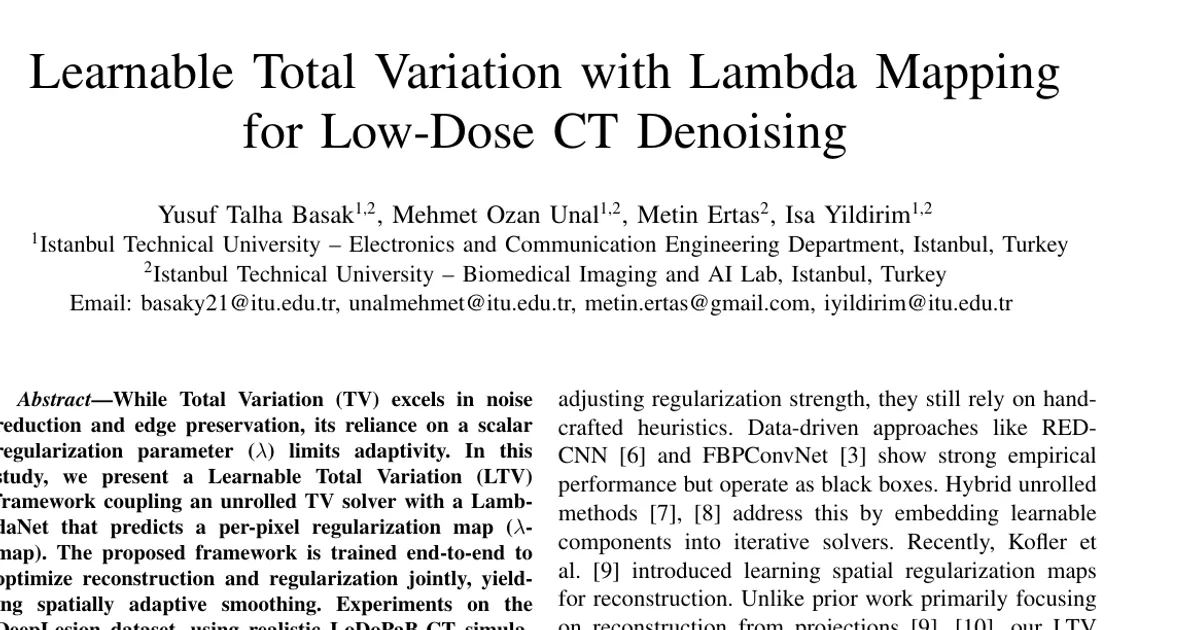
While Total Variation (TV) excels in noise reduction and edge preservation, its reliance on a scalar regularization parameter limits adaptivity. In this study, we present a Learnable Total Variation (LTV) framework coupling an unrolled TV solver with a LambdaNet that predicts a per-pixel regularization map. The proposed framework is trained end-to-end to optimize reconstruction and regularization jointly, yielding spatially adaptive smoothing. Experiments on the DeepLesion dataset, using realistic LoDoPaB-CT simulation, show consistent gains over classical TV and FBP+U-Net, achieving up to +3.7 dB PSNR and 8% relative SSIM improvement. LTV provides an interpretable alternative to black-box CNNs for low-dose CT denoising.