Research
Leaner Transformers Can Easily Learn to Cluster
Overview Research area: Machine learning theory and architecture design — specifically, in-context learning and the algorithmic expressivity of transformers applied to Euclidean k-means clustering. Te
- arXiv
- 2610.09760
- Published
- 2026-10-07
- Authors
- Charlotte Park, Kenneth L. Clarkson, Lior Horesh, Takuya Ito, Parikshit Ram
AI summary
Overview
- Research area: Machine learning theory and architecture design — specifically, in-context learning and the algorithmic expressivity of transformers applied to Euclidean k-means clustering.
- Technical level: Advanced. The paper combines a constructive expressivity theorem (transformers that exactly emulate Lloyd's algorithm), a Lipschitz/generalization analysis of stochastic-gradient training, and empirical benchmarking of forward/backward pass time and GPU memory.
- Scope: One sentence — the paper shows that a transformer with embedding size
d + ⌈log₂k⌉can exactly execute Lloyd's algorithm for k-means (instead of the earlierd + k), then studies how such transformers can be trained to learn clustering from a distribution of tasks, plus the tradeoffs this smaller design introduces.
What This Paper Is About
Prior work established that a transformer can exactly reproduce Lloyd's algorithm for k-means — clustering n points in d dimensions into k groups — inside a single forward pass, but it required an embedding size of d + k and attention projection matrices of size (d + k)². This paper asks whether that architecture can be made leaner without losing exactness, and whether the resulting models can actually be trained (via stochastic gradients) to learn clustering algorithms from data rather than only being constructed by hand. It then characterizes the factors that govern training convergence and in-distribution generalization, and probes where the learned clustering behavior succeeds and fails.
Key Contributions
-
A leaner exactly-expressive architecture. The authors present a transformer that exactly executes Lloyd's algorithm for k-means with embedding size
d_emb = d + ⌈log₂k⌉, achieved by replacing the one-hot cluster-index encoding (OH) with a binary encoding (BN) of cluster indices. This is described as an up to 75% reduction in the number of transformer parameters whenk ≈ d, and a much larger reduction ifk ≫ d. The architecture requiresO((d + log₂k)²)parameters, reducing the dependence onkfromΩ(k²)toO((log₂k)²). -
A training procedure and its theory. They study a computationally cheap, end-to-end differentiable training scheme that learns to cluster given a distribution of clustering tasks, and they theoretically characterize factors affecting convergence and in-distribution generalization. The specific factors examined are the token embedding scheme and the smoothing procedure used to optimize the discrete clustering objective.
-
A quantified tradeoff between size and convergence. The analysis shows that for a fixed number of clusters
kand relatively small data dimensionalityd, the leanerd + ⌈log₂k⌉transformer takes longer to converge and generalize than the previousd + ktransformer — but both eventually converge to the same performance, and the difference vanishes asdgrows. -
Empirical profiling and probing. They benchmark the
BNversusOHembeddings on forward/backward pass times and GPU memory across many(d, k)configurations, and probe the general clustering abilities of the learned transformers to understand where they succeed and fail.
Main Findings
-
Exact expressivity is preserved at a smaller size. Theorem 2.1 states that with the
BNembedding giving latent dimensiond_emb = d + ⌈log₂k⌉, there exist parameters for a single-head transformer (four query/key/value triples, shared across layers) with inverse softmax temperatureγ = ∞such that thet-th transformer layer output exactly matches the output of Lloyd's algorithm aftertiterations for anyt ≥ 1. -
Memory gains are consistent; time gains depend on scale. Across
d ∈ {4, 8, 16, 32, 64, 128}andk ∈ {10, 16, 25, 40, 64, 100}(32 clustering problems,n = 1024points, 30 repetitions with 10 warm-up rounds), theBNembedding shows memory gains "across the board, ranging from +1–15%." For computation times,BNdoes not always show a positive gain for smallerk, especially when theOHbaseline runtime is already small (under 10 ms), but oncekis large enough the gains can reach over 50% in some cases. -
Large speedups when
kgreatly exceedsd. At fixedd = 32andkvaried over[6, 1000], the paper reports up to 12×/9× speedup in forward/backward pass and almost 70% reduction in memory usage. Concretely: atk = 1000(d_emb − dof 1000 forOHversus 10 forBN), forward pass was 193.07 ms versus 15.90 ms (12.14×) and backward pass 308.28 ms versus 32.33 ms (9.54×), with GPU memory 3930.34 MB versus 1207.75 MB (69.3% reduction). Atk = 6,BNwas slightly slower (4.25 ms versus 4.83 ms forward; 0.88×). -
A theoretical tradeoff: leaner embeddings have a worse Lipschitz constant. Theorem 3.1 (informal) gives
α ~ O( (k n ω_τ / τ) · max{1, γ²} · √d_E · max{1, (d_E/√d_emb)²} · exp(γ d_E/√d_emb) ), whered_E = d + 1, d_emb = d + kforOHandd_E = d_emb = d + ⌈log₂k⌉forBN. TheOHscheme therefore has a better Lipschitz constant thanBN, exposing a tradeoff between fewer parameters and improved convergence. For largedrelative tok, this difference is limited becaused_embandd_Escale asdfor both embeddings. -
Faster passes do not automatically mean faster training. The paper states explicitly that the faster forward/backward passes of the
BNarchitecture do not necessarily translate into faster model training to convergence. -
The choice of smoothing has a measurable role. The objective is optimized through a smoothed surrogate
L̃^τ_Ωthat upper-bounds the true per-point k-means loss, with equality atτ = 0. Softmax weights come from an NE-regularizedmin(withτas the softmax temperature), while sparsemax uses L2-norm regularization to give a tighter, sparser bound. The gapC^τ_Ωbetween the true and smoothed objective controls the tightness of the generalization bound, and certain regularized forms ofmincan make this gap exactly zero — for instance, when there is usually a sufficiently large margin between inter-cluster and intra-cluster distances, the sparsemax-based upper bound is tight. -
SGD convergence and generalization guarantees. For an
α-Lipschitz andβ-smooth loss,ε ~ O(β α² (Σ η_m²)/(Σ η_m)), withη_m = η/m ⇒ ε ~ O(β α² / log M)andη_m = η/√m ⇒ ε ~ O(β α² log M / √M). The in-distribution generalization bound for the non-differentiable k-means objective is the empirical loss plusC^τ_Ωplus a gap termεthat depends onβ,η,α,M, and the number of sampled tasks|S|. -
Training setup. The learned model is a single-layer transformer with finite
γ(set toγ = 1in all experiments), trained to perform single-step clustering by outputting the firstdrows of the updated center embeddings. A separate model is learned for each(d, k), but the same model applies to tasks with differentn. Training tasks use points from a mixture of isotropic normal distributions, Adam at learning rateη = 0.01forM = 10000steps with task batch sizeB = 32, and deliberately no gradient clipping. Results are aggregated over 10 random seeds and shown as medians with inter-quartile ribbons. -
Validation results. In Figure 2, experiments use
n = 512andk = 6; the dotted black line aty = 1on the validation panels corresponds to the performance of a single Lloyd's iteration. Six curves compare NE-regularizedmin(softmax) against L2-regularizedmin(sparsemax), jointly withOH,BN, and no token embedding (NA). One panel fixesd = 4and variesτ ∈ {1, 0.1}; another fixesτ = 0.25and variesd ∈ {4, 16}. -
Not reported in the supplied content. The paper's stated third probe — the general clustering abilities of the learned transformers and the situations where they succeed and fail — is described in the abstract and the introduction, but the detailed results are cut off in the provided text (the content ends mid-sentence in the Figure 4 caption). Similarly, the specific data distributions used in Figure 4 and their outcomes are not given beyond the task settings
n = 512, d = 32, k = 10.
Methodology in Plain English
The authors start from a known construction: a transformer can be hand-built so that each of its layers corresponds to one round of Lloyd's algorithm — assign each point to its nearest center, then recompute centers. That construction stores the cluster assignment of each point as a one-hot vector, which costs k extra embedding dimensions. The key idea here is to notice that a cluster index is just an integer between 1 and k, so it can be stored far more compactly in binary using ⌈log₂k⌉ bits. The authors prove this substitution still lets the transformer exactly reproduce the same algorithm, and they verify it empirically.
For the learning part, they take a single-layer version of this architecture and train it with gradient descent on many randomly generated clustering tasks. Because the k-means objective is built on a min over centers and is therefore not differentiable, they replace it with a smooth upper bound — either a softmax-style weighting of distances or a sparser sparsemax-style weighting — and optimize that instead. They then analyze how properties of that smoothed loss (its Lipschitz constant, driven by the smoothing penalty τ, the regularizer, the attention temperature γ, and the token embedding) propagate into standard convergence and generalization bounds for stochastic gradient descent. Finally, they benchmark the two embedding schemes on wall-clock time and GPU memory, and visualize loss surfaces to see how trainable each configuration looks.
Why This Matters
Impact on research. The paper separates two questions that are often conflated: whether a transformer can express an algorithm, and whether it can learn one. It shows the expressivity result is robust to a much smaller embedding, that the size reduction is dramatic once k grows beyond d, and that this architectural win comes with a quantified convergence cost via a worse Lipschitz constant. The generalizable training framework applies to any discrete clustering objective for which a reasonably smoothed surrogate can be found, and the memory/time profiles give practical guidance on when the leaner design pays off.
Real-world applications (as listed in the paper for clustering generally):
- Exploratory data analysis, where grouping items reveals structure before any labels exist.
- Unsupervised labeling, producing group assignments without annotated data.
- Data compression, by representing many points through a small set of prototypes.
- Quantization, where a compact set of representatives stands in for a larger collection.
Industry relevance. The headline numbers are operational: up to 12× forward and 9× backward pass speedups and almost 70% memory reduction at k = 1000 with d = 32. Memory reduction in particular is reported as consistently positive across all tested configurations (typically +1–15%). Since fitting a separate model is required per (d, k) but not per n, the framing suits pipelines where the number of dimensions and clusters is fixed but the number of points varies.
Future Directions
- Narrowing the convergence gap. The paper documents that
BNhas a worse Lipschitz constant thanOHand takes longer to converge for smalld, though the paper's own text says both eventually reach the same performance. Whether a different binary encoding, embedding initialization, or parameterization can recover theOHconvergence rate remains open. - Exploiting the zero-gap condition. The bound is tight when the smoothed objective gap
C^τ_Ωis zero, which the paper notes can happen under a sufficiently large margin between inter- and intra-cluster distances. Characterizing when that margin holds in practice, and designing regularizers that guarantee it, is a natural next step. - Beyond in-distribution generalization. The analysis covers in-distribution generalization only. Out-of-distribution behavior — for example, transferring to different numbers of points, different
d, or differentkthan trained on — is not characterized here, even though the same model is described as applicable to differentn. - Broadening to other clustering objectives. The training scheme is stated to apply to any discrete clustering objective with a usable smoothed surrogate, and the paper cites fuzzy, robust,
k-medoids, spectral, and kernelized clustering as related families. Extending the expressivity-plus-learning treatment to those objectives is an obvious direction.
Target Audience
This paper suits machine learning theorists and architecture researchers working on in-context learning, algorithmic expressivity, and the trainability of transformers; researchers interested in learned optimization and learned algorithms; and practitioners of large-scale clustering who care about the compute and memory cost of attention-based clustering models, particularly in regimes where the number of clusters k is large relative to the dimensionality d. Readers need comfort with transformer attention mechanics, Lipschitz/smoothness arguments, and stochastic-gradient convergence and generalization bounds.
Authors’ abstract
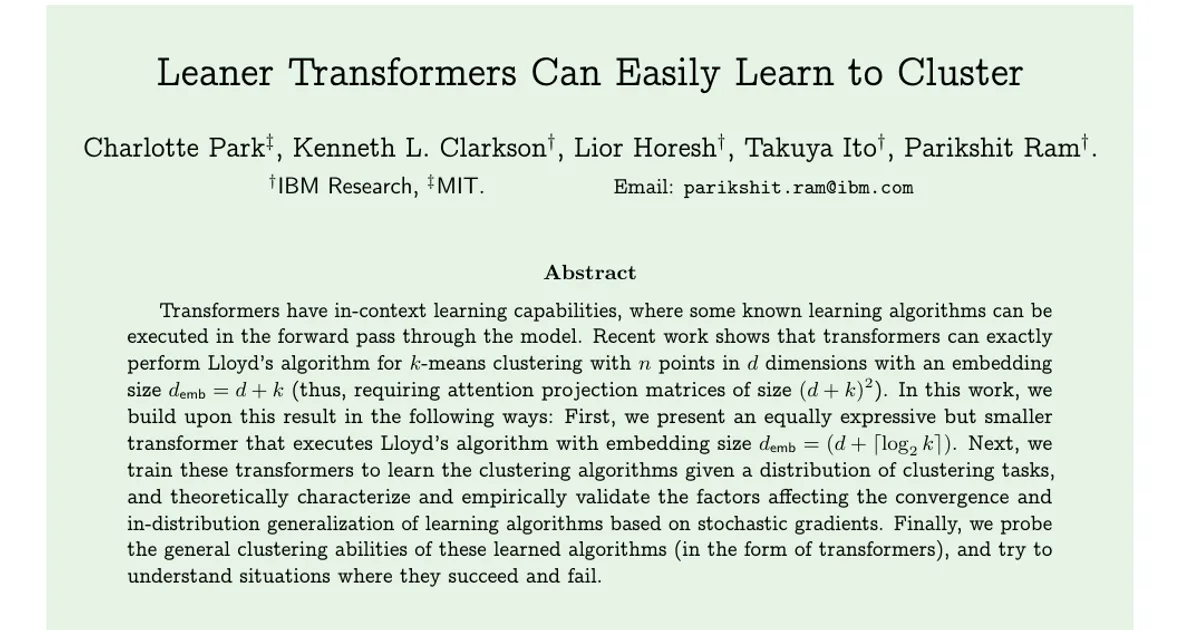
Transformers have in-context learning capabilities, where some known learning algorithms can be executed in the forward pass through the model. Recent work shows that transformers can exactly perform Lloyd's algorithm for $k$-means clustering with $n$ points in $d$ dimensions with an embedding size $d_{\textsf{emb}} = d+k$ (thus, requiring attention projection matrices of size $(d+k)^2$). In this work, we build upon this result in the following ways: First, we present an equally expressive but smaller transformer that executes Lloyd's algorithm with embedding size $d_{\textsf{emb}} = (d + \lceil \log_2 k \rceil)$. Next, we train these transformers to learn the clustering algorithms given a distribution of clustering tasks, and theoretically characterize and empirically validate the factors affecting the convergence and in-distribution generalization of learning algorithms based on stochastic gradients. Finally, we probe the general clustering abilities of these learned algorithms (in the form of transformers), and try to understand situations where they succeed and fail.