Research
Labels Matter More Than Models: Rethinking the Unsupervised Paradigm in Time Series Anomaly Detection
Overview Research area: Time series anomaly detection (TSAD), with a focus on the supervised versus unsupervised paradigm debate and data-centric machine learning. Technical level: Intermediate. The p
- arXiv
- 2511.16145
- Published
- 2025-11-20
- Authors
- Zhijie Zhong, Zhiwen Yu, Kaixiang Yang, Yongheng Liu, Jun Jiang, C. L. Philip Chen
AI summary
Overview
Research area: Time series anomaly detection (TSAD), with a focus on the supervised versus unsupervised paradigm debate and data-centric machine learning.
Technical level: Intermediate. The paper assumes familiarity with standard deep learning components (MLPs, LSTMs, Transformers, autoencoders) and with basic anomaly detection metrics, but its central argument is conceptual rather than technical.
Scope: The paper argues, through a minimalist supervised baseline (STAND) plus theoretical sample-complexity analysis and a unified benchmark, that a small amount of anomaly labeling outperforms architectural complexity in time series anomaly detection.
What This Paper Is About
Most time series anomaly detection research assumes labels are essentially unavailable and therefore builds increasingly complex unsupervised models to learn what "normal" data looks like. The authors argue this premise is often wrong in practice: a small number of anomaly labels is usually obtainable, and that small label budget is worth more than any architectural improvement. To test this, they build a deliberately simple supervised model and benchmark it against a large set of state-of-the-art unsupervised methods.
Key Contributions
- Empirical paradigm argument. The authors introduce STAND (Supervised Time-series ANomaly Detection), an intentionally minimalist supervised baseline, and use it to show that under a limited labeling budget simple supervised models substantially outperform complex state-of-the-art unsupervised methods across five public datasets.
- Quantification of the supervisory gain. They argue both theoretically and empirically that the performance gain from minimal supervision (for example, using as little as 10% of the data) exceeds the incremental gains typically obtained from unsupervised architecture improvements.
- Practicality and prediction consistency analysis. They report that existing unsupervised methods often fail to clearly delineate anomaly segments and lack prediction consistency, whereas supervised methods anchor anomalies with better structural consistency, including under label noise.
- A unified benchmark and open-source library. They release a benchmark framework and library (https://github.com/EmorZz1G/STAND) that places supervised methods alongside unsupervised baselines in a single TSAD evaluation setting.
Main Findings
- Labels matter more than models. The authors state that under a limited labeling budget, the simple supervised STAND baseline significantly outperforms highly complex state-of-the-art unsupervised architectures. The abstract summarizes this as the core thesis: "Labels Matter More Than Models."
- Supervision yields higher returns than architecture. The paper claims that the gain from minimal supervision "far exceeds" the incremental gains from architectural innovations. In the theoretical remark, the authors frame this as collapsing an exponentially hard distribution-matching problem into a polynomially solvable discrimination problem.
- Supervised methods are more consistent and better at localization. The paper reports that unsupervised methods often fail to clearly delineate anomaly segments and lack prediction consistency, while supervised methods anchor anomalies and maintain stronger structural consistency, with greater practical applicability even under label noise.
- Theoretical sample-complexity gap. For unsupervised density estimation, the required sample size is stated as N_UTAD = Ω(ε^(−C/s)), which grows exponentially with the number of variables C. For supervised classification with VC dimension d_VC(H), the required labeled sample size is stated as N_STAD = O((d_VC(H) + ln(1/δ))/ε²), which grows only polynomially in 1/ε and linearly in model capacity. The paper cites C = 122 in the WADI dataset as an illustration of the dimensional penalty.
- Computational scalability. STAND's total per-epoch time complexity is given as approximately O(T(Cd + Ld²)), scaling strictly linearly in sequence length T, in contrast to Transformer-based unsupervised methods such as Anomaly Transformer at approximately O(T²d). Runtime memory is stated as O(TdL) versus O(T²) for attention matrices.
- Stable convergence. Under a Lipschitz-continuous gradient assumption with learning rate η < 2/K, the authors show the loss sequence is non-increasing and the gradient norm converges to zero, which they contrast with the training instability and mode collapse risk of adversarial or reconstruction-bottleneck unsupervised methods.
- Ablation and sensitivity behavior: The paper's task list includes an ablation study of STAND's key components and a hyperparameter sensitivity analysis. Specific numerical results of these analyses are not reported in the provided (truncated) content.
- Dataset-level results: The abstract states experiments were run on five public datasets. Only PSM (with subsets SP1–SP3) and WADI are named in the available content; per-dataset numeric results are not reported in the provided text.
Methodology in Plain English
The authors do not propose a new complex model. Instead they build the simplest reasonable supervised detector they can and let it compete against strong unsupervised alternatives.
- STAND architecture. Three parts. A feature embedding (a two-layer MLP with GELU activation and Layer Normalization) projects each timestamp's raw measurements into a latent space. A bidirectional LSTM reads the sequence forward and backward and concatenates the two hidden states so each timestamp sees both past and future context. A single linear layer then outputs one anomaly logit per timestamp.
- Training. The task is reframed as per-timestamp binary classification. The model is trained end-to-end by minimizing binary cross-entropy between predicted scores and timestamp labels, updated by a standard gradient optimizer such as Adam.
- Benchmark design. They build a unified evaluation harness that runs both paradigms under consistent settings, using the TSB-AD benchmark library implementations for the unsupervised baselines and scikit-learn implementations for the classical supervised baselines.
- Experimental tasks. Six are described: (1) unsupervised versus supervised comparison, where unsupervised methods are tested under the unsupervised condition and supervised methods train on half of the labeled data; (2) supervisory gain analysis on the PSM datasets, including training with as little as 10% of the data across subsets SP1–SP3 with increasing anomaly counts; (3) robustness to label noise injected as varying proportions of point and segment noise in training labels; (4) ablation of STAND's components; (5) hyperparameter sensitivity; (6) visualization of model outputs.
- Metrics. Point-wise F1 and AUC-ROC; event-level Aff-F1, UAff-F1, and VUS-PR; plus Confidence-Consistency Evaluation (CCE) for prediction consistency under noisy labels or scores.
- Baselines. Unsupervised Type I: Random Guess, IForest, LOF, PCA, HBOS, KNN, KMeans. Unsupervised Type II: OCSVM, AE, CNN, LSTM, TranAD, USAD, Omni, Anomaly Transformer, TimesNet, M2N2, LFTSAD, CATCH. Supervised: Random Forest, SVM, AdaBoost, Extra-Trees, LightGBM.
Why This Matters
The paper pushes back on a research culture that equates progress in TSAD with ever more elaborate unsupervised architectures. It argues that a small amount of labeling effort can be a better investment than another layer of attention or another generative bottleneck, and it supplies a benchmark to make that comparison routine rather than anecdotal.
Real-world applications:
- Industrial system monitoring. The paper opens with IoT and industrial sensor streams as the motivating setting; labeling a small fraction of historical fault events may be cheaper than deploying ever-larger unsupervised models.
- Cybersecurity. Anomaly detection in network and system traffic is named among the paper's target application areas, where a handful of confirmed intrusion labels could sharpen detection.
- Health surveillance. Also listed as a target domain, where confirmed abnormal events provide sparse but highly informative supervision.
- Large-scale streaming deployments. Because STAND's complexity scales linearly with sequence length, it is presented as suitable for massive long-term streams where quadratic attention cost becomes prohibitive.
Industry relevance: The practical claim is a resource-allocation claim. If a limited labeling budget buys more detection performance than a larger compute budget, then teams should reconsider how they staff data annotation versus model engineering for anomaly detection pipelines.
Future Directions
- How much labeling is enough? The paper compares as little as 10% and 20% of labeled data and half-labeled training sets, but does not establish a general stopping rule for labeling investment across domains.
- Label noise handling. Robustness to injected point and segment noise is one of the stated tasks, but the paper does not report a noise-tolerance threshold or a label-cleaning strategy in the available content.
- Extending the benchmark beyond the classical supervised baselines. Future work could add stronger supervised and semi-supervised architectures to the same unified harness, since STAND is explicitly a proof-of-concept probe rather than a champion model.
- Transferring the label-efficiency argument to other detection settings. Multivariate TSAD is the studied case; whether the same "labels beat models" conclusion holds for other anomaly detection regimes is left open.
Target Audience
Researchers and practitioners working on time series anomaly detection who want an evidence-based argument for spending effort on labels rather than on model complexity. It will be most useful to: benchmark builders who need a unified supervised-versus-unsupervised comparison harness; industrial and security engineers deciding how to budget annotation versus compute; and students or newcomers to TSAD who want a concise, readable baseline (STAND) and a clear taxonomy of UTAD-I, UTAD-II, and STAD methods before diving into the more complex literature.
Authors’ abstract
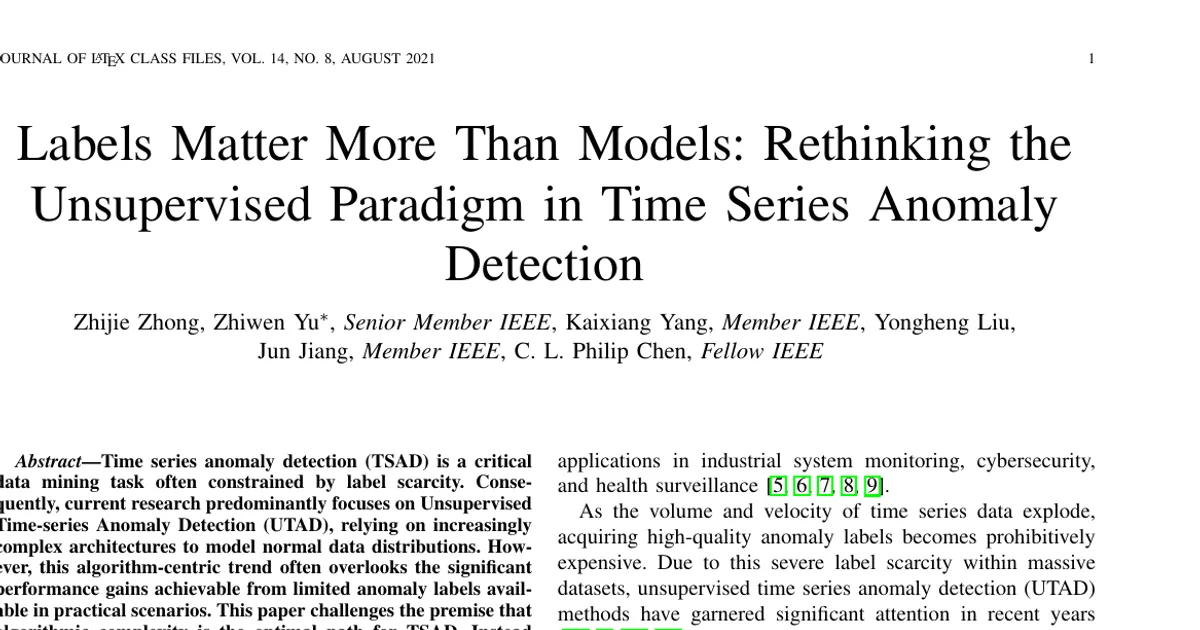
Time series anomaly detection (TSAD) is a critical data mining task often constrained by label scarcity. Consequently, current research predominantly focuses on Unsupervised Time-series Anomaly Detection (UTAD), relying on increasingly complex architectures to model normal data distributions. However, this algorithm-centric trend often overlooks the significant performance gains achievable from limited anomaly labels available in practical scenarios. This paper challenges the premise that algorithmic complexity is the optimal path for TSAD. Instead of proposing another intricate unsupervised model, we present a comprehensive benchmark and empirical study to rigorously compare supervised and unsupervised paradigms. To isolate the value of labels, we introduce \stand, a deliberately minimalist supervised baseline. Extensive experiments on five public datasets demonstrate that: (1) Labels matter more than models: under a limited labeling budget, simple supervised models significantly outperform complex state-of-the-art unsupervised methods; (2) Supervision yields higher returns: the performance gain from minimal supervision far exceeds the incremental gains from architectural innovations; and (3) Practicality: \stand~exhibits superior prediction consistency and anomaly localization compared to unsupervised counterparts. These findings advocate for a paradigm shift in TSAD research, urging the community to prioritize data-centric label utilization over purely algorithmic complexity. The code and benchmark are publicly available at https://github.com/EmorZz1G/STAND.