Research
Knowing When Not to Reuse: Conditional Experience Transfer in Autonomous LLM Post-Training
Overview Research area: Autonomous LLM post-training, experience transfer, and sequential model adaptation (cs.AI). Technical level: Intermediate. The paper uses formal notation for its decision probl
- arXiv
- 2608.26730
- Published
- 2026-08-27
- Authors
- Tingyun Li, Wenfeng Feng, Weiqing Li, Abudukelimu Wuerkaixi, Guohua Liu, Yuewei Zhang
AI summary
Overview
Research area: Autonomous LLM post-training, experience transfer, and sequential model adaptation (cs.AI).
Technical level: Intermediate. The paper uses formal notation for its decision problem and statistical reporting for its results, but the central idea — deciding whether past training evidence still applies to a changed model — is described in accessible terms.
Scope: The paper formulates "conditional experience transfer" and introduces Boundary-Calibrated Intervention Transfer (BCIT), a decision method that authorizes or refuses reuse of past post-training updates before full training compute is spent, evaluated on one Qwen3-4B model across finance reasoning, text-to-SQL, and function calling.
What This Paper Is About
Autonomous post-training systems propose updates, train candidates, evaluate them, and use the feedback to choose what to try next, building up a history of updates that worked. The problem is that an update's effect depends on its parent model, data mixture, training stage, and evaluation contract, so evidence that an update helped under one source context may be misleading under a different current context. The paper asks how an autonomous system can use past updates without turning context-bound evidence into context-free instructions, and builds a method that decides per candidate whether to reject it, run a bounded validation trial, or spend the full training budget.
Key Contributions
-
A new problem formulation. The authors define conditional experience transfer as a distinct control problem in autonomous post-training: because each promoted child becomes the parent for later decisions, evidence from past updates must remain bound to its source conditions.
-
The BCIT method. Boundary-Calibrated Intervention Transfer is a transparent reject–validate–train method combining source evidence strength, explicit applicability conditions, non-compensable hard conflicts, a bounded proposal-generation quota, and a shared promote-or-rollback adoption rule.
-
Separating authorization from adoption. BCIT authorizes compute before weight-changing training, while a rule shared across all compared policies decides whether the fully trained child actually replaces the parent. A validation checkpoint is never promoted directly.
-
An evidence chain of four linked studies. The paper reports matched candidate–context diagnostics (RQ1), outcome-blind authorization audits under matched information (RQ2), short-to-full validation fidelity (RQ3), and paired equal-budget episodes against validation-intensive and same-evidence alternatives (RQ4).
Main Findings
-
Update effects are heterogeneous across contexts (RQ1). In a retrospective audit of 24 matched candidate–context pairs, eight per capability, 13 of the 24 candidates do not improve their target. Only 3 of the 11 target-improving candidates also improve both retention measures. A standard supervised SQL update gains 2.25 target points but loses 22.74/18.71 IFEval-P/I points, and a random-sampling function-calling update gains 1.35 points but loses 11.09/8.15.
-
BCIT authorizes fewer harmful candidates while keeping beneficial ones (RQ2). On the outcome-blind Audit-24, which contains 10 beneficial, 8 harmful, and 6 neutral outcomes, BCIT authorizes 2 of 8 harmful candidates and 9 of 10 beneficial candidates, versus 5 and 8 for Flat-Additive. Harmful authorization is 25.0% versus 62.5%, beneficial coverage 90.0% versus 80.0%, and the harmful share among authorized candidates falls from 31.3% to 14.3%. The exact McNemar test gives p = .25, so the authors describe this as directional cohort evidence rather than a population error rate.
-
The components contribute in complementary directions. Removing candidate-specific applicability conditions raises harmful authorization to 75.0%; adding a veto to the additive score lowers it to 37.5%; removing the veto from BCIT raises it to 50.0%.
-
Bounded validation is useful but imperfect (RQ3). Short and full target directions agree for 20 of 24 candidates (83.3%) with Spearman ρ = .72. The three-way screen returns 10 Pass, 9 Fail, and 5 Inconclusive. Pass identifies Beneficial full-run outcomes with 80.0% precision and 80.0% recall at a median 17% of full-training cost. Agreement rises from 62.5% at a nominal 5% budget to 75.0% at 10% and 83.3% at 20%. Four sign reversals and two false Pass cases remain.
-
The complete policy improves equal-budget outcomes (RQ4). Over six paired end-to-end seeds under a 36-GPU-hour cap, BCIT reaches a cross-task mean of 47.0 ± 0.4 (TAT-QA 35.9, BIRD 44.3, BFCL 60.8) versus 42.5 for Base, 44.4 ± 0.3 for Flat-Additive, 45.5 ± 0.2 for Validate-All, and 46.1 ± 0.2 for Additive+Veto. BCIT improves over Flat-Additive in all six paired runs, with a mean gain of 2.63 points (95% CI [2.10, 3.16]; exact sign-flip p = .03125) and gains of 2.48 on TAT-QA, 3.04 on BIRD, and 2.37 on BFCL.
-
Advantage persists against the stronger alternatives. BCIT exceeds Validate-All by 1.50 points (95% CI [0.85, 2.14]) and Additive+Veto by 0.90 points ([0.27, 1.52]), with each difference positive in all six pairs (p = .03125). BCIT also uses 0.74 fewer GPU-hours than Validate-All.
-
Trajectory evidence is mixed. BCIT's budget-normalized AUC is 44.9 versus 43.6 for Flat-Additive and 44.2 for Validate-All. The paired BCIT–Validate-All AUC gain is 0.70 [0.22, 1.18], while the 0.47-point gap to Additive+Veto includes zero, so the authors state AUC does not support superiority over every baseline.
-
Component ablations are descriptive only. Removing the hard veto lowers the three-seed mean by 1.49 points; BCIT-Reject-Unresolved, which rejects every validation-routed candidate, lowers it by 1.76 points.
-
Specialists versus the shared model. Task specialists exceed BCIT on their named task (finance 39.6, SQL 49.3, function calling 65.1) but require three budgets, each using 36.0 GPU-hours. BCIT has the highest mean among shared models.
Methodology in Plain English
Each update is stored as a state-bound record: not just "this helped," but the source context where the effect was observed, the strength and provenance of that evidence, prespecified applicability conditions, and named hard conflicts. Evidence is graded — grade A for replicated matched-control evidence, grade B for a single matched internal comparison, grade C for a provenance-checked external result or recipe — and discounted by d(A) = 1.00, d(B) = 0.75, d(C) = 0.50. Only grade A can skip validation.
Source strength is the signed source-metric change, normalized by κ = .02 raw score units and clipped to [0, 1]. Current compatibility is the mean of five pre-training fields (capability-family match, data availability and identity, runtime availability, parent compatibility, evaluator/output-protocol compatibility), each scored 0, .5, or 1 for mismatch, unresolved, or match. The positive score is the product Q = S × A, so high source strength cannot compensate for low current-context compatibility, with frozen thresholds τ_l = .30 and τ_h = .70. A hard conflict H = 1 — a named required condition contradicted — triggers rejection outright; missing information is only unresolved.
Historical candidates then follow a three-way route: reject on hard conflict or low Q, train directly when Q is high and evidence is grade A, otherwise run a bounded validation trial from the current parent (capped at a nominal 20% budget) whose temporary checkpoint is never promoted. A new proposal has no source score at all, so it can reach full training only through a faithful validation; the agent may generate at most q = 3 atomic proposals when the frozen library lacks coverage or progress stalls. Validation results split into Pass, Fail, and Inconclusive, with Inconclusive routed to full training only when a frozen fallback has reserved a full-run lease and budget allows.
Every fully trained child then faces the same adoption rule, on data disjoint from validation: promote only if the primary target gain is at least +0.5 pp, every non-primary capability changes by at least −1 pp, cross-capability utility U_prom > 0, all retention constraints pass, and no hard execution failure occurs. Otherwise the parent is restored. Only observed events extend memory; rejections record a frozen reason but create no effect label.
Comparators receive the same candidates, evidence, applicability fields, proposal route, validation, executor, adoption rule, and budget. Flat-Additive averages S, A, and (1 − H) so evidence can compensate for poor context match; Additive+Veto keeps the hard rejection but combines positive signals as (S + A)/2; Validate-All ignores S, A, and H and validates every executable candidate. Validation fidelity was measured by executing every frozen candidate once under the nominal 20% validation budget and once under its matched full-training budget, regardless of the validation result.
Why This Matters
Impact on research. The paper argues that deciding whether past experience still applies is a distinct control problem, separate from storing, retrieving, or organizing that experience. It shows that treating past success as context-free permission can waste compute and, if the child is promoted, degrade the subsequent training trajectory. The authors frame this using learning-transfer research and Toulmin's model of practical argument, where evidence supports a claim only through an applicable warrant that explicit exceptions can defeat.
Real-world applications. These follow from the paper's setting rather than from reported deployment results:
- Enterprise assistants that are repeatedly fine-tuned as domains, tools, and requirements change, where each promotion shifts the parent checkpoint.
- Agentic AutoML or post-training pipelines that must allocate scarce GPU budgets across many proposed updates.
- Multi-capability model adaptation where a gain on one target task can silently violate retention constraints on another, such as instruction following.
- Retaining and reusing a training history across model versions without re-running every experiment from scratch.
Industry relevance. The work comes from Alibaba Cloud Computing and is motivated by the practical cost of repeated post-training. The core claim — that past success in one source context should not authorize modifying every future parent — is a budgeting and risk-control question for teams that run sequential adaptation under fixed compute, and the paper reports BCIT using 0.74 fewer GPU-hours than Validate-All while reaching a higher endpoint mean under the same 36-GPU-hour cap.
Future Directions
-
Learned boundaries. The paper's applicability conditions, evidence grades, thresholds, and conflicts are human-specified and frozen; the authors identify learned boundaries as future work.
-
Broader domains and longer trajectories. The current evidence covers one 4B model, three target capabilities, one retention benchmark, and human-specified boundaries, with episodes of a fixed budget.
-
Scale and schedule sensitivity. Validation fidelity and compute trade-offs may vary with model scale, data, and training schedule.
-
Independent replication. The four studies share candidates and are complementary rather than independent replications; only complete-policy comparisons use six paired seeds, while component ablations remain descriptive with three seeds, and no pooled effect is computed across the studies.
Target Audience
Researchers and engineers working on autonomous post-training, agent-driven training pipelines, continual learning, and transfer-learning decision-making will benefit most. The paper is also relevant to practitioners who manage repeated fine-tuning of a shared model under fixed GPU budgets, and to readers interested in how evidence provenance and applicability conditions can be made explicit in automated decision systems. Readers wanting only the conceptual framing can follow the introduction and problem formulation; those wanting to reproduce or extend the work will need the formal controller contract and the seed-level results in the supplement.
Authors’ abstract
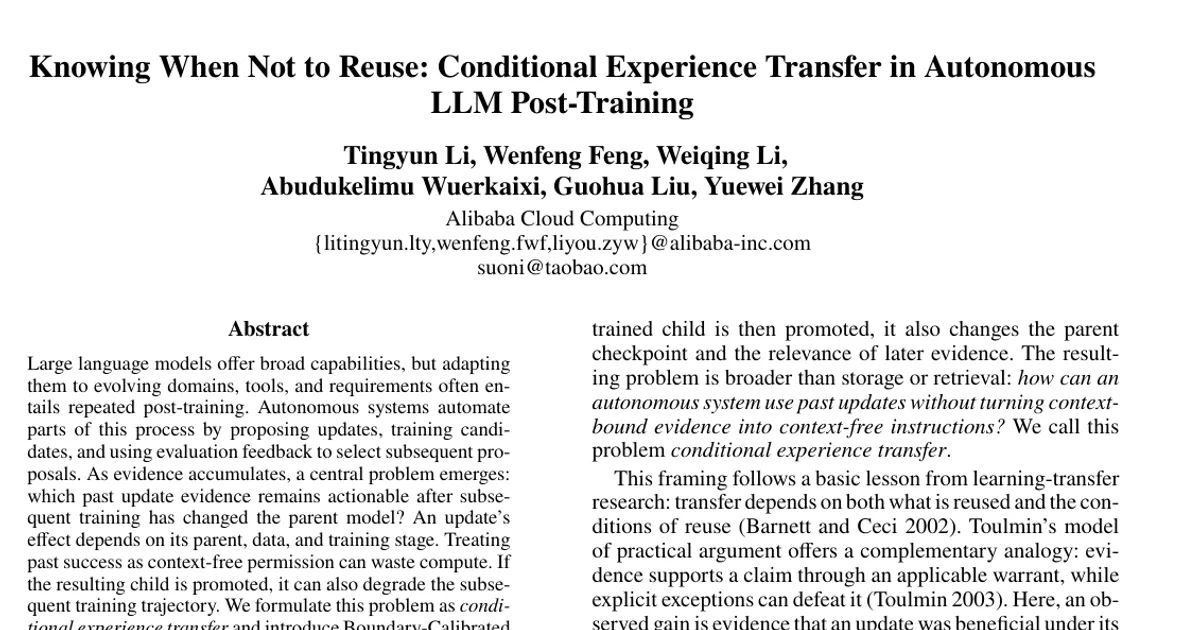
Large language models offer broad capabilities, but adapting them to evolving domains, tools, and requirements often entails repeated post-training. Autonomous systems automate parts of this process by proposing updates, training candidates, and using evaluation feedback to select subsequent proposals. As evidence accumulates, a central problem emerges: which past update evidence remains actionable after subsequent training has changed the parent model? An update's effect depends on its parent, data, and training stage. Treating past success as context-free permission can waste compute. If the resulting child is promoted, it can also degrade the subsequent training trajectory. We formulate this problem as conditional experience transfer and introduce Boundary-Calibrated Intervention Transfer (BCIT), a method that authorizes experience reuse before weight-changing training. BCIT binds an observed effect to its source context, checks applicability conditions, vetoes candidates with named hard conflicts, and obtains current-state evidence through a bounded training trial when needed. Fully trained candidates still face a shared adoption rule, and only observed events extend memory. On one 4B model adapted across finance reasoning, text-to-SQL, and function calling, candidate updates exhibit heterogeneous target and retention effects across the evaluated contexts. Under matched candidates, evidence, and compute, BCIT authorizes fewer harmful updates and attains higher equal-budget final-model quality than the evaluated alternatives. These results support treating experience authorization as a distinct problem in autonomous post-training.