Research
KH-FUNSD: A Hierarchical and Fine-Grained Layout Analysis Dataset for Low-Resource Khmer Business Document
Overview Research area: Document AI, specifically document layout analysis, semantic entity classification, and information extraction for low-resource, non-Latin scripts (Khmer business documents). T
- arXiv
- 2512.11849
- Published
- 2025-12-04
- Authors
- Nimol Thuon, Jun Du
AI summary
Overview
Research area: Document AI, specifically document layout analysis, semantic entity classification, and information extraction for low-resource, non-Latin scripts (Khmer business documents).
Technical level: Intermediate. The paper sits at the intersection of dataset construction and benchmark evaluation using standard object detection and document-understanding models (YOLO, DETR, LayoutLM), so it helps to know roughly how those model families work. No new architecture is proposed, which keeps the core ideas accessible.
Scope: The paper introduces KH-FUNSD, the first publicly available hierarchically annotated Khmer form-document dataset (receipts, invoices, quotations) with 158 documents and 12,126 annotated entities across three annotation levels, plus baseline results for region detection, FUNSD-style question/answer labeling, and fine-grained semantic role classification.
What This Paper Is About
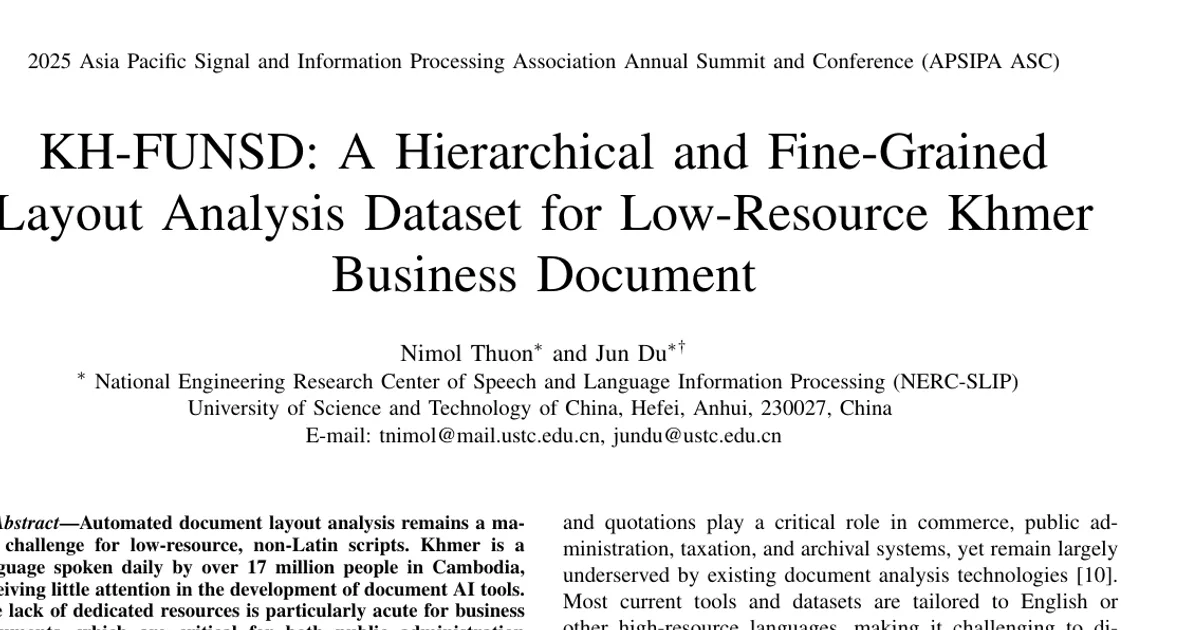
Document layout analysis tools and benchmarks have been built mainly for high-resource, Latin-script languages, leaving scripts such as Khmer largely unsupported even though Khmer is spoken daily by over 17 million people in Cambodia. The authors address this gap by building an annotated dataset of real and synthetically generated Khmer business documents, with annotations spanning coarse layout zones, question/answer entity linking, and fine-grained label–value roles. They then benchmark several leading models on this data to provide the first baseline results for Khmer business document understanding.
Key Contributions
- KH-FUNSD dataset and benchmark: The authors introduce what they describe as the first dataset and benchmark for Khmer Form Document Understanding, with comprehensive region annotations, FUNSD-style question/answer annotations, and hierarchical fine-grained annotations for layout analysis.
- Three-level annotation schema: A framework covering (1) region-level zones such as header, form field, and footer; (2) FUNSD-style entity types (question, answer, header, other) with explicit relationships between entities; and (3) fine-grained roles including header_label, header_value, form_label, form_value, footer_label, footer_value, symbol, and other.
- Baseline evaluations: Results for region detection and semantic role prediction using state-of-the-art models (YOLOv8, YOLOv9, YOLOv10, DETR, and LayoutLMv1/v2/v3).
- Public release of resources: Dataset, annotation guidelines, and documentation are stated to be released to support further research, at https://github.com/back-kh/KH-FUNSD.
Main Findings
- Dataset composition: KH-FUNSD contains 158 business documents total — 68 invoices (48 train, 10 validation, 10 test), 40 quotations (28/6/6), and 50 receipts (35/7/8). Overall splits are 111 training, 23 validation, and 24 test documents, with no overlap of templates or sources across splits.
- Annotation volume: The dataset contains 12,126 annotated entities in total. Region-level annotations cover 158 header zones, 158 form field zones, 145 footer zones, and 10 "other" zones. The fine-grained level includes 1,273 header labels, 1,369 header values, 1,457 form labels, 1,624 form values, 317 footer labels, 332 footer values, and 128 symbols across header, form field, and footer columns as tabulated.
- Annotation reliability: Inter-annotator agreement was measured with Cohen's kappa on randomly selected, independently labeled subsets, with values consistently exceeding 0.85.
- Region detection: DETR achieved the highest average mAP50 at 86.6%, compared with 85.6% for YOLOv9, 84.7% for YOLOv8, and 84.1% for YOLOv10. Form field detection was the strongest category (94.9% to 96.9% across models), while footer detection was weakest (70.9% to 76.2%).
- FUNSD-style entity classification: LayoutLMv3 gave the best average F1 at 65.3%, ahead of LayoutLMv2 at 61.5% and LayoutLMv1 at 57.6%. Questions were classified best (78.3% F1 with LayoutLMv3), while the "other" class was hardest (50.0% with LayoutLMv3).
- Fine-grained classification via detection: YOLOv9 had the highest average mAP50 at 83.4%, versus YOLOv8 at 82.9% and YOLOv10 at 81.1%. Performance was strong for form labels and form values (roughly 96% to 97%) but lower for footers, symbols, and other roles.
- Fine-grained classification via LayoutLM: LayoutLMv3 again led with an average F1 of 68.6%, compared with 66.5% for LayoutLMv2 and 62.3% for LayoutLMv1, with form_label (78.3%) and form_value (76.0%) the strongest roles.
- Error patterns: Models frequently misclassify entities in densely populated table regions, struggle with visually similar or ambiguous labels such as "symbol" versus "header_label", and are sensitive to the complex ligatures of Khmer script. Scarcity of robust Khmer OCR tools and pretrained language models contributed to annotation difficulty and downstream errors.
Methodology in Plain English
The authors assembled Khmer business documents from two sources: open-access repositories and government or business websites, plus synthetically generated samples built from templates modeled on authentic Cambodian receipts and invoices. All sensitive information — company names, addresses, phone numbers, and financial details — was anonymized or replaced with synthetic values. Documents were standardized to high-resolution images at a minimum of 300 dpi and passed through de-skewing, cropping, noise reduction, and contrast enhancement. Open-source OCR tools adapted for Khmer produced initial text localization, and every OCR output was manually reviewed and corrected for bounding box accuracy and textual fidelity. Poor-quality documents were filtered out.
Annotation proceeded in three stages. First, annotators segmented each document into principal regions (header, form field, footer). Second, following the FUNSD benchmark approach, they labeled entities as header, question, answer, or other and explicitly marked relationships between related question and answer entities. Third, they assigned each text segment a precise semantic role from the fine-grained label set, including symbols such as logos, seals, or signature stamps. Annotation was carried out by Cambodian student researchers with Chinese collaborators providing cross-validation and technical oversight, with multiple review rounds and adjudication of ambiguous cases by senior annotators. Each document has a structured JSON annotation file spanning all three levels, where FUNSD-style entities carry linking fields and fine-grained annotations use relation attributes such as "value-of".
For evaluation, region detection used YOLOv8, YOLOv9, YOLOv10, and DETR, while FUNSD-style and fine-grained semantic classification used LayoutLMv1, LayoutLMv2, and LayoutLMv3. Models were trained with cross-entropy loss and the Adam optimizer on two NVIDIA RTX 3090 Ti GPUs with 24 GB memory each. YOLO models used an initial learning rate of 0.001, batch size 16, 100 epochs, images resized to 640×640, and augmentation including random rotation, scaling, and horizontal flipping. LayoutLM models used a learning rate of 2×10⁻⁵, batch size 8, 25 epochs, and a maximum sequence length of 512 tokens, with early stopping and validation-based checkpointing. Metrics were per-class precision, recall, and F1-score for classification and Intersection over Union for region detection.
Why This Matters
Impact on research: KH-FUNSD provides the first standardized evaluation setup for Khmer receipts and invoices, giving researchers a reproducible benchmark where none previously existed for this script and document domain. It also offers an annotation schema that could be adapted to other underrepresented Southeast Asian scripts, and it documents the practical difficulties — OCR scarcity, script ligatures, ambiguous labels — that make low-resource document AI distinct from Latin-script work.
Real-world applications:
- Automated data entry and digitization: Structured extraction from receipts, invoices, and quotations supports large-scale digitization of paper-based business records.
- Taxation and public administration: Business documents are described as critical for commerce, public administration, taxation, and archival systems, all of which depend on reliable automated processing.
- Business analytics: Turning form documents into structured label–value pairs enables downstream analysis of financial and operational data.
- Regulatory compliance: Consistent document understanding supports compliance workflows that require accurate, auditable extraction of document contents.
Industry relevance: Financial institutions, accounting and enterprise software vendors, and government digitization programs in Cambodia and the wider region currently have few Khmer-specific document AI options. The baseline results show which model families are worth deploying (transformer-based LayoutLM variants for semantic roles, DETR for region detection) and where performance remains weak (footers, symbols, dense tables), which is directly useful for planning production systems. The authors also note that the dataset's scale remains modest compared with high-resource benchmarks, so deployment claims should be made cautiously.
Future Directions
- Dataset expansion: Extending KH-FUNSD to additional document types and layouts, and to handwritten and multi-page documents, which the authors identify as outside the current scope of printed and scanned receipts, invoices, and quotations.
- End-to-end joint modeling: Exploring unified models that perform segmentation and semantic classification together rather than as separate detection and classification steps.
- New task formulations: Investigating document visual question answering and semantic relation extraction on top of the existing annotation schema.
- Script-specific model adaptation: Improving handling of irregular layouts and Khmer ligatures, and reducing errors in dense table regions and on visually similar label classes such as "symbol" versus "header_label".
- Cross-script transfer: Encouraging adoption of the benchmark and annotation schema for other Southeast Asian scripts to broaden representation in document understanding research.
Target Audience
Researchers and engineers working on document layout analysis, form understanding, and key-value information extraction, particularly those focused on low-resource or non-Latin scripts. It is also relevant to practitioners building document processing pipelines for Cambodian or Southeast Asian business documents, and to dataset creators interested in a worked example of hierarchical annotation design, quality control through Cohen's kappa, and baseline benchmarking. Readers looking for a new model architecture will not find one here; the contribution is the resource and its evaluation.
Authors’ abstract
Automated document layout analysis remains a major challenge for low-resource, non-Latin scripts. Khmer is a language spoken daily by over 17 million people in Cambodia, receiving little attention in the development of document AI tools. The lack of dedicated resources is particularly acute for business documents, which are critical for both public administration and private enterprise. To address this gap, we present \textbf{KH-FUNSD}, the first publicly available, hierarchically annotated dataset for Khmer form document understanding, including receipts, invoices, and quotations. Our annotation framework features a three-level design: (1) region detection that divides each document into core zones such as header, form field, and footer; (2) FUNSD-style annotation that distinguishes questions, answers, headers, and other key entities, together with their relationships; and (3) fine-grained classification that assigns specific semantic roles, such as field labels, values, headers, footers, and symbols. This multi-level approach supports both comprehensive layout analysis and precise information extraction. We benchmark several leading models, providing the first set of baseline results for Khmer business documents, and discuss the distinct challenges posed by non-Latin, low-resource scripts. The KH-FUNSD dataset and documentation will be available at URL.